
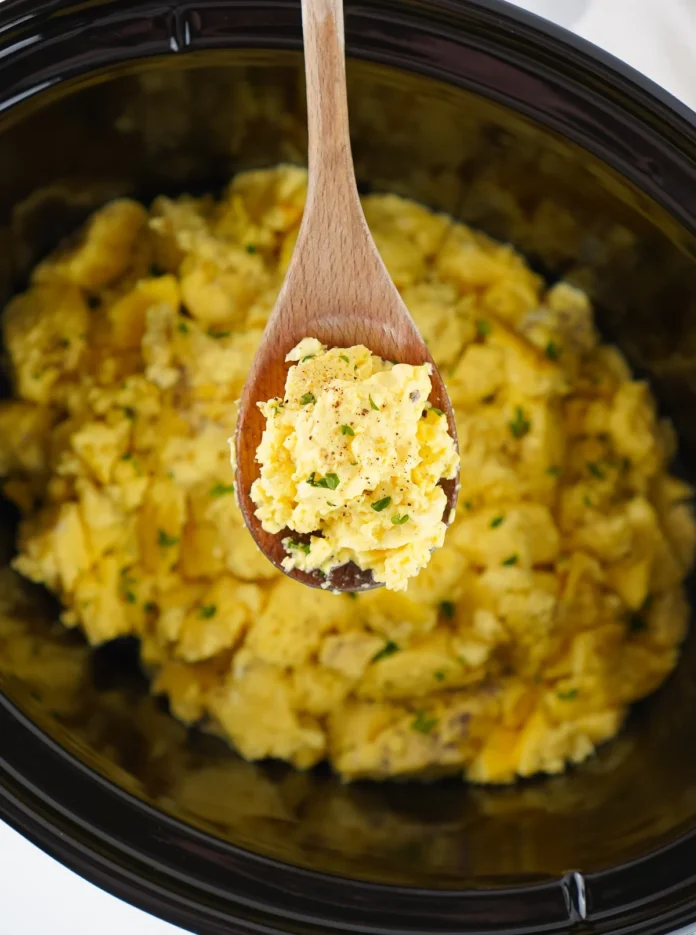

There are certain recipes that quietly earn permanent status in a kitchen not because they are flashy or complicated, but because they solve a problem people deal with constantly. Slow cooker scrambled eggs fall directly into that category.
For anyone who has ever tried to manage a crowded holiday morning, a family brunch, overnight guests, youth sports schedules, or the chaotic rush of getting children ready for school while simultaneously attempting to cook breakfast for multiple people, the appeal becomes immediately obvious. Instead of standing over a stove scrambling batch after batch of eggs while everything else gets cold, the slow cooker handles nearly the entire process on its own.
The result is a breakfast dish that feels surprisingly practical for modern life while still delivering the soft, creamy texture people expect from properly made scrambled eggs.
Across New Jersey kitchens, especially during spring entertaining season and the approach of Memorial Day weekend gatherings, recipes built around simplicity, flexibility, and crowd-friendly preparation continue gaining momentum. Slow cooker breakfasts have become especially popular because they allow hosts to focus less on active cooking and more on the experience surrounding the meal itself.
That shift reflects a broader evolution happening throughout home cooking culture.
People still want meals that feel homemade and comforting, but they increasingly prioritize recipes that reduce stress, simplify preparation, and create flexibility during busy mornings. Slow cooker scrambled eggs succeed because they accomplish all of those goals without sacrificing flavor or texture.
At first glance, the recipe sounds almost too simple to justify attention. Eggs, milk, butter, salt, pepper, and optional herbs hardly read like groundbreaking culinary innovation. But the technique changes the experience entirely.
Instead of high-heat scrambling that requires constant movement and precise timing, the slow cooker creates a gentler cooking environment that allows the eggs to set gradually. The texture stays soft and tender rather than dry or rubbery, particularly when the eggs are left mostly undisturbed during cooking.
That low-maintenance approach is exactly why the recipe has become increasingly attractive for brunches, family breakfasts, church gatherings, graduation weekends, shore house mornings, and holiday entertaining throughout New Jersey.
The recipe itself remains refreshingly straightforward. Slow cooker scrambled eggs that turn out fluffy and creamy, perfect for feeding a crowd without standing at the stove. The Slow Cooker Scrambled Eggs is a Jersey Girl Cooks recipe.
Prep Time 10 minutes mins
Cook Time 1 hour hr 30minutes mins
Course: Breakfast
Cuisine: American
Servings: 8
Calories: 169kcal
Ingredients
- 12 Large Eggs
- 2 Cups Whole Milk
- 3 Tablespoons Salted Butter melted
- ½ Teaspoon Salt
- ¼ Teaspoon Pepper
- optional chopped parsley, chives or green onions for garnish
Instructions
- Crack eggs into a medium size mixing bowl. Add the salt and pepper. Beat until the yolks are broken and then add the milk. mix until no yellow/orange or clear strings are present in the mixture.
- Pour the melted butter into the crockpot and spread evenly.
- Pour the egg mixture into the crockpot.
- Cover and cook on high for 1.5 hours. Immediately break up with a large spoon. Do not overmix as the eggs will get mushy. Garnish with chopped parsley or chives if desired.
- To store, place in an airtight container, in the fridge, for up to 4 days.
- This cooking time results in soft or creamy style scrambled eggs. If you prefer your scrambled eggs a little firmer, add 15-20 minutes to the cooking time, and remove ½ cup of the milk.
- Resist the urge to overmix them while cooking as they turn out more evenly, in my experience, when left to cook.
Nutrition
Serving: 12g | Calories: 169kcal | Carbohydrates: 3g | Protein: 10g | Fat: 12g | Saturated Fat: 6g | Polyunsaturated Fat: 1g | Monounsaturated Fat: 4g | Trans Fat: 0.2g | Cholesterol: 264mg | Sodium: 296mg | Potassium: 185mg | Fiber: 0.02g | Sugar: 3g | Vitamin A: 587IU | Calcium: 114mg | Iron: 1mg
Large eggs form the base, with whole milk added to create a richer, creamier consistency. Melted butter coats the bottom of the slow cooker both for flavor and to prevent sticking, while salt and freshly ground pepper keep the seasoning balanced and simple. Optional additions like chopped parsley, chives, or green onions add freshness and color without overwhelming the eggs themselves.
The preparation process takes only a few minutes. The eggs are whisked thoroughly with the milk and seasoning until fully combined, then poured directly into the buttered slow cooker. After roughly ninety minutes on high heat, the eggs are gently broken apart with a spoon or spatula and served immediately.
That simplicity is part of the appeal.
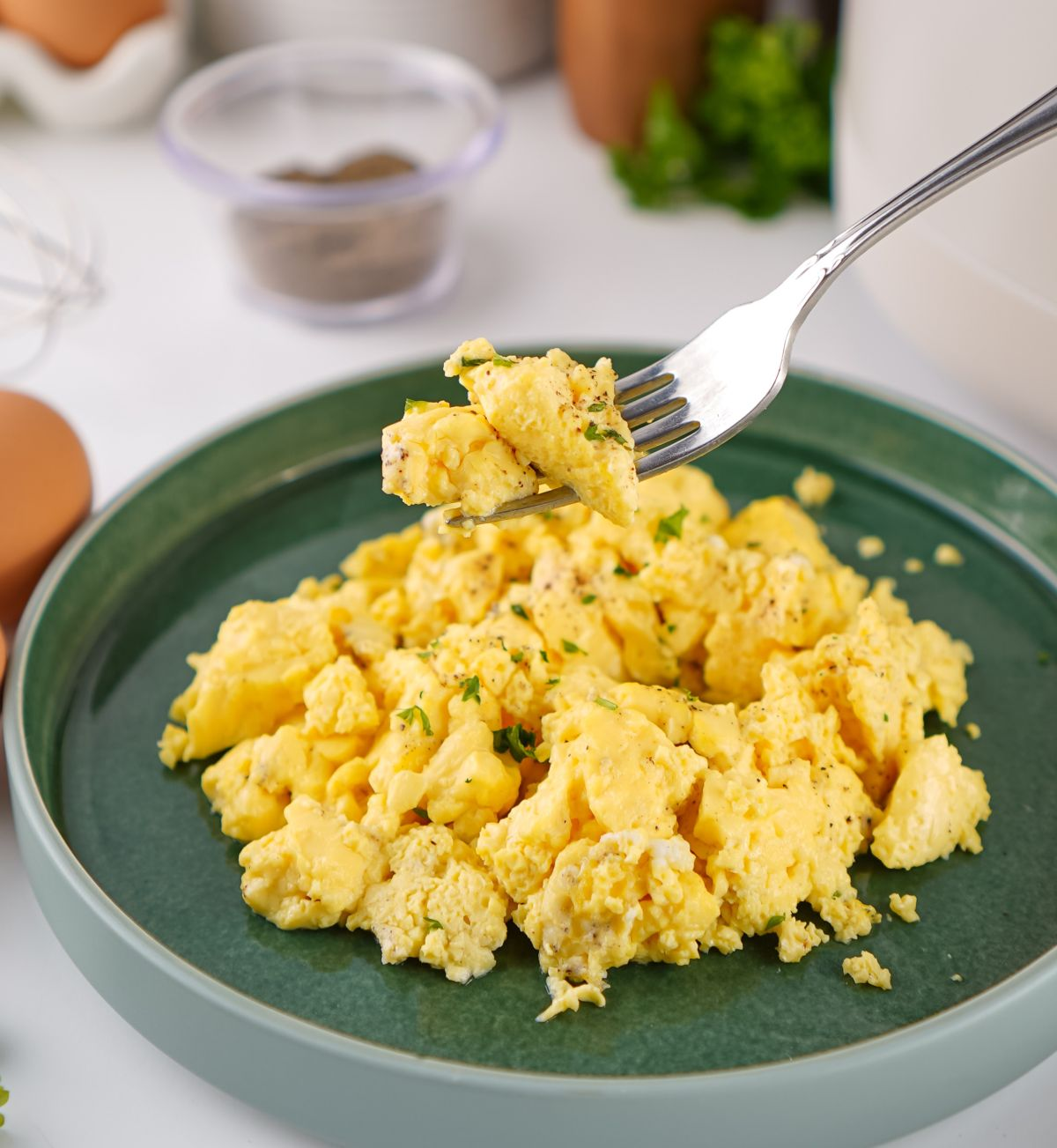
There is no complicated technique. No advanced timing. No nonstop stirring over a hot pan while simultaneously preparing toast, coffee, fruit, pancakes, potatoes, bacon, or sausage.
And unlike many breakfast recipes that deteriorate quickly after cooking, these eggs reportedly hold their texture surprisingly well even when reheated later. That makes them especially useful for meal prep, leftover breakfasts, or larger family households where everything is not eaten at once.
The versatility of the recipe also helps explain why it fits naturally into the kind of approachable, comfort-oriented food culture that continues defining so much of New Jersey home cooking.
The eggs can remain classic and minimal or become a foundation for dozens of different variations depending on the occasion. Cheese can be folded in for richness. Bacon, sausage, or diced ham instantly shift the dish toward traditional diner-style breakfast territory. Sautéed spinach, onions, mushrooms, or peppers create a more vegetable-forward brunch version that feels equally appropriate alongside roasted potatoes or fresh fruit.
Fresh herbs like dill, thyme, or basil can subtly change the flavor profile without making the dish feel overly elaborate.
That adaptability matters because breakfast culture itself has changed significantly over the last decade.
Breakfast is no longer viewed exclusively as a rushed weekday necessity. Increasingly, it functions as a slower social meal tied to weekends, gatherings, holidays, and home entertaining. Across New Jersey, brunch culture continues expanding not only in restaurants and cafés but inside homes where people want food that feels comforting and generous without requiring restaurant-level effort.
Slow cooker recipes fit naturally into that environment because they allow hosts to prepare food without becoming trapped in the kitchen.
That balance between convenience and comfort increasingly defines many of the recipes resonating most strongly with families right now. People want food that feels warm, recognizable, and satisfying, but they also want recipes capable of fitting realistically into busy schedules.
The texture achieved through slow cooking may be the most surprising element for first-time cooks trying the recipe.
Many people associate slow cookers with heavy stews, pulled meats, soups, or braised dishes rather than delicate breakfast foods. But eggs cooked slowly at controlled temperatures develop a remarkably soft consistency when prepared correctly. The milk helps maintain moisture while the low agitation prevents the eggs from tightening too aggressively during cooking.
The key, according to many home cooks embracing the method, is restraint.
Overmixing can quickly turn the eggs dense or mushy. Constant stirring interrupts the gradual setting process that creates the softer texture in the first place. Letting the eggs cook relatively undisturbed produces a much more even and appealing final result.
That relaxed approach almost feels symbolic of why recipes like this continue spreading so widely.
Modern cooking culture often swings between two extremes — ultra-complicated food designed primarily for social media presentation or hyper-processed convenience meals built entirely around speed. Slow cooker scrambled eggs occupy a middle ground that feels far more sustainable for everyday life.
They are homemade without being exhausting.
Comforting without feeling overly heavy.
Practical without feeling lazy.
And in many ways, that balance mirrors the kinds of recipes increasingly shaping home cooking conversations across New Jersey and beyond.
The serving possibilities further expand the recipe’s usefulness.
The eggs pair naturally with breakfast classics like pancakes, muffins, toast, bacon, breakfast sausage, and home fries. They also work surprisingly well alongside more brunch-oriented additions like fresh fruit, pastries, breakfast casseroles, roasted vegetables, or even chicken tenders and savory sandwiches for larger gatherings.
For shore weekends, family reunions, graduation parties, or holiday mornings, the ability to prepare eggs for multiple people without constant stove management becomes especially valuable.
That convenience only becomes more important during warmer months when households often fill with guests, visitors, and unpredictable schedules. Summer entertaining tends to favor recipes that can feed groups without requiring restaurant-style kitchen coordination, and slow cooker breakfasts fit perfectly into that environment.
Even the leftovers become useful.
The eggs can be folded into breakfast wraps, added to sandwiches, mixed into pasta dishes, layered into quesadillas, or reheated alongside potatoes for a second breakfast the following morning. Unlike some egg recipes that become watery or rubbery after refrigeration, slow cooker scrambled eggs tend to retain their structure surprisingly well when reheated gently.
That practicality is ultimately why recipes like this continue finding an audience.
Not because they are trendy.
Not because they are overly stylized.
But because they make real mornings easier while still delivering something that feels homemade, warm, and satisfying.
And in kitchens across New Jersey, that combination may matter more now than ever.
The Slow Cooker Scrambled Eggs is a Jersey Girl Cooks recipe.
















