
For generations, the New Jersey Symphony has occupied a unique place within the cultural landscape of the Garden State. While many major orchestras remain concentrated within a single city, the New Jersey Symphony has built its identity around serving an entire state, bringing world-class orchestral performances, educational programs, community engagement initiatives, and artistic innovation to audiences from Newark and Princeton to Red Bank, New Brunswick, Morristown, Jersey City, and beyond. That commitment to accessibility and statewide engagement is once again taking center stage as the Symphony unveils an expansive slate of summer and early fall programming that highlights not only its artistic excellence but also its growing role as one of New Jersey’s most important cultural institutions.
The newly announced schedule for the 2025-26 season reflects an organization that continues to evolve while remaining deeply connected to the communities it serves. Through outdoor concerts, educational initiatives, contemporary composition programs, free public performances, and the launch of an entirely new arts festival, the Symphony is reinforcing its position as a cultural leader while demonstrating that classical music and orchestral performance remain vibrant, relevant, and accessible to audiences of all ages.
At a time when arts organizations across the country continue searching for new ways to connect with communities, the New Jersey Symphony is taking a distinctly New Jersey approach—meeting audiences where they are. Rather than concentrating all activity within traditional concert halls, the organization is expanding into public parks, libraries, educational institutions, neighborhood gathering spaces, and cultural districts. The result is a season that feels less like a collection of performances and more like a statewide celebration of music and community.
The summer schedule begins in June with two signature performances that showcase both the versatility and public-facing mission of the orchestra. The first takes place in Morristown as part of Morris Arts’ Giralda fundraiser, an event that has become one of the region’s most anticipated cultural gatherings. Set against the backdrop of Saint Elizabeth University, the performance offers audiences an opportunity to experience the orchestra in a more intimate environment while supporting one of northern New Jersey’s most important arts organizations.
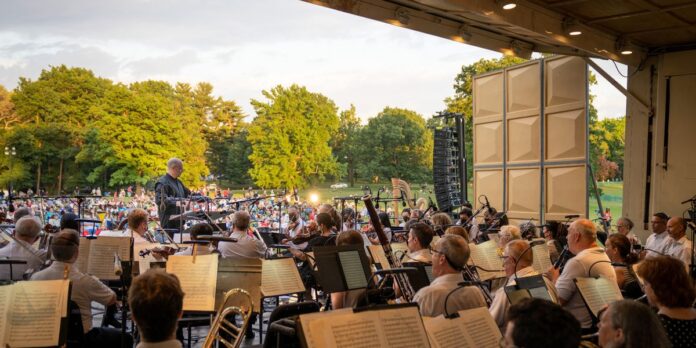
A week later, the Symphony returns to one of its most beloved traditions with a free outdoor concert at Newark’s historic Branch Brook Park. Presented in partnership with Essex County Parks, the event continues a longstanding commitment to making orchestral music available to all residents regardless of economic circumstance. Few settings capture the spirit of community music-making quite like an outdoor summer performance, and Branch Brook Park has become synonymous with some of New Jersey’s most memorable cultural gatherings.
The program itself reflects a carefully crafted balance between tradition, accessibility, and celebration. Audiences can expect a musical journey that spans centuries and genres, incorporating patriotic selections, Broadway favorites, orchestral masterworks, film music, and American classics. The repertoire includes familiar and beloved works by Leonard Bernstein, Duke Ellington, Igor Stravinsky, Aaron Copland, John Williams, and John Philip Sousa, creating an experience designed to resonate with both longtime classical music enthusiasts and first-time concertgoers.
Particularly noteworthy is the inclusion of Valerie Coleman’s Seven O’Clock Shout, a contemporary work inspired by the collective resilience displayed during the COVID-19 pandemic. Its presence alongside canonical works by Bernstein, Copland, and Stravinsky reflects the Symphony’s ongoing commitment to balancing historical repertoire with contemporary voices. This programming philosophy has become one of the defining characteristics of the organization’s artistic identity, allowing audiences to experience the evolution of orchestral music while maintaining strong connections to its rich traditions.
Yet behind the announcement of summer concerts lies another story that speaks to both the challenges and resilience of arts organizations in the modern era. For decades, the New Jersey Symphony’s mobile soundstage served as one of the most recognizable symbols of the orchestra’s commitment to bringing music directly into communities throughout the state. Originally acquired during the 1970s through support from the Robert Wood Johnson Jr. Charitable Trust, the stage enabled countless outdoor performances and became an essential component of the Symphony’s summer programming.
The retirement of that mobile stage following significant structural and mechanical failures marked the end of an era. The orchestra’s ongoing efforts to secure funding for a replacement underscore the financial realities facing arts organizations even as public demand for community programming continues to grow. While the absence of the mobile stage limits some programming opportunities in the immediate future, the Symphony’s determination to restore those capabilities demonstrates a continued commitment to serving audiences throughout New Jersey. The organization’s goal of returning its full parks concert series in 2027 reflects both optimism and a long-term vision for statewide engagement.
Innovation remains a central theme throughout the upcoming season, perhaps nowhere more evident than in the Edward T. Cone Composition Institute. For years, the Institute has served as one of the country’s premier programs dedicated to nurturing emerging composers and introducing audiences to the next generation of orchestral voices. The annual concert in Princeton has become a showcase for creativity, experimentation, and artistic discovery, offering audiences a rare opportunity to hear new works performed by a major professional orchestra.
This year’s participating composers represent a diverse range of perspectives and musical approaches. Their compositions explore themes ranging from memory and perception to reflection and transformation, illustrating the breadth of contemporary orchestral writing. By presenting these works alongside selections from Institute Director Steven Mackey’s acclaimed Concerto for Orchestra, the Symphony continues to position itself at the forefront of contemporary classical music while maintaining strong ties to educational and artistic development.
The post-concert reception, featuring a specially crafted cone-inspired ice cream flavor created in partnership with Princeton’s renowned Bent Spoon, may seem like a small detail, but it reflects something larger about the Institute’s approach. Rather than treating contemporary music as an academic exercise reserved for specialists, the event creates opportunities for audiences to engage directly with composers and experience the creative process in an approachable and welcoming environment.
Community engagement takes another significant step forward through the expansion of Symphony in the Stacks, a collaborative initiative with the Jersey City Free Public Library. The program brings chamber music performances directly into neighborhood libraries, transforming familiar public spaces into intimate performance venues. These concerts represent one of the most effective examples of cultural accessibility in action. Libraries have long served as centers of learning, creativity, and civic engagement, making them ideal settings for introducing new audiences to live orchestral music.
By offering free performances designed for both children and adults, the Symphony is helping remove barriers that often discourage participation in the arts. The initiative recognizes that audience development begins not inside concert halls but within communities themselves. Programs like Symphony in the Stacks create opportunities for families, students, and residents to experience professional musicianship in familiar surroundings, fostering connections that can last a lifetime.
Perhaps the most exciting development in the announcement is the creation of the inaugural Jersey City Music & Arts Festival. Scheduled to take place over ten days within the city’s rapidly evolving Powerhouse Arts District, the festival signals an important new chapter in both the Symphony’s growth and Jersey City’s emergence as a major cultural destination.
The festival reflects a broader vision of what a modern arts event can be. Rather than focusing exclusively on orchestral performance, the programming embraces collaboration across disciplines and communities. Partnerships with organizations including Nimbus Dance, Riverview Jazz, Kulture Kool, and Let’s Talk Women’s Health and Wellness demonstrate an understanding that vibrant cultural ecosystems are built through collaboration rather than isolation.
The inclusion of a dedicated Kids Day further reinforces the organization’s commitment to accessibility and future audience development. Interactive activities, instrument demonstrations, dance performances, educational programming, and family-friendly experiences create an environment where children can engage with the arts in meaningful and memorable ways. These moments often serve as the first introduction to music and performance for young audiences, planting seeds that can inspire lifelong participation in cultural life.
The significance of these initiatives extends beyond individual performances or events. Collectively, they represent a vision for how a major arts institution can serve a diverse and dynamic state. New Jersey’s cultural identity has always been shaped by its remarkable diversity, its proximity to major metropolitan centers, and its strong tradition of community engagement. The New Jersey Symphony’s programming reflects those same characteristics, embracing both excellence and accessibility while finding new ways to connect with audiences across geographic, economic, and generational boundaries.
As the organization prepares for the opening of its new permanent home in Jersey City in 2027, these programs offer a glimpse into its future. The Symphony is not simply preserving traditions; it is actively redefining what a statewide orchestra can be. Through concerts, educational programs, community partnerships, and innovative cultural initiatives, it continues to demonstrate that orchestral music remains an essential part of New Jersey’s cultural fabric.
The upcoming season is ultimately about more than performances. It is about connection—between artists and audiences, between communities and culture, and between the rich traditions of the past and the creative possibilities of the future. For residents throughout New Jersey, that commitment ensures that the Symphony remains not only one of the state’s premier artistic institutions but also one of its most important civic and cultural resources.