New Jersey’s two senators tried to force an immediate vote to shut down the Newark ICE facility permanently, only to be blocked by a single Republican objection, as a previously unreported death, a canceled visitation policy, and a growing protest movement compound the pressure on the privately run detention center.
Booker’s Push to Close Delaney Hall Blocked in the Senate as a Third Death Comes to Light
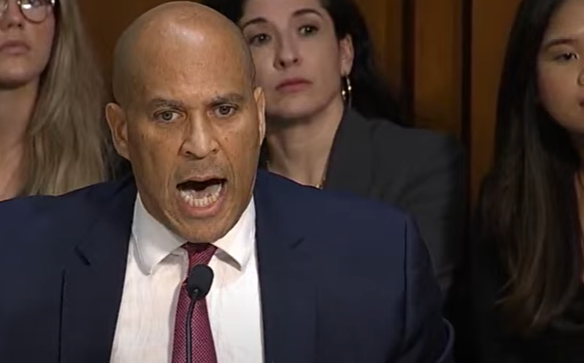
Senators Cory Booker and Andy Kim took to the Senate floor this month asking for something Congress rarely grants on a controversial issue, unanimous consent to immediately pass a bill. The legislation in question, the Delaney Hall Closure Act, would require Immigration and Customs Enforcement to permanently shut down the Newark detention facility within 90 days. Booker made the request directly, asking colleagues to let the bill pass without the usual floor debate and committee process, telling the chamber that officials were out of excuses and that the country was out of time. Missouri Senator Eric Schmitt objected, which under Senate rules was enough on its own to block the request, leaving the bill in the same procedural limbo most legislation faces rather than moving toward a vote.
The push for immediate closure came directly on the heels of the death of Edwin Lopez Cornejo, a 41 year old Salvadoran national who died August 1st after a medical emergency at the facility, and it intensified further within days when Representative Rob Menendez disclosed that a third detainee had died in connection with Delaney Hall without ever being publicly reported. Menendez said he learned of the earlier death, believed to have occurred in late July, during an unannounced oversight visit to the facility. According to the congressman, a detainee began having a seizure shortly after arriving at Delaney Hall, and ICE granted him what the agency calls a discretionary release, transferring him to University Hospital before he died there. Because he had technically been released from ICE custody at the moment of his death, Menendez said, the agency was not required to report it under a recently changed policy that stopped counting deaths occurring within 30 days of a detainee’s release.
A Bill With a Simple Premise and No Path Forward Yet
Booker has been one of the loudest voices calling for Delaney Hall’s closure for months, having conducted multiple oversight visits to the 1,000 bed facility, which is owned and operated by the private prison contractor GEO Group under a 15 year, roughly 1 billion dollar contract. He has said those visits showed him degrading conditions and insufficient medical care firsthand, and he has pointed to a broader national pattern, citing figures showing at least 56 deaths in ICE custody during the current administration and noting that more than 70 percent of people currently held by ICE have never been convicted of a criminal offense. Kim, who has also visited the facility, said what he had seen and heard inside over the past year made clear that private prisons like GEO Group have no place in New Jersey, framing his decision to cosponsor the closure bill as an effort to shut the facility down before anyone else is harmed.
The closure bill is only the latest piece of a broader legislative push Booker has built around immigration detention oversight. He has previously introduced the Dignity for Detained Immigrants Act, which would ban private detention centers and family detention nationally while strengthening detention standards and civil rights protections, along with separate legislation to restore the Office of the Immigration Detention Ombudsman and a bill called the Governors’ Right to Inspect Act, which would explicitly authorize governors and state health and safety officials to inspect immigration detention facilities within their own states, a response to Governor Mikie Sherrill’s public claims that federal authorities have actively obstructed New Jersey’s efforts to conduct health inspections at Delaney Hall.
Visitation Canceled, Then a Fight Over Why
Compounding the tension, Delaney Hall officials abruptly canceled all family visiting hours in early August, a decision facility staff attributed to safety concerns tied to protests outside the gates. That cancellation came only a day after the ACLU of New Jersey had formally pressed ICE to overhaul the facility’s visitation policies, arguing in a letter that current rules limiting visits to immediate family members within two narrow weekly windows, while excluding legal guardians and close friends who often serve as a detainee’s primary support system, may violate constitutional protections. Observers on the ground at the time of the cancellation described only a small handful of protesters gathered outside the facility that day, a considerably smaller presence than the demonstrations that drew a heavy law enforcement response near the facility earlier in the year.
The dispute over Delaney Hall has not broken down entirely along the lines the closure push might suggest. At a House subcommittee hearing on the facility held in late July, Republican members called witnesses who defended immigration detention broadly but had no direct firsthand knowledge of conditions at Delaney Hall itself, two had never visited the facility at all, and a third had last been there nearly a decade earlier before it briefly closed. ACLU of New Jersey executive director Amol Sinha, the only witness called by Democrats at that hearing, challenged Republican members directly to open the facility to full, unannounced, and uncensored oversight, inviting the press, members of Congress, and advocacy organizations to see conditions for themselves rather than rely on secondhand characterizations from either side.
Protests Continue Outside the Gates
Outside the facility, grassroots organizing has continued to build. Activists have organized a coordinated national day of action in solidarity with those held at Delaney Hall and similar facilities elsewhere, and demonstrators have tied black ribbons to the perimeter fencing surrounding the facility, a visual marker meant to represent the people who have died in custody there. With Booker and Kim’s closure bill now blocked from an immediate vote and no clear timetable for when or whether it might advance through the normal legislative process, the combination of congressional pressure, legal advocacy, and continued protest activity appears likely to keep Delaney Hall at the center of New Jersey’s immigration debate for the foreseeable future, even as the facts of exactly what has happened inside the facility remain contested between the agency that runs it and the lawmakers, attorneys, and families pushing for its closure.