
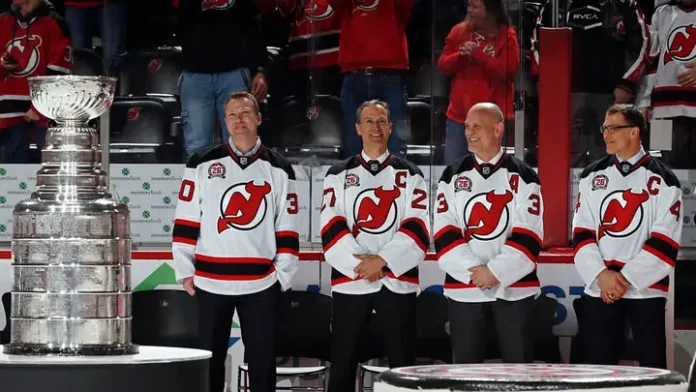

Few organizations in professional sports have undergone a transformation as dramatic as the New Jersey Devils. When the franchise arrived in New Jersey in 1982 following its relocation from Colorado, success did not come immediately. The early years were marked by growing pains, difficult seasons, and the challenge of establishing a hockey identity in a region already crowded with established professional sports teams. Yet over the next four decades, the Devils would evolve into one of the most respected organizations in the National Hockey League, capturing three Stanley Cup championships, producing Hall of Fame talent, and building a culture that became synonymous with discipline, toughness, defensive excellence, and postseason success.
Today, as a new generation led by Jack Hughes, Nico Hischier, and Jesper Bratt continues to write the franchise’s next chapter, it is worth reflecting on the players who built the foundation of one of hockey’s most successful modern franchises. From championship captains and legendary defensemen to elite scorers and franchise-defining goaltenders, the history of the New Jersey Devils is ultimately the story of extraordinary individuals whose contributions helped transform the organization into a perennial contender.
No discussion begins anywhere other than with Martin Brodeur. The consensus greatest player in New Jersey Devils history is legendary Hall of Fame goaltender Martin Brodeur, followed closely by core Stanley Cup pillars Scott Stevens, Scott Niedermayer, and all-time leading forward scorer Patrik Elias.
| Rank | Player | Position | Devils Tenure | Franchise Legacy / Accolades |
|---|---|---|---|---|
| 1 | Martin Brodeur | G | 1991–2014 | 3x Stanley Cup Champ, NHL all-time leader in wins & shutouts, No. 30 retired. |
| 2 | Scott Stevens | D | 1991–2004 | Captain for 3x Stanley Cups, Conn Smythe winner (2000), No. 4 retired. |
| 3 | Scott Niedermayer | D | 1991–2004 | 3x Stanley Cup Champ, 2004 Norris Trophy winner, No. 27 retired. |
| 4 | Patrik Elias | LW | 1995–2016 | 2x Stanley Cup Champ, franchise leader in goals, assists, and points, No. 26 retired. |
| 5 | Ken Daneyko | D | 1983–2003 | “Mr. Devil,” played franchise-record 1,283 regular season games, No. 3 retired. |
| 6 | John MacLean | RW | 1983–1998 | 1995 Cup Champ, scored iconic 1988 playoff-berth goal, 2nd all-time points. |
| 7 | Kirk Muller | C | 1984–1991 | Early franchise captain, 4x All-Star with NJ, 4th all-time in team scoring. |
| 8 | Travis Zajac | C | 2006–2021 | Elite two-way center, 1,024 games played as a Devil, 3rd in franchise games. |
| 9 | Bobby Holik | C | 1992–2002, 2008–2009 | 2x Stanley Cup Champ, physical engine of the legendary “Crash Line”. |
| 10 | Claude Lemieux | RW | 1990–1995, 1999–2000 | 2x Stanley Cup Champ, 1995 Conn Smythe playoff MVP winner. |
| 11 | Jack Hughes | C | 2019–Present | Current franchise centerpiece, holds single-season team scoring record (99 points). |
| 12 | Brian Rafalski | D | 1999–2007 | 2x Stanley Cup Champ, elite offensive quarterback of the 2000s blue line. |
| 13 | Scott Gomez | C | 1999–2007, 2014–2015 | 2x Stanley Cup Champ, Calder Trophy winner (2000), premier playmaker. |
| 14 | Zach Parise | LW | 2005–2012 | Captained 2012 Cup Final run, scored 45 goals in 2008–09 season. |
| 15 | Sergei Brylin | F | 1994–2008 | One of only five Devils to win all three Stanley Cups (1995, 2000, 2003). |
| 16 | Pat Verbeek | RW | 1982–1989 | “The Little Ball of Hate,” first Devil to score 40 goals in a single season. |
| 17 | Nico Hischier | C | 2017–Present | First overall draft pick (2017), current captain, elite Selke-level two-way center. |
| 18 | Jesper Bratt | LW | 2017–Present | Drafted 162nd overall, evolved into an elite, highly consistent point-per-game winger. |
| 19 | Jamie Langenbrunner | RW | 2002–2011 | 2003 Stanley Cup Champ (led playoffs in scoring), former team captain. |
| 20 | Bruce Driver | D | 1983–1995 | 1995 Stanley Cup Champ, crucial offensive defenseman of the early eras. |
The greatest player in franchise history is also widely regarded as one of the greatest goaltenders the sport has ever produced. Over a remarkable career that spanned more than two decades in New Jersey, Brodeur became the face of the franchise and the backbone of its championship years. His accomplishments remain staggering. Three Stanley Cup championships, four Vezina Trophies, Olympic gold medals, and NHL records for career wins and shutouts established a standard that may never be matched. More importantly, Brodeur’s consistency gave the Devils a competitive advantage every night he stepped on the ice.
For an entire generation of New Jersey hockey fans, Brodeur was not simply a goaltender. He was the franchise itself. His calm demeanor, elite puck-handling ability, and unmatched durability made him the centerpiece of every championship run and helped establish the defensive identity that defined the organization throughout the 1990s and early 2000s.
If Brodeur was the backbone of the Devils dynasty, then Scott Stevens was unquestionably its heart and soul.
Few captains in NHL history commanded greater respect than Stevens. Acquired in 1991, he quickly became the emotional leader of the franchise and helped transform the Devils into one of hockey’s most intimidating teams. Stevens combined physical dominance with exceptional defensive awareness and unmatched leadership qualities. His thunderous open-ice hits became legendary, but his greatest contribution may have been the culture he helped establish inside the locker room.
Under Stevens’ leadership, the Devils captured three Stanley Cups and built a reputation for mental toughness that often overwhelmed opponents long before the puck dropped. His Conn Smythe Trophy performance during the 2000 Stanley Cup run remains one of the finest postseason displays by a defenseman in league history. To many longtime fans, Stevens remains the embodiment of what it means to wear a Devils sweater.
Alongside Stevens stood one of the most elegant defensemen ever to play the game.
Scott Niedermayer provided the perfect counterbalance to Stevens’ physical style. Where Stevens delivered crushing hits and emotional leadership, Niedermayer supplied speed, grace, and offensive brilliance. His ability to transition the puck from defense to offense transformed the Devils’ attack and helped modernize the position long before offensive defensemen became commonplace throughout the league.
Niedermayer’s skating ability remains legendary. Even among elite NHL players, he seemed capable of moving through the neutral zone with a level of ease that others simply could not match. His Norris Trophy-winning career and central role in all three Stanley Cup championships cemented his place among the greatest defensemen of his era and among the most important players in franchise history.
On the offensive side of the puck, no player accomplished more for New Jersey than Patrik Elias.
For over two decades, Elias quietly built one of the most remarkable careers in franchise history. While never seeking the spotlight, he consistently delivered elite production, becoming the Devils’ all-time leader in goals, assists, and points. His versatility allowed him to excel in every situation, whether scoring critical goals, killing penalties, creating offense for teammates, or matching up against opposing stars.
Elias represented the perfect Devils player. Skilled, intelligent, unselfish, and relentlessly consistent, he was a cornerstone of two Stanley Cup championship teams and remained productive throughout multiple eras of the franchise’s evolution. His number retirement was not merely a recognition of statistical achievement but a celebration of a player whose professionalism helped define the organization.
Completing the Devils’ inner circle of immortals is Ken Daneyko.
Known affectionately as “Mr. Devil,” Daneyko spent his entire career with the franchise and became one of the most beloved figures in New Jersey sports history. While he was never the flashiest player on the ice, his commitment, durability, and loyalty embodied everything the organization valued. Daneyko played a franchise-record 1,283 regular-season games and contributed to all three Stanley Cup championships.
His journey mirrors the growth of the franchise itself. From struggling expansion-era hockey to championship parades through the streets of New Jersey, Daneyko was present for every step. Few athletes have ever become more closely connected to a franchise than Daneyko became to the Devils.
Beyond the iconic Mount Rushmore of Brodeur, Stevens, Niedermayer, Elias, and Daneyko, numerous players left significant marks on franchise history.
John MacLean delivered one of the most important goals the organization has ever witnessed when he secured the Devils’ first playoff berth in 1988. That moment helped legitimize hockey in New Jersey and signaled that brighter days were ahead.
Claude Lemieux became a postseason legend whose playoff heroics often elevated his game when the stakes were highest. His Conn Smythe Trophy performance during the 1995 Stanley Cup run remains one of the defining individual playoff achievements in franchise history.
Bobby Holik brought toughness, grit, and versatility to the famous Crash Line that became a crucial component of the Devils’ championship formula. Sergei Brylin provided remarkable consistency and remains one of only a handful of players to appear on all three Stanley Cup-winning teams.
Brian Rafalski emerged as one of the greatest undrafted success stories in NHL history, quarterbacking the blue line during two championship runs while becoming one of the league’s most effective offensive defensemen. Scott Gomez brought elite playmaking ability and youthful energy to the Devils at the turn of the millennium, earning the Calder Trophy and helping lead the next generation of championship contenders.
The post-dynasty era produced its own stars as well.
Zach Parise became the face of the franchise during the late 2000s and captained the Devils to the 2012 Stanley Cup Final. Travis Zajac provided elite two-way play for more than a decade while becoming one of the most respected leaders in team history. Jamie Langenbrunner captained the organization and played a critical role during the 2003 Stanley Cup championship season.
Today, however, the conversation increasingly includes members of the current roster.
Jack Hughes has already established himself as one of the most dynamic offensive players ever to wear a Devils uniform. His franchise-record 99-point season demonstrated a level of offensive creativity and explosiveness rarely seen in team history. When healthy, Hughes possesses the ability to alter games with a single shift and represents the modern face of the franchise.
Nico Hischier has emerged as one of the NHL’s premier two-way centers and serves as the team’s captain. His leadership, defensive excellence, and commitment to all areas of the game have drawn comparisons to some of the franchise’s greatest leaders. Meanwhile, Jesper Bratt’s remarkable rise from a late-round draft selection to an elite point-producing winger stands as one of the organization’s greatest modern development success stories.
What makes the Devils’ history unique is the way each generation has built upon the accomplishments of the one before it. The franchise’s legends did more than win championships. They established standards. They created a culture of accountability, professionalism, and team-first hockey that continues to influence the organization today.
The modern Devils may play a faster, more offensive style than the championship teams of the past, but the core principles remain familiar. Leadership, commitment, resilience, and an expectation of excellence continue to define the franchise. Those qualities can be traced directly back to the players who transformed a struggling young organization into one of hockey’s most respected franchises.
As the next chapter unfolds, new stars will undoubtedly continue climbing the franchise rankings and challenging records once thought untouchable. Yet regardless of what the future holds, the names Brodeur, Stevens, Niedermayer, Elias, and Daneyko will forever occupy a special place in New Jersey sports history. They are more than great players. They are the architects of a dynasty, the foundation of a franchise, and the reason the New Jersey Devils became one of the NHL’s defining organizations.
















