
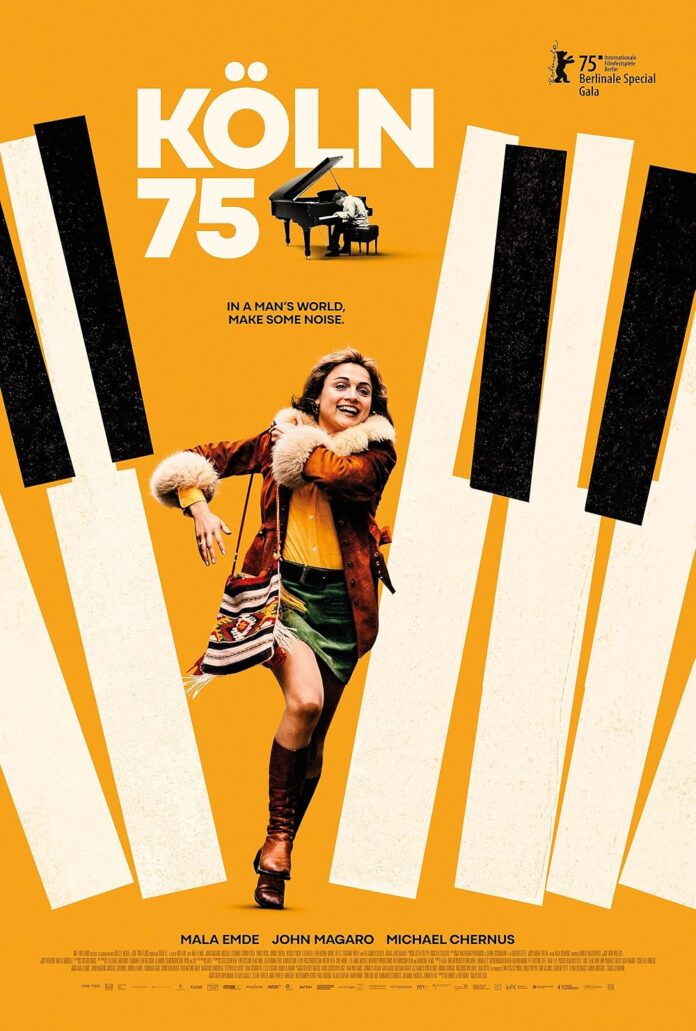

Music history is often remembered through albums, performances, and artists. What frequently gets overlooked are the unlikely stories, impossible circumstances, and determined individuals working behind the scenes who make those moments happen in the first place. Some of the greatest recordings ever captured exist because someone refused to give up when everything appeared to be falling apart. That reality sits at the heart of Köln 75, director Ido Fluk’s energetic, inventive, and unexpectedly moving new film that revisits one of the most celebrated events in modern jazz history.

Rather than delivering a conventional artist biography focused solely on legendary pianist Keith Jarrett, Köln 75 takes a far more interesting route. The film shifts its attention to Vera Brandes, the teenage German concert promoter whose determination, passion, and sheer stubbornness helped create what would become The Köln Concert, the best-selling solo piano album in jazz history. The result is a film that feels less like a traditional biopic and more like a high-stakes backstage drama, a coming-of-age story, and a love letter to live performance all rolled into one.
The film arrives at a moment when music-centered storytelling continues to resonate with audiences, and it does so with enough personality and originality to distinguish itself from the crowded field of recent music biopics. While many films in the genre follow a familiar rise-fall-redemption formula, Köln 75 succeeds because it understands that sometimes the most compelling stories are not about fame itself but about the people who make greatness possible.
At the center of the film is Mala Emde’s captivating performance as Vera Brandes, an eighteen-year-old promoter whose enthusiasm for jazz borders on obsession. In the hands of a lesser filmmaker, Vera could have been portrayed as a supporting character orbiting around Jarrett’s genius. Instead, Fluk places her firmly at the center of the narrative, transforming her into the film’s emotional engine. Her ambition, confidence, and refusal to accept defeat drive the story forward at a relentless pace.
What makes the character so compelling is that she represents something larger than a single individual. Vera embodies every promoter, producer, manager, and dreamer who has ever risked everything to make an event happen. Long before she became part of music history, she was simply a young woman trying to pull off an impossible concert while facing obstacles at every turn.
Those obstacles form the foundation of the film’s central conflict.
Jazz fans know the outcome. What many do not know is how close The Köln Concert came to never happening at all.
When Keith Jarrett arrived in Cologne in January 1975, he expected to perform on a world-class Bösendorfer Imperial Grand Piano. Instead, he was greeted by what amounted to a concert promoter’s nightmare. Due to a series of logistical mistakes and miscommunications, the piano waiting for him was an aging rehearsal instrument that was badly out of tune, mechanically flawed, and nowhere near suitable for a major performance.
For a pianist as exacting and demanding as Jarrett, the situation was infuriating.
The film expertly builds tension around this crisis, transforming what might sound like a technical inconvenience into a genuinely suspenseful drama. Every attempt to solve the problem creates new complications. Every solution seems to introduce another setback. The audience knows history will ultimately be made, yet Fluk keeps the uncertainty alive by focusing on the human emotions unfolding behind the scenes.
John Magaro delivers a fascinating performance as Jarrett. Rather than portraying him as a stereotypical musical genius, the film embraces his complexity. He appears exhausted, frustrated, skeptical, and often difficult, yet never becomes unsympathetic. Magaro captures the pressure that accompanies artistic excellence, illustrating how perfectionism can become both a gift and a burden.
What emerges is a portrait of an artist confronting impossible circumstances while simultaneously wrestling with his own expectations.
The brilliance of Köln 75 lies in its understanding that limitations sometimes create innovation.
Forced to adapt to the instrument’s deficiencies, Jarrett ultimately approached the performance differently than he otherwise would have. The restrictions altered his playing style, his improvisations, and his musical decisions throughout the evening. Ironically, the very flaws that threatened to ruin the concert may have helped shape its distinctive sound and emotional character.
That concept resonates far beyond jazz.
Whether in music, film, sports, business, or everyday life, some of the most memorable achievements emerge not from ideal conditions but from adversity. Köln 75 explores this idea repeatedly, showing how setbacks can become opportunities and how persistence often matters as much as talent.
Stylistically, the film embraces a playful, energetic approach that distinguishes it from more traditional music dramas. Fluk incorporates fourth-wall-breaking moments, historical commentary, and bursts of humor that keep the story moving at a brisk pace. The result feels refreshingly modern while remaining firmly grounded in the period. Some viewers may find the educational segments a bit heavy-handed at times, but they also contribute to the film’s unique personality and willingness to experiment.
The pacing recalls some of the most inventive European films of the past several decades, blending factual storytelling with a kinetic sense of momentum. There is a constant feeling that events are racing toward an uncertain conclusion, even though audiences already know how the story ends.
For jazz fans, the film serves as an engaging exploration of one of the genre’s defining moments. For general audiences, however, the appeal extends well beyond the music itself. At its core, Köln 75 is about ambition, resilience, creativity, and the extraordinary things that can happen when passionate people refuse to quit.
The timing of the film’s growing visibility is particularly noteworthy given the broader attention currently being paid to independent cinema and music-centered storytelling across the festival circuit. As audiences continue seeking films that offer something beyond formula-driven blockbusters, projects like Köln 75 demonstrate the enduring power of character-driven narratives rooted in real-life events.
Its emergence alongside major festival activity, including ongoing screenings and premieres attracting attention throughout the Northeast, highlights the continuing strength of independent filmmaking as a platform for unconventional stories. While many biographical films focus on chart success, celebrity culture, or personal scandals, Köln 75 reminds viewers that some of the most remarkable stories unfold behind the curtain, far from the spotlight.
Ultimately, the film succeeds because it understands that The Köln Concert was never simply about a piano performance. It was about risk. It was about perseverance. It was about a young promoter refusing to let a dream collapse. It was about an artist finding inspiration in imperfection. Most importantly, it was about a single evening when everything that could have gone wrong nearly did—and history was made anyway.
More than fifty years later, people still listen to The Köln Concert. They still celebrate its beauty, its spontaneity, and its emotional depth. Thanks to Köln 75, audiences now have the opportunity to discover the remarkable story behind that music and the unlikely chain of events that transformed a potential disaster into one of the most influential recordings ever created.
For film lovers, music fans, and anyone fascinated by the unpredictable nature of artistic achievement, Köln 75 stands as one of the year’s most engaging and rewarding cinematic experiences. It proves that sometimes the greatest stories in music history are not found in the spotlight itself, but in the chaos, determination, and sheer willpower required to make the spotlight turn on in the first place.
















