
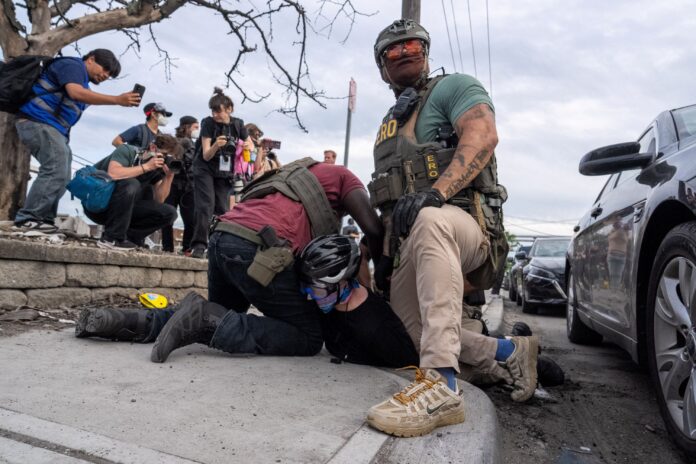

New Jersey is experiencing a genuinely significant increase in federal immigration enforcement activity, with local hotlines tracking daily arrests reporting call volumes roughly doubling in recent weeks. That escalation reflects a broader nationwide push by the Trump administration toward more aggressive enforcement targets, and across New Jersey specifically, it has translated into a marked rise in street detentions, workplace sweeps, and vehicle stops carried out by federal immigration agents.
Several high-profile incidents have drawn particular public attention in recent weeks. On July 20, 2026, ICE agents entered El Nopalito Mexican Restaurant on Haddon Avenue in Haddonfield and detained two kitchen workers, a sudden staffing loss that forced the family-owned business to issue a public statement acknowledging the resulting operational disruption. On July 1, 2026, Homeland Security Investigations and ICE arrested a Slovakian citizen residing in New Jersey on a green card, charging him with illegally registering and voting during the 2022 federal elections. Beyond those specific cases, multiple videos captured by community members have surfaced documenting genuinely physical arrest tactics, including an incident in Passaic where five officers brought a man to the pavement, an incident in Harrison where a man was reportedly pulled from his vehicle in front of his American citizen wife, and an incident in North Bergen where agents restrained a man face down inside a local park. On July 17, 2026, ICE agents also carried out a targeted arrest outside an apartment building on Boulevard East in West New York, with agents wearing tactical masks during the operation, a detail that has drawn specific scrutiny given a state law signed by Governor Mikie Sherrill that bars law enforcement from wearing masks during public interactions with residents.
The Delaney Hall detention facility in Newark has emerged as a genuine flashpoint amid this broader enforcement surge. Detainees held at the facility have launched hunger and labor strikes, alleging inhumane conditions including cell overcrowding, being denied adequate medical care, and being served food they say contained maggots. Those allegations remain contested claims made by detainees and advocates rather than independently verified findings, though they have drawn genuine political attention regardless. The situation reportedly grew more severe during a stretch of severe summer heat, when the facility’s air conditioning system failed entirely. On July 22, 2026, the House Judiciary Oversight Subcommittee held a genuinely contentious congressional hearing examining conditions at Delaney Hall, a session that unfolded alongside physical clashes between police and protesters gathered outside the facility’s gates.
A separate, significant legal battle continues unfolding in Morris County over a proposed immigration detention facility in Roxbury. The Department of Homeland Security purchased a 474,000-square-foot warehouse in the township for $129 million, with plans to convert the site into a large processing and detention hub capable of holding up to 1,500 migrants. Governor Sherrill’s administration filed suit against the federal government specifically to block that conversion. DHS briefly indicated it would abandon the Roxbury project altogether, but court filings from July 17 confirm the federal government is still actively evaluating whether to move forward with the facility despite that earlier statement, leaving the matter genuinely unresolved as the legal fight continues.
That broader enforcement surge has also produced direct financial and political backlash at the municipal level. Montclair pulled roughly $91 million in municipal funds out of Citizens Bank, citing the bank’s role financing private detention facility operators including the GEO Group, a move reflecting a deliberate strategy among some local governments to use their own financial leverage as a form of political protest against companies connected to immigration detention infrastructure.
Not every local government response has moved in that same direction, however. Weeks after an incident in Stafford Township in which Eduardo Cruz Garcia was arrested for allegedly striking a federal ICE agent with a van following a failed traffic stop on June 15, 2026, the Stafford Township Council unanimously adopted a resolution calling on Governor Sherrill and the state Legislature to formally reject New Jersey’s status as a sanctuary state. That resolution reflects a genuinely different political response than Montclair’s divestment decision, illustrating just how divided New Jersey’s own municipalities remain on how local government should respond to the current enforcement environment, some pushing back against federal immigration operations directly, others explicitly aligning themselves with stricter enforcement policies in the aftermath of an attack on a federal officer within their own community.
Taken together, these developments reflect a New Jersey genuinely caught between escalating federal enforcement activity and a deeply fragmented political response at both the state and local level. With the Roxbury lawsuit still working through the courts, the Delaney Hall conditions dispute still drawing congressional scrutiny, and individual towns adopting starkly different formal positions on enforcement itself, the coming weeks and months are likely to bring continued developments across nearly every front of this now genuinely statewide story.
















