
The City Council voted 8 to 1 to grant a two decade tax abatement for a new apartment building near West Side High School, despite unanimous public opposition and a lone council member’s warning that the city keeps repeating the same mistake on affordability.
Newark Approved a 20 Year Tax Break for a Building Where Most Residents Still Can’t Afford to Live
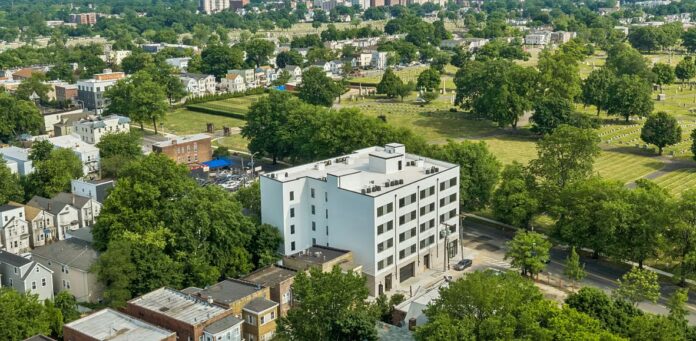
Newark’s City Council voted 8 to 1 on July 15th to approve a 20 year tax abatement for a new apartment building rising at 448-452 South Orange Avenue, at the corner of County Route 510 and South 15th Street in the city’s West Ward, near West Side High School. The vote followed a familiar pattern for anyone tracking Newark’s development politics in recent years, a council majority approving a long term tax incentive for a private developer, and every resident who submitted public testimony opposing it.
A Small Building, a Familiar Fight
The five story building will hold 34 apartments once complete, along with nearly 1,900 square feet of ground floor retail space and 15 parking spots. Under the terms the council approved, the developer will pay the city a predictable service charge in place of standard property taxes for the next two decades, a common financing tool cities use to make new construction pencil out financially, but one that has drawn increasing scrutiny in Newark as the pace of these agreements has picked up. Of the building’s 34 units, only seven are designated as affordable housing, set at 40, 60, and 80 percent of area median income, which the state currently calculates at 137,800 dollars for a family of four. The remaining 27 units will rent at whatever the market will bear.
That gap between the income figure used to calculate affordability and what Newark residents actually earn sits at the center of why the vote drew such uniform criticism. The city’s own median household income stood at 52,060 dollars in 2024, according to Census Bureau data, meaning the area median income standard driving these affordability calculations reflects a regional figure pulled up considerably by wealthier surrounding Essex County suburbs rather than Newark’s own economic reality. A unit priced at 80 percent of a 137,800 dollar benchmark can still land well out of reach for a family earning closer to the city’s actual median income, a mismatch residents raised repeatedly during public comment on the ordinance.
What Residents Actually Said
Public testimony on the ordinance was unanimous in its opposition, according to city records, with residents raising concerns that extended beyond the specific affordability percentages. One resident pointed to a pattern already visible elsewhere in the city, noting that ground floor retail space in several of Newark’s newer mixed use developments has sat empty long after the residential units above filled up, raising doubts about whether the retail component of projects like this one delivers the neighborhood benefit it is often used to justify. Other residents pressed the council to build stronger guarantees into these tax agreements specifically benefiting longtime Newark residents, rather than treating affordability requirements as a minimum box to check on the way to approving another market rate building.
Jackson’s dissenting vote reflected those same concerns from inside the council chamber itself. Beyond flagging the mismatch between AMI calculations and local incomes, she pointed to a related problem already visible in some of downtown Newark’s more established residential towers, where she said vacant units persist even as those same buildings decline to accept Section 8 housing vouchers, leaving both empty apartments and unhoused or underhoused residents sitting on opposite sides of a solvable gap.
Part of a Pattern, Not an Isolated Deal
This particular abatement is a small piece of a considerably larger trend in how Newark has financed new housing construction in recent years. Independent fiscal analysis of the city’s abatement practices has found the total value of tax credits, subsidies, and abatements the city has extended to developers grew sharply over the past decade, climbing from roughly 10 million dollars in 2016 to nearly 30 million the following year and reaching an estimated 68 million dollars in potential forgone revenue by 2020. The same developer behind this South Orange Avenue project, an LLC affiliated with Roselle Park based GonSosa Development, has secured similar long term abatements elsewhere in the city, including a 25 year exemption for a separate development on South 12th Street, and holds a partnership stake in the Rise Living apartment complex on Springfield Avenue, a project led in part by Newark native Queen Latifah’s BlueSugar Corporation.
Mayor Ras Baraka’s administration has generally framed this steady stream of abatements as a necessary tool for accelerating housing production in a city working to expand both market rate and affordable stock simultaneously, pointing to broader initiatives, including deed restriction requirements on city owned properties and LLC ownership transparency rules, as evidence of a parallel effort to protect long term affordability and homeownership even while individual project level incentives continue rolling through council meetings on a near weekly basis. Critics, including the residents who testified against this specific ordinance, argue that pattern has become the problem rather than the solution, with a rotating cast of new mixed use buildings offering token affordability set asides calculated against a regional income figure most Newark residents will never approach, while the city’s own tax base absorbs the cost of two decades of forgone revenue on each project. With this ordinance now approved and construction on South Orange Avenue already well underway, the building is expected to open with that same tension baked directly into its lease structure, a small development standing in for a debate about affordability that Newark’s council appears likely to keep having, one abatement vote at a time.