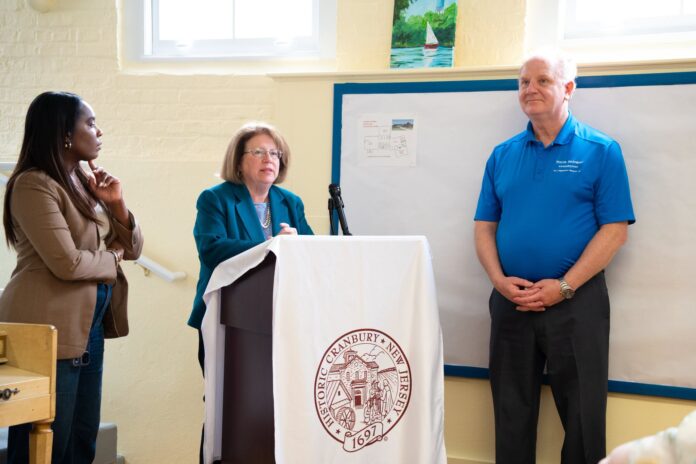

State Senator Linda Greenstein sat down for a morning interview with InsiderNJ in a diner booth along a Central Jersey highway in East Windsor, working through a genuinely wide-ranging conversation touching the political landscape under Governor Mikie Sherrill’s new administration, energy policy, the challenges posed by data center development, labor, the environment, the economy, issues specific to her own legislative district, Israel and the Middle East, ICE enforcement and masking policies, and the newly signed Fiscal Year 2027 budget.
Greenstein represents New Jersey’s 14th Legislative District, covering parts of Mercer and Middlesex counties, including towns like Cranbury, Plainsboro, Hamilton, and Monroe. Within the state Senate, she serves as Assistant Majority Leader and chairs the Law and Public Safety Committee, positions reflecting a political career spanning more than two decades, having served in the New Jersey General Assembly from 2000 to 2010 before winning election to the state Senate later that same year.
Much of Greenstein’s conversation centered on the affordability measures included in the new state budget, which she supported based on more than $4 billion in targeted tax relief directed at vulnerable populations across the state. That relief spans several distinct programs, including the Child Care Tax Credit, offering up to $1,000 per dependent child age five or younger, StayNJ, a property tax relief program specifically for homeowners age 65 and older, and ANCHOR, which provides property tax relief to New Jersey residents who own or rent their primary home and meet certain income limits. Greenstein framed these programs as a direct response to what she described as a genuine affordability crisis facing the state, arguing that lawmakers need to use every tool available to help residents manage rising costs. She emphasized that both StayNJ and ANCHOR carry real importance for New Jersey residents across every age group, helping give people a genuine reason to remain in the state rather than relocating elsewhere, while expressing hope that many families will take advantage of the Child Care Tax Credit specifically, since it’s designed to make working considerably more manageable for parents balancing employment with childcare costs. She described these programs collectively as ones she and her colleagues fought hard to preserve within the final budget.
As a veteran of the Legislature representing a genuine battleground district, Greenstein has built a reputation over the years for paying close attention to labor’s interests, working to bring together the sometimes competing priorities of public sector unions and Building Trades labor within a single, coherent pro-union agenda. She argued that Democrats need to remain genuinely true to their own roots, roots she sees as deeply intertwined with organized labor itself, contending that the party performs best electorally when it stays consistently pro-union, whether that support extends to public or private sector unions specifically. Greenstein went further, suggesting that traditional, moderate Democrats tend to perform best on affordability and working-class issues broadly, framing that more centrist approach as the party’s strongest asset on economic policy specifically.
Beyond her broader labor philosophy, Greenstein also discussed the genuinely delicate three-way balance New Jersey continues navigating between labor interests, energy policy, and environmental priorities, a tension that runs directly through many of the state’s current legislative debates, including how to handle the growing demand data centers are placing on the electric grid without abandoning the state’s broader environmental commitments or sidelining the labor unions responsible for building out that same energy infrastructure.
Greenstein also reflected on her own approach to legislative prioritization within a genuinely complex district, one that requires balancing the needs of several distinct communities at once. She described the importance of doing the necessary homework on any given issue, engaging directly with impacted communities, genuinely listening to their concerns, gathering information from multiple sources, and ultimately working to build real consensus before moving legislation forward, an approach she credits with helping her navigate a district that spans genuinely diverse communities across both Mercer and Middlesex counties.
Taken together, Greenstein’s interview offers a genuinely candid look at how a longtime legislator balances competing priorities within her own party and her own district, weighing affordability relief for residents against the state’s broader labor, energy, and environmental commitments, all while working to build the kind of consensus she views as essential to getting meaningful legislation across the finish line in Trenton.