
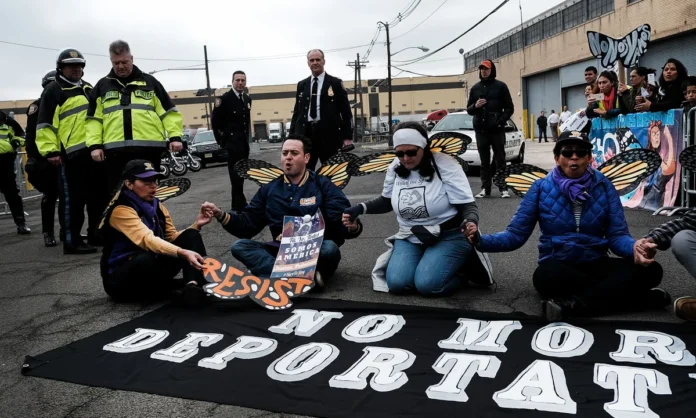

New Jersey has once again placed itself at the center of one of the most consequential public policy debates facing the nation. In a move that is already generating significant discussion among lawmakers, legal advocates, immigration organizations, taxpayers, and residents throughout the state, Governor Mikie Sherrill and Democratic leaders in the Legislature have announced a major expansion of funding for the Detention Deportation Defense Initiative (DDDI), increasing annual support for the program by $12 million.
The announcement raises the total state commitment to the initiative from $8.2 million to $20.2 million annually, representing one of the most significant investments New Jersey has made in immigration-related legal services. The expanded funding is intended to provide free legal representation to low-income New Jersey residents and migrants facing federal immigration detention and deportation proceedings, while simultaneously creating a rapid-response legal network designed to address emergency detention cases throughout the state.
The decision immediately places New Jersey at the forefront of a national conversation about immigration enforcement, due process rights, state involvement in federal immigration matters, public spending priorities, and the role local governments should play in supporting individuals facing removal proceedings.
For supporters, the funding expansion represents a necessary commitment to fairness, constitutional protections, and access to legal representation in an increasingly complex immigration system. For critics, it raises serious questions about taxpayer expenditures, state intervention in federal enforcement activities, and the broader direction of immigration policy.
The significance of the announcement extends far beyond the dollar amount itself. It reflects the growing reality that immigration policy is no longer solely a federal issue. Across the country, states have increasingly become active participants in shaping how immigration laws affect local communities, businesses, schools, healthcare systems, labor markets, and legal institutions.
In New Jersey, a state with one of the largest and most diverse immigrant populations in the nation, those conversations carry particular importance.
The Detention Deportation Defense Initiative was originally established to address a fundamental feature of immigration law that often surprises many Americans. Unlike criminal defendants, individuals facing deportation proceedings in federal immigration court are not guaranteed government-appointed legal counsel. Deportation cases are considered civil proceedings, meaning many detainees must either secure legal representation on their own or attempt to navigate an extraordinarily complex legal system without an attorney.
Supporters of the DDDI argue that this reality creates significant disadvantages for individuals who may have legitimate legal claims but lack the resources necessary to present them effectively.
Under the expanded program, state funding will continue supporting public defenders, legal aid organizations, nonprofit immigration attorneys, and community legal services that provide representation to qualifying individuals facing detention or deportation proceedings.
Advocates argue that access to counsel significantly improves the ability of individuals to understand legal processes, attend court hearings, present evidence, and pursue whatever legal remedies may be available under federal law.
The newly announced funding increase is intended to expand the program’s capacity at a time when state officials report growing demand for legal services associated with federal immigration enforcement activities.
In addition to the funding increase itself, the administration unveiled a new Rapid Legal Response Initiative designed to address emergency detention situations.
The effort will be coordinated through the Department of Human Services’ Office of New Americans, an agency that has increasingly become a focal point for New Jersey’s immigrant support infrastructure.
Under the new framework, attorneys and legal advocates will be able to mobilize more quickly when individuals are detained, pursuing immediate legal remedies that may include emergency court filings, habeas corpus petitions, and other federal legal actions intended to challenge detention circumstances or expedite judicial review.
Supporters describe the initiative as an important safeguard designed to ensure that detainees have meaningful access to the legal system during critical early stages of detention proceedings.
The timing of the expansion is closely connected to ongoing developments in federal immigration enforcement throughout the region.
State officials have specifically referenced increased detention activity and ongoing concerns surrounding operations associated with the Delaney Hall facility in Newark. The facility has become a recurring focal point in debates surrounding immigration detention, enforcement priorities, community impacts, and legal oversight.
As enforcement activity has intensified, advocates argue that demand for legal representation and emergency legal intervention has increased significantly.
The expanded funding is intended to respond directly to those pressures while providing additional resources to organizations already working within the immigration legal system.
Yet while supporters view the investment as an effort to strengthen due process protections, critics see the situation through a very different lens.
The announcement has sparked immediate criticism from conservative organizations, immigration enforcement advocates, and Republican lawmakers who argue that the state is dedicating taxpayer resources toward efforts that effectively undermine federal immigration enforcement.
Critics contend that federal immigration authorities are tasked with enforcing immigration laws enacted by Congress and that state-funded legal programs may create obstacles that delay or complicate enforcement actions.
Some opponents have characterized the initiative as an inappropriate use of public funds, arguing that taxpayer dollars should not be used to finance legal challenges against federal detention and deportation proceedings.
Others question whether the growing financial commitment reflects the priorities of New Jersey residents who are simultaneously facing concerns related to housing affordability, property taxes, transportation infrastructure, healthcare costs, education funding, and public safety.
Those criticisms have become central to a broader political debate unfolding throughout New Jersey and across the nation.
Immigration policy remains one of the most divisive issues in American politics, with sharp disagreements emerging over enforcement strategies, border security, legal immigration pathways, asylum procedures, detention practices, and the role of state governments in responding to federal actions.
The DDDI expansion has become the latest example of how those national debates increasingly play out at the state level.
Supporters counter that the issue is not fundamentally about immigration policy but rather about legal fairness.
Organizations advocating for the expansion argue that access to counsel is a cornerstone of any functioning justice system and that immigration courts present legal challenges that are often impossible for unrepresented individuals to navigate effectively.
They note that immigration law has become one of the most complex areas of American jurisprudence, involving extensive federal statutes, regulations, judicial decisions, administrative procedures, and evolving policy interpretations.
From that perspective, providing legal representation helps ensure that proceedings operate as intended while protecting constitutional principles related to due process and access to justice.
The debate also reflects a larger question that New Jersey policymakers have increasingly confronted in recent years: what responsibilities do states have when federal policies directly affect local communities?
As immigration enforcement actions impact families, employers, schools, healthcare providers, and municipalities, state governments frequently find themselves navigating the intersection of federal authority and local consequences.
New Jersey’s approach has often emphasized integration, legal assistance, community outreach, and institutional support for immigrant populations. The expansion of the DDDI continues that broader policy direction while simultaneously intensifying political disagreements over its implementation.
Beyond the immediate political arguments, the funding increase represents a substantial operational expansion that will likely influence legal services throughout the state.
Additional attorneys, support staff, community organizations, and legal resources will be needed to accommodate the expanded mission. The initiative may also influence how legal aid providers coordinate services, respond to emergency cases, and interact with federal detention systems moving forward.
As implementation begins, policymakers, advocates, and critics alike will closely monitor the program’s outcomes.
Questions regarding case volume, legal success rates, operational efficiency, financial accountability, and broader community impacts will likely shape future discussions about the initiative’s effectiveness and long-term sustainability.
For New Jersey residents, the announcement serves as another reminder that immigration policy remains deeply intertwined with questions about governance, public investment, constitutional protections, and community identity.
The expanded Detention Deportation Defense Initiative is not merely a budget item. It represents a significant policy statement about how New Jersey intends to engage with one of the defining legal and political issues of our time.
Whether viewed as a critical defense of due process rights or as a controversial use of taxpayer resources, the $12 million expansion ensures that the conversation surrounding immigration enforcement, legal representation, and state involvement will remain at the forefront of public debate throughout the coming year.
As New Jersey moves forward with implementation, the program’s impact will be measured not only through legal outcomes but through its broader influence on the continuing discussion over fairness, enforcement, public policy, and the evolving relationship between state and federal authority in modern America.
















