
The direction of the New York Giants has been unmistakably redefined following a 2026 NFL Draft that signals not just a roster overhaul, but a philosophical shift at the highest levels of the organization. Armed with two top-10 selections and operating under the vision of new head coach John Harbaugh, the Giants executed a draft strategy rooted in positional value, athletic ceiling, and schematic adaptability—three pillars that now shape the blueprint for the franchise’s next era.
This was not a draft about incremental improvement. It was a deliberate recalibration of identity, one that reflects a front office and coaching staff aligned in their pursuit of building a faster, more physical, and more dynamic football team capable of competing in a rapidly evolving NFC landscape. From the opening pick to late-round depth additions, the Giants approached the draft with clarity and conviction, prioritizing players who can alter games rather than simply fill roles.
The Giants entered with two top-10 picks and focused on high-upside foundational players for new head coach John Harbaugh.
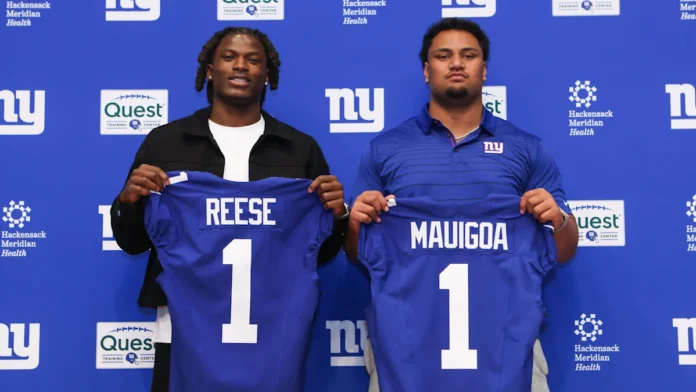
Arvell Reese (LB/EDGE, Ohio State): Selected at No. 5 overall, Reese is a hyper-athletic hybrid compared to Micah Parsons. He ran a 4.46 40-yard dash and is expected to be a versatile “game-wrecker”.
Francis Mauigoa (OT, Miami): Taken at No. 10 overall, Mauigoa was acquired via the trade of Dexter Lawrence to the Bengals. He is a 330-pound “mauler” who may start at guard before transitioning to tackle.
Day 2 & 3 Highlights: The Giants traded up into the third round for Malachi Fields (WR, Notre Dame) to give quarterback Jaxson Dart a big-bodied mismatch target. They also added cornerback Colton Hood in the second round.
At the center of this transformation is Arvell Reese, the hybrid linebacker-edge defender selected fifth overall out of Ohio State. Reese arrives in East Rutherford with rare athletic metrics and positional versatility that immediately places him among the most intriguing defensive prospects in the league. His 4.46-second 40-yard dash at his size underscores a profile that defensive coordinators covet but rarely find—a player capable of collapsing the pocket, chasing down plays in space, and seamlessly transitioning between edge responsibilities and off-ball linebacker duties. Comparisons to elite disruptors are inevitable, but what matters most for the Giants is how Reese fits into a defensive system that now prioritizes speed and multiplicity. His presence alone forces opposing offenses to account for him on every snap, and that kind of gravitational impact reshapes the entire defensive structure.
The Giants’ second top-10 selection further emphasized their commitment to building from the line of scrimmage outward. With the tenth overall pick, the organization selected Francis Mauigoa, a physically imposing offensive lineman from Miami whose arrival was made possible through a significant roster move that sent veteran defensive anchor Dexter Lawrence to Cincinnati. The decision to part with an established presence in exchange for long-term offensive line stability reflects a calculated shift in roster construction philosophy. Mauigoa’s size, power, and finishing ability project him as a foundational piece along the offensive front. While early projections suggest he may begin his career at guard, his long-term trajectory points toward a cornerstone tackle role, anchoring protection schemes and elevating the run game with his ability to dominate at the point of attack.
This dual investment—an explosive defensive playmaker and a foundational offensive lineman—captures the essence of the Giants’ draft: balance with upside. It is a recognition that sustainable success in the NFL is built not only through star power, but through structural integrity across both sides of the ball.
As the draft progressed into its middle rounds, the Giants continued to demonstrate strategic aggression, most notably by trading up into the third round to secure wide receiver Malachi Fields from Notre Dame. This move was not incidental; it was a targeted acquisition designed to support the development of quarterback Jaxson Dart, whose progression remains central to the franchise’s long-term outlook. Fields brings a size-speed combination that introduces a new dimension to the Giants’ passing attack, offering a physical mismatch against defensive backs and a reliable target in contested situations. His addition reflects an understanding that quarterback development is inseparable from surrounding talent, and the Giants have made it clear that Dart will not be left to develop in isolation.
In the secondary, the selection of cornerback Colton Hood in the second round adds another layer to a defense undergoing rapid transformation. Hood’s skill set aligns with modern coverage demands—fluid movement, recovery speed, and the ability to operate in both man and zone schemes. His presence strengthens a unit that is being rebuilt with an emphasis on adaptability and playmaking, qualities that will be essential in countering the diverse offensive systems across the conference.
What distinguishes the Giants’ 2026 draft is not simply the individual talent acquired, but the coherence of the overall strategy. Every selection fits within a broader framework that prioritizes athleticism, versatility, and long-term scalability. This is a roster being constructed with an eye toward sustained competitiveness, not short-term fixes.
For New Jersey fans and followers of the team’s ongoing evolution, the implications are immediate and far-reaching. The Giants are not merely adding players—they are redefining expectations. The infusion of youth, combined with a coaching philosophy rooted in discipline and adaptability, positions the team to accelerate its rebuild and reenter the conversation as a legitimate contender within the division.
The connection between the Giants and the region they represent remains a defining element of the franchise’s identity, and this new chapter carries with it a renewed sense of alignment between team and fan base. The energy surrounding this draft class reflects more than optimism; it reflects belief in a direction that is finally clear and measurable.
For continued coverage, roster analysis, and deeper insights into how this draft class will shape the upcoming season, explore more through the official New York Giants coverage hub, where every development surrounding the team’s transformation is being tracked in real time.
As rookie minicamps approach and training camp battles begin to take shape, the success of this draft will ultimately be determined on the field. Yet even at this early stage, one conclusion is unavoidable: the Giants have executed a draft that aligns talent with vision, and in doing so, they have taken a decisive step toward reclaiming their place among the NFL’s most competitive franchises.