
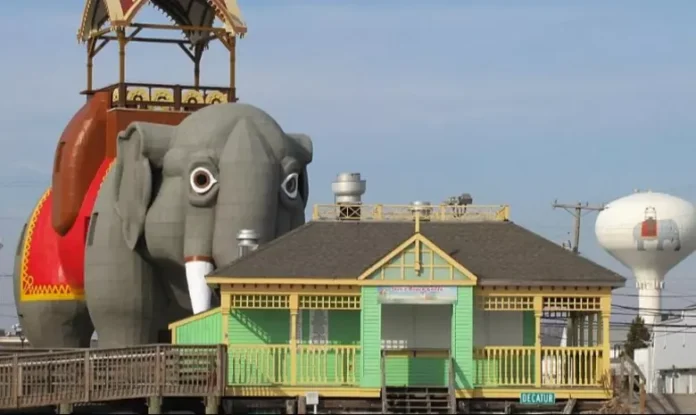

Long before the Jersey Shore became synonymous with sprawling casinos, towering boardwalk rides, beach concerts, luxury resorts, and modern tourism campaigns, one gigantic elephant standing along the coastline in Margate City was already redefining what American roadside entertainment could become. Rising 65 feet above the sand and weighing approximately 90 tons, Lucy the Elephant remains one of the strangest, most beloved, and most historically important landmarks not only in New Jersey, but anywhere in the United States.
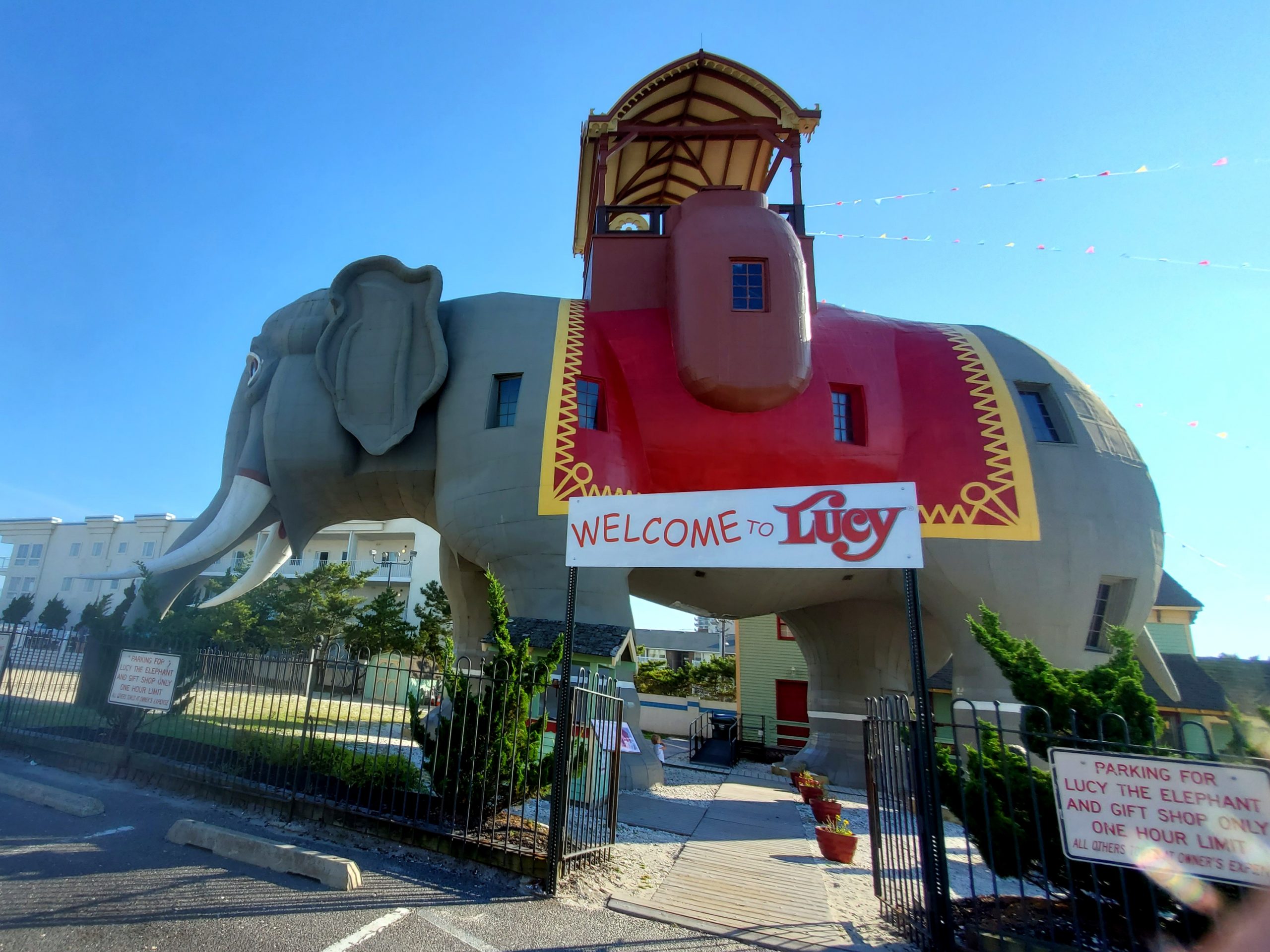
More than 140 years after her construction in 1881, Lucy continues to attract visitors from around the world who arrive at the southern New Jersey shoreline expecting to see a novelty attraction and instead discover something much larger: a living symbol of American imagination, eccentricity, preservation, tourism history, architectural experimentation, and the enduring personality of the Jersey Shore itself.
In an era where countless roadside attractions have vanished beneath redevelopment, hurricanes, neglect, or changing travel habits, Lucy’s survival feels almost impossible. She has endured salt air, economic downturns, abandonment, structural decay, demolition threats, relocation, restoration campaigns, and multiple reinventions while somehow remaining one of the most instantly recognizable figures in New Jersey culture.
Today, Lucy the Elephant exists simultaneously as a National Historic Landmark, a functioning museum, a tourism icon, an architectural curiosity, a preservation success story, and one of the most photographed attractions anywhere along the Atlantic coastline. Yet what makes Lucy especially remarkable is not merely her survival, but the bizarre and deeply American story behind why she was built in the first place.
The origins of Lucy begin with ambition, speculation, and pure spectacle.
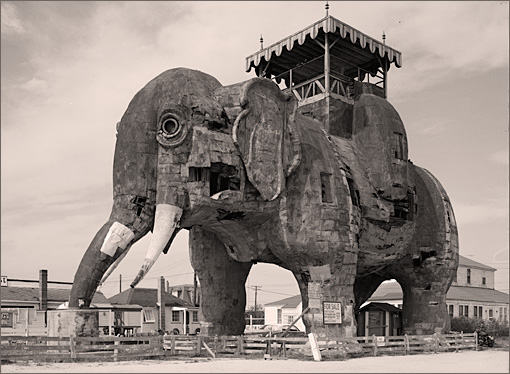
During the late 19th century, southern New Jersey’s coastline remained largely undeveloped, consisting of vast stretches of sandy terrain waiting for investors, developers, and entrepreneurs eager to capitalize on the rapidly expanding tourism economy connected to rail travel from Philadelphia and other northeastern cities. One of those visionaries was James V. Lafferty, an eccentric engineer, inventor, and land developer whose imagination dramatically exceeded conventional real estate marketing strategies.
Lafferty owned significant parcels of land in what was then called South Atlantic City, the community eventually renamed Margate City. Like many developers of the era, he needed a way to convince wealthy Victorian-era travelers and homebuyers that the undeveloped coastline represented an exciting investment opportunity. Unlike most developers, however, Lafferty believed the solution involved constructing an enormous elephant-shaped building directly along the shore.
The idea was outrageous.
It was also brilliant.
Lafferty patented his elephant-building concept in 1882 and quickly turned Lucy into one of the earliest examples of novelty architecture in American history. Prospective buyers would travel down from Philadelphia by railroad before climbing a spiral staircase located inside Lucy’s massive hind leg. Once reaching the top viewing platform, known traditionally as a howdah, visitors could survey the coastline while Lafferty pointed toward available oceanfront lots below.
The structure functioned simultaneously as observation tower, advertising campaign, conversation piece, and tourism magnet. Long before modern billboards, viral marketing, or destination branding existed, Lucy was already accomplishing exactly what contemporary attractions still attempt to achieve today: making people stop, stare, talk, photograph, and remember.
And they did.
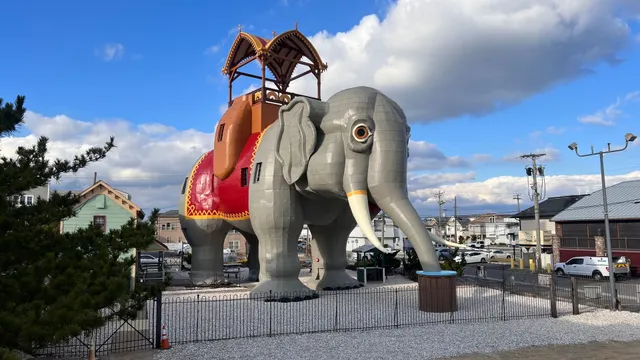
Over time, Lucy became far more than a real estate gimmick. She evolved into a permanent landmark woven directly into the emotional identity of the Jersey Shore itself.
Her architecture alone remains astonishing even by modern standards. Constructed primarily from wood and covered in tin, the colossal elephant contains nearly 12,000 square feet of timber framework engineered decades before contemporary structural technology existed. The interior resembles an intricate cathedral of beams, braces, curved supports, and handcrafted construction techniques that continue astonishing architects, engineers, and preservation experts who study the building today.
Standing inside Lucy’s body feels less like entering a traditional tourist attraction and more like walking inside a massive handcrafted sculpture. The internal structure reveals the remarkable ambition and craftsmanship required to construct something so unusual at a time when neither modern engineering software nor advanced fabrication systems existed.
But Lucy’s story became even stranger after her original real estate purpose faded.
Throughout the 20th century, the giant elephant cycled through multiple bizarre second lives that only deepened her folklore. In 1902, she was purchased by the Gertzen family, officially given the name “Lucy,” and transformed into a tavern operating during the years before Prohibition. Local legends still persist claiming bootleggers once used Lucy’s giant eyes to signal offshore ships carrying illegal alcohol during the Prohibition era.
Later, for one memorable summer, a wealthy family actually leased the structure and attempted to use Lucy as a seasonal residence. The family outfitted portions of the interior with living accommodations, including a bathtub, despite lacking running water throughout the building. The idea of living inside a six-story elephant along the Jersey Shore sounds almost surreal today, yet it perfectly reflects the kind of eccentric Americana Lucy has always embodied.
More than a century later, that strange residential history unexpectedly resurfaced again during the modern vacation-rental era when Lucy briefly became one of the most talked-about overnight listings on Airbnb in 2020. The limited overnight opportunity generated national attention, with visitors eager for the chance to sleep inside one of America’s most unusual surviving landmarks.
Despite her popularity, Lucy’s existence has never been guaranteed.
By the late 1960s, decades of relentless Atlantic salt air, moisture exposure, coastal storms, and structural deterioration had pushed the building dangerously close to collapse. The once-celebrated landmark had fallen into severe disrepair and was officially condemned. Plans emerged to demolish the elephant entirely, potentially erasing one of the nation’s oldest surviving roadside attractions forever.
What happened next permanently transformed Lucy from novelty architecture into preservation legend.
In response to the demolition threat, local residents, historians, preservationists, and community advocates united to form the Save Lucy Committee, launching one of New Jersey’s earliest and most significant grassroots historic preservation campaigns. Rather than allowing the building to disappear, the group organized efforts to physically relocate the massive structure approximately two blocks away onto city-owned property where restoration efforts could begin.
The move itself became one of the most dramatic moments in Jersey Shore preservation history.

In 1970, workers carefully transported the gigantic elephant through Margate streets in an operation that captured enormous public attention. Watching a 90-ton elephant structure slowly move across town instantly entered local folklore and reinforced Lucy’s emotional importance to the surrounding community.
That relocation ultimately saved her life.
Since then, preservation has remained a constant battle. Maintaining a wooden and metal structure exposed year-round to ocean air, humidity, storms, and seasonal temperature shifts requires continuous conservation work, structural monitoring, and extensive fundraising. Lucy’s survival is not passive. It is the result of decades of ongoing intervention, restoration, and community commitment.
Recent preservation efforts have been especially ambitious.
Lucy recently underwent a massive exterior restoration project replacing sections of her aging tin skin with advanced rust-resistant nickel-copper alloy materials designed to better withstand coastal weather conditions. Additional funding has supported interior plaster restoration, historic flooring improvements, upgraded climate control systems, and new HVAC technology intended to reduce internal condensation capable of damaging the massive timber framework hidden beneath the exterior shell.
Those preservation investments are critical because Lucy’s importance extends far beyond nostalgia. She occupies a unique position within American architectural history as the oldest surviving roadside tourist attraction in the nation. Long before giant dinosaurs, oversized diners, neon motel signs, themed restaurants, or roadside entertainment complexes spread across America’s highways, Lucy established the basic concept that architecture itself could become spectacle.
That influence continues shaping American tourism culture even today.
Yet perhaps the most fascinating aspect of Lucy’s survival is how emotionally attached people remain to her. Visitors do not experience Lucy merely as a historical artifact. They treat her almost like a living character embedded within the personality of the Jersey Shore itself. Families return generation after generation. Vacation photos repeat across decades. Children who once climbed Lucy’s staircases now bring grandchildren back to experience the same views overlooking the Atlantic Ocean.
That emotional continuity matters deeply at a time when much of the Jersey Shore continues rapidly modernizing through redevelopment, luxury construction, and shifting tourism trends. Lucy represents something increasingly rare: a direct surviving connection to the strange, playful, imaginative spirit that originally defined American shore tourism culture.
Today’s visitor experience allows guests to explore nearly every dimension of Lucy’s history firsthand. Guided tours lead visitors through the internal museum spaces showcasing historic blueprints, preservation artifacts, architectural materials, and photographs documenting Lucy’s remarkable journey across nearly a century and a half of American history.

Climbing through the interior remains one of the most memorable parts of the experience. Visitors eventually emerge inside Lucy’s howdah viewing platform, where sweeping panoramic views stretch across Margate City, the Atlantic Ocean, and the distant Atlantic City skyline. Looking outward through Lucy’s giant porthole-style eyes creates one of the most unique visual perspectives anywhere along the Jersey coastline.
The surrounding area has also evolved into a broader tourism destination anchored partially by Lucy’s continued presence. Visitors frequently pair tours with beach trips, boardwalk excursions, dining experiences, and broader exploration throughout Atlantic County and the southern Jersey Shore region.
As New Jersey continues investing heavily in cultural tourism, heritage preservation, arts programming, and experiential travel destinations, Lucy the Elephant increasingly stands not merely as a quirky roadside attraction, but as one of the state’s most important surviving cultural landmarks. Her story touches architecture, engineering, tourism history, preservation activism, Americana, and coastal identity all at once.
More importantly, Lucy still accomplishes the exact thing James V. Lafferty originally intended back in 1881.
She makes people stop.
She makes people curious.
She makes people gather.
She makes people remember.
People can gaze at her from the Bar Patio next door.
More than 140 years after wealthy Victorian travelers first climbed her staircases overlooking undeveloped shoreline property, Lucy the Elephant remains one of the great surviving symbols of American imagination standing proudly above the Jersey Shore, still watching over the coastline, still astonishing first-time visitors, and still proving that sometimes the strangest ideas become the most enduring landmarks of all.
















