
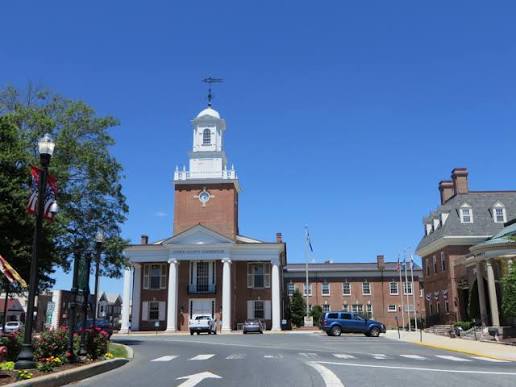

Forty or fifty people showed up to protest a vote everyone already knew the outcome of. That’s the strange part of what happened at the Sussex County Administrative Center this week, a meeting where the result was never actually in doubt, yet the room, and eventually the parking lot outside it, turned into something close to a shouting match anyway.
Sussex County’s Board of County Commissioners is entirely Republican, and has been for longer than most residents can remember, with registered Republicans outnumbering Democrats in the county by nearly two to one. So when the board called a special meeting to pass a pair of resolutions, the outcome was never genuinely in question. Both measures passed unanimously. What made the meeting newsworthy wasn’t the vote count. It was everything surrounding it.
The first resolution demanded an independent investigation into recent problems with New Jersey’s voter registration system, specifically the roughly 6,600 people who got registered to vote despite indicating on their own MVC paperwork that they weren’t citizens. Here’s the detail that gives this resolution an odd, almost theatrical quality. Governor Mikie Sherrill’s administration had already launched exactly this kind of investigation before Sussex County ever called its meeting, going as far as retaining an outside law firm led by a prominent Republican attorney to lead the review. Supporters of the resolution argue that a formal, independent local demand still adds pressure and visibility regardless of what the state was already doing. Critics counter that the entire measure was symbolic theater dressed up as urgent oversight, aimed at a problem the state government had already moved to fix on its own initiative. Both of those readings can be true at once, and reasonable people watching the same meeting walked away with genuinely different conclusions about whether the resolution accomplished anything beyond a headline.
The second resolution carried real teeth, or at least real intent, opposing a package of state laws designed to limit how much local police can cooperate with federal immigration enforcement. That fight traces back to a law Governor Sherrill signed banning ICE agents and other law enforcement officers from wearing masks or face coverings during public arrests. The state’s argument is straightforward. Masked agents erode public trust and make it dangerously easy for someone to impersonate a federal officer during an arrest, a legitimate public safety concern that’s hard to dismiss outright. The Trump administration’s Department of Homeland Security sued New Jersey almost immediately, arguing the state has no constitutional authority to dictate how federal officers operate, pointing to the Supremacy Clause, and countering that agents wear coverings specifically to protect themselves and their families from being doxxed or targeted by people opposed to their work. That’s also a legitimate concern, and it’s the kind of genuine constitutional and safety tension that doesn’t resolve cleanly in either direction no matter how forcefully either side argues it.
Sussex County’s resolution effectively told the state it sides with federal ICE agents over New Jersey’s own governor on this question, and the commissioners didn’t shy away from mocking the mask ban specifically during the meeting. That’s where the human moment of the night actually landed. A former student at the county-run community college stood up and asked the board directly whether they had any concern about international students at that same college potentially becoming ICE targets under looser cooperation rules. The commissioners didn’t engage with the question. They moved on. Whatever you think of the underlying policy debate, declining to even acknowledge a direct, specific question about students at an institution the board itself oversees is the kind of moment that tends to stick with people longer than the resolution’s actual text does.
What happened after the vote is honestly the part of this story that deserves the most attention. Despite Sussex County’s overwhelming Republican lean, forty to fifty protesters turned out, described by at least one local official as mostly older women, hardly the picture of outside agitators that gets invoked in these situations. Some reportedly followed resolution supporters out into the parking lot afterward, yelling at them directly. That’s a genuine breakdown in civility regardless of which side of the immigration debate you land on, and it’s worth naming plainly rather than excusing because the underlying politics feel urgent to one side or the other.
The next day, county Republican chairman Joseph LaBarbera escalated things considerably further, describing the protesters as “dark forces” working to make elections “chaotic” and “untrustworthy.” That’s a significant rhetorical jump, from a local zoning-adjacent meeting about resolutions to language pulled straight from national conversations about mail-in ballots and voting software integrity. I’ll say plainly what I think about that particular choice of words. Calling a group of mostly older women who showed up to protest a symbolic vote “dark forces” isn’t persuasive rhetoric aimed at winning anyone over. It’s the kind of language built to rally an already-convinced base rather than actually engage with the substance of what critics were saying, and it tends to deepen exactly the kind of local division this meeting created rather than settle anything.
Here’s what’s actually true underneath all the noise. New Jersey has a real, unresolved legal fight going on right now between the state and the federal government over how ICE agents are allowed to operate here, a fight that’s already produced a federal lawsuit and touches on genuine constitutional questions about state versus federal authority that courts, not county commissioners, will ultimately have to sort out. Sussex County’s resolution didn’t settle that fight. It couldn’t have, symbolic county resolutions don’t carry legal weight over federal immigration enforcement or state law. What it did do was put a very local, very human face on a much larger national argument, complete with a defiant board, a determined group of protesters willing to show up even in hostile political territory, and a party chairman whose chosen words the next morning did more to inflame the moment than explain it. Whatever comes of the actual state versus federal legal battle over ICE masks and cooperation, this meeting made one thing clear. That fight has fully arrived in New Jersey’s smallest, reddest corners, and it’s not staying confined to courtrooms and press releases.
















