
Roughly 6,600 people got registered to vote in New Jersey between June 2023 and June 2024 despite telling the state, in writing, that they weren’t citizens. That single sentence has since pulled Governor Mikie Sherrill’s administration into a national fight over election data, a federal lawsuit, and a court ruling that’s now the eighteenth straight loss for the Trump administration’s Justice Department on this exact issue.
Here’s how the mess actually happened. When New Jersey residents apply for a driver’s license or state ID through the Motor Vehicle Commission, they’re asked directly whether they’re U.S. citizens. Thousands of people answered no. The MVC’s computer system, built on software from vendor Idemia, transmitted their information for voter registration anyway, apparently ignoring their own stated answer entirely. State officials say the underlying flaw was corrected back in June 2024, but nobody in the previous administration disclosed the problem publicly until Sherrill’s team surfaced it this year. Fewer than 400 of the roughly 6,600 affected individuals actually cast ballots, according to the state’s own figures, a detail that matters enormously depending on which side of this fight you’re listening to.
Sherrill, who took office in January, has said she learned about the issue last week and ordered an independent investigation immediately. She didn’t mince words about the underlying failure either, calling it unacceptable that a vendor released software with an error this significant, unacceptable that it took roughly a year to fix, and unacceptable that nobody in the prior administration flagged it or demanded accountability when it happened. On that point, frankly, I don’t think there’s much room for real disagreement. A voter registration system silently overriding a citizen’s own written answer is a serious operational failure regardless of party, and it deserved public disclosure the moment anyone in state government understood what had occurred.
Cleanup is already underway. New Jersey’s Division of Elections has moved to directly remove approximately 4,500 confirmed noncitizens from the voter rolls. A separate group of roughly 2,100 flagged individuals isn’t being automatically scrubbed, though, because early review suggests some of them may actually be legal citizens caught up by clerical mistakes rather than genuine noncitizen registrations. Those names have been referred to local county election officials for individual, manual verification rather than a blanket removal, and the state has begun mailing notices directly to affected residents so nobody discovers their registration status changed without warning.
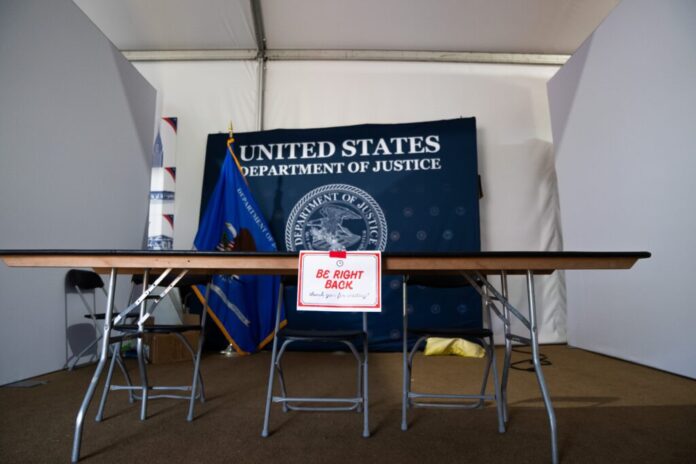
That’s where the story should have ended, a messy but fixable administrative failure being corrected in real time. Instead, it collided directly with an existing federal lawsuit. The Justice Department had already sued New Jersey months earlier seeking the state’s complete, unredacted voter registration database, part of a broader campaign that’s now produced similar lawsuits against roughly two dozen states and localities. When the MVC error became public, DOJ moved quickly to use it as fresh justification, arguing the newly disclosed registrations strengthened its case for obtaining the state’s full voter data, including names, birthdates, and addresses of everyone affected.
Sherrill refused. She informed Assistant Attorney General Harmeet Dhillon directly that the federal request had no legal basis, pointing to protections under the federal Privacy Act and the Driver’s Privacy Protection Act as reasons the state wouldn’t hand over private, identifying information on the individuals involved. New Jersey is instead treating this as its own investigation to run, not a federal takeover to accommodate.
The legal question landed in front of U.S. District Judge Zahid Quraishi, and his ruling came down decisively. He dismissed the Justice Department’s lawsuit with prejudice, finding that the Civil Rights Act of 1960, the law DOJ was relying on, simply doesn’t cover the kind of computerized statewide voter list the department was demanding. In his written opinion, Quraishi noted plainly that the MVC’s software error had no bearing on the actual legal question in front of him, since the case turned on statutory authority rather than the merits of New Jersey’s registration troubles. He also pointed out that his court was joining at least sixteen other federal district courts, along with one federal appeals court, in rejecting nearly identical DOJ demands elsewhere in the country. Add it up and the federal government now stands at zero wins and eighteen losses pursuing this exact legal theory nationwide, a losing streak that’s hard to characterize as anything other than a consistent, cross-jurisdictional signal from the judiciary.
Dhillon wasn’t shy about her reaction. She accused Sherrill of protecting illegitimate voters who, in her framing, canceled out the ballots of legitimate New Jersey citizens, and made clear the department intends to keep pursuing the state’s data regardless of the dismissal. Sherrill, for her part, has argued the administration is more interested in weaponizing the MVC’s mistake politically than in genuinely securing elections, and her office has pointed to the state’s own removal and referral process as proof New Jersey is handling this responsibly without federal intervention.
Both sides are making arguments that deserve to be taken seriously rather than dismissed outright. The Justice Department’s underlying concern, that thousands of ineligible registrations sat on the books for over a year without public disclosure, is a legitimate thing to want transparency about. New Jersey’s position, that handing over the private identifying information of thousands of residents to federal authorities requires an actual legal basis the courts haven’t found DOJ to have, is also a legitimate constitutional argument, and so far it’s the one holding up in court after court across the country. Where you land on the broader fight over federal versus state control of voter data probably depends on priors you walked in with. What’s not really in dispute anymore is that New Jersey’s software failure has been publicly acknowledged, is actively being fixed through direct removals and individual county reviews, and that eighteen federal judges in a row have now told the Justice Department it doesn’t have the legal standing it claims to have. This story isn’t finished, DOJ has signaled it plans to keep pushing, but round one clearly went to Trenton.