
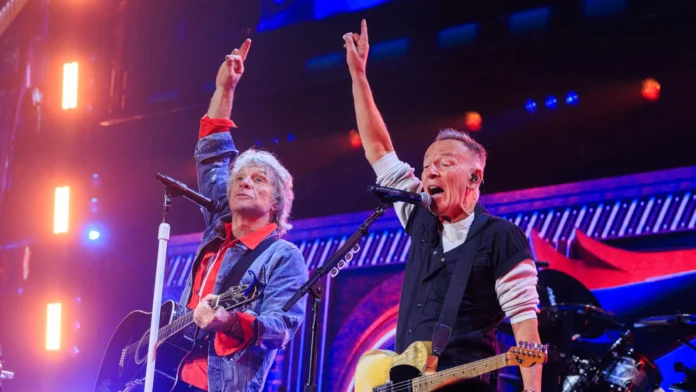

Rock and roll came home to New Jersey this week, and it did it with two of the state’s own standing shoulder to shoulder under one roof. Bruce Springsteen walked onto the Madison Square Garden stage Sunday night unannounced, and the building nearly came off its foundation. Jon Bon Jovi called him “the king of the great state of New Jersey.” That was it. No fanfare beyond those nine words. The crowd didn’t need more.
Let me get you caught up, because if you weren’t glued to your phone Sunday night refreshing every fan account and bootleg clip, you missed something that won’t happen again anytime soon.
The Complete July 26 Finale Setlist: According to official tracking from Ultimate Classic Rock and Setlist.fm, the band played a powerhouse 19-song set:
- Beautiful Drug
- We Weren’t Born to Follow
- Lost Highway
- You Give Love a Bad Name
- Born to Be My Baby
- Legendary
- Whole Lot of Leavin’
- In These Arms
- The People’s House (Featuring a live guest performance debut with the country-soul duo The War and Treaty)
- It’s My Life
- Livin’ on a Prayer
- Raise Your Hands
- This House Is Not for Sale
- I’ll Sleep When I’m Dead
- Keep the Faith
First Encores: - I’ll Be There for You
- Bad Medicine
Second Encores (With Bruce Springsteen): - Who Says You Can’t Go Home (Trading lead vocals with The Boss)
- The Promised Land (Springsteen’s 1978 classic, closing with the two rock icons locking arms for a group bow)
Bon Jovi’s nine-show residency at the Garden was already a big deal before Bruce ever showed up. This marked the band’s first extended New York run since Jon underwent serious vocal cord reconstruction surgery back in 2022, a procedure that had fans quietly wondering whether that voice, the one that carried arenas for four decades, would ever sound like itself again. It does. Anyone who caught even a clip from July 26 can tell you that.
The road to that final night wasn’t smooth, either, and that’s part of what made the ending land so hard. Just three days earlier, on July 23, Bon Jovi had to cut the eighth show short. A sinus infection knocked Jon off his game mid-set, and the band pulled the plug rather than push through and risk the very instrument they’d fought to rebuild. That’s the kind of moment that could have cast a shadow over the whole residency’s closing chapter. Instead, it made Sunday feel like a comeback within a comeback. Jon addressed it directly during the encores, telling the crowd, “This has been the privilege of a lifetime,” and making clear that what they’d just witnessed wasn’t a farewell. It was, in his words, a continuation, not the end of a chapter. I believe him. Bands that are actually done don’t talk like that.
The setlist itself ran nineteen songs deep, a genuine career-spanning set that pulled from Bon Jovi’s earliest breakout years all the way through to their most recent material. They opened with “Beautiful Drug” and tore through staples like “You Give Love a Bad Name,” “Livin’ on a Prayer,” “Bad Medicine,” and “Keep the Faith,” while also making room for deeper cuts that longtime fans have been begging to hear live for years. “The People’s House” brought out the country soul duo The War and Treaty for a guest turn that added an unexpected texture to the middle of the set, proof that Jon still likes throwing curveballs even after all this time. But it was the second encore where the night stopped being a really good concert and became something people will talk about for the rest of their lives.
That’s when Springsteen came out. The building erupted into that unmistakable, guttural “Bruuuce” chant the second he appeared, and the two of them shared a single microphone stand for “Who Says You Can’t Go Home,” trading lines back and forth like a couple of guys who’ve known each other since the Jersey Shore bar circuit, because that’s exactly what they are. Then came “The Promised Land,” Springsteen’s own 1978 classic, with Bruce taking over lead vocals and rhythm guitar while Bon Jovi’s band fell in behind him. It ended with the two of them locking arms center stage for a bow that felt less like a scripted finale and more like two guys closing out a long night the way they always have, together.
I’ve got a personal stake in all of this that goes back further than most people would guess. Back in the late 1980s, I managed a recording studio that hosted Jon Bon Jovi and the band during pre production for what would become New Jersey, the 1988 album. Even though I was never in any sessions, I had to administrate a song called “Love For Sale” that I think was done impromptu in one of those seeions. It happened to make the album to one of the most successful arena rock records ever made, and I still have the personalized RIAA platinum plaque and honestly, just finding out it did over 7 Million sales, I want a Multi Platinum Award by the RIAA. How do I get it bumped up to reflect what the album eventually sold. Is that even a thing in the music industry? How does that work when they forget about you after however much time. Do people get them issued automatically as more sales happen? I bet the newer ones are cool too.
What people forget, or maybe never knew, is how much material actually got written before that album took its final shape. Jon and Richie Sambora wrote an almost unreasonable amount of songs during that period, enough that they originally planned a sprawling double LP called Sons of Beaches. It had the kind of ambition you’d expect from a band riding the momentum of Slippery When Wet, ready to swing bigger. Mercury Records had other ideas. The label stepped in, rejected the double album format outright, and pushed the band to trim everything down to a tight, single 12 track record that eventually got renamed after their home state instead. Turned out to be a good call commercially, even if it meant a lot of strong material got left on the cutting room floor for years. Decades later, when the deluxe anniversary editions finally arrived, thirteen of those original 1987 and 1988 acoustic and electric demos got officially released as bonus material. Songs I bet that were tracked live in those studio bays became prized historical artifacts for millions of fans who never knew they existed until then. That’s a strange feeling, hearing something you watched get built in real time suddenly treated like buried treasure. I honestly had no clue about any of this until I did the reasearch today.
One track in particular deserves its own paragraph, because the story behind it is better than most people realize. I mentioned “Love for Sale” which is the song that closes out side B of the album, and it’s about as far from a polished arena anthem as you can get. That track is a completely raw, unedited acoustic session, taped live during pre production, and what ended up on the final studio pressing is literally that same demo, not a re recorded, cleaned up version. Richie Sambora talked about it in later interviews, describing how they basically sat down in the booth with a harmonica, an acoustic guitar, and a bottle of wine, and just started wailing without any real plan. You can hear the difference instantly if you know what you’re listening for. Producer Bruce Fairbairn stacked the rest of New Jersey with glossy, layered arena rock production, the kind built for stadium PA systems. Then “Love for Sale” hits, and suddenly you’re sitting inside the room with them, listening to laughing, clinking glasses, using the wall as a drum kit, and loose ad libs that never got cleaned up. The band originally planned to cut the track entirely. Jon decided against it, choosing instead to bury it at the very end of the record as a way of showing fans who they actually were underneath the hair and the lights. I think that decision aged better than almost anything else on that album. It’s the one moment where the mythology drops and you just get four guys enjoying themselves. I think they just played it live in recent years or as part of one tour.
Jack Ponti, who did not write any tracks on the 1988 New Jersey album, still matters a great deal because he was heavily involved at the studio level and was an important part of the band’s earlier story. He co-wrote “Runaway,” the 1983 breakout single that put Jon Bon Jovi on the map and effectively launched the entire career that followed. Ponti was a major creative force during the band’s formative years from 1983 through 1985. By the time Slippery When Wet and New Jersey arrived, however, the band had fully developed its songwriting chemistry with Desmond Child who ironically or because of those sessions, brought the great Alice Cooper to do work at the sudio.
Here’s where things get genuinely interesting from a business standpoint, and honestly, a little frustrating if you’re the one holding a piece of that publishing pie. Owning a stake in a multi platinum album used to mean something very specific. When New Jersey came out in 1988, people bought the whole album as one physical package. Whether a fan skipped straight to “Livin’ on a Prayer” or sat through the entire thing twice, “Love for Sale” being track twelve on a record that moved over seven million copies in the U.S. alone meant that publishing share got paid out on every single unit sold. Didn’t matter if anyone actually listened to the deep cut. The check cleared regardless.
Streaming flipped that model on its head completely. Modern platforms operate on a pro rata, pay per play basis, and an album gets unbundled the second it hits a streaming service. A track has to be actively played for at least thirty seconds before it even registers a stream, let alone triggers a payout. That means a passive album closer, something that never lands on a curated playlist or gets radio spins, quietly generates next to nothing compared to the songs everyone already knows by heart. Kworb’s Spotify tracking data puts the entire New Jersey album at roughly 796 million lifetime streams, and nearly all of that weight sits on just a few songs. “I’ll Be There for You” alone accounts for well over 315 million streams. “Bad Medicine” sits north of 230 million. “Born to Be My Baby” clears 120 million. Meanwhile “Love for Sale,” the song with arguably the richest behind the scenes story on the whole record, has pulled in something like 2.2 million streams total. At an estimated $3,000 to $5,000 per million streams once you factor in distributors, the label’s cut, performance rights organizations, and every other hand in the pot, that number translates to almost nothing in ongoing revenue. It’s a strange irony. The most human moment on the entire album, the one where you can actually hear the band being themselves instead of performing, is the one that pays the least in the streaming economy. I don’t have a tidy solution for that. I just think it’s worth saying out loud, because nobody talks about how differently these old contracts age once the business model underneath them completely changes.
None of that takes anything away from what happened at the Garden Sunday night, though. This is me humble bragging on an another tangent, however, if anything, it makes it land harder. Watching Jon and Bruce share that stage, locking arms after “The Promised Land,” you’re not just watching two rock stars. You’re watching two guys who came up out of the same bars, the same boardwalks, the same state that shaped both of their entire catalogs, still showing up for each other decades later. Bon Jovi’s residency at MSG officially kicks off the global Forever Tour, and after this well earned run, the band is taking a short break, about a month, to let Jon’s voice rest before they head to Europe to open the international leg on August 28. Given how this residency ended, I wouldn’t bet against more surprises before that tour wraps.
















