
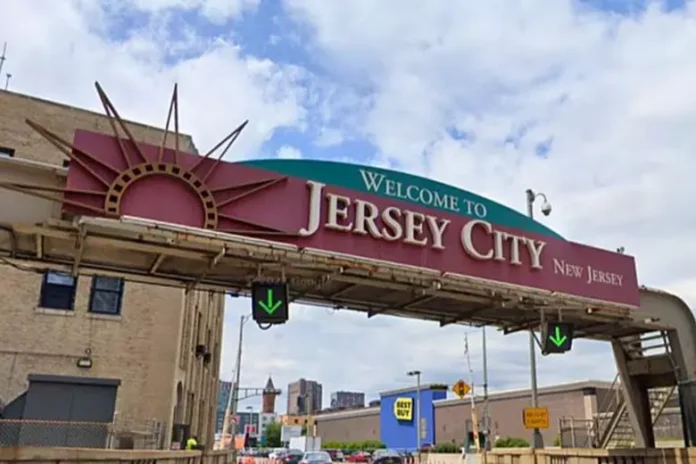

A million dollars doesn’t buy a single tower in Jersey City anymore. It’s buying something arguably more valuable right now, the soul of the neighborhoods sitting underneath all that new construction, and the Exchange Place Alliance is the one spending it.
The organization, a special improvement district with a mandate that’s quietly outgrown the typical SID playbook, is rolling out a fresh wave of projects across the city, and the scope of it caught my attention immediately. This isn’t the usual sidewalk cleaning and holiday lights operation most improvement districts run. EPA’s rehabilitating the iconic Welcome to Jersey City sign downtown, adding new public art installations at Exchange Place, restoring the Cathedral of Oviedo sculpture, and pushing forward a full beautification effort outside City Hall, all at once, all while continuing the monument conservation work that’s already become something of a signature for the group.
That City Hall relationship matters more than it might look on paper. After EPA successfully restored the Soldiers and Sailors monument last year, something shifted in how the city and the Alliance work together. Mayor James Solomon called the partnership a genuine driver of investment in the public spaces that define the city, and honestly, that’s not the usual boilerplate mayoral quote you skim past. City government doesn’t typically hand this much cultural runway to a business improvement district, but Jersey City clearly likes what it’s seeing.
Part of why EPA can operate at this scale comes down to plain budget math. Executive Director Deidre Reynolds has pointed out that the Alliance’s budget runs roughly eight times larger than a typical local improvement district’s, and that kind of financial headroom changes what’s actually possible. Most SIDs are stretching dollars to keep streetlights working and trash cans emptied. EPA’s stretching dollars to fund actual restoration work led by conservator Jakki Godfrey of Boro 6 Art Conservation, the same team behind the earlier monument work, and to commission new sculpture. The current lineup of active restorations includes the Katyn Memorial, an obelisk, the 9/11 Memorial, the Philippine War Memorial bust, and the Korean War Memorial, on top of the previously completed Police Memorial restoration that earned considerable community goodwill when it wrapped. Individually, the newest restorations and art acquisitions are running close to $300,000 apiece, which tells you this isn’t small, symbolic patchwork. It’s real capital investment in things you can’t put a normal ROI calculation on.
Here’s my honest take on why that spending actually matters right now, not just as a nice gesture but as something close to necessary. Jersey City’s waterfront is in the middle of a genuinely staggering construction boom. More than ten thousand units are currently under construction citywide, and CoStar data cited in recent local reporting puts the waterfront pipeline alone at over 6,600 units, a 28 percent jump over existing inventory that reportedly makes it the tightest construction-to-inventory ratio of any multifamily submarket in the entire New York region. Developers like Tishman Speyer and Related aren’t circling this market by accident. They’re circling because the demand is real and the momentum is obvious.
But raw density isn’t the same thing as a place people actually want to live. Reynolds put it plainly, recalling that walking the waterfront fifteen years ago meant literally tripping over old railroad ties, remnants of an industrial past that hasn’t fully disappeared even as glass towers rise around it. That history doesn’t vanish just because a new building goes up next to it, and the Alliance seems to understand that better than most developers do. As Reynolds framed it, public art signals something specific about a place, that its community actually values a diverse cultural identity rather than treating every lot as interchangeable square footage. I think that’s exactly right, and it’s the piece most rapid-growth neighborhoods get wrong until it’s too late to fix cheaply.
The memorials themselves make that point better than any mission statement could. A Korean War Memorial standing near a Katyn Memorial honoring Polish victims, standing near a Philippine War Memorial bust, isn’t decorative coincidence. Meredith Burns, executive artistic director at Art House and a longtime collaborator on these efforts, described it as a direct reflection of the cultures that built Jersey City into what it is today, and argued those public spaces deserve real maintenance rather than slow, quiet neglect. Burns isn’t speaking as an outside consultant here either. Her family has lived in Jersey City for four generations, tracing back to Irish immigrant ancestors who worked the waterfront factories before most of that industry disappeared entirely. That’s not a small detail. It’s the difference between people managing a neighborhood’s change from a spreadsheet and people who’ve actually watched it happen across their own family history.
EPA isn’t stopping at restoration, either. The group plans to add up to four brand new public art installations, with two or three landing at 108 1st Street near the light rail stop, joining the Puppy Love and Convergence pieces unveiled there last year, and at least one more slated for a future park still a couple of years out. Alongside the sculpture walk expansion, the Alliance is refreshing existing installations like Labyrinth for Reflection and Generation of Love, pushing forward the Ice House Creative Center on Washington Street, and building what’s being called Morgan Park, a children’s park planned for the Powerhouse Arts District. Making room for that park meant relocating a community garden the Boys and Girls Club had maintained on the site, and EPA handled that relocation directly rather than just displacing it. There’s more on the horizon too, with Nathanael Greene Park, Morris Canal Park, and Colgate Clock Park all flagged for future attention, and Reynolds has talked about eventually partnering with the state to turn that land into genuinely functional green space rather than leaving it as an afterthought.
Board President Michael DeMarco summed up the philosophy behind all of it about as well as anyone could, saying public art gets overlooked far too often as a meaningful community benefit, and that changing that perception is exactly the point. I’d go a step further than that. In a neighborhood adding thousands of new units a year, the monuments, sculptures, and parks aren’t decoration competing for attention against the skyline. They’re the thing that keeps a rapidly rising skyline from turning into a placeless one, and Jersey City is lucky to have people this personally invested making sure that distinction doesn’t get lost in the construction dust.
















