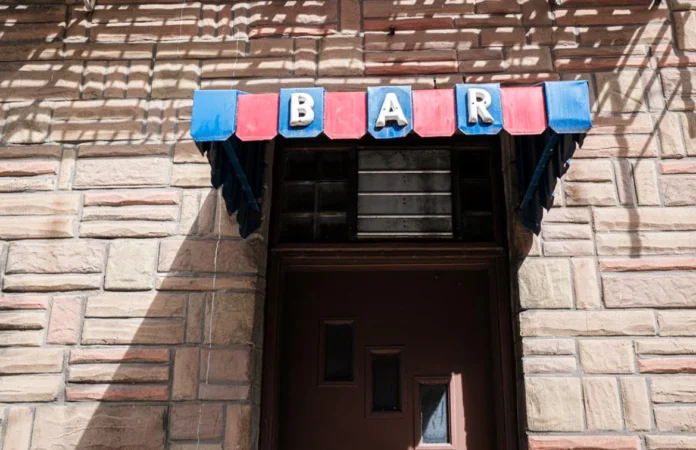

Seventy five years of history sat empty on Park Avenue for over ten years. Now, all that time is being put to a final end. On July 21, the Hoboken Zoning Board approved development plans for the site at 301-303 Park Avenue for the first time since its opening in 1949, and this time, the wrecking ball is finally coming.
For those unfamiliar with Mario’s Bar’s storied past, it was a cash-only, no-frills establishment that survived through decades of more fashionable bars rising and falling around it. Locals say that it’s known to have been a haunt for actor Mickey Rourke during his formative years in the 1980s before he exploded into a major Hollywood star. It’s unclear what if anything of this is actually true, but few would argue that its mystique has helped it survive in this location for so long. As of 2014, the bar was shuttered for good and sold to a family member in 2016, who subsequently moved on with a complicated ownership and planning history for the parcel. It was bought by a Brooklyn-based developer in June of this year, 2023, who moved through a chain of approvals that had begun in 2018. Those approvals, finalized in 2022, would have seen the current owners maintain the bar as is, while adding on a large expansion to 303 Park Avenue that would have seen four large apartments built on top of the existing building. This latest plan has come from a different owner, Arbat Investments, which owns the property through an address in Hoboken, and has drawn on significantly different development goals for the site. The new proposed project, from MVMK Architecture and Design, would see the entire parcel razed and replaced with a four story residential building, with five apartments built atop roughly 1,000 square feet of ground floor retail space. There is an elevator, which is something of a necessity for a four story building that is likely to gain a significant number of elderly residents alongside families, and a shared courtyard built into the northeastern corner of the parcel for the residents on the upper floors to enjoy. The exterior walls are made of urban grey brick and cement board, with the latter being used extensively to give the appearance of a less flashy, and more grounded feel for the building’s potential residents. That doesn’t mean that the architecture firm doesn’t aim for style, because it does; this plan represents a subtle shift in the architectural landscape of Hoboken to a more “accessible,” modern style without sacrificing the feel of an old New Jersey building entirely.
The plan also required a significant number of variances to be approved by the Zoning Board in order to be implemented, including “d” variances for building height and density, and a number of “c” variances for building coverage, bulk, and rear yard and lower roof deck requirements, among other things. This is a surprisingly extensive list of variances to grant for a single site, and shows how much leeway the developer is asking for in order to realize this plan.
As for my own opinion on the matter, I can understand why a number of long-time residents of Hoboken would be dissapointed to see a local landmark such as Mario’s Bar go, especially in favor of a more generic development that few would argue has any particular charm or personality whatsoever, even with the addition of Mickey Rourke’s name to its legacy. However, there is also a significant amount to be said for a building that has stood empty for over ten years finally getting its due. Ten years of silence is far too long to wait for history to be forgotten, and ten years of sitting empty on Park Avenue is far too long to let pass when a building should be replaced. After all, commercial space along Park Avenue is something that Hoboken has long needed, and the return to retail in this building, albeit far smaller than the original, will help to preserve at least a fraction of that vital presence. Five new units built atop this former bar is also far from an insignificant addition to Hoboken’s housing stock either, especially one as constrained as its current market demands. It has already begun construction under the old development plans, and it is unclear exactly when the new construction is set to begin, much less when the demolition of the old building is set to occur. But when it does come, it will undoubtedly mark the end of an era and the quiet beginning of a new one.