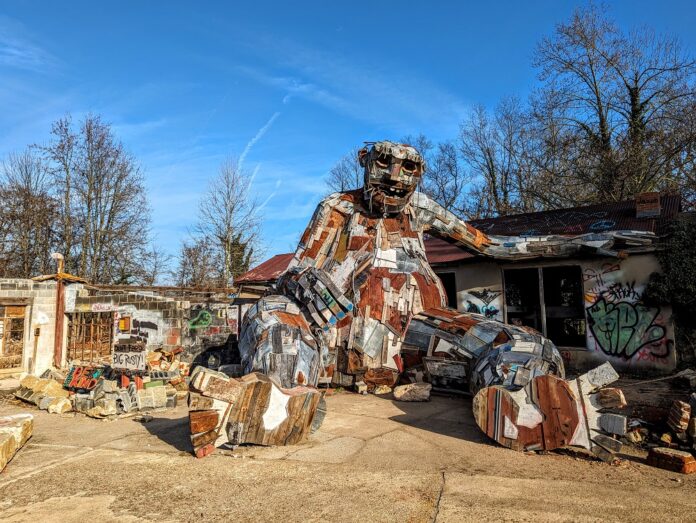

Hidden quietly within the woods of Burlington County beside the winding edges of the Rancocas Creek, a gigantic rust-colored troll now sits among the remnants of an abandoned industrial property, grinning mischievously as visitors emerge through the trees to encounter one of the most unusual public art installations anywhere in New Jersey. Towering roughly 20 feet high and constructed almost entirely from salvaged industrial debris, Big Rusty has rapidly evolved from a curious regional attraction into one of the most photographed, discussed, and symbolically powerful works of public environmental art in the state.
Located in Hainesport Township just off Route 38, Big Rusty is not simply a sculpture. She is a statement about waste, recycling, forgotten spaces, environmental responsibility, and the strange beauty that can emerge when discarded materials are transformed through imagination and artistic vision. Since her completion during the summer of 2023, the giant eco-troll has become a destination for photographers, families, environmental advocates, road-trip travelers, public art enthusiasts, and curious New Jersey explorers seeking something entirely different from the traditional museum experience.
The sculpture’s growing popularity also reflects a larger cultural shift happening throughout New Jersey, where immersive outdoor art experiences are increasingly becoming major tourism draws in their own right. Across the state, visitors are searching for artistic destinations that feel interactive, discoverable, visually dramatic, and deeply connected to place. Big Rusty embodies all of those qualities simultaneously while adding an unmistakable sense of myth, fantasy, and industrial surrealism to the surrounding South Jersey landscape.
The mastermind behind the project is internationally celebrated Danish artist Thomas Dambo, whose monumental recycled-material troll sculptures have become global cultural phenomena over the last decade. Known for constructing enormous troll installations from salvaged and discarded materials, Dambo has placed more than 120 giant sculptures across forests, parks, abandoned landscapes, and hidden outdoor settings throughout the world. His work intentionally blurs the line between environmental activism, fantasy storytelling, folk mythology, and large-scale sculptural engineering.
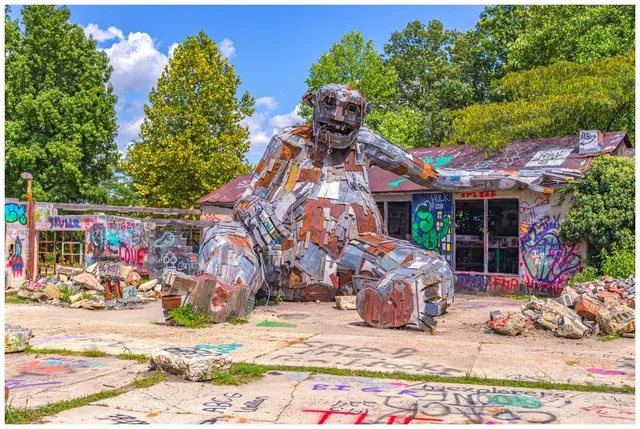
Big Rusty represents one of the most distinctive creations in Dambo’s entire international portfolio because of both her construction materials and her environment. While most of Dambo’s famous trolls are primarily built from reclaimed wood, Big Rusty relies heavily on salvaged industrial metal and debris harvested directly from the nearby abandoned Creek Turn Ceramic Supply factory where the sculpture now resides. The result gives the troll an entirely different visual identity from her global counterparts. Instead of appearing rustic or woodland-inspired, Big Rusty feels industrial, weathered, post-apocalyptic, and deeply intertwined with the history of the abandoned property itself.
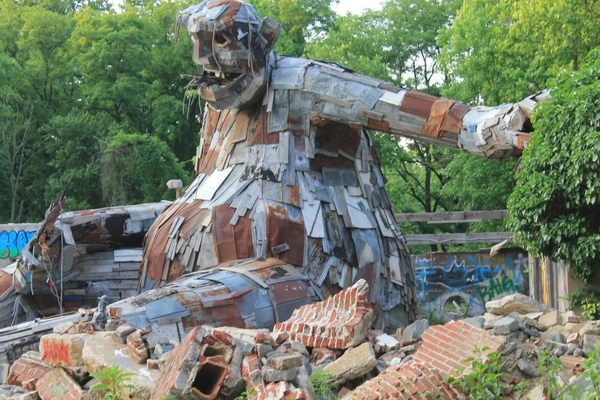
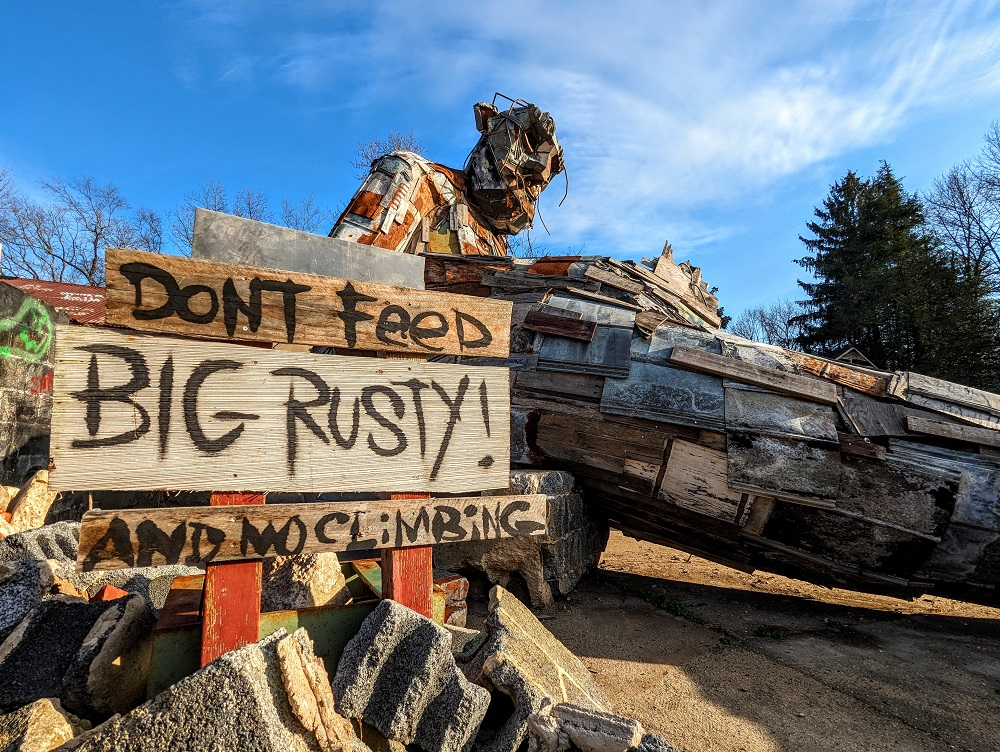
That connection is central to Dambo’s artistic philosophy. One of his defining creative principles is the phrase “you are what you eat,” meaning every troll should physically embody the materials and environmental history surrounding its location. Big Rusty follows that rule literally. Her massive body was assembled using over 100 square meters of rusted corrugated roofing, discarded plywood salvaged from factory attics, concrete fragments, drywall, broken pallets, rebar, wiring conduit, and countless pieces of abandoned industrial waste collected directly from the site.
Nothing about the sculpture feels artificially polished or detached from its environment. Big Rusty appears almost as though she emerged organically from the ruins themselves. Sitting casually against the graffiti-covered remains of the former factory, the troll leans backward with a giant toothy grin stretched across her face while tangled electrical wires hang from her mouth as though she has been feeding directly on the discarded debris surrounding her.
The imagery is intentionally unsettling while remaining playful enough to invite curiosity rather than fear. Dambo’s trolls often function simultaneously as whimsical fantasy creatures and environmental warnings, using humor and scale to encourage audiences to think differently about waste, pollution, and humanity’s relationship with the natural world. Big Rusty may appear friendly at first glance, but the symbolism beneath the sculpture is unmistakable.
A poetic plaque installed beside the troll reinforces that message with eerie simplicity: “For every piece of trash she eats, she grows so big and thick. So careful to not feed the beast, one day she might grow sick.” The wording transforms Big Rusty into a metaphor for environmental excess itself, suggesting that unchecked consumption and careless waste eventually create consequences too massive to ignore.
That layered storytelling helps explain why Big Rusty resonates far beyond traditional public art audiences. Visitors are not simply looking at a sculpture. They are stepping into a narrative environment where abandoned industrial history, environmental commentary, fantasy mythology, and immersive outdoor exploration all collide within a single experience.
The location itself contributes enormously to that atmosphere. Unlike conventional roadside attractions designed for instant visibility from highways or commercial districts, Big Rusty remains intentionally hidden from immediate view. Thomas Dambo strongly prefers installations that require visitors to physically engage with outdoor environments rather than simply observing artwork from parking lots or roadside overlooks. As a result, finding Big Rusty becomes part of the artistic experience itself.
Travelers heading eastbound along Route 38 in Hainesport must look carefully for a modest gravel drive located just beyond milepost 14. After parking near the entrance area, visitors continue down a short dirt trail weaving through wooded terrain before suddenly emerging into the clearing containing the abandoned factory ruins and the giant sculpture herself. That gradual reveal dramatically enhances the emotional impact of the installation. The moment Big Rusty finally appears among the industrial remains feels cinematic, unexpected, and strangely surreal.
The setting also reflects broader themes connected to adaptive reuse and environmental reclamation. Rather than demolishing every trace of the industrial property’s past, the site now exists in a transitional state where abandoned infrastructure, public art, environmental restoration, and future redevelopment coexist simultaneously. Big Rusty effectively transforms the former factory grounds into a new kind of cultural landscape where industrial decay becomes part of the artistic narrative rather than something hidden or erased.
The sculpture’s popularity has already produced significant ripple effects throughout Burlington County. Following the attention generated by Big Rusty’s installation, local leaders and arts advocates launched a broader “Troll Trek” initiative designed to expand public art experiences throughout regional parks and outdoor recreation spaces. Smaller companion sculptures and troll-inspired installations have since been discussed and developed as part of a growing effort to position the county as a destination for immersive environmental art tourism.
That development reflects a larger trend happening throughout New Jersey as municipalities increasingly recognize the economic and cultural power of large-scale public art installations. Once viewed primarily as decorative additions, ambitious outdoor sculptures are now functioning as tourism anchors capable of driving regional visitation, supporting local businesses, encouraging outdoor recreation, and strengthening community identity.
Big Rusty accomplishes all of those goals while also remaining deeply accessible. Unlike many large cultural institutions requiring admission fees, formal reservations, or structured programming, the troll exists freely within an open natural environment where visitors can experience the artwork on their own terms. Families, photographers, students, hikers, artists, and travelers all interact with the space differently, allowing the sculpture to operate simultaneously as landmark, conversation piece, educational tool, and recreational destination.
Photographers in particular have embraced the location because of the constantly changing environmental conditions surrounding the sculpture. Morning fog drifting through the woods, dramatic sunset lighting reflecting off the rusted metal surfaces, snowfall covering the industrial ruins, and overgrown summer vegetation all dramatically alter Big Rusty’s appearance throughout the year. Social media imagery from the site has helped accelerate the sculpture’s popularity, turning the troll into one of South Jersey’s fastest-growing visual landmarks.
Despite the playful atmosphere surrounding the installation, preservation concerns remain important. Because Big Rusty is built from salvaged materials and exposed continuously to outdoor weather conditions, visitors are strongly discouraged from climbing on the structure. The sculpture’s framework, while massive in scale, remains vulnerable to physical damage, particularly given the complex combination of reclaimed industrial materials used throughout the construction process.
The long-term future of the surrounding site also continues evolving as plans tied to the future Creek Turn Park development gradually move forward. As environmental restoration, public recreation, and cultural programming continue expanding in the area, Big Rusty increasingly appears positioned to become a permanent centerpiece within a larger regional arts and recreation corridor.
What makes the sculpture especially compelling within New Jersey’s cultural landscape is how completely unexpected it feels. Few visitors anticipate discovering a giant rust-covered troll hidden beside abandoned factory ruins in Burlington County. Yet that sense of surprise has always been part of New Jersey’s creative identity. Some of the state’s most memorable destinations emerge precisely because they defy expectations, blending art, history, landscape, eccentricity, and reinvention into experiences that feel impossible to duplicate anywhere else.
Big Rusty now belongs firmly within that tradition.
At a time when so much contemporary development feels polished, commercialized, and predictable, the giant troll beside the Rancocas Creek offers something refreshingly strange, imaginative, and emotionally resonant. She transforms discarded waste into art, forgotten industrial space into cultural destination, and environmental warning into public spectacle without sacrificing humor, accessibility, or visual wonder.
As more visitors continue making the trek through the woods to encounter her enormous grin rising from the abandoned ruins, Big Rusty is quickly becoming more than a public sculpture. She is evolving into one of New Jersey’s most unforgettable modern landmarks, proving that some of the state’s most powerful cultural experiences are still waiting quietly off the highway, hidden among the trees, rusting beautifully beside the water.