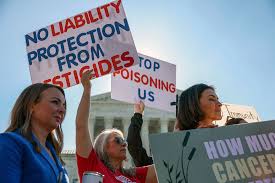

A major political and legal battle surrounding pesticides, public health, corporate accountability, and agricultural regulation intensified dramatically on April 30, 2026, when the U.S. House of Representatives voted to remove controversial liability protection language from the proposed Farm, Food, and National Security Act of 2026. The decision represented a significant setback for Bayer, the parent company of Monsanto, which had spent years lobbying aggressively for federal protections tied to its Roundup herbicide and the ongoing wave of cancer-related lawsuits connected to glyphosate exposure.
The amendment removing the provision passed by a bipartisan 280–142 vote, underscoring how politically volatile the issue has become nationally as public concern surrounding pesticides, food systems, environmental safety, and long-term health risks continues expanding across both rural and suburban communities. For Bayer, the defeat arrives at an especially dangerous moment. The company already faces enormous financial pressure tied to thousands of active lawsuits alleging that prolonged exposure to Roundup contributed to various forms of cancer, particularly non-Hodgkin lymphoma. At the same time, the broader national conversation surrounding food safety and chemical regulation has become increasingly politicized, emotionally charged, and impossible for lawmakers to ignore.
At the center of the conflict was a proposed provision that would have sharply limited the ability of individual states to require warning labels or pesticide disclosures that differ from language already approved by the Environmental Protection Agency. Supporters of the provision argued that allowing individual states to establish their own pesticide warning standards could create a fragmented regulatory landscape for agricultural producers and chemical manufacturers. Critics, however, viewed the language as a direct attempt to shield Bayer from mounting legal exposure while weakening the ability of states to respond independently to public health concerns.
That criticism ultimately gained traction across party lines.
The amendment to remove the protections was led by Representative Anna Paulina Luna, a Republican from Florida, alongside Representative Chellie Pingree, a Democrat from Maine. The unusual bipartisan coalition reflected the increasingly unpredictable political alliances forming around public health and agricultural policy. While debates surrounding farming regulations traditionally split along predictable industry-versus-environmental lines, the modern conversation has become significantly more complicated. Questions surrounding food systems, chemical exposure, chronic disease, and environmental accountability now intersect with broader concerns about government transparency, corporate influence, healthcare costs, and consumer trust.
Those dynamics have become especially visible through the growing influence of the “Make America Healthy Again” movement, commonly referred to as MAHA, which played a major role in mobilizing opposition to the Bayer-backed language. Supporters of the movement argued that the proposed liability protections prioritized corporate interests over public health while limiting the ability of states to enact stronger consumer protections if federal regulators failed to act aggressively enough.
The political optics surrounding the issue became difficult for lawmakers to ignore.
Cancer concerns tied to glyphosate have remained one of the most persistent legal and reputational crises facing Bayer since the company acquired Monsanto in 2018. What initially appeared to be a manageable litigation challenge evolved into one of the most expensive corporate legal battles in modern agricultural history. Bayer has already paid more than $11 billion in settlements related to Roundup lawsuits, and earlier this year the company proposed an additional $7.25 billion settlement designed to resolve tens of thousands of remaining claims.
Even after those massive payouts, however, approximately 60,000 active lawsuits remain unresolved.
That ongoing litigation pressure is now colliding with a potentially landmark Supreme Court case that could dramatically reshape the future of pesticide liability nationwide. In late April, the Supreme Court heard oral arguments in Monsanto v. Durnell, a case focused on whether federal pesticide labeling laws preempt state-level “failure to warn” claims involving glyphosate-based products. The case could ultimately determine whether companies like Bayer can continue facing lawsuits alleging insufficient health warnings even when their labels comply with federal EPA standards.
A ruling is expected sometime this summer, and its impact could extend far beyond Bayer alone.
The case is being watched intensely not only by chemical manufacturers but also by agricultural producers, public health advocates, environmental organizations, insurers, trial attorneys, and state regulators nationwide. Depending on the Court’s decision, the ruling could either strengthen corporate protections under federal labeling authority or reaffirm the ability of states and private plaintiffs to pursue independent legal action despite existing federal approvals.
For agricultural states like New Jersey, the broader implications are especially important.
New Jersey occupies a unique position within the national agricultural conversation. Although often overshadowed by larger farming states in the Midwest and South, New Jersey maintains one of the country’s most diverse agricultural economies, ranging from produce farms and nurseries to vineyards, equine operations, organic agriculture, and specialty crops. Questions involving pesticide regulation, environmental safety, and consumer trust directly affect both agricultural producers and suburban communities throughout the state.
At the same time, New Jersey has increasingly positioned itself within broader national discussions surrounding sustainability, food transparency, environmental stewardship, and public health oversight. The state’s agricultural identity is deeply tied not only to production but also to consumer-facing trust surrounding local farming, food sourcing, and environmental responsibility. As a result, national debates surrounding pesticide liability and chemical regulation resonate particularly strongly across New Jersey’s agricultural and suburban regions alike.
The congressional vote also reflects a larger shift occurring within American agriculture overall.
For decades, major chemical manufacturers operated within a regulatory environment largely defined by federal oversight agencies and scientific review processes that remained relatively insulated from broader public debate. Today, however, agricultural policy exists inside a far more visible cultural and political environment. Social media, public health activism, environmental movements, and increased consumer awareness have fundamentally altered how agricultural products, pesticides, herbicides, and food systems are discussed publicly.
That change has created enormous pressure not only on corporations but also on lawmakers.
Increasingly, elected officials are being forced to navigate competing demands between protecting agricultural productivity, supporting large-scale food systems, responding to health concerns, and maintaining public confidence in regulatory oversight. The Bayer liability debate exposed exactly how politically difficult those balancing acts have become.
The company’s failure to secure federal liability protections does not necessarily end the fight. Bayer has already succeeded in lobbying for similar protections at the state level in places such as Georgia and North Dakota, while comparable legislation remains under consideration elsewhere. But the House vote nevertheless represented a major symbolic defeat because it demonstrated that congressional support for broad federal shielding may be far weaker than the company anticipated.
And the timing could hardly be worse.
Public scrutiny surrounding food systems and chemical exposure continues intensifying nationally just as healthcare costs, chronic illness rates, and environmental anxieties remain central public concerns. Whether scientifically justified or not in every instance, public skepticism toward large corporations and regulatory agencies has become a defining feature of modern political life. That atmosphere makes it increasingly difficult for any company associated with health controversies to secure sweeping legal protections without substantial backlash.
For Bayer, the consequences now extend far beyond the courtroom.
The company remains locked in a battle over public perception, regulatory trust, financial liability, and long-term reputational survival. The congressional defeat may not immediately alter ongoing litigation, but it reinforces a larger reality becoming impossible to ignore: the national conversation surrounding pesticides, public health, and corporate accountability has fundamentally changed.
And lawmakers across the country are beginning to respond accordingly.