

More battles and skirmishes were fought in New Jersey during the American Revolution than in any of the other twelve original colonies. That is not a boast subject to interpretation or generous historical accounting — it is the documented military record of a state that, by virtue of its geographic position between the British military headquarters in New York City and the Continental Congress sitting in Philadelphia, became the most consistently contested territory in the war for independence. Washington crossed the Delaware not once but twice in the winter of 1776, and the victories he secured at Trenton and Princeton in those Ten Crucial Days in late December and early January are widely regarded by military historians as the turning point that saved a revolution that had been collapsing toward failure. The Battle of Monmouth, fought in scorching June heat in 1778, was one of the largest engagements of the entire war, involving more than 25,000 combatants. More than 90 separate military engagements unfolded across New Jersey’s counties during the war’s active years.
The federal government recognized New Jersey’s singular place in the Revolutionary War story in 2002, when Congress designated the Crossroads of the American Revolution as a National Heritage Area — the first National Heritage Area in the country dedicated specifically to the war for independence, and the first such designation in New Jersey’s history. The Crossroads Heritage Area encompasses 2,155 square miles of New Jersey across 213 municipalities in 14 counties, stretching from Passaic and Bergen in the north through Morris, Essex, Hudson, Union, Hunterdon, Somerset, Middlesex, Mercer, Monmouth, Burlington, and Camden to Gloucester in the south — a geographic footprint that covers the Delaware and Hudson valleys and the central corridor between them where the Continental Army and British forces were most intensely engaged from 1776 through 1778. The Crossroads of the American Revolution Association has managed the Heritage Area since 2006, working with Morristown National Historical Park and partners statewide to connect the people and places of New Jersey’s Revolutionary heritage to the residents of the communities where that history actually happened.
The story the Heritage Area tells is more complicated than the version most Americans carry with them from school history. The Revolution in New Jersey was not simply a conflict between patriot colonists and the British Crown — it was, as Crossroads documents explicitly, a civil war that divided families and neighbors in ways that left permanent marks on the communities the war moved through. New Jersey residents in 1776 were roughly evenly divided among those who supported independence, those who remained loyal to the Crown, and those who chose neutrality, a choice that often became untenable when armies arrived in a community and required residents to make their loyalties visible under pressure. Loyalists who chose the wrong side when the war’s balance shifted faced property seizure, social ostracism, and worse. Neutrals who attempted to supply both armies for survival faced the suspicion and retaliation of both. Enslaved people navigated a revolution whose stated ideals of liberty and self-government were, in the most fundamental sense, directly relevant to their own situation but whose outcomes did not extend to include them. Women managed households, farms, and businesses through extended periods of military occupation, foraging, and the practical disruptions that armies in transit impose on civilian life. These are the stories the Crossroads Heritage Area exists to tell — the story of the Revolution as a total social experience for the people who lived through it, not simply as a sequence of battles and political declarations.
Morris County is embedded in the center of that story in ways that the county’s own residents encounter regularly whether or not they are actively seeking Revolutionary history. Morristown National Historical Park, which preserves Washington’s winter encampment headquarters, is a federal facility of national historical significance located within minutes of the county courthouse at which Morris County Commissioners sit today. The Ford Mansion, where Washington lived and worked during the winter of 1779-80, is a structure whose physical dimensions and interior layout preserve the operational reality of what running a continental military campaign from a private house actually required. The Wick House, the Jockey Hollow encampment area where the Continental Army’s enlisted soldiers lived in log huts through one of the most brutal winters of the eighteenth century, is the other side of the same story — the rank-and-file of the revolution eating horses and shoe leather while their commander worked the diplomatic and logistical levers of a war that was, in the winter of 1779-80, not yet won.
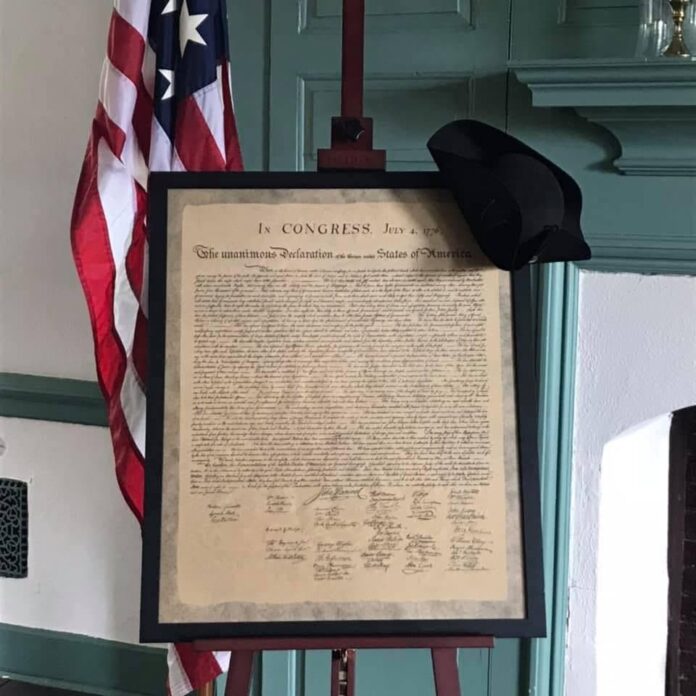
Against this backdrop of concentrated Revolutionary history, Morris County is hosting a public ceremony on July 8 that connects this specific place to a nationally synchronized observance of one of the founding era’s most consequential moments. On July 8, 1776 — exactly 250 years before this year’s event — the Declaration of Independence was read aloud to the public in the yard of what is now Independence Hall in Philadelphia. It was one of the document’s first public readings, and it occurred four days after the Continental Congress formally adopted the Declaration on July 4 — days during which printers worked through the night to produce copies that could be distributed to communities that had no other means of learning what the Congress had declared on their behalf. In the same city, later that same day, the Declaration was also read publicly in Trenton — making New Jersey one of the earliest sites outside Philadelphia to receive the founding document in the form of a public oral proclamation.
The Morris County event at 56 Washington Street, Morristown, on July 8 will take place on the front lawn of the historic Morris County Courthouse beginning at 5:45 p.m., with the reading commencing at exactly 6 p.m. — the same moment at which communities across all 50 states, Washington D.C., and the U.S. territories will participate in the nationwide Sharing the Spirit of America initiative. The ceremony will open with music performed by the Colonial Musketeers Senior Ancient Fife and Drum Corps of Hackettstown, one of New Jersey’s most active living history musical organizations whose period-accurate instrumentation places listeners in sonic contact with the musical world of the Continental Army era. Just before the 6 p.m. reading begins, the historic courthouse bell will ring thirteen times — once for each of the original colonies whose delegates voted for independence in Philadelphia in 1776.
The reading itself will be delivered by an assembly of Morris County’s elected officials and constitutional officers that represents the full span of the county’s governance: members of the Morris County Board of County Commissioners, County Prosecutor Robert J. Carroll, Sheriff James M. Gannon, County Clerk Ann F. Grossi, County Surrogate Heather J. Darling, and Superior Court Morris/Sussex Vicinage Assignment Judge Stuart A. Minkowitz will each read assigned portions of the document. That distribution of the reading across the elected and constitutional offices of county government is itself an appropriate civic choice: the Declaration of Independence is not simply a literary text or a historical artifact but a founding statement about the nature of legitimate governmental authority, and having it read by the actual officeholders of that government in the county where Washington himself kept his wartime headquarters gives the ceremony a civic dimension that a performance reading by actors or volunteers would not fully replicate.
Commissioner Director Stephen H. Shaw has framed the ceremony in terms that acknowledge both the specific community significance and the national context of the simultaneous readings happening across the country. By joining Americans across the country in reading the Declaration at the exact same moment, he said, the participants honor the principles of liberty and self-government that continue to unite the country two hundred and fifty years later. The simultaneous timing — 6 p.m. Eastern in New Jersey, adjusted for time zones across the country — is the ceremony’s most distinctive feature, creating the closest approximation available in 2026 to the experience of a nationwide public proclamation.
After the reading, the ceremony continues with activities that invite attendees deeper into the county’s specific historical record. The Morris County 250th Traveling Mural, which has been appearing at county events and locations throughout the anniversary year, will be on display on the courthouse grounds. Inside the courthouse itself, a special 250th anniversary exhibition traces the evolution of Morris County’s courthouse buildings from the colonial era through the present, highlights landmark trials that shaped New Jersey jurisprudence, and features historic artifacts, photographs, and interactive displays that illuminate the county’s legal history across two and a half centuries. Exhibits covering the history of the Morris County Sheriff’s Office add the law enforcement dimension of the county’s institutional story. Attendees will receive complimentary pocket Constitutions courtesy of the New Jersey State Bar Association — a small but substantive gesture connecting the Declaration being read outside to the governing document it helped make possible. Complimentary Bomb Pop frozen treats mark the occasion in the specifically American summer holiday way that connects a formal historical observance to the community gathering it is also meant to be.
The July 8 ceremony concludes Morris County’s Light to Unite campaign, a weeklong initiative that began July 2 and invited residents, businesses, schools, houses of worship, and local governments to illuminate their buildings in red, white, and blue in honor of America’s 250th anniversary. The campaign’s visual dimension — the way it transforms a community’s built environment into a collective statement — connects the individual household to the broader anniversary in a form that requires no special knowledge of Revolutionary history to participate in and that makes the anniversary visible across the county in a way no single event could achieve.
For residents of Morris County and the surrounding region, the July 8 ceremony at 56 Washington Street in Morristown is free, open to the public, and requires no registration. The event will be livestreamed on the Morris County Facebook page for those who cannot attend in person. Morris County officials have specifically encouraged municipalities, civic organizations, veteran halls, and other groups to organize their own synchronized readings across the county at 6 p.m. on the same date — extending the ceremony’s reach beyond the courthouse lawn and into the neighborhood and community-level settings where the Declaration’s original 1776 public readings were also received.
The Crossroads of the American Revolution National Heritage Area’s website, RevolutionaryNJ.org, maintains a comprehensive listing of Revolutionary War sites, programming events, and interpretive resources across all 14 Heritage Area counties for residents and visitors looking to extend their engagement with New Jersey’s Revolutionary history beyond this single ceremony. The RevolutionNJ events calendar includes programming across the state throughout 2026, from the Monmouth Battlefield 5K race series to the Washington Crossing at 250 reenactment planned for December. The summer of the 250th is, for New Jersey, not simply a national anniversary but the recognition of a specific and central historical role that the state itself can claim with more documentary and geographic evidence than almost any other.
















