
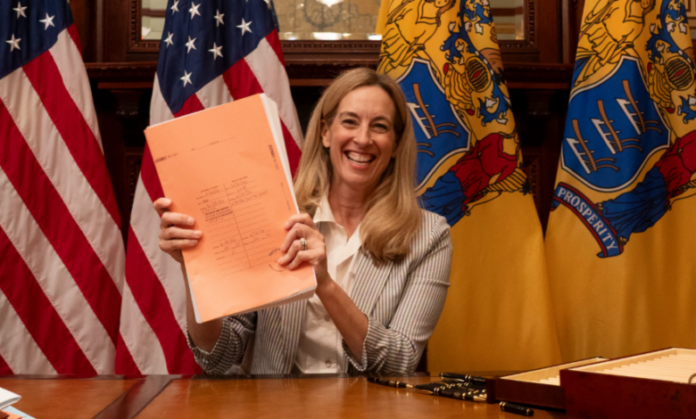

Governor Mikie Sherrill signed her first state budget into law on Tuesday night, meeting the June 30 constitutional deadline with hours to spare after the full Legislature passed the $60.75 billion fiscal year 2027 spending plan in votes that reflected the same partisan fault lines that had defined the budget’s entire negotiation arc. The Assembly approved the legislation 58 to 20. The Senate followed with a 26-to-14 vote. Democrats, who hold majorities in both chambers, provided all of the supporting votes. Republicans voted uniformly against a budget they characterized as too large, too secretive in its construction, and too reliant on new taxes that the state’s business and employer community had been publicly opposing since the plan’s March introduction.
Speaking at a Tuesday night news conference at the State House in Trenton, Sherrill framed the completed budget in terms that tracked directly with the language she had used throughout the fiscal year’s debate. “What we just passed today is an affordability budget, one that attacks the rising cost of housing, healthcare, utilities and property taxes,” she said, speaking directly to New Jersey residents in the kind of addressed-to-the-public framing that budget signings typically invite. “This budget runs toward our toughest problems, not away from them. It’s the most fiscally responsible budget passed in decades and invests in the priorities that matter most to working families.” The $60.75 billion final figure represents an essentially flat landing from her original March proposal of $60.7 billion — Senate Budget Chairman Paul Sarlo, whose committee shepherded the legislation through its final days, specifically noted in his floor statement that the final number matched the governor’s original proposal, crediting the collaborative process between Sherrill’s office and the Democrat-controlled Legislature for holding the total within the lines she had initially drawn.
The budget’s major priority investments — the ones Democrats cited most prominently during floor debate on Tuesday — include a full actuarially required pension payment at $7.3 billion, the continuation of the expanded Child Tax Credit, $12 billion in K-12 public school aid reflecting the full funding formula, and Medicaid coverage maintained for the 1.8 million New Jerseyans enrolled in NJ FamilyCare. The $6.5 billion surplus reserves, which represent more than 10 percent of the total budget, have been framed by the Sherrill administration and legislative Democrats as a deliberate defensive posture against a federal funding environment they regard as unstable and actively hostile to the social safety net programs New Jersey’s budget relies on, specifically Medicaid and SNAP. The StayNJ senior property tax relief program survived the process, though with an income eligibility threshold narrowed from $500,000 to $200,000, converting the program from a broad-based senior benefit into one more tightly concentrated on lower and middle-income retirees.
Senator Declan O’Scanlon, the Republican’s budget officer from the 13th District, delivered the minority’s formal counterargument from the Senate floor with the kind of comprehensive condemnation that signals a party in opposition that views the vote primarily as an opportunity to define the record rather than to persuade. “This budget fails in the categories the governor herself rightly laid out: affordability, transparency, pork, taxes, general gross unfairness,” O’Scanlon said. “It fails by any objective measure of success. It fails the people of New Jersey who are starving for someone to hear their pleas for relief and honesty, and it’s not a good sign of things to come.” He had earlier proposed an amendment that would have redirected $300 million he characterized as flowing to unexplained pork projects and reallocated those funds toward school funding and to restore grants for certain nonprofit service providers — an amendment that was voted down along party lines before the budget itself was approved. O’Scanlon explicitly called on every member of the chamber to vote against the budget, though the outcome was not in genuine doubt.
The main appropriations act — Assembly Bill 5327, Senate Bill 2027 — was not the only piece of legislation advanced through the Legislature during Tuesday’s final budget session. Democrats also passed a companion supplemental appropriations bill, Assembly Bill 5326, that carried a total value of $358,811,000 in new spending beyond the primary budget document. This supplemental bill became the day’s more combustible political flashpoint, drawing more pointed, specific criticism from Republican members than the main budget bill itself produced. The supplemental is described in official communications as a collection of aid and investments primarily directed at municipalities and cities, but Republicans characterized it in considerably harsher terms — as a package of pork and political rewards for Democratic-aligned urban constituencies, structured in ways that the supplemental bill’s opponents argued circumvented the transparency norms that a year’s worth of formal budget appropriations processes are meant to enforce.
The supplemental’s most controversial single item is a loan package exceeding $100 million directed at Jersey City, which is confronting a municipal fiscal crisis that would, without state intervention, require a property tax increase that local officials have estimated at 31 percent. Governor Sherrill addressed the Jersey City provision directly in separate public statements, defending the assistance as a necessary intervention in a situation affecting hundreds of thousands of residents who would bear the direct cost of the tax increase through no fault of their own. The politics of Jersey City’s fiscal crisis are genuinely complex: the crisis is documented, its scale is not in dispute, and the consequences of allowing it to produce a 31 percent property tax increase — or the deeper service cuts that might accompany an attempt to close the gap without additional revenue — are real and immediate for ordinary Jersey City households. But the circumstances that produced the crisis, including years of documented reliance on one-time revenue sources and deferred obligations under the previous mayoral administration, have allowed Republican critics to characterize the state assistance as a reward for poor management rather than relief for affected residents.
Assemblywoman Victoria Flynn, a Republican from the 13th District, was direct in her assessment of the Jersey City provision and the municipality’s management track record. “They have demonstrated no effort to clean up their house,” Flynn said of Jersey City. “I don’t care how many monitors are put in there. They’re not going to change.” Assemblyman Gregory Myhre, a Republican from the 9th District, characterized the provision in terms that reflected the core Republican critique of the supplemental bill as a whole: “This isn’t state aid. It’s a taxpayer funded reward for fiscal malfeasance.” The characterizations drew a sharp response from the Democratic side of the aisle. Assemblyman Gary Schaer, a Democrat from the 36th District, chastised Republican members for what he described as naivete about how majority governance works — noting without particular apology that Democrats control the legislative process and that support for cities in difficult circumstances is a natural expression of that majority’s priorities. Assemblywoman Carmen Morales, a Democrat from the 29th District, defended the supplemental on substantive grounds, arguing that the legislation funds the services that New Jersey families rely on every single day. Assemblywoman Katie Brennan, a Democrat who represents Jersey City in the 32nd District, put the most concrete number on the stakes: without the state assistance, she said, the property tax increase in Jersey City would reach 31 percent — a figure that captures the specific, household-level consequence the provision is designed to prevent.
Among the other allocations in the supplemental bill is $5 million designated for a recreation center in Wood-Ridge — a Bergen County municipality whose significance to the supplemental discussion lies in the identity of its sitting mayor: Paul Sarlo, the same senator who chairs the Senate Budget and Appropriations Committee and who played a central role in constructing and advancing both the main budget and the supplemental package. The Wood-Ridge allocation drew attention from critics precisely because of that overlap, though it is the kind of provision that appears in supplemental spending bills across administrations and under both parties, the traditional mechanism through which legislative leaders secure support and direct resources toward specific local priorities within their own districts and constituencies.
Governor Sherrill, in framing the completed budget at Tuesday’s signing news conference, situated the document within both its immediate fiscal challenges and its longer horizon of intent. The structural deficit inherited from prior administrations, the threat of federal funding cuts to programs New Jersey depends on, and the affordability pressures that New Jersey households have described consistently across polling and public comment throughout this budget cycle — these are the problems the governor argued Tuesday’s signing addressed, imperfectly and under constraints, but with the fiscal discipline that a $6.5 billion surplus and a flat total relative to the March proposal represents. Whether the business community, Republican critics, and the many New Jersey residents who will feel the budget’s specific tradeoffs — the narrowed StayNJ eligibility, the new corporate tax measures, the supplemental spending that arrived at the last hour — share that assessment is a question Tuesday’s vote settled procedurally but not politically. The fiscal year 2027 spending plan is now law. The debate about what it represents for New Jersey’s economic future, its tax climate, and the competitiveness of its government’s basic finances will continue well past the signature it received Tuesday night.
















