
The geography of LGBTQ+ visibility in New Jersey has never been evenly distributed, and the distance between what that community looks like in the state’s most celebrated queer destinations and what it looks like in the state’s more rural, politically conservative southern counties is wide enough to constitute a genuinely different experiential reality for the residents living on either side of it. Asbury Park has been a nationally recognized queer sanctuary for decades, its boardwalk and bar scene drawing LGBTQ+ visitors from across the country who come specifically for the concentrated, unself-conscious visibility that the city offers. Lambertville, set along the Delaware River in Hunterdon County, has built a comparable reputation as one of the most welcoming small towns in the northeast for gay and lesbian couples looking to settle in a community where their presence is not simply tolerated but structurally welcomed. These communities exist, and they matter enormously to the people who live in or visit them. They are also not Salem County. They are not the rural, agricultural, politically conservative South Jersey region where, until very recently, there was essentially no dedicated infrastructure of any kind — no gay bar, no community center, no regular public event — to give LGBTQ+ residents a physical expression of their own visibility in the community where they live.
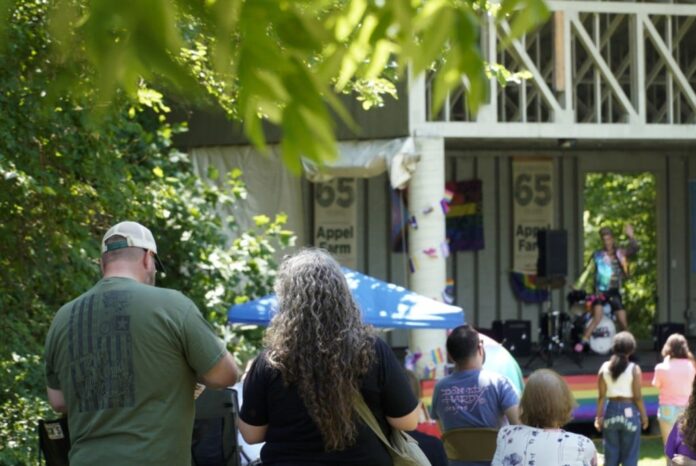
That reality has not meant that LGBTQ+ people are absent from Salem County and the surrounding southern counties of New Jersey. It has simply meant that their existence has been largely invisible to the surrounding community in the specific way that physical absence from public life produces — the kind of invisibility that accumulates not through any single deliberate act of exclusion but through the accumulated weight of a community that has never, within recent memory, organized a public gathering around their identity and presence. Salem County Pride+, the nonprofit organization that has been working for several years to build the local LGBTQ+ infrastructure that the county lacks, is the organization that decided to confront that accumulated invisibility directly. On June 20, 2026, at the Appel Farm Arts and Music Center at 457 Shirley Road in Elmer, it did.
The event was called South Jersey PrideFest, and it represented a deliberate expansion of scope from the smaller, county-specific events Salem County Pride+ had organized in prior years. By moving to Appel Farm — a well-established arts and music destination in Salem County with the physical space and community reputation to accommodate a regional gathering — and rebranding from a county-specific event to one explicitly inviting LGBTQ+ organizations and community members from across the broader South Jersey region, the organizers were making a public statement about scale: that the LGBTQ+ community in this part of New Jersey was large enough, and the need for a shared visible gathering was significant enough, to build something bigger than any single county’s organizing capacity could sustain on its own. The event featured live music from local bands, food trucks, vendors, and a curated selection of community organizations and resource partners — the standard architecture of an outdoor Pride festival, deployed here in a geographic context where even the standard architecture represented something that had never previously existed.
What actually happened at Appel Farm on June 20th exceeded what the organizers publicly admitted they had expected. The crowd reached nearly 1,000 attendees — a number that, in a rural county with a total population of roughly 64,000, represents a level of community response that would be remarkable for any single-day event of any kind, let alone one organized around an identity that the surrounding political and social culture has not historically centered or welcomed. The fundraising dimension of the event was equally striking: according to reporting by NJ Spotlight News and NJ Urban News, between 80 and 85 percent of the festival’s funding came from local small businesses. That figure is worth dwelling on, because it describes a business community that chose, in a county where local Republican political leadership has tended toward conservatism on social issues, to put financial support behind an explicitly LGBTQ+ community event. Whatever the specific motivations behind each individual sponsorship decision — solidarity, economic calculation, genuine community investment, or some combination of all three — the aggregate result was a funding base that demonstrates the region’s small business ecosystem was considerably more willing to associate itself publicly with LGBTQ+ Pride programming than the county’s political environment might have suggested to outside observers.
The festival’s organizers made one structural programming decision that set the South Jersey PrideFest apart from many comparable events in more established queer communities, and that decision reflects something specific about the particular challenges of LGBTQ+ life in rural New Jersey. The layout of the event was deliberate: the flow of foot traffic was designed so that attendees moving through the festival grounds encountered mental health resources, faith community representatives, and medical professionals before they reached commercial vendor booths. That sequencing was not accidental. In a region where LGBTQ+ residents may have limited access to healthcare providers who are knowledgeable about or affirming of their specific healthcare needs, where mental health resources that are explicitly LGBTQ+-informed are scarce or nonexistent, and where the question of whether a faith community is a source of support or a source of pain is a genuinely contested one for many queer people navigating southern New Jersey’s religious landscape, ensuring that attendees physically moved through those resources on their way to the festival’s more commercial offerings was a statement about what the organizing team believed the event’s primary purpose should be. Celebration matters, and the South Jersey PrideFest was clearly a celebration by any measure. But the organizers understood that for many of the people who would attend, this was potentially the first time in their community that they had seen mental health providers, medical professionals, and religious leaders presenting themselves as specifically affirming and available — and that making that encounter an unavoidable part of the festival experience was more important than optimizing the flow toward food trucks and merchandise.
The coverage generated by the event’s success, published jointly by NJ Spotlight News and NJ Urban News, situates the South Jersey PrideFest within a broader and more complicated national context in which the arc of LGBTQ+ acceptance has not been uniformly positive in recent years. National polling has shown what advocates describe as a measurable softening in broad public acceptance of LGBTQ+ rights across several demographic categories, and the political environment at the federal level has produced policy changes and rhetorical shifts that LGBTQ+ advocacy organizations consider directly hostile to the communities they serve. In that context, activists working in South Jersey have articulated a view of the South Jersey PrideFest that goes beyond its community-building function and into something closer to a political act — not in the partisan sense, but in the sense that choosing to make your existence joyfully and peacefully visible in a public space where that visibility has historically been absent is itself a form of resistance that produces real consequences for real people’s sense of safety and belonging. A queer teenager in Salem County who attended the June 20th festival and saw nearly 1,000 people gathered in their county under a rainbow banner, funded by local businesses they recognize, in a setting as established and community-affirming as Appel Farm, experienced something categorically different from what prior generations of LGBTQ+ residents in the same county experienced in their own youth. That difference is not a policy change. It is not a legal protection. It is an experiential shift in what a young person can believe is possible in the community they grew up in, and the research on how such shifts affect long-term health outcomes for LGBTQ+ youth is consistent and clear.
Salem County Pride+ was founded as a 501(c)(3) nonprofit organization with a mission built around providing support, resources, and representation for the LGBTQIA+ community across Salem County. Its programming has extended well beyond the annual festival to include regular community meetings, scholarship funding for graduating LGBTQIA+ high school seniors and allied students heading into college or trade school, community yoga programming, and regular community events designed to create the kind of recurring gathering infrastructure that LGBTQ+ community life in more established urban and suburban queer communities takes for granted. The scholarship program in particular reflects the organization’s understanding that material investment in the next generation is as important as the visibility work that a Pride festival provides: six scholarships to graduating seniors from Salem County high schools, awarded based on leadership, compassion, and commitment to building a more inclusive community, represents a tangible commitment to the young people who will decide, year after year, whether their future lies in Salem County or somewhere else.
The South Jersey PrideFest drew nearly 1,000 attendees to a rural arts center in one of the most politically conservative counties in New Jersey. Local small businesses funded the overwhelming majority of its operating costs. The organizers structured the festival itself as a resource-access event as much as a celebration, ensuring that mental health professionals and medical experts were among the first presences attendees encountered. And the reporting that emerged from the event has placed Salem County Pride+’s work in the context of a broader state and national conversation about where LGBTQ+ visibility exists, where it does not, and what it costs the people living without it. These are not small things. For a community that has spent years organizing in a county without gay bars, without community centers, without any regular public gathering space for queer residents, a crowd of nearly 1,000 people at Appel Farm in Elmer, New Jersey, represents exactly the kind of evidence that local organizing matters — and that the geographic gaps in New Jersey’s LGBTQ+ infrastructure are not fixed natural conditions but human-made realities that human effort can change.