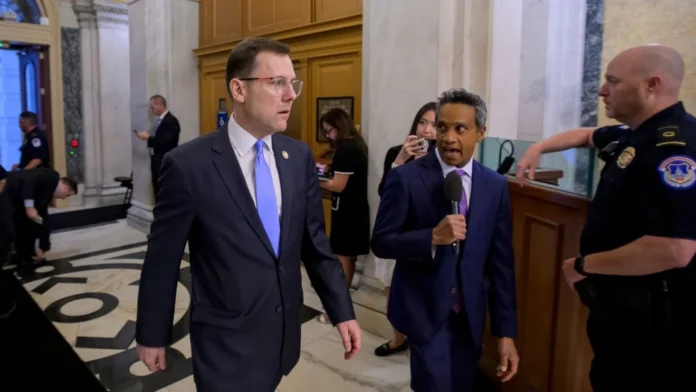

U.S. Representative Tom Kean Jr., a New Jersey Republican whose extended absence from Congress had fueled months of speculation in Washington, returned to the House floor on June 30, 2026, delivering a rare and deeply personal explanation for his time away: a severe clinical depression diagnosis that required a 142-day hospitalization and structured treatment. The disclosure immediately reshaped both the political and human dimensions of his absence, transforming what had been a procedural mystery into one of the most closely watched mental health disclosures by a sitting member of Congress in recent years.
Kean’s return arrives at a moment when mental health in public life has become an increasingly visible and contested subject, particularly among elected officials balancing high-pressure legislative responsibilities with personal medical crises. His remarks, delivered from the House floor, marked a deliberate effort to clarify not only why he had been absent since early March, but also to challenge prevailing misconceptions about the nature of clinical depression itself. He described the condition not as a temporary emotional state, but as a severe, physically and psychologically disabling illness that required intensive treatment and medical supervision.
In his address, Kean emphasized that recovery depended on clinical care rather than willpower alone, and he framed the experience as one that underscored the importance of seeking help without stigma. His central message, repeated in different forms throughout the speech, was that depression is not synonymous with sadness and should not be reduced to a matter of personal resilience. The remarks were delivered with an emphasis on transparency, particularly regarding the need to acknowledge serious illness as part of public life rather than conceal it.
The response across political and advocacy circles was immediate and sharply divided along two distinct lines, reflecting broader national tensions over how personal health intersects with public accountability in elected office.
Among mental health professionals, patient advocates, and a number of lawmakers, Kean’s disclosure was viewed as a significant moment in destigmatizing psychiatric hospitalization at the highest levels of government. Advocates pointed to the rarity of elected officials describing inpatient treatment in such direct terms, particularly over an extended period involving more than four months away from legislative duties. The openness, they argued, provided a public example of clinical depression as a medical condition requiring structured intervention rather than informal coping mechanisms.
Some of Kean’s colleagues in Congress, particularly those who have publicly discussed their own mental health struggles, expressed solidarity. Lawmakers such as Representative Ritchie Torres of New York and Senator John Fetterman of Pennsylvania, both of whom have previously acknowledged treatment for depression, were cited among those offering support and emphasizing the importance of normalizing treatment within institutional environments. Their reactions underscored a growing awareness in Washington that mental health conditions do not exist outside the responsibilities of public office, but within them.
At the same time, Kean’s revelation reignited a separate and more politically charged debate centered on transparency, governance, and the expectations placed on elected officials during periods of incapacity. Critics argued that while medical privacy is a protected right, the absence of public communication over a 142-day period raised questions about legislative accountability, particularly in a narrowly divided House of Representatives where individual votes carry significant weight.
During Kean’s absence, more than 140 votes were recorded in the chamber, a detail that has become central to critiques from both Democratic opponents and some Republican colleagues. Among them, Representative Ritchie Torres argued that while mental health treatment must be respected and protected, public office requires a higher threshold of disclosure when prolonged absences affect legislative participation. The concern, as articulated by critics, is not the diagnosis itself but the absence of public acknowledgment during an active term in office.
Within his own party, reactions were more fragmented but no less pointed. Representative Lauren Boebert of Colorado publicly criticized the duration of the absence, framing it in stark political terms and questioning the lack of explanation during the period in which Kean was receiving treatment. Her remarks reflected a broader tension within Republican ranks over expectations of availability and communication, particularly at a time when the party holds a narrow governing margin in the House.
That internal division highlights the broader institutional challenge confronting Congress: how to reconcile legitimate medical privacy with the operational realities of governance in an era of narrow majorities and high legislative volatility. Kean’s absence, though medically justified in retrospect, became a point of political friction precisely because its scope and duration were unknown to colleagues and constituents during a critical stretch of legislative activity.
The political stakes are further amplified by the electoral landscape in New Jersey’s 7th Congressional District, which remains one of the most competitive districts in the state. Classified as a “toss-up” by nonpartisan analysts, the district is expected to be a central battleground in the upcoming general election. Kean’s Democratic challenger, Rebecca Bennett, is positioning the race as one focused on accountability, governance, and public trust, themes that have gained new relevance in the wake of his disclosure.
At the same time, the revelation of a prolonged medical hospitalization introduces a different dimension into the campaign narrative. Voters are now confronted with competing interpretations: one centered on transparency and legislative responsibility, and another focused on empathy, medical privacy, and the realities of severe mental illness. The intersection of those themes is likely to define the trajectory of the race as both candidates navigate a rapidly evolving political context.
Beyond immediate electoral considerations, Kean’s remarks contribute to a broader national conversation about how mental health is understood within systems of power. In recent years, public figures across government, sports, and entertainment have increasingly spoken openly about depression, anxiety, and inpatient treatment. However, disclosures from sitting members of Congress remain comparatively rare, particularly when they involve extended absences and direct impacts on legislative participation.
What distinguishes Kean’s case is not only the duration of his absence but the explicit framing of depression as a condition requiring hospitalization. That detail places the discussion firmly within the realm of acute clinical care rather than outpatient treatment or intermittent leave, shifting public perception of mental health away from abstraction and toward the realities of medical intervention.
As Kean returns to legislative duties, the long-term implications of his disclosure remain uncertain. It may influence future expectations around transparency standards in Congress, particularly regarding extended medical absences. It may also contribute to evolving norms around how elected officials communicate personal health challenges to the public while balancing privacy rights and institutional responsibilities.
For now, the immediate impact is unmistakable: a moment of personal vulnerability has become a focal point in national political discourse, forcing a renewed examination of how mental illness is experienced, disclosed, and interpreted within the highest levels of American government. In doing so, it has placed New Jersey once again at the center of a debate that extends far beyond state lines, touching on questions of leadership, accountability, and the human condition behind public office.