
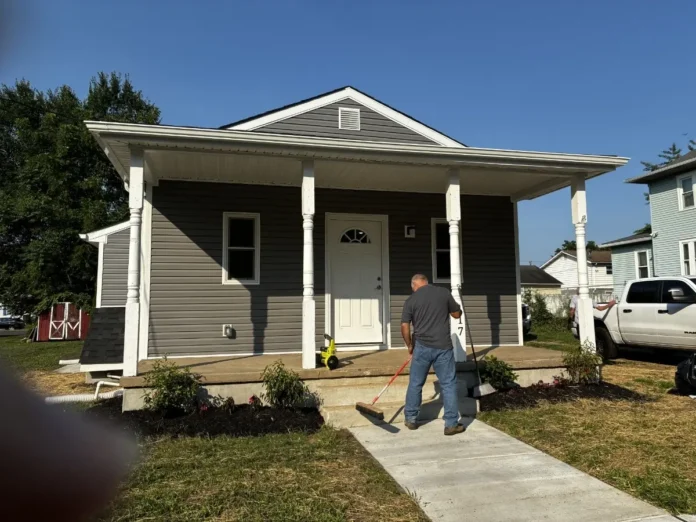

Cherry Hill Family Finds Stability Through Habitat for Humanity Home Dedication as Community Volunteers Help Restore Long-Term Housing Security. In Cherry Hill, where housing demand and affordability continue to shape the region’s residential landscape, a quiet but significant milestone unfolded as Habitat for Humanity of South Central New Jersey formally dedicated a newly renovated home to a local mother and her three children. The moment marked more than the transfer of property. It represented the convergence of volunteer labor, municipal support, and personal resilience in a housing market where stability can often feel out of reach for working families navigating economic disruption and caregiving responsibilities.
The recipient of the home, Corinne Schulter, and her three sons, ages 13, 11, and 6, now begin a new chapter in a fully renovated single-story bungalow on the west side of Cherry Hill. The residence, once in need of substantial rehabilitation, has been transformed into a livable, long-term family home with expanded interior space and a private yard designed to give the children room to grow. For a family that previously endured years in a confined apartment setting, the shift represents not only improved living conditions but a structural change in daily life.
Schulter’s path to homeownership was shaped by a series of disruptions that reflect broader challenges faced by many households in New Jersey during and after the COVID-19 pandemic. During that period, her youngest son experienced a serious health crisis requiring sustained medical attention. The demands of frequent hospital visits and extended caregiving responsibilities ultimately led to the loss of her employment. Like many single parents navigating sudden instability, she faced the dual pressure of financial uncertainty and ongoing family medical needs.
Her eventual return to stability came through remote work in the insurance sector, a transition that allowed her to rebuild income while maintaining flexibility for her family’s needs. That shift proved pivotal in meeting the eligibility requirements for Habitat for Humanity’s homeownership program, which emphasizes both financial readiness and a demonstrated commitment to long-term stability through structured participation in the building process.
The Cherry Hill project itself was carried out by Habitat for Humanity of South Central New Jersey, an organization that has long operated at the intersection of housing development and community volunteerism. The organization’s model relies on a combination of professional oversight and volunteer construction labor, allowing local residents, tradespeople, civic groups, and faith-based organizations to contribute directly to the creation of affordable housing.
In this case, hundreds of volunteers participated in the renovation process, contributing time, skill, and physical labor to transform the bungalow into a safe and functional home. Their work included structural updates, interior improvements, and exterior enhancements designed to extend the home’s lifespan while improving energy efficiency and livability. The result reflects a broader trend in nonprofit housing development, where community engagement plays an increasingly central role in addressing affordability gaps that persist across suburban New Jersey.
Cherry Hill Township officials also played a visible role in supporting the project, underscoring the importance of local government involvement in housing initiatives that extend beyond zoning and planning discussions. Township community development services collaborated with Habitat for Humanity throughout the process, ensuring that the renovation aligned with local housing standards and neighborhood expectations. At the dedication ceremony, officials including Council Member DiRenzo, Commissioner Bianco Bezich, and members of township staff joined volunteers and Habitat representatives to formally welcome the family into their new home.
The atmosphere of the ceremony reflected a blend of civic formality and personal significance. On a bright Tuesday morning, the transfer of ownership was marked not only by speeches and acknowledgments but by the visible presence of the community members who had contributed to the project’s completion. For those involved in the construction process, the event represented the conclusion of months of coordinated effort. For the Schulter family, it signaled the beginning of a more stable and predictable chapter of life.
Habitat for Humanity’s model requires partner families to contribute sweat equity hours alongside volunteers, reinforcing the principle that homeownership is both earned and supported through collective effort. This structure has become a defining feature of the organization’s work nationwide, blending philanthropy with participation in a way that distinguishes it from traditional housing assistance programs. In Cherry Hill, that approach has allowed families who might otherwise remain locked out of the housing market to build a pathway toward long-term stability.
The renovated bungalow itself reflects the organization’s emphasis on practical design and durable construction. Single-story layouts are often prioritized for families with young children, offering accessibility and safer navigation of interior spaces. In this case, the addition of a private yard further extends the livable environment beyond the home’s interior, providing children with outdoor space that was previously unavailable in their former housing situation. For families transitioning from apartment living, such changes can significantly alter daily routines, from study habits to recreation and family interaction.
Beyond the physical structure, the significance of the home lies in the stability it provides. Housing insecurity often carries secondary effects on education, health, and employment, particularly for children who experience frequent disruptions in living arrangements. By securing a permanent residence in Cherry Hill, the Schulter family gains continuity in school enrollment, access to community resources, and a foundation for long-term planning that was previously difficult to maintain.
The broader context of this dedication reflects ongoing pressures in New Jersey’s housing landscape, where affordability remains a persistent concern for working families. Municipalities across the state continue to explore partnerships with nonprofit organizations as a means of expanding access to homeownership without placing additional strain on local housing inventories. Habitat for Humanity projects, in particular, have become a visible example of how public-private cooperation can translate into tangible outcomes for individual households.
In Cherry Hill, that cooperation is evident not only in completed projects but in the sustained engagement of volunteers who return repeatedly to support construction efforts. Many participants are drawn from surrounding communities, including skilled tradespeople who donate professional expertise alongside residents contributing general labor. This blend of skill sets allows projects to move forward efficiently while fostering a sense of shared investment in the outcome.
For the Schulter family, the impact of that collective effort is now measured in daily life rather than construction milestones. The transition from a constrained apartment environment to a renovated home with dedicated space for each child represents a fundamental shift in living conditions. It also provides a framework for stability that supports both immediate needs and long-term aspirations.
As the ceremony concluded, attention turned from the past months of construction to the future unfolding inside the home itself. The dedication of a Habitat for Humanity property is never solely about architecture or renovation timelines. It is about the reconfiguration of possibility for a family that has moved through hardship and emerged with a renewed sense of permanence.
In Cherry Hill, that permanence now has an address, a front door, and a yard where three children can grow with the assurance that they are no longer in transition, but at home.
















