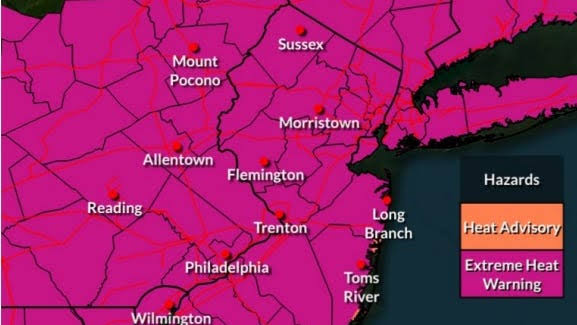

The National Weather Service’s Excessive Heat Warning remains in effect across New Jersey as the state enters one of the most meteorologically hostile Fourth of July weekends in recent memory — a convergence of extreme heat, dangerous humidity, a multi-day air quality alert affecting all of Essex County and much of the urban corridor, and the developing thunderstorm threat that meteorologists have been warning about since the heat dome settled over the Mid-Atlantic earlier this week. For residents planning outdoor activities, fireworks viewing, or any activity that requires sustained time outside between now and Sunday evening, understanding what the next 72 hours actually look like — hour by hour, day by day — is the difference between a holiday weekend that is uncomfortable but manageable and one that presents genuine health and safety risk.
Hourly Forecast for Today (Friday, July 3)
| Hour | Sky Condition | Temperature | Chance of Rain |
|---|---|---|---|
| 11 AM | 97°F (Feels like 109°F) | 0% | |
| 1 PM | 100°F (Feels like 112°F) | 0% | |
| 3 PM | 102°F (Feels like 115°F) | 0% | |
| 5 PM | 101°F (Feels like 113°F) | 15% | |
| 7 PM | 94°F (Feels like 103°F) | 25% | |
| 9 PM | 86°F (Feels like 92°F) | 15% | |
| 11 PM | 82°F | 0% |
4-Day Extended Outlook
- Saturday, July 4 (Independence Day): High 98°F / Low 74°F. A high UV index of 9 with daytime heat continuing, followed by severe scattered afternoon and PM thunderstorms (45% daytime, jumping to a 75% chance at night) that could disrupt evening fireworks.
- Sunday, July 5: High 88°F / Low 73°F. The severe heat breaks slightly but stays highly humid. Expect scattered thunderstorms throughout the day with a 75% chance of rain by evening.
- Monday, July 6: High 80°F / Low 73°F. Mostly cloudy and much cooler, but a very wet day with an 85% chance of heavy thunderstorms and rain.
- Tuesday, July 7: High 84°F / Low 73°F. A mix of sun and clouds with a 75% lingering chance of scattered daytime thunderstorms.
The peak of the current heat event is occurring now. Friday, July 3rd is posting the highest measured temperatures of the week, with actual air temperatures reaching near 100 degrees or above across most inland New Jersey locations and remaining in the upper 80s to near 90 degrees even along the immediate coastline where Atlantic sea breezes have provided some modest relief. The heat index — the combined perceived temperature produced by the interaction of heat and humidity — has been climbing into the 109 to 115 degree range during peak afternoon hours, a level the National Weather Service classifies as extreme danger: heat stroke is possible with prolonged exposure, and vigorous activity outdoors is genuinely hazardous for anyone without full shade and continuous hydration. Overnight lows on Thursday and Friday nights have refused to fall below the 75 to 83 degree range, stripping away the body’s recovery window and producing the cumulative physiological stress that makes multi-day heat events more dangerous than a single extremely hot afternoon.
The sky conditions on Friday are mostly clear and hazy, which means maximum solar radiation reaching the surface, amplifying the heat index toward its highest values of the afternoon hours. The storm threat on Friday is isolated and relatively low probability — isolated showers and thunderstorms remain possible, particularly in the late afternoon and evening hours as daytime heating peaks, but the pattern on Friday leans toward a classic high-pressure suppressed environment where most areas see no rain at all. For anyone with outdoor plans on Friday, the elevated storm risk in the 5 to 9 p.m. window should be tracked on radar — not because storms are certain, but because an isolated cell that does develop in this thermodynamic environment, with atmospheric moisture and instability at levels associated with the ring of fire pattern that has defined the week’s large-scale meteorology, can produce damaging wind gusts and heavy downpours with relatively little advance warning.
Saturday, July 4th, is Independence Day and it is the day the storm threat escalates significantly. High temperatures Saturday will reach the 95 to 100 degree range for most New Jersey locations, with coastal areas receiving slightly more relief than in the preceding days as sea breezes hold temperatures closer to the lower end of that range. Saturday daytime conditions will begin sunny, but the afternoon and evening shift to scattered thunderstorms represents a genuine risk to outdoor Independence Day programming across the state. The probability of storms during the afternoon hours is estimated at approximately 45 percent, rising to 75 percent or higher through the evening hours as the cold front that is beginning to break down the heat dome generates its own severe weather before doing so. These are not minor summer pop-up storms in this atmospheric environment — the combination of extreme heat, high moisture, and the approaching frontal forcing creates conditions in which storm cells can organize quickly and produce damaging straight-line winds alongside heavy rainfall and lightning. Anyone with fireworks viewing plans for Saturday evening should have a specific plan that accounts for a 75 percent storm probability after dark: a location with weather shelter access, a clear go/no-go decision point before crowds assemble, and an exit strategy that does not depend on driving through potential severe thunderstorms.
Sunday, July 5th, continues the pattern of high heat without the dome’s full intensity and with the highest storm probability of the three-day stretch. High temperatures on Sunday are forecast in the mid-90s for most inland New Jersey areas and mid-to-upper 80s along the coastline — down from Friday and Saturday’s peak but still well above any comfortable baseline. The storm chances Sunday are broadly elevated across the full daytime period rather than confined to the afternoon peak, with a 75 percent chance of rain by evening. These storms are described by meteorologists tracking the pattern as capable of high winds, consistent with the tropical downpour and thunderstorm character that has defined the severe weather events associated with this heat pattern. The atmosphere will retain its instability and moisture through Sunday as the cold front completes its passage, and the unsettled conditions will continue into Sunday night before the pattern begins to meaningfully shift.
The relief that arrives Monday and through the following week is, by the meteorological description, genuinely dramatic by comparison to what the preceding days have produced. Highs returning to the 80s by Monday, with overnight lows dropping into the 50s and 60s as early as midweek, will produce conditions that the forecasting community is already describing with enthusiasm: the kind of lower humidity and moderate temperature combination that feels physically transformative after spending four to five days inside a heat dome. The contrast will be most noticeable to anyone who has had continuous outdoor exposure through the peak of the event.
For Newark specifically, the Fourth of July weekend carries a distinct additional public health concern beyond the heat itself. Mayor Ras J. Baraka and Department of Health and Community Wellness Director Ketlen Baptiste Alsbrook have issued a direct public advisory regarding an Air Quality Alert from the New Jersey Department of Environmental Protection that has been in effect since Thursday, July 2 and is expected to continue through 8 p.m. Sunday, July 5. The alert is driven by elevated ground-level ozone — the secondary air pollutant that forms when nitrogen oxides and volatile organic compounds react in the presence of sunlight and heat, a process that accelerates dramatically on hot, sunny days in urban environments like Newark’s. The current Air Quality Index is expected to reach 110, which the EPA classifies as unhealthy for sensitive groups.
Ground-level ozone at elevated concentrations is not a visible hazard but it produces documented physiological effects, particularly on respiratory tissues. Short-term ozone exposure can cause chest pain, coughing, throat irritation, and airway inflammation, and it can trigger asthma episodes, reduce lung function, and worsen existing heart and lung conditions. The populations the Newark health advisory specifically identifies as sensitive — those with heart or lung disease, older adults, young children, and people with asthma or other respiratory conditions — face genuinely elevated risk of adverse health effects from sustained outdoor exposure during this alert period, particularly combined with the physical exertion that many Fourth of July activities involve.
The specific protective measures Newark health officials are recommending during the air quality alert window reflect the severity of the combined ozone and heat conditions: staying indoors as much as possible with windows closed rather than opened, using air purifiers where available, and for anyone who must go outside during extended periods, wearing an N95 or KN95 mask to filter particulate matter and reduce ozone inhalation. The mask recommendation is particularly significant because ozone is a gas rather than a particulate and N95 masks do not filter gas-phase pollutants — but the broader respiratory protection they provide, combined with the reduction in time at risk that the indoor-first guidance implies, represents the most practical protective measure available outside of medical-grade respiratory equipment. Newark residents in the sensitive population categories should treat the indoor guidance as a genuine health directive rather than a precautionary suggestion during this specific window.
The simultaneous presence of an extreme heat warning and an elevated ozone air quality alert in the same metropolitan environment during the same holiday weekend creates a compounding risk environment that is worth naming directly. Heat causes people to breathe faster and more deeply — the respiratory rate increases as the body attempts to regulate its temperature — which increases the volume of outdoor air, including ozone-laden outdoor air, moving through the airways per unit of time. Physical exertion in the heat amplifies this effect further. The standard advice during ozone alerts to limit outdoor exercise is already more difficult to follow during a holiday weekend with outdoor celebrations planned, but the combination of extreme heat and elevated ozone makes that limitation more medically important rather than less.
The Excessive Heat Warning covers all 21 New Jersey counties and extends through the heat dome’s passage. Cooling centers remain open across the state — residents who lack working air conditioning or whose home cooling systems cannot maintain safe indoor temperatures against triple-digit outdoor readings can locate the nearest cooling center through NJ 2-1-1 by dialing 2-1-1 from any phone, or through the NJ 211 website. The guidance regarding children, pets, and other vulnerable individuals in parked vehicles remains in full effect and carries additional urgency in a weekend where temperature extremes make interior vehicle temperatures reach lethal levels within minutes.
For New Jersey residents navigating the July 4th weekend under these conditions, the decision framework is straightforward: prioritize shade, hydration, and access to cooling in every outdoor activity. Track live radar through the National Weather Service Philadelphia and Mount Holly regional bureau or through regional weather monitoring services to stay aware of storm timing relative to outdoor plans. Have a specific contingency for fireworks events given the 75 percent storm probability Saturday evening. Follow Newark’s additional air quality guidance if you live in or are visiting the city during the alert period. And know that Monday will feel like a different state. The heat dome that has made the first days of July so physically demanding is breaking up. The forecast through the holiday weekend is what it is — genuinely difficult — but it has a specific, near-term endpoint.