
General Manager Sunny Mehta arrived at the opening of NHL free agency on July 1 with a clear hierarchy of priorities and, by the time the first day had concluded, had addressed the top of that hierarchy in decisive fashion while simultaneously deploying one of the most aggressive and tactically interesting moves in the league on the same afternoon. The headline was the announcement every Devils observer had been anticipating since the final weeks of the regular season: Nico Hischier, the franchise captain and the organizational cornerstone around whom every significant decision in the New Jersey roster will be made for the foreseeable future, agreed to a five-year contract extension carrying an average annual value of $11.7 million per season — a $58.5 million total commitment that keeps the Swiss center in New Jersey through the 2031-32 season and, crucially, answers a question that had been hanging over the franchise’s entire offseason planning process.
Equally consequential, though of a different and more unpredictable character, was the Devils’ decision to file an offer sheet for Utah Mammoth center Barrett Hayton — the first such offer sheet issued in the NHL in two full years, and only the second significant use of the restricted free agent offer sheet mechanism in recent memory. The offer sheet, at $4.775 million for one year, gives the Mammoth seven days to decide whether to match and retain their center or walk away and receive a 2027 second-round pick as compensation. Whatever Utah decides, the move served notice that Mehta is willing to use every tool available in the collective bargaining agreement to address roster needs that the conventional free agency market cannot adequately satisfy.
Hischier’s extension is, by every measure of the contemporary NHL contract market, a reasonable outcome for both sides of the negotiation. The five-year term beginning in 2027-28 — after Hischier plays out the final year of his current $7.25 million contract in 2026-27 — means the deal kicks in when the captain will be 28 years old and runs through age 32, covering what should be the most productive and stable phase of a center’s career before the statistical diminishment that typically begins in the mid-30s. The $11.7 million AAV represents a $4.45 million annual increase from his current rate but keeps him significantly below the $12.5 million per season that Connor McDavid has been framed as the market ceiling, and below the $13.5 million per season that Jack Eichel will earn beginning next season. For context on what the market has produced for comparable players, Martin Necas recently received $11.5 million per year, and the contract values available to top-end NHL centers have risen substantially as the salary cap has increased following the flat-cap COVID years.
The hockey case for the contract is straightforward and well-supported by the statistics Hischier produced in 2025-26, a season in which the Devils missed the playoffs but in which Hischier remained, by objective measurement, one of the most complete centers in the NHL. He led the team with 28 goals while appearing in all 82 regular-season games — the durability dimension of his production is among the contract’s most compelling justifications, given how consistently he has played high-volume minutes without significant injury across multiple seasons. More significantly, Hischier led the entire NHL in faceoff wins, a metric that reflects daily competitive excellence rather than the occasional highlight reel moment, and he continued to receive Selke Trophy consideration as one of the league’s premier defensive forwards. The combination of leading the NHL’s faceoff circle, consistently matching up against opposing top lines, scoring at a 28-goal clip, and doing so across 82 games without missing a shift is the profile that Mehta and the Devils’ analytics department have evaluated and determined is worth $11.7 million per year through 2032.
When Hischier addressed the uncertainty surrounding the extension — acknowledging directly that there were a lot of talks and that he had been curious about the plan — the subtext was the legitimate possibility that he might have allowed his current contract to expire and explored what other organizations would pay. Multiple teams that had been searching for a top-six center were described in reporting as monitoring the situation with significant interest, prepared to make substantial offers if negotiations between Hischier and the Devils stalled. That they did not stall, and that the deal was completed on the first day it could contractually be registered, reflects both the relational investment Mehta made in the conversation with his captain and Hischier’s own stated preference to finish what he started in New Jersey — an organization that has given him three playoff appearances and one series victory in nine seasons and that he is, apparently, committed to helping reach a higher standard.
The Hayton offer sheet, issued on the evening of July 1 after trade discussions with Utah broke down according to a source speaking without authorization to discuss private negotiations, operates on a strategic logic that is worth understanding in its specifics. Barrett Hayton, 26, was selected fifth overall by the Arizona Coyotes in the 2018 draft and moved with the franchise when it relocated to Salt Lake City as the Utah Mammoth. His 2025-26 season was statistically modest — 10 goals and 25 points in 65 games, with his ice time dropping to an average of 15 minutes per game — but his profile as a defensively responsible two-way center with prior legitimate first-line deployment history gives him value in a league where the unrestricted free agent market for centers in 2026 was, by multiple accounts, conspicuously thin.
The $4.775 million one-year figure in the offer sheet is notable for its precision relative to the NHL’s compensation tier structure. NHL offer sheet compensation is graduated based on the average annual value of the tendered contract, and the $4.775 million figure sits just below the threshold that would trigger a first-round pick obligation as part of the compensation package, requiring instead only a second-round pick. If Utah matches, they retain Hayton but are prohibited from trading him for one year — at which point he will be an unrestricted free agent entering his final season value negotiation with no long-term organizational commitment from the Mammoth. AFP Analytics had projected Hayton’s restricted free agent market value at approximately $5.37 million on a three-year deal, making the one-year offer sheet slightly below that valuation and reflecting the specific combination of risk management and opportunity cost the Devils are navigating.
Utah’s decision is genuinely complicated by the context the Mammoth created on the same day the offer sheet arrived. The organization had already signed Anders Lee to a $5.6 million contract and acquired center Vincent Trocheck via trade on July 1 — moves that fill the roster’s center depth and reduce Hayton to a likely third-line role within a lineup that now has more established options ahead of him. Matching an offer sheet that prevents a trade for one year, on a player whose role has been diminished by the same-day additions, and whose UFA status the following summer limits his long-term organizational value, is a different decision than it would have been before Trocheck and Lee arrived. The Mammoth have sufficient cap space to match but would be operating within a few million of the ceiling if they do. They have seven days to decide.
The offer sheet mechanism has been used successfully only twice in a comparable period, most recently in 2024 when the St. Louis Blues signed both Dylan Holloway and Philip Broberg away from the Edmonton Oilers, receiving second- and third-round picks as the Oilers chose not to match. The reluctance of NHL teams to use the mechanism more frequently reflects both the relationship costs associated with targeting another organization’s restricted free agent and the specific risk profile of one-year contracts at the offer sheet’s dollar range. For the Devils, who attempted to acquire Hayton via trade before those discussions collapsed, the offer sheet represents the alternative path to addressing a specific organizational need — center depth behind Hischier — through the one mechanism available when a mutually agreeable trade price does not exist.
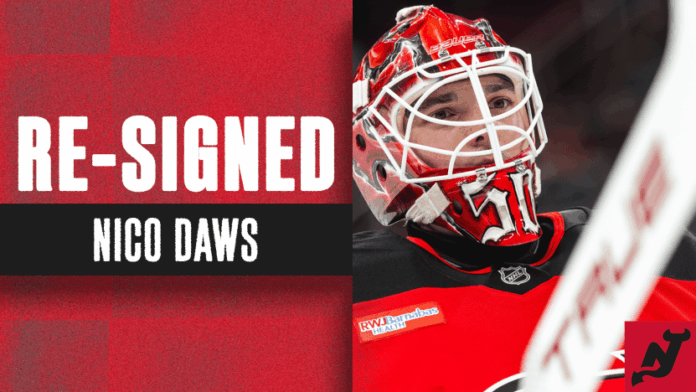
Elsewhere on the Devils’ July 1 transaction sheet, the organization formalized a collection of roster moves that collectively fill out the depth structure the Mehta administration is building around the Hischier-Hughes core. Nico Daws, the organization’s development-track goaltender who has been splitting time between the Utica Comets of the AHL and occasional NHL appearances for the past several seasons, was re-signed to a two-year contract with an average annual value of $1.1 million, structured at $975,000 in the first year and $1.225 million in the second. The deal ensures that the 25-year-old netminder, who was selected by the Devils in the third round of the 2020 draft and has spent five seasons developing within the organization, remains available to the system while the team works through whatever decisions await on the starting goaltender question opened by the Jacob Markstrom trade.
Daws’s career contains one defining moment that has made him something of a cult figure within the New Jersey hockey community: his performance in the Devils’ first outdoor game win, a 6-3 victory against the Philadelphia Flyers at MetLife Stadium on February 17, 2024, during the Navy Federal Credit Union Stadium Series. Making 45 saves on 48 shots, Daws set the NHL record for the most saves by a goaltender in an outdoor game, with the 48 shots he faced also representing the most any NHL netminder had ever faced in an outdoor game. That performance, in front of 80,000 people at a stadium eight miles from Prudential Center, remains the single most prominent moment of his career and the clearest illustration of the save volume and composure that have made the organization view him as a legitimate organizational asset rather than a depth placeholder.
New defensive depth arrived via two one-year contracts at $850,000 each: Vladislav Kolyachonok, a 25-year-old left-shot defenseman who adds another physical option to the organizational blue-line depth chart, and Riley Tufte, a forward whose size and penalty-killing competency addressed specific depth needs at the NHL roster margin. Both signings carry the low-risk, high-upside character that one-year contracts at entry-level-adjacent rates provide — players with NHL competency who are being evaluated for a larger role while remaining financially manageable within the organization’s cap structure.
The extension of Xavier Parent and Marc McLaughlin on one-year, two-way contracts maintained developmental-tier continuity, keeping options alive at the AHL level while preserving roster flexibility heading into training camp. Nico Daws’s two-year commitment and the Hayton offer sheet together bracket the organizational priorities at the roster’s middle tier: goaltending continuity and center depth behind the franchise’s cornerstone, addressed through whatever combination of internal development and external acquisition the market makes available.
The full picture of Sunny Mehta’s first free agency day as Devils general manager is one of deliberate, prioritized action rather than reactive spending. The Hischier extension removed the most consequential source of organizational uncertainty and did so at a number that leaves the Devils with approximately $9.7 million in cap space to continue building. The Hayton offer sheet demonstrates a willingness to use mechanisms that most front offices avoid, accepting the relationship friction that offer-sheeting creates in exchange for the possibility of acquiring a legitimate two-way center at below-market valuation. The Daws re-signing maintains developmental continuity. The Kolyachonok and Tufte signings address specific roster holes at manageable cost. Whether the Hayton gambit ultimately brings a center to Newark or returns a second-round pick to the organization, July 1 established clearly that Mehta approaches roster construction with an uncommon willingness to be creative, and that the franchise’s most important player will be at center for the Devils well into the next decade.