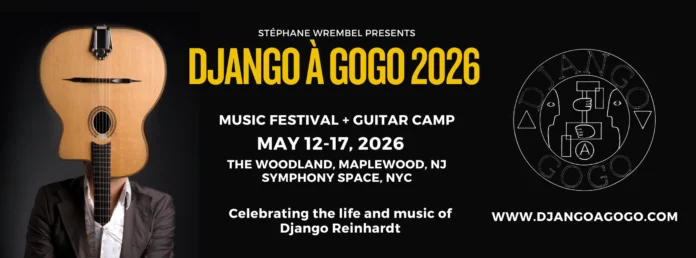

Every year, countless music festivals attempt to position themselves as immersive cultural experiences. Few actually succeed. Most become interchangeable collections of performances built around sponsorships, social media visibility, and broad branding language that often has little connection to the music itself. But occasionally, a festival develops an identity so rooted in artistry, musicianship, history, and place that it evolves beyond the normal concert circuit entirely. It becomes part performance, part preservation, part education, and part international gathering point for an entire musical tradition.
That is precisely what Django à Gogo has become.
Returning May 12 through May 17, 2026, the internationally respected festival and guitar intensive once again transforms Maplewood, New Jersey into one of the most important centers of gypsy jazz and Django Reinhardt-inspired music anywhere in North America. Produced and curated by Grammy Award-winning guitarist Stephane Wrembel, Django à Gogo has spent more than two decades building a reputation not simply as a festival, but as one of the world’s premier celebrations of Django Reinhardt’s enduring musical legacy and the global evolution of jazz manouche itself.
What makes the event remarkable is not only the level of musicianship involved, though that alone would justify its reputation. It is the fact that one of the most respected gypsy jazz gatherings in the world exists not in Paris, New Orleans, or New York City, but in suburban New Jersey, where Maplewood has quietly become an annual international meeting ground for virtuoso guitarists, improvisers, composers, educators, and devoted fans of one of jazz history’s most influential musical voices.
That New Jersey connection is central to the festival’s identity.
Though Django à Gogo concludes each year with high-profile performances in New York City venues such as Symphony Space and previously Carnegie Hall and The Town Hall, the heart of the festival remains firmly rooted in Essex County. Maplewood serves as the operational and creative headquarters for the weeklong experience, hosting the festival’s intensive guitar camp, workshops, community gatherings, jam sessions, and several of its major performances at The Woodland, the historic local venue that has increasingly become synonymous with the festival itself.
The setting matters because Django à Gogo has never functioned like a detached touring showcase dropped into different cities. It feels built into the community around it.
Throughout festival week, Maplewood transforms into something resembling an international jazz village. Musicians carrying Selmer-style guitars move between workshops and cafés. Students gather in small circles practicing rhythm patterns and improvisational techniques. Evening performances stretch into conversations, collaborations, and impromptu jams. Audience members do not simply attend concerts. They immerse themselves inside a living musical ecosystem shaped around improvisation, virtuosity, and shared reverence for Django Reinhardt’s revolutionary influence on guitar music.
That immersive atmosphere begins immediately with the festival’s opening events at The Woodland.
On May 13, Django New Orleans launches the concert series with one of the festival’s most distinctive and ambitious projects. Rather than presenting gypsy jazz strictly as historical recreation, the performance expands Reinhardt’s musical DNA into the rhythmic language and brass-driven energy of New Orleans. Led by Stephane Wrembel alongside an international ensemble featuring Josh Kaye, Adrien Chevalier, Steven Duffy, Scott Kettner, David Langlois, Nick Driscoll, Joe Boga, and vocalist Sarah King, the performance blends jazz manouche guitar traditions with second-line grooves, horns, washboard percussion, clarinet improvisation, and deep rhythmic interplay.
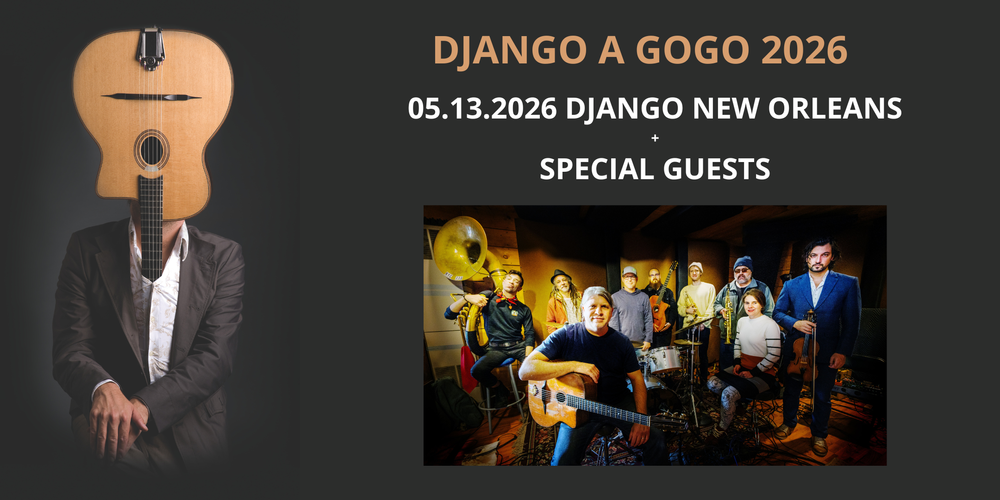
The result is not fusion for the sake of novelty. It is a demonstration of how flexible and alive Django Reinhardt’s musical vocabulary remains nearly a century after it first emerged.
Special guests Jean-Michel Pilc, Gismo Graf, Sébastien Felix, and legendary guitarist Angelo Debarre further elevate the evening into something closer to a summit meeting of international improvisers than a standard festival performance.
That collaborative spirit continues May 14 with Night of the Gypsies, one of the festival’s signature presentations. Built around a rotating cast of internationally respected musicians, the performance showcases the expressive depth and improvisational brilliance that define the gypsy jazz tradition itself. Wrembel joins David Gastine, Frank Anastasio, Scott Kettner, and returning guests including Debarre, Graf, Felix, Pilc, and Driscoll for an evening designed less around structured concert formalities and more around dynamic musical conversation.
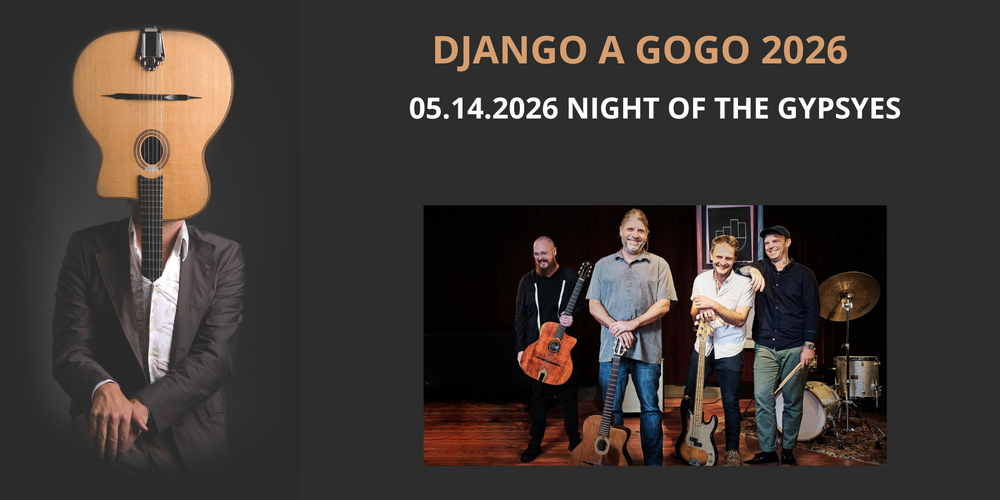
The distinction matters because Django à Gogo succeeds largely through spontaneity.
While the technical precision onstage remains extraordinary, the festival never feels rigid or academic. Performances evolve organically through interplay, improvisation, rhythmic exchange, and real-time musical risk-taking. Audiences witness musicians listening and responding to one another at an elite level rather than merely reproducing arrangements.
That approach reaches an even larger scale when the festival moves into New York City for its two-night Django à Gogo All Stars residency at Symphony Space on May 15 and 16.
The first evening centers around a historic milestone: the American celebration surrounding the release of Gypsy Guitars II, the long-awaited continuation of the influential 1989 album that helped ignite the modern global Django revival movement. Angelo Debarre’s presence alone makes the evening significant within the international gypsy jazz community, but the larger ensemble elevates the performance into one of the festival’s marquee events.
The lineup reads like a world summit of contemporary Django-influenced musicianship. Stephane Wrembel, Angelo Debarre, Gismo Graf, Sébastien Félix, David Gastine, Josh Kaye, Ari Folman-Cohen, and Nick Anderson anchor the Gypsy Jazz Ensemble portion of the evening before Django New Orleans returns for a second expansive set blending European string traditions with American brass-band energy.
By May 16, the intensity escalates further.
Night of the Gypsies Part Two simultaneously celebrates the vinyl release of Django New Orleans 2 while showcasing both legendary players and younger virtuosos shaping the next phase of the genre’s evolution. The performance structure allows audiences to experience multiple dimensions of the music in a single evening, from intimate acoustic trio arrangements to large ensemble explosions driven by horns, percussion, piano, and layered improvisation.
Importantly, Django à Gogo is not only a performance festival. It is equally respected for its educational component.
The Django à Gogo Music Camp, held throughout the week in Maplewood, has developed into one of the premier gypsy jazz educational programs anywhere in the world. Limited to approximately 40 students, the intensive workshop environment creates unusually close interaction between attendees and elite-level instructors including Wrembel, Angelo Debarre, Serge Camps, Frank Anastasio, Gismo Graf, Josh Kaye, and Sébastien Felix.
Students of varying skill levels participate in focused sessions exploring rhythm technique, improvisation, phrasing, harmonic structure, accompaniment, and ensemble communication within the Django Reinhardt style. Unlike larger institutional music camps, Django à Gogo maintains a deliberately intimate structure that prioritizes access, interaction, and immersion.
The educational environment becomes especially significant given the increasingly global nature of gypsy jazz itself.
What began with Django Reinhardt’s groundbreaking work in 1930s France has evolved into a worldwide musical language interpreted differently across cultures, generations, and regions. Django à Gogo reflects that internationalism beautifully. French, German, American, Dutch, and other musical traditions intersect throughout the festival, creating a living dialogue between preservation and innovation.
Stephane Wrembel remains the central figure connecting those worlds together.
Born in France and now based in New Jersey, Wrembel has spent years establishing himself as one of the foremost interpreters and innovators working within the Django tradition. His Grammy-winning composition “Bistro Fada,” featured prominently in Woody Allen’s Midnight in Paris, introduced many listeners to his work internationally, but his deeper influence has come through his relentless commitment to expanding and preserving gypsy jazz through recording, education, performance, and curation.
That commitment is precisely why Django à Gogo has endured for more than twenty years while continuing to grow artistically rather than simply commercially.
The festival does not chase trends. It does not dilute its identity for broader accessibility. Instead, it trusts audiences to engage deeply with musicianship, improvisation, tradition, and artistic excellence. In doing so, it has built one of New Jersey’s most sophisticated and internationally respected cultural events almost entirely through authenticity and artistic credibility.
And for one remarkable week every spring, Maplewood becomes the unlikely epicenter of a global musical tradition still evolving in real time.