
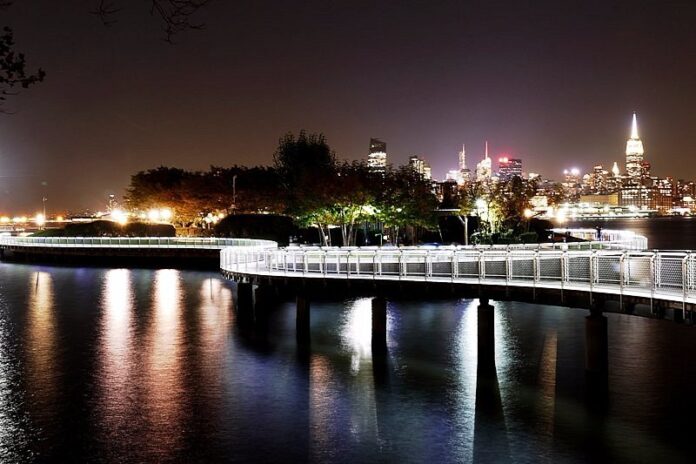

Few cities in New Jersey have transformed public outdoor space as dramatically or as successfully as Hoboken. Once defined primarily by shipping terminals, industrial piers, rail yards, and working waterfront infrastructure, the city has evolved into one of the most recognizable urban waterfront destinations on the East Coast. Central to that transformation has been Hoboken’s extraordinary network of parks stretching along the Hudson River, where innovative design, public accessibility, recreation, architecture, and some of the most breathtaking skyline views in America converge within a remarkably compact urban footprint.
What makes Hoboken’s park system so compelling is not simply the scenery. It is the way the city has integrated parks directly into everyday urban life. The waterfront is not isolated from the community. It functions as the city’s front yard, gathering space, exercise corridor, entertainment venue, playground system, and cultural hub simultaneously. Residents move seamlessly between apartment buildings, restaurants, bike paths, athletic fields, playgrounds, ferry terminals, concert spaces, and waterfront promenades in a way that few American cities have managed to accomplish so effectively.
In many ways, Hoboken has become the model for modern urban waterfront redevelopment in New Jersey. The city’s parks demonstrate how dense urban environments can still prioritize green space, recreation, public access, and community identity without sacrificing economic development or walkability. The result is one of the most dynamic and visually striking public park systems anywhere in the region.
At the center of that transformation stands Pier C Park, one of the most architecturally distinctive playground parks in New Jersey. Unlike traditional rectangular city parks, Pier C was designed as an organic island-like landscape extending into the Hudson River, connected to the waterfront by a winding pedestrian bridge that immediately separates visitors from the surrounding city grid.
The park’s layout feels intentionally imaginative. Rolling hills, curved pathways, elevated lookout areas, climbing structures, water play zones, and interactive playground elements create an environment that resembles a miniature fantasy landscape more than a conventional municipal park. Children navigate rope bridges, towers, and steep slides while adults gather along the waterfront edges overlooking Midtown Manhattan.
The design helped redefine expectations for urban playgrounds throughout the state. Rather than treating playgrounds as isolated equipment installations surrounded by asphalt or fencing, Pier C integrated architecture, landscaping, waterfront scenery, and play into one cohesive public experience. The park’s fishing pier, shaded seating areas, and panoramic skyline views ensure the space functions equally well for families, walkers, photographers, and visitors simply seeking a quiet place along the river.
Just steps away, Pier A Park provides a dramatically different but equally iconic waterfront experience. Where Pier C emphasizes playful design and layered topography, Pier A is defined by openness. The expansive green lawn extends directly into the Hudson River, creating one of the clearest uninterrupted views of the Manhattan skyline anywhere in New Jersey.
Pier A has become one of the most important gathering spaces in Hoboken. Throughout the year, residents use the park for picnics, recreation, fitness, festivals, and waterfront events. During summer months, the park transforms into a major cultural venue through outdoor programming including movie nights, concerts, and public celebrations.
The park also carries emotional and historical significance through its 9/11 memorial grove, where visitors experience direct visual connections to Lower Manhattan while reflecting on one of the defining moments in modern American history. Like much of Hoboken’s waterfront, the location merges recreation and civic identity in a way that feels authentic rather than manufactured.
Further north along the Hudson River, Sinatra Park honors Hoboken’s most famous native son while serving as one of the city’s busiest recreation and entertainment destinations. Named after Frank Sinatra, the park blends athletic space, performance venues, boating access, and public gathering areas into one active waterfront corridor.
Its amphitheater regularly hosts concerts, cultural festivals, and public events throughout the warmer months, reinforcing Hoboken’s reputation as one of New Jersey’s most active outdoor entertainment communities. Simultaneously, the park’s soccer field, kayaking facilities, and waterfront promenade create constant activity from morning through evening.
The kayak launch has become particularly symbolic of the city’s evolving relationship with the Hudson River. For generations, industrial infrastructure largely disconnected residents from direct river access. Today, parks like Sinatra Park physically reconnect the public with the waterfront through recreation and environmental engagement.
Nearby, Maxwell Place Park represents another layer of Hoboken’s transformation from industrial corridor to residential waterfront destination. Built on the site of the former Maxwell House coffee plant, the park preserves elements of the area’s industrial legacy while introducing new forms of recreation and public access.
The park’s small urban beach area has become one of its defining features, frequently used by kayakers launching directly into the Hudson River. Combined with playgrounds, seating areas, landscaped walkways, and nearby dog parks, Maxwell Place demonstrates how even relatively compact urban parks can create meaningful recreational ecosystems when carefully integrated into surrounding neighborhoods.
Yet Hoboken’s waterfront parks do not exist in isolation. Their success has helped inspire broader investments in urban parks throughout New Jersey, particularly in cities reclaiming industrial waterfronts for public use.
Just south of Hoboken, Newport Green Park has emerged as one of the most ambitious modern urban parks in the state. The park features New Jersey’s first true “urban beach,” where visitors lounge on sand directly facing the Manhattan skyline. Combined with a splash pad, playground, carousel, and large open lawns, Newport Green demonstrates how dense residential development and large-scale recreational space can successfully coexist.
The park reflects a broader trend reshaping Hudson County, where former industrial and rail infrastructure is increasingly being converted into public waterfront space designed around recreation, walkability, and quality of life.
Nearby, J Owen Grundy Park offers another striking example of urban waterfront design. Extending outward from Exchange Place into the Hudson River, the park functions almost like a floating civic plaza surrounded by skyscrapers and ferry terminals.
The location has become one of the region’s most popular public gathering spaces because of its direct views toward Lower Manhattan and the Freedom Tower. Public seating, game tables, event spaces, and performance areas create an environment where office workers, tourists, residents, and commuters all converge throughout the day.
The transformation of New Jersey’s waterfront parks extends beyond North Jersey as well.
In Camden, Wiggins Waterfront Park has become one of South Jersey’s premier riverfront destinations. Positioned along the Delaware River directly facing Philadelphia, the park features a marina, outdoor amphitheater, event spaces, and expansive promenades overlooking the Ben Franklin Bridge and Center City skyline.
The park has played a major role in Camden’s broader waterfront redevelopment strategy, helping reconnect residents and visitors to portions of the Delaware River long dominated by industrial infrastructure.
Nearby, Cramer Hill Waterfront Park reflects a newer generation of community-focused urban parks emphasizing accessibility, environmental restoration, and family recreation. Sensory-friendly playgrounds, trails, fishing areas, and panoramic skyline views have transformed the area into a major recreational asset for local neighborhoods.
Meanwhile, inland urban parks throughout New Jersey continue demonstrating how green space remains central to community identity even outside waterfront environments.
Cadwalader Park remains one of the state’s most historically important urban parks. Designed by legendary landscape architect Frederick Law Olmsted, who also designed New York’s Central Park, the park combines rolling landscapes, historic structures, recreational facilities, and museums into one of Trenton’s defining civic spaces.
Similarly, Mill Hill Park continues functioning as a downtown gathering place hosting festivals, concerts, markets, and public events along the Delaware River corridor.
For families seeking destination playgrounds, parks such as Regatta Playground and Wish Upon A Star Park have become regional attractions in their own right. Massive nautical-themed climbing structures, inclusive playground equipment, sensory-friendly design, musical play installations, and waterfront settings increasingly define the next generation of New Jersey public parks.
What ultimately connects all these locations is a larger statewide shift in how New Jersey views public outdoor space. Parks are no longer treated merely as passive green areas or isolated recreation fields. Increasingly, they are being designed as integrated social infrastructure supporting public health, tourism, economic development, environmental resilience, cultural programming, and community identity simultaneously.
Hoboken’s waterfront remains one of the clearest examples of that evolution. The city’s parks have successfully transformed former industrial shoreline into one of the most vibrant public spaces anywhere in the Northeast while preserving accessibility, walkability, and extraordinary visual character.
As more New Jersey cities continue reclaiming waterfronts, redeveloping industrial corridors, and investing in public recreation infrastructure, Hoboken’s park system increasingly serves as both blueprint and inspiration. Its success demonstrates that even in one of the nation’s most densely populated states, public space can still feel imaginative, expansive, welcoming, and deeply connected to the identity of the surrounding community.
For more coverage of New Jersey parks, waterfront destinations, recreation spaces, and outdoor attractions, visit Explore New Jersey Parks
















