
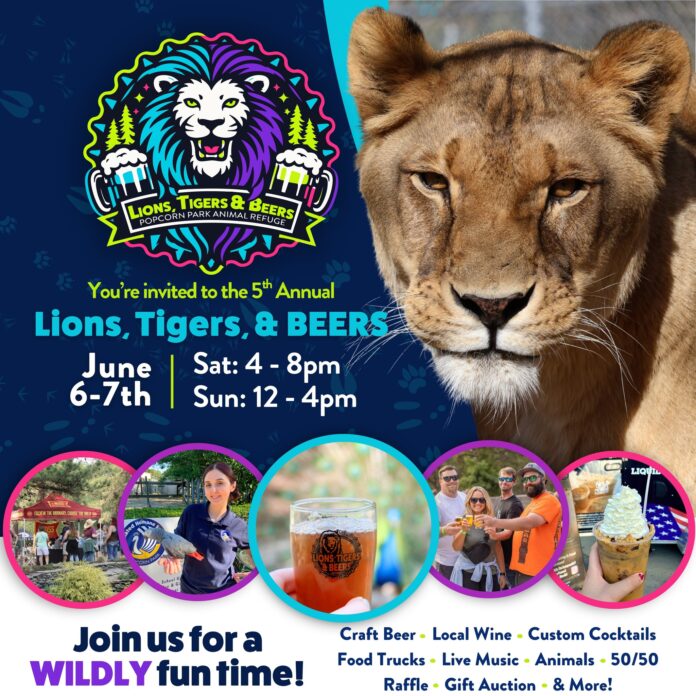

Every summer in New Jersey, countless festivals compete for attention with craft beer tastings, food trucks, live music, and outdoor entertainment. Most disappear into the seasonal calendar without leaving much of an impression beyond a crowded parking lot and a social media post. But the annual Lions, Tigers & Beers Festival at Popcorn Park Animal Refuge in Forked River occupies a very different space entirely because beneath the festival atmosphere sits something far more serious: one of the state’s longest-running animal rescue sanctuaries and one of the most distinctive wildlife refuge operations anywhere in the Northeast.
Returning for its fifth year on June 6 and 7, the Lions, Tigers & Beers fundraiser has evolved into one of Ocean County’s most recognizable nonprofit events, blending New Jersey’s thriving craft beverage culture with direct support for rescued wildlife, exotic animals, farm animals, and abused or abandoned creatures that have nowhere else to go. Unlike traditional zoos built around acquisition, breeding programs, or exhibition economics, Popcorn Park operates under an entirely different philosophy. Every animal at the refuge arrived there because something went wrong somewhere else.
That distinction matters enormously.
In an era where public scrutiny surrounding animal welfare continues growing, many people have become increasingly cautious about facilities involving lions, tigers, bears, and exotic wildlife. Questions surrounding accreditation, captivity ethics, breeding programs, and sanctuary legitimacy have become central to how modern audiences evaluate animal organizations. Popcorn Park understands those concerns because its entire existence is built around rescue rather than entertainment.
Located within the Pine Barrens of Ocean County and operated through the Associated Humane Societies, Popcorn Park Animal Refuge has spent decades functioning less like a commercial attraction and more like a permanent sanctuary for animals rescued from cruelty, neglect, injury, failed roadside zoos, illegal ownership situations, hoarding environments, exploitation, or circumstances where survival elsewhere became impossible. The refuge traces its origins back to 1977 after the rescue of an injured raccoon caught in a leg-hold trap. What began as a small rescue effort gradually evolved into a sprawling sanctuary now housing more than 200 animal residents across seven acres.
The stories behind many of those residents are often difficult to hear.
Some of the refuge’s lions and tigers arrived after being discovered in catastrophic conditions at failed private facilities and unregulated compounds. Others came from situations involving neglect, unsafe ownership, or collapsing roadside attractions unable to care for the animals they possessed. Bobcats, cougars, bears, monkeys, birds, reptiles, deer, horses, goats, and countless domestic animals have all passed through the organization over the years. Some are rehabilitated and released when possible. Many cannot ever safely return to the wild and instead spend the remainder of their lives under permanent care in Forked River.
That rescue-first identity remains central to the Lions, Tigers & Beers event itself.
While the fundraiser carries a playful name and festival atmosphere, organizers consistently emphasize that the event exists to support lifelong animal care operations that receive no federal or state funding. Veterinary treatment, habitat maintenance, feeding programs, staffing, rescue response, transportation, and ongoing medical care for exotic animals require enormous financial resources, especially for aging wildlife residents with specialized needs.
The fundraiser helps sustain that mission.
During the festival, guests move through the refuge grounds after hours while sampling craft beer, wine, cocktails, and food from dozens of participating vendors across New Jersey. But unlike many large-scale tasting events built around excess or spectacle, the environment at Popcorn Park tends to feel unusually grounded and community-oriented. The setting itself changes the atmosphere. Attendees are not walking through convention halls or parking lot fairgrounds. They are walking through an active rescue refuge where the reality of animal care remains visible throughout the experience.
That balance between entertainment and mission is part of why the event has expanded so dramatically over the last several years.
The 2026 edition introduces multiple ticket tiers, including General Admission packages featuring unlimited tastings with collectible glasses, VIP experiences with early access and exclusive animal encounters, and a newly launched Elite VIP option centered around a private hospitality experience known as The Wild Reserve. Designated driver tickets remain available as well, reinforcing the organization’s effort to make the event accessible while encouraging responsible attendance.
More than 30 breweries, beverage producers, and food vendors are expected across the weekend, alongside live music performances, games, raffles, and fundraising activities that continue supporting refuge operations. One of the festival’s biggest attractions remains its massive 50/50 raffle, which reportedly produced a winning payout exceeding $40,000 last year alone.
Yet what separates Lions, Tigers & Beers from countless other New Jersey summer festivals is the emotional context surrounding the event.
People are not simply attending for alcohol tastings or outdoor entertainment. Many arrive because they already know the refuge’s story. Others come because they increasingly prefer supporting rescue-centered animal organizations rather than conventional animal attractions. In recent years, public awareness surrounding animal welfare ethics has shifted dramatically. Consumers now routinely question whether facilities breed animals for display, purchase wildlife commercially, or prioritize visitor revenue over animal wellbeing.
Popcorn Park’s rescue-only structure directly addresses many of those concerns.
The refuge does not breed animals. It does not buy exotic wildlife for attraction purposes. It does not operate as a commercial zoo dependent on constant acquisition cycles. Instead, the organization functions as a permanent refuge for animals that often have nowhere else to go. That includes elderly animals, injured wildlife, surrendered exotic pets, and animals rescued from abusive environments where survival had become uncertain.
The facility also continues maintaining federal USDA licensing requirements while operating under the broader Associated Humane Societies nonprofit structure, which currently holds strong accountability ratings through major nonprofit evaluators. While the refuge is not accredited through the Association of Zoos and Aquariums or the Global Federation of Animal Sanctuaries, its operational identity remains firmly rooted in long-term rescue care rather than commercial exhibition.
For many attendees, that distinction creates a level of comfort that fundamentally changes how they experience the event.
The festival also arrives during a period when nonprofit animal organizations nationwide continue facing growing operational pressures. Veterinary costs have risen sharply. Rescue intake numbers remain elevated following years of post-pandemic animal abandonment issues. Staffing shortages continue affecting shelters and sanctuaries throughout the country. Simultaneously, the cost of caring for large wildlife animals remains extraordinarily high, particularly for facilities committed to lifetime sanctuary rather than short-term housing.
Events like Lions, Tigers & Beers help close that gap.
And in New Jersey, where craft beverage culture continues expanding rapidly alongside growing interest in locally focused nonprofit events, the fundraiser has gradually become one of the state’s more unique examples of mission-driven community programming.
The timing also aligns closely with broader growth throughout New Jersey’s craft brewery and independent beverage landscape. Breweries throughout the state increasingly participate in collaborative community events, charity partnerships, and local nonprofit initiatives that extend beyond simple taproom promotion. The Lions, Tigers & Beers Festival reflects that evolution clearly. Craft breweries are no longer functioning solely as beverage producers. Increasingly, they are acting as cultural anchors within local fundraising ecosystems, neighborhood revitalization efforts, and public gathering spaces.
That community energy is likely a major reason tickets continue selling rapidly year after year.
Because despite the festival branding, the live music, the tastings, and the social atmosphere, the core emotional reality remains impossible to ignore once visitors walk through the refuge itself. These animals are not props. They are survivors of abandonment, exploitation, injury, and neglect who now exist inside a permanent care environment funded almost entirely through donations, sponsorships, admissions, and fundraising support.
That reality gives the event a different kind of emotional weight.
And in a summer entertainment landscape increasingly dominated by expensive corporate festivals and disposable social media experiences, Lions, Tigers & Beers continues standing apart by offering something far more meaningful: an event where entertainment directly supports rescue, rehabilitation, lifelong sanctuary care, and the preservation of an organization that has spent nearly five decades protecting animals that had already been failed elsewhere.
For Popcorn Park Animal Refuge, the festival is not simply another weekend event on the calendar.
It is part of what keeps the refuge alive.
















