

The New Jersey Devils entered the offseason earlier than expected, but the organization is wasting little time reshaping both its front office and its international profile as the 2026 IIHF World Championship gets underway in Switzerland.
While the Stanley Cup Playoffs move deeper into the Conference Final stage without New Jersey involved, the Devils remain heavily represented on the global hockey stage through a combination of executive restructuring, player development decisions, and major international tournament participation. The result is an unusually important offseason moment for a franchise attempting to recalibrate after another year that ended short of championship expectations.
The most significant organizational move so far came inside the Devils’ front office, where newly elevated executive leadership has already begun putting its stamp on hockey operations.
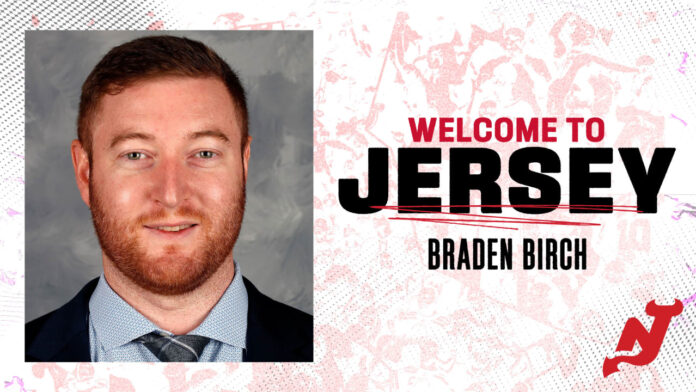
In one of the first major personnel decisions of the offseason, the Devils hired Braden Birch away from the Florida Panthers organization to serve as the club’s new Assistant General Manager. Birch arrives from one of the NHL’s most respected front offices after playing an important role in Florida’s recent rise into perennial Stanley Cup contention. His addition signals a clear desire by New Jersey to modernize and strengthen its executive structure with personnel tied directly to organizations that have built sustained playoff success.
The hiring also represents the beginning of broader changes throughout the Devils’ hockey operations department.
The organization confirmed that veteran executives Dan MacKinnon and Chuck Fletcher will not return as part of the front office moving forward. Both departures underscore the reality that this offseason is not being treated as routine internal maintenance. The Devils are actively reshaping decision-making structures as pressure continues mounting around a roster widely viewed as talented enough to compete much deeper into the postseason than it ultimately has in recent years.
For New Jersey, the timing of these changes matters.
The franchise remains built around one of the NHL’s strongest young cores, headlined by Jack Hughes, Nico Hischier, Jesper Bratt, Luke Hughes, Simon Nemec, and Timo Meier. But after injuries, inconsistency, and defensive instability contributed to another uneven season, expectations surrounding the organization have shifted from rebuilding patience to competitive urgency.
That urgency extends well beyond the NHL calendar itself, which is why the IIHF World Championship has become particularly important for several Devils players this spring.
As the tournament opens in Zurich and Fribourg, multiple members of New Jersey’s roster are taking on major international responsibilities representing their countries against many of the world’s top professional players.
For Team Switzerland, Devils captain Nico Hischier enters the tournament carrying one of the largest leadership roles of any player in the competition. Hischier was officially named alternate captain for the Swiss national team, reinforcing both his growing stature internationally and his importance to Switzerland’s continued emergence as one of hockey’s strongest nontraditional powers.
Switzerland enters the tournament with legitimate expectations of making a deep run on home ice, and much of that optimism centers around a core featuring Hischier alongside fellow Devils winger Timo Meier, Roman Josi, Nino Niederreiter, Pius Suter, and J.J. Moser.
For Hischier specifically, the tournament provides another opportunity to strengthen his reputation as one of the NHL’s most complete two-way centers. While his offensive production often receives less national attention than flashier stars across the league, his value inside international competition becomes especially pronounced because of the structure, discipline, and defensive responsibility required in short tournament formats.
Timo Meier also enters the event facing an important international moment after another physically demanding NHL season. Switzerland will rely heavily on Meier’s power game, net-front presence, and scoring ability if the host nation hopes to challenge tournament favorites like Canada and the United States.
One notable absence for the Swiss roster, however, is Devils defenseman Jonas Siegenthaler, who will not participate due to a late-season injury. Siegenthaler is reportedly remaining involved with the Swiss program in a support capacity, but his absence removes an important defensive stabilizer from a team already dealing with questions about depth beyond its top-end talent.
On Team Canada, Devils representation arrives through Dawson Mercer, who was added to the roster as part of a loaded Canadian lineup determined to reassert itself after recent international disappointments.
Canada’s roster is one of the strongest assembled for the tournament in years, featuring Sidney Crosby, Macklin Celebrini, Mark Scheifele, Ryan O’Reilly, John Tavares, Robert Thomas, and several other established NHL stars. Mercer joins former teammate Connor Brown among the Canadian forwards as the country attempts to reclaim international dominance ahead of future Olympic competition.
For Mercer, the tournament carries significant developmental importance.
After an up-and-down NHL season in New Jersey, international play provides him an opportunity to regain confidence offensively while playing inside a structured, veteran-heavy environment alongside elite talent. Canada’s depth means Mercer is unlikely to carry a starring role, but strong performances in limited opportunities could still become an important confidence builder entering next season.
Meanwhile, Devils forward Paul Cotter will represent Team USA, giving New Jersey another presence inside one of the tournament’s most intriguing rosters.
The American team arrives with a younger and somewhat less experienced lineup than many expected, though it still features substantial NHL talent led by Matthew Tkachuk. Cotter’s inclusion reflects the growing respect he has earned around the league for his physical style, forechecking pressure, and ability to impact games through energy and physicality rather than pure offensive production.
For Team USA, roster construction has become one of the major storylines of the tournament.
Unlike Canada, which aggressively pursued veteran NHL participation, the United States enters the event with a roster blending prospects, younger NHL players, and developmental talent. That creates opportunities for players like Cotter to earn larger roles than they might otherwise receive in more veteran-heavy international settings.
The tournament itself arrives during an especially important period for international hockey.
With Olympic participation returning to the NHL calendar and the league continuing to expand its global footprint, events like the IIHF World Championship are increasingly viewed not simply as offseason exhibitions, but as meaningful evaluation opportunities for players hoping to strengthen future international roles.
That context matters significantly for several Devils players participating this year.
For Hischier and Meier, strong performances could reinforce Switzerland’s legitimacy entering future Olympic competition. For Mercer and Cotter, the tournament offers a chance to establish themselves more firmly within long-term national team discussions. And for New Jersey itself, international visibility remains valuable for a franchise continuing to build around a globally recognized young core.
Beyond Devils involvement specifically, the 2026 tournament also features several compelling broader storylines.
Canada enters as one of the clear favorites, motivated heavily by recent international frustrations and armed with arguably the deepest forward group in the tournament. Sweden arrives with a younger developmental roster focused heavily on prospects and future NHL talent. Czechia and Finland remain dangerous because of their structure and tournament experience, while Switzerland hopes home-ice support can push the country toward one of its strongest international finishes in modern history.
The tournament’s group-stage structure should also create several important early matchups before the top four teams from each group advance into the single-elimination bracket.
For Devils fans, however, the larger focus remains fixed on what all of this means for New Jersey’s future.
The front office is changing. Expectations are rising. The roster remains talented but incomplete. And as the organization watches its players compete internationally, the realities of the upcoming NHL offseason continue looming in the background.
The Devils are no longer operating like a rebuilding franchise searching for direction. They are operating like a team expected to contend immediately.
Everything happening this month — from executive hires to international tournament performances — reflects that shift.
















