

- This event has passed.
Django à Gogo presents Night of the Gypsies
Django à Gogo 2026 Continues in Maplewood With “Night of the Gypsies,” an International Gathering of Modern Gypsy Jazz Masters
May 14 @ 8:00 PM – 11:30 PM
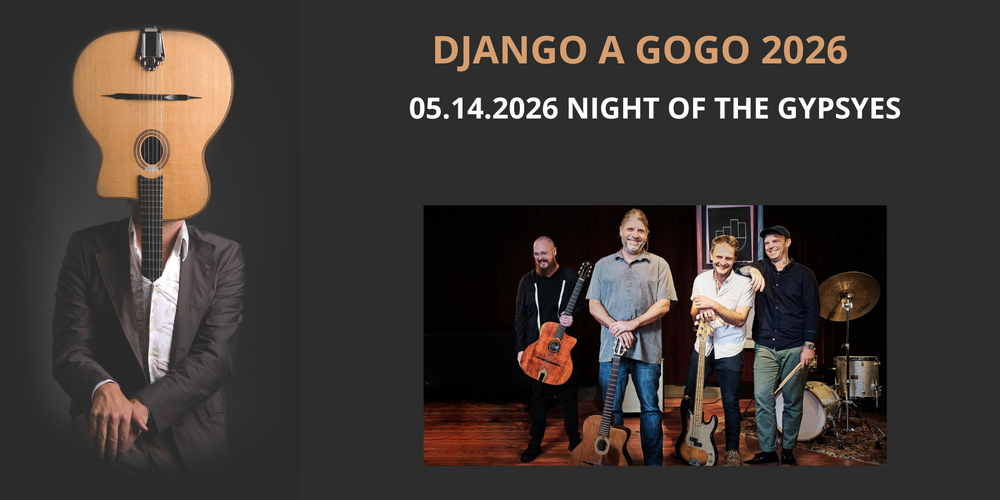
There are certain live music performances that function as concerts, and then there are performances that feel more like encounters with an entire musical tradition unfolding in real time. Django à Gogo has long operated within that second category. For more than twenty years, the internationally respected festival created by Grammy Award-winning guitarist Stephane Wrembel has transformed parts of New Jersey and New York into one of the world’s most important annual celebrations of Django Reinhardt’s legacy, attracting elite improvisers, virtuoso guitarists, and devoted audiences from across the globe.
But even within a festival already defined by extraordinary musicianship, some evenings carry a different level of anticipation.
On Thursday, May 14 at 8 PM, Django à Gogo presents Night of the Gypsies at The Woodland in Maplewood, New Jersey, bringing together an exceptional international lineup for what promises to be one of the defining performances of the 2026 festival. Built around improvisation, rhythmic interplay, virtuoso guitar work, and deeply emotional musical conversation, the evening represents the essence of what has made Django à Gogo such an enduring and respected force within the global gypsy jazz community.
At its center stands Stephane Wrembel, whose work over the past two decades has elevated not only the Django Reinhardt tradition itself, but also New Jersey’s role within the international jazz landscape.
Though globally recognized for his Grammy Award-winning composition “Bistro Fada” from Midnight in Paris, Wrembel’s deeper artistic legacy may ultimately rest in the community and cultural infrastructure he has built through Django à Gogo. The festival has become far more than a performance series. It operates as a living ecosystem of musicians, educators, composers, students, and improvisers dedicated to exploring and expanding the musical vocabulary Reinhardt introduced nearly a century ago.
Night of the Gypsies represents perhaps the purest expression of that mission.
The evening’s core ensemble features Wrembel on guitar alongside David Gastine on guitar and oud, Frank Anastasio on bass, and Scott Kettner on drums. That lineup alone would already constitute a formidable performance unit, balancing rhythmic sophistication, melodic improvisation, and a broad understanding of both traditional and contemporary gypsy jazz language. But Django à Gogo rarely stops at simple excellence.
Joining the ensemble are several internationally revered special guests whose combined reputations place the performance among the most musically significant jazz events taking place anywhere in the region this spring.
Jean-Michel Pilc brings his adventurous and deeply expressive piano work to the evening, while saxophonist Nick Driscoll expands the harmonic and textural possibilities of the ensemble beyond traditional gypsy jazz instrumentation. Most notably, the night also features guitar appearances from Gismo Graf, Sébastien Felix, and the legendary Angelo Debarre, one of the most respected living figures in the entire Django Reinhardt lineage.
Debarre’s presence alone changes the scale of the event.
For decades, Angelo Debarre has been viewed internationally as one of the defining interpreters of Django Reinhardt’s style, known for combining explosive technical precision with remarkable rhythmic aggression and emotional immediacy. His performances rarely feel academic or restrained. They feel alive, urgent, and deeply physical in the way the best improvisational music always does. Watching Debarre perform within an intimate venue like The Woodland creates the kind of musical access that larger festivals and institutional jazz presentations often cannot replicate.
That intimacy is one of the reasons Django à Gogo continues standing apart from nearly every other festival operating within the jazz world.
The Woodland’s atmosphere allows audiences to experience the interaction between musicians up close, where every improvisational exchange, rhythmic adjustment, and spontaneous musical turn becomes visible in real time. The room itself encourages listening. It encourages immersion. Unlike larger venues built around spectacle and distance, The Woodland places the audience directly inside the energy of the performance.
And Night of the Gypsies is designed entirely around that kind of interaction.
This is not a rigidly choreographed production built around exact reproductions of historic recordings. The concert thrives on improvisation, communication, and risk. Songs evolve differently each night depending on the chemistry between players, the momentum of the room, and the spontaneous decisions unfolding onstage. One performance may lean heavily into blistering guitar exchanges while another may drift toward moodier harmonic exploration or rhythmically dense ensemble interplay.
That unpredictability is central to the tradition itself.
Gypsy jazz has always existed as a deeply communal music form where listening matters as much as playing. Musicians react to one another constantly, shaping phrases, dynamics, and structures together in real time. The greatest performances often emerge not from perfection, but from tension, surprise, and instinctive communication between elite improvisers operating without safety nets.
Night of the Gypsies embraces exactly that spirit.
The inclusion of David Gastine’s oud work also subtly broadens the evening’s musical vocabulary beyond conventional gypsy jazz expectations. The oud’s tonality introduces Middle Eastern textures and phrasing into the ensemble, reinforcing Django à Gogo’s larger philosophy that Reinhardt’s influence should remain expansive rather than confined to strict stylistic preservation.
That openness has helped the festival maintain artistic relevance long after many niche genre events lose creative momentum.
Rather than treating Django Reinhardt’s work as untouchable museum material, Django à Gogo approaches it as a living language still capable of growth, reinterpretation, and cross-cultural evolution. The musicians participating each year are not merely preserving history. They are actively extending it.
Maplewood’s role in that process has become increasingly remarkable.
For one week every spring, the Essex County community becomes an international destination for musicians and listeners connected through a shared reverence for improvisation, virtuosity, and musical conversation. Students carrying guitars move between workshops. Visiting artists gather in cafés and rehearsal spaces. Informal jam sessions emerge organically after performances. The atmosphere feels less like a commercial festival and more like a temporary musical village built entirely around creativity and collaboration.
That authenticity may ultimately explain why Django à Gogo continues resonating so strongly after more than two decades.
In a live entertainment landscape increasingly dominated by branding, spectacle, algorithms, and disposable festival culture, Django à Gogo remains rooted in artistry first. Audiences attend because the musicianship matters. Because the improvisation matters. Because the experience cannot be replicated through streaming clips or social media fragments.
And on May 14 in Maplewood, Night of the Gypsies appears poised to deliver exactly the kind of unforgettable, deeply human musical encounter that has defined the festival from the beginning.











