

- This event has passed.
Django à Gogo presents Django New Orleans
Django à Gogo 2026 Brings the Spirit of New Orleans and the Soul of Gypsy Jazz to Maplewood
May 13 @ 8:00 PM – 11:30 PM
For more than two decades, Django à Gogo has occupied a singular place in the American music landscape. What began as a highly focused celebration of Django Reinhardt’s revolutionary guitar legacy has evolved into one of the most respected international gatherings of gypsy jazz musicians, improvisers, composers, and adventurous listeners anywhere in North America. Each spring, the festival transforms parts of New Jersey and New York into a temporary world capital for jazz manouche, where elite musicians from multiple continents gather not merely to perform repertoire, but to reinterpret, expand, and reimagine an entire musical language in real time.
In 2026, that tradition returns once again to Maplewood with a centerpiece performance that may also be one of the festival’s most ambitious artistic statements yet.
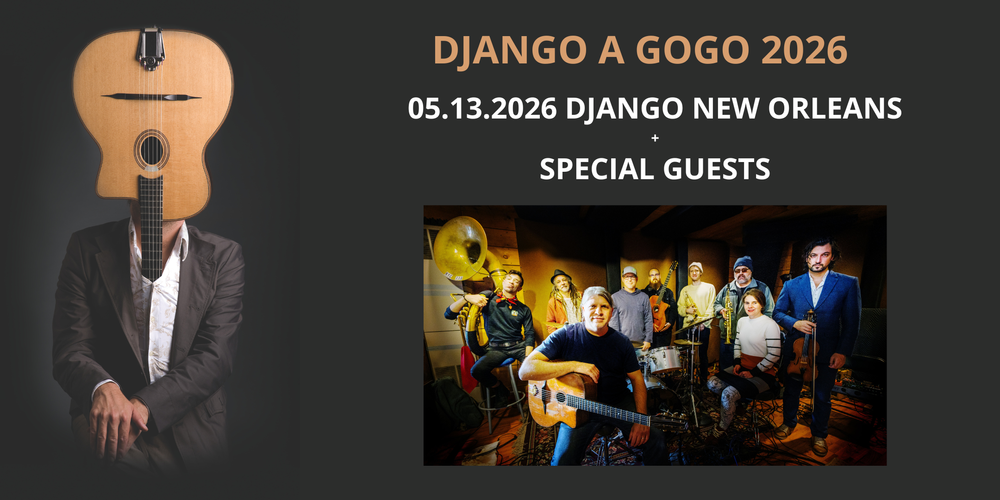
On Wednesday, May 13 at 8 PM, Django à Gogo presents Django New Orleans at The Woodland in Maplewood, New Jersey, bringing together an extraordinary ensemble led by Grammy Award-winning guitarist Stephane Wrembel for an evening designed to blur borders between gypsy jazz virtuosity, New Orleans rhythm traditions, brass band energy, and modern improvisational interplay. More than a standard concert, the performance represents a living conversation between musical cultures that were never as far apart as history sometimes suggests.
That connection sits at the center of the Django New Orleans concept itself.
Django Reinhardt’s music has always carried rhythmic urgency, swing propulsion, melodic freedom, and emotional spontaneity at its core. New Orleans music, meanwhile, thrives on collective rhythm, improvisation, communal performance, and deeply physical groove. What Django New Orleans does so effectively is reveal how naturally those traditions can coexist when placed in the hands of musicians capable of navigating both worlds authentically.
The result is not a novelty crossover project. It is a full-scale musical expansion of Reinhardt’s legacy into another foundational branch of global improvisational music.
Stephane Wrembel anchors the performance alongside guitarist Josh Kaye, violinist Adrien Chevalier, tuba player Steven Duffy, drummer Scott Kettner, washboard specialist David Langlois, saxophonist and clarinetist Nick Driscoll, trumpeter Joe Boga, and vocalist Sarah King. Together, the ensemble creates a sound built equally around virtuosity and atmosphere, where intricate guitar runs coexist with second-line rhythms, brass textures, clarinet improvisations, and deeply layered rhythmic movement.
The instrumentation alone immediately signals that this is not traditional gypsy jazz revivalism.
The inclusion of tuba, washboard, horns, and New Orleans percussion structures introduces an entirely different physicality into the music. Songs breathe differently. Rhythms move differently. The performances lean less toward formal recreation and more toward collective celebration, where improvisation becomes the connective tissue binding together multiple jazz traditions simultaneously.
That openness has become one of Django à Gogo’s defining artistic strengths over the years.
Unlike many genre festivals that treat musical tradition as something frozen in time, Django à Gogo consistently approaches Reinhardt’s influence as living material capable of evolving across generations and cultures. The festival’s best performances are rarely museum pieces. They are conversations between musicians who understand the tradition deeply enough to expand it without losing its soul.
This year’s Maplewood performance becomes even more significant through the addition of several internationally respected special guests.
Legendary pianist Jean-Michel Pilc joins the lineup alongside guitar virtuosos Gismo Graf, Sébastien Felix, and Angelo Debarre, each of whom brings a distinct interpretive voice rooted in the gypsy jazz tradition while pushing its vocabulary forward in different ways. Debarre, in particular, remains one of the most revered living guitarists associated with the Django lineage, known for a playing style that balances breathtaking technical precision with explosive rhythmic energy and emotional immediacy.
The presence of musicians of that caliber inside an intimate New Jersey venue reinforces what has made Django à Gogo such an important event internationally.
This is not a scaled-down regional festival attempting to imitate larger jazz institutions elsewhere. It is one of the genuine centers of the international gypsy jazz world, drawing musicians and audiences from across the globe into Maplewood each spring because the artistic level consistently justifies that reputation.
The Woodland itself has increasingly become central to the festival’s identity.
Located in the heart of Maplewood, the venue offers precisely the kind of atmosphere that suits Django à Gogo best: intimate enough for audiences to feel immersed in the interaction between players, yet large enough to generate the collective energy that improvisational music thrives upon. Performances there rarely feel distant or overly formal. Audiences experience the music almost inside the ensemble rather than separated from it.
That intimacy becomes especially important with a project like Django New Orleans, where interplay and rhythmic communication drive the entire performance.
The evening also reflects Stephane Wrembel’s broader influence on New Jersey’s cultural identity. Though internationally known through recordings, film work, and global touring, Wrembel has spent years quietly helping establish New Jersey as an unexpected but deeply respected hub for world-class gypsy jazz performance and education. Through Django à Gogo, he has built a bridge connecting local audiences to an international network of musicians whose work rarely appears within conventional American concert circuits.
In doing so, he has created something increasingly rare in modern music culture: an event built around artistry first.
There is no sense of disposable festival branding surrounding Django à Gogo. The audience arrives because of the music itself, because of the musicianship, and because of the opportunity to witness elite improvisers operating at an unusually high creative level inside an environment designed for listening rather than distraction.
That authenticity is precisely why the festival continues growing artistically after more than twenty years.
At a time when many music festivals increasingly prioritize spectacle, social media optics, and commercial branding over musical substance, Django à Gogo remains rooted in the idea that virtuosity, collaboration, improvisation, and cultural exchange still matter deeply to audiences searching for something more lasting than temporary entertainment.
And on May 13 in Maplewood, Django New Orleans appears poised to deliver exactly that kind of experience.
For one evening, New Jersey once again becomes the meeting point between European gypsy jazz tradition, New Orleans rhythmic spirit, international improvisation, and the timeless musical vocabulary first unleashed by Django Reinhardt nearly a century ago.











