
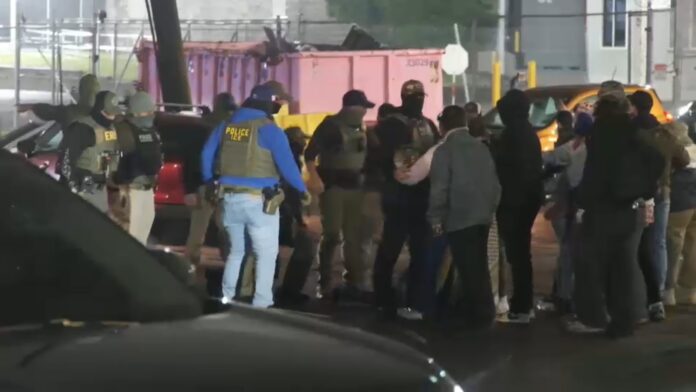

What began as mounting unrest outside a privately operated immigration detention facility in Newark has rapidly escalated into one of the most politically charged flashpoints in the country, unfolding at the exact moment federal officials move toward expanding immigration enforcement capabilities through a new wave of funding and operational support for Immigration and Customs Enforcement. As protests intensify outside Delaney Hall and national political rhetoric surrounding immigration hardens even further, New Jersey now finds itself at the center of a growing confrontation involving federal power, detainee conditions, public protests, immigration enforcement policy, and the future direction of the country’s detention system itself.
The unrest surrounding Delaney Hall has transformed from a localized demonstration into a broader symbol of the increasingly volatile national debate over immigration enforcement under President Donald Trump’s administration. Reports emerging from inside the Newark detention center have fueled outrage among advocates, civil rights organizations, Democratic lawmakers, and community groups, while federal officials and Republican leaders continue defending aggressive enforcement operations as necessary components of national security and border policy.
At the core of the controversy are allegations from detainees describing deteriorating living conditions, psychological distress, inadequate food resources, limited medical access, and what protesters characterize as systemic mistreatment inside the privately operated facility. Statements attributed to individuals held within Delaney Hall have intensified scrutiny surrounding conditions inside the center, with detainees alleging severe emotional strain and deteriorating mental health connected to confinement conditions and uncertainty surrounding their legal status.
“We are being tortured physically and psychologically due to the poor food resources provided,” one statement circulating among advocacy organizations alleged, helping ignite additional protests and intensifying demands from activists and elected officials for greater transparency surrounding operations inside the facility.
The demonstrations outside Delaney Hall have steadily escalated over recent days, drawing activists, immigration advocates, clergy members, mutual aid groups, elected officials, and protesters who accuse federal authorities of operating detention facilities without sufficient oversight or humane safeguards. Tensions reached another level after confrontations involving protesters and federal law enforcement officers generated widespread political fallout across New Jersey and beyond.
The situation became even more politically combustible after President Trump and Department of Homeland Security Secretary Markwayne Mullin publicly addressed the Newark unrest during a White House Cabinet meeting, sharply condemning what they characterized as unlawful actions and violent obstruction carried out by protesters outside the facility. Federal officials framed the demonstrations not as peaceful protest activity but as dangerous interference with law enforcement operations and federal immigration enforcement responsibilities.
The administration’s rhetoric signaled a broader hardening of tone surrounding immigration enforcement nationwide. Officials indicated that recent unrest would not deter ongoing ICE operations and instead reinforced arguments inside the administration that additional enforcement resources, personnel expansion, detention capacity, and operational funding remain necessary moving forward.
That backdrop is what makes the latest federal funding developments especially significant. While protests intensify outside Delaney Hall, new federal financial support aimed at expanding immigration enforcement infrastructure could substantially increase ICE operational capabilities in the months ahead. Critics argue the timing symbolizes a widening disconnect between growing public concern over detention conditions and the federal government’s continued investment in enforcement expansion.
Supporters of the administration, however, argue precisely the opposite. They contend that the Newark unrest demonstrates why ICE requires additional resources, tactical support, detention infrastructure, and operational authority to maintain order while carrying out immigration enforcement responsibilities under increasingly hostile political conditions.
The clash unfolding in Newark therefore represents far more than a dispute over one detention center. It has effectively become a proxy battle over the future of federal immigration enforcement itself.
For New Jersey officials, the political pressure surrounding Delaney Hall continues mounting rapidly. Governor Mikie Sherrill has publicly criticized conditions reported inside the facility while calling for greater accountability and oversight. Democratic lawmakers throughout the state have intensified demands for inspections, transparency, and potential closure discussions tied to the privately run center.
The controversy surrounding access to the facility has only amplified tensions further. Reports that state officials and lawmakers faced barriers when attempting to inspect or monitor conditions inside Delaney Hall fueled additional accusations that federal contractors and detention operators are operating with insufficient public accountability.
At the same time, federal officials maintain that protesters outside the facility crossed legal boundaries by obstructing law enforcement operations, interfering with detainee transfers, and escalating confrontations with federal personnel. Administration officials argue that officers responded appropriately to increasingly volatile crowd conditions while attempting to maintain security and continue enforcement activities.
The collision between those competing narratives is rapidly reshaping the broader political conversation surrounding immigration enforcement nationwide. Civil rights organizations increasingly frame Delaney Hall as evidence of a detention system operating without sufficient humanitarian safeguards, while conservative voices point to the protests themselves as evidence that federal enforcement agencies are facing growing obstruction from activists and Democratic officials.
The stakes surrounding the facility also extend into broader questions about privatized detention operations. Delaney Hall has become part of a larger national debate over whether private contractors should continue operating immigration detention centers at all. Critics argue profit-driven detention systems create dangerous incentives tied to occupancy, cost reduction, and insufficient oversight. Supporters counter that private operators provide necessary infrastructure capacity within an immigration system already facing overwhelming operational strain.
Meanwhile, the human dimension of the crisis continues deepening. Families of detainees, advocacy groups, and legal organizations say uncertainty, prolonged detention, inconsistent communication, and alleged resource shortages are contributing to worsening psychological distress among those being held inside the facility. Protesters outside Delaney Hall increasingly describe the demonstrations not as isolated political activism but as emergency responses to what they believe are escalating humanitarian concerns.
Newark itself has now become symbolic terrain within a national ideological conflict over immigration, detention policy, federal authority, and public resistance. The city’s long history of activism, civil rights organizing, labor movements, and immigrant communities has amplified the intensity of the response surrounding Delaney Hall. Demonstrators continue organizing rallies, prayer vigils, press conferences, and public actions aimed at sustaining visibility around the facility and maintaining pressure on both state and federal officials.
At the federal level, however, there are few indications the administration intends to retreat from its current enforcement trajectory. If anything, recent rhetoric from President Trump and senior Homeland Security officials suggests the opposite. The administration appears increasingly committed to portraying immigration enforcement opposition as part of a broader national struggle over law, order, and federal authority.
That framing could have major implications moving forward, particularly as additional ICE funding, operational expansion, and detention infrastructure initiatives continue advancing politically. The Delaney Hall unrest may ultimately become not merely a regional controversy but an early indicator of how future confrontations between federal immigration authorities, state governments, activists, and local communities could unfold nationwide.
For New Jersey, the political consequences are already significant. State leaders now face mounting pressure to balance public safety concerns, constitutional rights, federal enforcement realities, humanitarian obligations, and increasingly polarized political narratives surrounding immigration itself.
As protests continue, federal rhetoric intensifies, and national attention remains fixed on Newark, Delaney Hall has evolved into far more than a detention center controversy. It has become a volatile intersection point where immigration enforcement, federal funding, public protest, state authority, civil liberties, and humanitarian accountability are colliding in real time under one of the most politically charged climates the country has seen in years.
















