
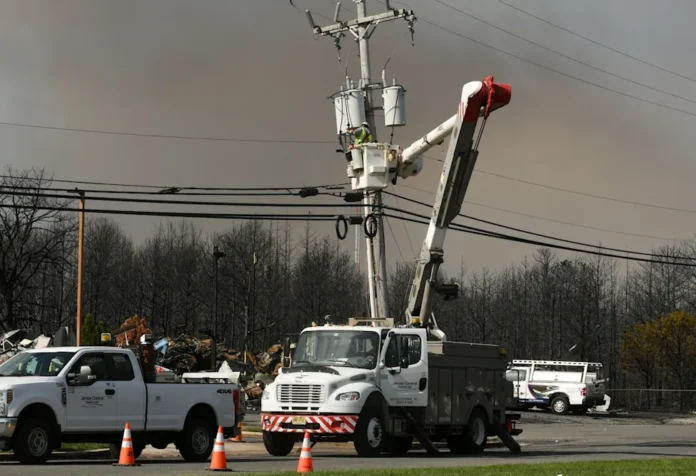

New Jersey’s utility companies have spent the past several days pulling off what state industry leaders are calling one of the most successful large-scale power restoration efforts in the state’s history, working around the clock to bring electricity back to hundreds of thousands of residents in the wake of a record-breaking heat wave followed almost immediately by a violent line of storms. The sequence of events left the state’s grid facing pressure from two directions at once, first from blistering, record-setting heat and then from the kind of severe, tree-toppling storms that turn a stressed grid into a genuinely widespread outage crisis.
The heat itself set records across New Jersey, with temperatures climbing past 100 degrees and combining with suffocating humidity intense enough to force the cancellation or postponement of Independence Day celebrations in communities throughout the state. That same oppressive heat helped fuel the severe thunderstorms that developed shortly afterward, sweeping across New Jersey, New York, Pennsylvania, and the broader Mid-Atlantic region. The storms slammed into New Jersey on the Friday night of the July 4th holiday weekend, toppling trees, snapping power lines, and leaving nearly 800,000 customers without electricity at the peak of the outages. The system tracked from the northern and central parts of the state down toward the Jersey Shore after 9 p.m., driving wind gusts that reached a genuinely destructive 70 miles per hour at both Newark Liberty International Airport and Perth Amboy, with gusts elsewhere across the state still reaching a substantial 64 to 67 miles per hour.
Despite the scale of that initial damage, New Jersey’s utilities have made remarkably steady progress restoring service in the days since. As of the morning of July 10, only 868 customers statewide remained without power, representing just 0.1 percent of all customers, a genuinely striking recovery given the size of the initial outage. The New Jersey Utilities Association reported that the state’s utility companies had roughly 15,000 workers engaged in restoration efforts around the clock, operating on a 24-hour, seven-day-a-week schedule to get the lights back on as quickly as possible.
Rich Henning, president and CEO of the New Jersey Utilities Association, credited much of that rapid turnaround to the mutual aid partnerships that bring in additional out-of-state utility workers during large-scale outage events. According to Henning, that kind of mutual aid multiplies available workforce capacity and meaningfully speeds up restoration timelines, a difference that matters enormously during extreme heat, when demand for electricity is running at its absolute highest and every additional hour without power carries real risk for vulnerable residents. In Henning’s assessment, that mutual aid response transformed what could have been a top-ten storm event by damage standards into one of the most successful large-scale power restoration efforts the state has ever completed, reinforcing the simple but essential principle that neighbors helping neighbors becomes genuinely critical once the grid comes under this kind of sustained stress.
Individual utility companies each mounted their own substantial restoration campaigns to reach that overall result. PSE&G restored power to more than 380,000 customers between July 1 and July 5 alone, a restoration effort that required replacing or repairing approximately 700 utility poles and clearing more than 1,500 trees just to safely access damaged equipment in the first place. The utility deployed 170 dedicated tree crews specifically to handle that clearing work, reflecting just how much of the storm’s damage came down to fallen trees tangled directly in power infrastructure rather than equipment failure alone.
Jersey Central Power & Light, a subsidiary of FirstEnergy Corp., mounted an even larger restoration operation, ultimately restoring power to more than 400,000 customers. The utility mobilized roughly 5,700 personnel to accomplish that, drawing on outside support from other FirstEnergy utilities, contracted crews, and mutual assistance partners from beyond New Jersey’s borders. That workforce included nearly 2,900 line workers alongside 1,400 foresters, and crews addressed more than 1,500 separate forestry work orders, many of which involved multiple downed trees tangled together at a single location. The physical scale of the damage JCP&L crews repaired was genuinely substantial, requiring the replacement of more than 500 broken utility poles and nearly 600 transformers, alongside the installation of more than 163,000 feet of new wire, just short of 31 total miles, giving a real sense of how much of the utility’s physical infrastructure needed to be rebuilt rather than simply repaired.
Atlantic City Electric moved quickly as well, restoring service to roughly 26,000 customers within the very first 24 hours following the storm, all while simultaneously responding to additional emergent issues created by the extreme heat itself straining portions of the local grid separately from the storm damage. The company confirmed that every customer whose service was affected by the weekend’s severe weather had power fully restored by Monday evening, a genuinely quick turnaround given the dual pressures of heat-related grid stress and storm damage happening simultaneously.
Rockland Electric Company, whose service territory spans both New Jersey and neighboring New York, restored power to more than 50,000 customers across its footprint, drawing on more than 150 mutual aid crew members brought in specifically to provide additional restoration support. The utility confirmed that every customer affected by the July 4th storm had service fully restored by Tuesday, closing out its portion of the broader statewide recovery effort within days of the initial damage.
Taken together, the speed and scale of this restoration effort across PSE&G, JCP&L, Atlantic City Electric, and Rockland Electric reflects a genuinely coordinated statewide response to back-to-back climate stresses arriving within days of each other. With record heat straining the grid’s capacity and a violent storm system following almost immediately behind it, New Jersey’s utilities leaned heavily on mutual aid partnerships, thousands of additional workers, and around-the-clock crews to bring outages down from nearly 800,000 customers to just a few hundred within roughly a week, a recovery timeline that industry leaders are already pointing to as a genuine model for how the state’s utility infrastructure can respond when extreme weather events compound on top of one another.
















