
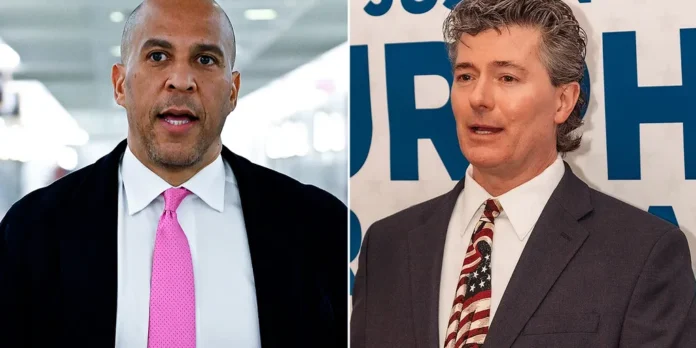

Justin Murphy may well be running one of the most anonymous Senate campaigns anywhere in the country this cycle, though that anonymity has far less to do with any shortcoming on his part than with the sheer scale of the race he’s stepped into. Murphy, a Republican from Burlington County, is not only campaigning in a state that has trended reliably blue for years, he’s doing so against Cory Booker, a genuinely national political figure whose name has already circulated as a potential 2028 presidential contender. Rather than treating that mismatch in name recognition as a disadvantage, Murphy has framed it as precisely the opening his campaign needs.
Murphy’s core strategic bet is straightforward: while Booker spends much of his time and attention on a national stage, Murphy intends to spend his campaigning directly across New Jersey, county by county. That approach brought him to a local American Legion hall in a Middlesex County town this past Friday night for a town hall, following a similar stop in Mercer County the night before. Murphy has committed to holding at least one town hall in all 21 of New Jersey’s counties, a genuinely ambitious retail politics strategy in an era when many statewide campaigns lean far more heavily on television advertising and digital outreach than face-to-face events. Roughly 70 people turned out for Friday’s gathering, a respectable showing for a summer weeknight event, even if it’s a fraction of the audience a race of this magnitude would typically draw in a presidential election year.
Murphy has been direct in arguing that his opponent is taking the race for granted, a characterization that carries real weight when applied to New Jersey’s Democratic establishment and much of the state’s political media coverage, both of which have shown limited early attention to a Senate contest widely assumed to favor Booker comfortably. Whether that same critique holds up when applied to Republican voters themselves is a considerably more complicated question. Last month’s four-candidate Republican Senate primary drew fewer than 250,000 total voters statewide, hardly evidence of surging enthusiasm within the party’s own base, and Murphy ultimately won that primary with only about a third of the overall vote. Murphy doesn’t dispute those numbers. He simply argues that Republicans currently offer what he describes as a better vision for both the state and the country, framing his campaign around the need for genuine ideas, a clear vision, and the willingness to fight for both rather than simply hoping favorable political winds carry the party forward.
Asked to identify his central campaign issue, Murphy pointed immediately to affordability, a word choice that might initially sound more at home in a Democratic stump speech than a Republican one. Murphy’s framing of the issue, though, runs in a very different direction than how Democrats typically deploy it. He pointed back to the economic conditions under President Joe Biden, recalling inflation and interest rates that approached 10 percent and a stretch in 2022 when gas prices climbed to nearly $5 a gallon nationally. By contrast, Murphy argued that inflation and interest rates have both dropped considerably since then, while wages and domestic oil production have risen. His broader argument holds that to the extent New Jersey residents are still struggling financially today, responsibility lies with the Democratic leadership running Trenton rather than with Donald Trump’s presence in the White House, a distinction Murphy has clearly built into the core of his affordability pitch.
Murphy describes himself as a pro-life, Reagan-style Republican, and he’s built out a broader platform around several familiar conservative priorities beyond affordability. He has made parental rights a significant plank of his campaign, argued that so-called sanctuary cities should face financial penalties for their policies, and voiced support for the SAVE Act as it relates to election integrity measures. Longtime observers of New Jersey politics will likely recognize much of that same platform from Jack Ciattarelli’s gubernatorial campaign last year, a campaign that ultimately fell short by 15 points statewide, a result that raises real questions about how much traction this particular combination of issues can generate in a state where Republicans haven’t won a statewide race in over a decade.
Murphy, for his part, doesn’t appear especially rattled by that history, and he’s pointed instead to a handful of data points he considers genuinely encouraging. He noted that Trump came remarkably close to winning New Jersey outright in 2024, pulling in nearly 2 million votes in the process, and that Ciattarelli, despite his eventual loss, still received roughly 150,000 more votes last year than he did in his previous 2021 run for governor. Murphy also pointed to New Jersey’s Republican voter registration numbers, which currently sit above 1.6 million, the highest total the party has ever recorded in the state. Taken together, Murphy argues, these are the kinds of signals Republicans need to focus on, draw inspiration from, and use as genuine motivation heading into the fall.
Murphy is realistic about the ceiling on his own persuasive power. He’s acknowledged plainly that voters who simply dislike Trump were never going to be won over regardless of his own campaign message, and he understands the broader structural challenge facing any midterm campaign, since turnout in midterm elections typically runs considerably lower than in presidential cycles, often dipping below 50 percent of eligible voters. That reality defines the actual challenge sitting at the center of Murphy’s campaign, one that’s simple to describe but considerably harder to execute: turning out voters who don’t typically show up for a midterm election at all. As Murphy put it, if Republicans can get organized, energized, and present a genuinely conservative platform to voters, he believes people will respond to that message, a bet his campaign will spend the rest of this year testing county by county, town hall by town hall, against one of the most recognizable names in national Democratic politics.
















