
For nearly nine decades, the Mayo Performing Arts Center has stood as one of New Jersey’s defining cultural institutions. Long before Morristown evolved into one of the state’s premier downtown destinations for dining, nightlife, business, and arts programming, the theater already occupied a central place within the community’s identity. Generations of audiences have passed through its doors. Broadway tours, symphony performances, comedians, dance companies, educational programs, film screenings, and nationally recognized artists have all contributed to transforming the venue into far more than a traditional theater. It has functioned as a civic anchor for Morris County and one of the most important regional arts institutions anywhere in the state.
Now, the organization is preparing for the most ambitious transformation in its history.
On May 6, 2026, the Mayo Performing Arts Center officially broke ground on a sweeping $65 million expansion and restoration project that will dramatically reshape both the theater itself and the surrounding Morristown arts corridor. The project represents not only a major investment into the future of MPAC, but also a significant statement about the evolving role arts institutions continue to play in New Jersey’s economic, educational, and cultural infrastructure.
The scale of the project is difficult to overstate.
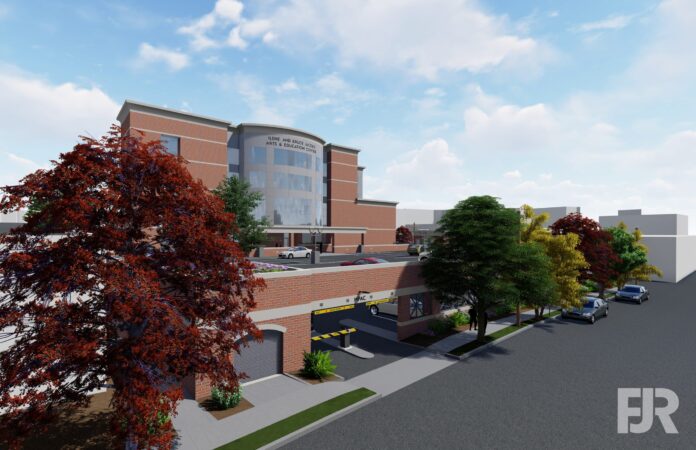
At the center of the expansion is the creation of the new Ilene and Bruce Jacobs Arts & Education Center, a 31,000-square-foot addition that will rise directly behind the historic theater. The facility is designed to become a major educational and community arts hub while simultaneously modernizing MPAC’s operational capacity for the next generation of performances, touring productions, and arts programming.
Importantly, the expansion is not being framed as modernization for modernization’s sake.
What makes the project particularly compelling is the organization’s effort to balance large-scale growth with historic preservation. MPAC’s original 1937 Art Deco character remains central to the theater’s identity, and the restoration effort appears designed to preserve that architectural legacy rather than erase it beneath contemporary redesign trends that have affected many older performance venues across the country.
That decision matters culturally.
Historic theaters occupy a unique position within American downtowns. Unlike new entertainment venues designed primarily around efficiency or capacity, older theaters carry emotional memory embedded directly into their architecture. Their lobbies, balconies, facades, seating layouts, plasterwork, and stage design become part of a community’s collective experience over decades. Preserving those details while upgrading infrastructure requires both financial commitment and institutional restraint.
MPAC appears determined to accomplish both.
The historic 1,300-seat theater itself will undergo extensive restoration work, including new period-style seating, repairs to aging Art Deco plaster finishes, upgraded public areas, and refreshed lobby spaces designed to maintain the venue’s original visual character while improving overall guest experience. Outdoor public spaces surrounding the theater will also be redesigned and modernized, further integrating the venue into Morristown’s increasingly active pedestrian-centered downtown environment.
But while restoration preserves the theater’s past, the expansion clearly focuses on its future.
The new Ilene and Bruce Jacobs Arts & Education Center represents a major escalation of MPAC’s educational ambitions. The facility will house the Jacobs Performing Arts School, creating a significantly larger and more sophisticated educational environment for students throughout the region. Seven dedicated education studios will support expanded arts instruction, rehearsals, workshops, and youth programming, while a new 150-seat rehearsal and performance space will create additional opportunities for smaller-scale productions, community events, student showcases, and developmental programming.
That educational component may ultimately become one of the project’s most important long-term contributions.
Arts education has increasingly become one of the most unstable areas within public education systems nationwide. Budget reductions, shifting curriculum priorities, and uneven district funding have left many arts organizations serving as supplemental educational institutions alongside schools themselves. Regional arts centers like MPAC increasingly occupy dual roles as both entertainment venues and educational providers, helping expose younger generations to music, theater, dance, visual arts, and live performance experiences that might otherwise become inaccessible.
The expansion acknowledges that reality directly.
Production infrastructure also forms a major part of the project’s scope. As touring productions become more technologically demanding and logistically complex, older theaters frequently face operational limitations involving load-in capacity, backstage movement, freight access, storage, and dressing room accommodations. MPAC’s expansion addresses those challenges through new loading facilities, a freight elevator system, modernized backstage areas, and upgraded technical support infrastructure designed to accommodate larger national productions and more advanced touring shows.
That operational modernization carries major implications not only for the theater itself but for Morristown’s local economy overall.
According to officials associated with the project, MPAC already functions as an estimated $18 million annual economic engine for surrounding businesses. Restaurants, bars, hotels, retail shops, parking operations, and surrounding hospitality businesses all benefit directly from theater traffic generated throughout the year. On performance nights, downtown Morristown’s economic activity is visibly tied to the movement of audiences entering and leaving the theater district.
In that sense, the expansion is not simply an arts project.
It is also a downtown development project.
Over the last fifteen years, Morristown has steadily evolved into one of New Jersey’s most vibrant mixed-use downtowns. Residential growth, office redevelopment, hospitality expansion, nightlife activity, and restaurant investment have transformed the town into a destination far beyond its historical identity as a commuter suburb or Revolutionary War landmark. MPAC has remained central to that transformation, serving as one of the foundational institutions helping anchor Morristown’s cultural identity amid its broader economic evolution.
This new expansion reinforces that role significantly.
The project also highlights the increasingly important relationship between public-private partnerships and large-scale arts development throughout New Jersey. Major funding support includes a substantial $7.5 million lead gift from Ilene and Bruce Jacobs, whose names will now become permanently associated with the new arts and education center. Additional support comes through the New Jersey Economic Development Authority’s CAFE Program, which contributed $65 million in tax credits toward the project.
That type of state-level investment into arts infrastructure reflects a broader recognition that cultural institutions are no longer viewed solely as nonprofit amenities. Increasingly, they are being treated as economic drivers capable of generating tourism, business activity, educational development, and regional identity simultaneously.
New Jersey’s arts sector has become increasingly central to redevelopment conversations throughout cities and suburban downtowns alike. From Newark and Jersey City to Asbury Park, Red Bank, Princeton, Montclair, and Morristown, cultural venues have emerged as essential anchors in broader urban and suburban revitalization strategies.
MPAC’s expansion exists directly within that larger statewide movement.
The project’s timeline also underscores its scale. Construction is expected to continue for approximately 18 to 24 months, with likely completion targeted for late 2027 or early 2028. Despite the magnitude of the renovation, the theater itself is expected to remain operational through much of the process, allowing performances and programming to continue while construction progresses around the facility.
That continuity feels particularly symbolic.
Rather than shutting down completely during redevelopment, MPAC will continue functioning as an active performance venue while simultaneously reinventing itself in real time. That balancing act mirrors the larger challenge facing many historic arts institutions across America today: preserving tradition while adapting aggressively enough to remain relevant, competitive, and financially sustainable within rapidly changing entertainment and cultural landscapes.
MPAC appears intent on doing both.
The addition of spaces like the Starlight Veranda, new meeting and reception areas overlooking Pine Street, dedicated gallery space, and expanded community gathering areas further demonstrates how modern arts institutions increasingly function as multi-use civic environments rather than single-purpose theaters. Today’s successful performing arts centers often operate simultaneously as concert halls, educational facilities, business event venues, public gathering spaces, and community cultural hubs.
This expansion positions MPAC firmly within that future.
At a moment when arts funding, downtown development, cultural preservation, and economic growth are all intersecting throughout New Jersey, the Mayo Performing Arts Center project stands as one of the most ambitious arts infrastructure investments currently underway anywhere in the region.
And when construction is complete, Morristown will not simply have a restored theater.
It will have one of the most advanced and culturally significant performing arts campuses in the Northeast, built upon nearly ninety years of history while positioning itself for decades still to come.