
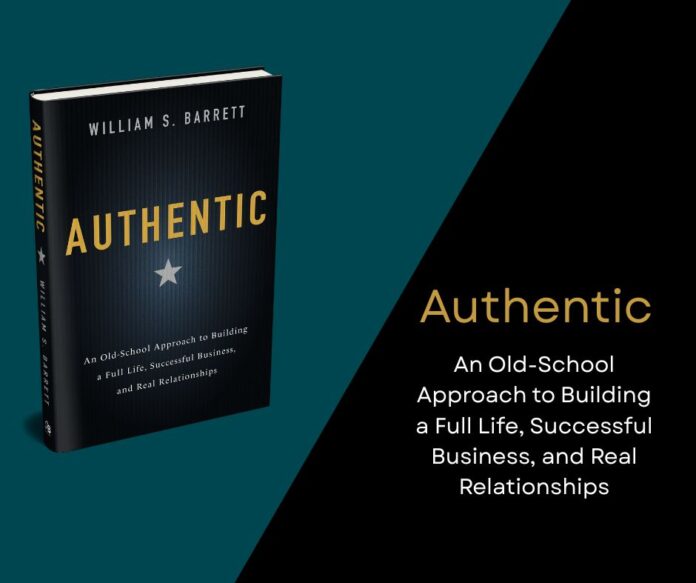

At a time when modern business culture increasingly revolves around automation, personal branding algorithms, remote networking, digital optimization, and transactional online relationships, New Jersey attorney and business leader William S. Barrett is making a deliberate argument for something many executives believe corporate America has quietly lost: authentic human connection.
That philosophy sits at the center of Authentic: An Old-School Approach to Building a Full Life, Successful Business, and Real Relationships, the newly released leadership and personal development book authored by Barrett, the Chief Executive Officer of Roseland-based law firm Mandelbaum Barrett PC.
Officially published May 12, 2026, the book enters the business leadership conversation during a period of enormous cultural and professional reevaluation across industries nationwide. Companies continue navigating the long-term effects of remote work expansion, AI-driven communication systems, shifting workplace identity, declining in-person interaction, and increasing concerns surrounding burnout, isolation, and transactional networking culture.
Barrett’s central argument directly challenges many of those trends.
Rather than presenting another productivity-hack manifesto or hyper-optimized entrepreneurial framework, Authentic instead advocates for what Barrett describes as an “old-school” approach rooted in resilience, trust, relationship-building, integrity, and face-to-face investment. The book positions genuine interpersonal connection not as nostalgic sentimentality, but as a strategic and sustainable foundation for long-term personal and professional success.
That message appears intentionally countercultural within today’s business climate.
Much of modern leadership literature increasingly emphasizes speed, scalability, audience growth, passive systems, automation, digital reach, and rapid transactional efficiency. Barrett’s approach instead centers on slower, relationship-driven business development models built around trust accumulation, personal reputation, emotional reliability, and local community connection.
For Explore New Jersey readers following the evolving intersection of business, leadership culture, entrepreneurship, and personal development, Authentic represents an especially interesting addition to the state’s growing ecosystem of executive thought leadership emerging directly from New Jersey-based companies and professionals.
Importantly, Barrett is not approaching these themes from outside corporate leadership structures.
As CEO and Co-Chair of the Corporate Practice Group at Mandelbaum Barrett PC, Barrett operates within one of New Jersey’s most established legal and business advisory environments. His career has involved direct exposure to mergers, acquisitions, negotiations, partnerships, entrepreneurial development, corporate structuring, and the often intensely interpersonal realities underlying business growth itself.
That experience appears central to the book’s credibility.
Rather than offering purely theoretical motivational commentary, Barrett frames his ideas around years of observing how relationships, reputation, communication style, and trust influence real business outcomes. The book’s core thesis argues that many contemporary professional environments have become overly dependent on transactional efficiency while undervaluing the human relationships that ultimately sustain meaningful long-term success.
That tension increasingly defines modern professional culture itself.
Across industries, professionals continue debating how technology-driven communication and remote infrastructure have reshaped workplace identity, mentorship structures, networking behavior, and emotional connection inside organizations. While digital tools have increased flexibility and scalability, many business leaders simultaneously report growing concerns surrounding isolation, weakened mentorship dynamics, reduced interpersonal loyalty, and increasingly superficial professional relationships.
Barrett’s book appears to directly address that cultural shift.
According to the book’s official release materials, Authentic argues that sustainable success requires rebuilding deeper forms of interpersonal investment often associated with earlier generations of business culture. Rather than dismissing modern technology entirely, the book instead questions whether excessive dependence on digital communication has eroded essential relationship-building instincts historically central to successful leadership.
That perspective likely resonates strongly with many executives currently navigating hybrid workplace environments where company culture, employee engagement, and long-term organizational trust have become increasingly difficult to maintain.
One of the most compelling aspects of the book appears to be its personal foundation.
Barrett reportedly credits much of the philosophy behind Authentic to lessons learned directly from his father, who grew up poor in the Bronx and emphasized values centered around work ethic, resilience, loyalty, humility, and personal accountability. That generational influence gives the book a more grounded emotional framework than many contemporary leadership titles built primarily around personal branding or optimization theory.
The emphasis on “old-school” values is not presented as resistance to progress itself.
Instead, Barrett appears to argue that modern professionals risk abandoning foundational human principles in pursuit of speed, convenience, and transactional advancement. Trust, consistency, reputation, and genuine relationship-building, according to the book’s philosophy, remain irreplaceable competitive advantages even within increasingly digitized industries.
That argument becomes especially interesting within the legal and corporate advisory sectors where reputation and long-term trust relationships often determine career sustainability more than short-term visibility alone.
The book also reportedly emphasizes actionable business principles rather than purely abstract motivational language.
Among the core takeaways outlined in launch materials are strategies centered around building localized trust, approaching business relationships with abundance rather than scarcity, converting setbacks into defining career opportunities, and outperforming competitors without sacrificing personal life stability.
Those themes reflect another growing shift within leadership literature.
Increasingly, business audiences appear less interested in aggressive “hustle culture” frameworks glorifying burnout, relentless optimization, and performative overwork. Instead, professionals are searching for more sustainable models balancing career achievement with personal fulfillment, emotional health, family life, and meaningful social connection.
Barrett’s emphasis on building a “full life” alongside professional success positions Authentic directly within that broader cultural conversation.
The book’s release also highlights New Jersey’s increasingly significant role within the national leadership, entrepreneurship, and professional-services ecosystem.
For decades, New Jersey’s corporate identity was often overshadowed nationally by neighboring New York and Philadelphia. Yet the state has steadily evolved into one of the country’s most influential centers for healthcare, legal services, finance, logistics, biotechnology, pharmaceuticals, real estate, and entrepreneurial development.
Leadership voices emerging from those industries increasingly contribute to national conversations surrounding workplace culture, business ethics, organizational structure, and professional identity.
Roseland-based Mandelbaum Barrett itself represents part of that broader evolution.
Modern law firms increasingly operate not merely as legal service providers, but as multidisciplinary advisory institutions influencing business strategy, healthcare operations, mergers and acquisitions, risk management, succession planning, and entrepreneurial development. Leaders within those environments often possess unusually broad visibility into how modern businesses actually function beneath public-facing branding narratives.
That perspective appears deeply embedded within Barrett’s writing approach.
The book’s title — Authentic — itself reflects a growing cultural preoccupation with sincerity, transparency, and emotional credibility within professional environments increasingly saturated by digital performance and curated personal branding.
Consumers, employees, and business partners now frequently evaluate leaders not only by technical competence, but by perceived trustworthiness, consistency, emotional intelligence, and personal integrity. That cultural shift has fundamentally changed expectations surrounding leadership communication itself.
Barrett’s argument appears to suggest that authenticity is no longer merely a moral virtue.
It is becoming a competitive necessity.
The book’s emphasis on making business “personal” again also aligns with broader trends happening throughout entrepreneurship and regional economic development across New Jersey. Particularly among smaller and mid-sized businesses, relationship-driven local trust networks remain enormously important despite the rise of national digital marketplaces.
In many industries, personal referrals, long-term reputation, community integration, and face-to-face credibility continue driving business growth more effectively than algorithmic visibility alone.
That reality may explain why Barrett’s message resonates particularly strongly right now.
Professionals increasingly operate inside environments where technological efficiency continues accelerating while emotional connection simultaneously becomes more fragile. Many executives and entrepreneurs now openly acknowledge concerns about loneliness, detachment, weakened mentorship, shallow networking culture, and the psychological cost of constant digital performance.
Books like Authentic gain traction because they address those anxieties directly.
Rather than promising overnight transformation, Barrett appears to advocate for slower, deeper, relationship-centered growth models built around trust accumulation and human consistency.
That perspective may ultimately be what distinguishes the book most sharply from much of today’s crowded business-literature marketplace.
For Explore New Jersey readers following leadership culture, entrepreneurship, executive development, and the state’s expanding influence within national business conversations, Authentic arrives as both a personal philosophy book and a broader cultural critique of modern professional life itself.
And in an era increasingly defined by automation, remote interaction, and transactional digital communication, Barrett’s argument is ultimately striking in its simplicity:
Long-term success may still depend less on mastering systems than on mastering relationships.
















