
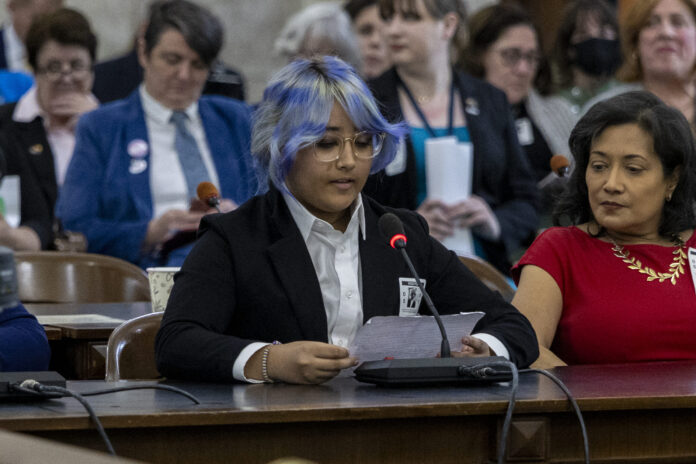

One of the most politically charged healthcare debates unfolding anywhere in New Jersey this year intensified dramatically this week as the New Jersey Senate Health Committee voted 5–2 along party lines to advance Senate Bill 2260, a sweeping healthcare “shield law” designed to expand legal protections for patients and providers connected to abortion access and gender-affirming medical care.
The Monday, May 11 committee hearing lasted more than two hours and quickly evolved into one of the most emotionally intense legislative sessions of the current Statehouse calendar. Medical professionals, LGBTQ+ advocates, parents, religious organizations, legal experts, healthcare workers, and conservative opposition groups packed testimony sessions that reflected just how nationally significant New Jersey’s healthcare policy direction has become.
At the center of the debate sits a broader question increasingly shaping political battles across the United States: how far individual states are willing to go to protect healthcare services that remain legal within their borders while other states continue imposing new restrictions, investigations, and legal penalties connected to reproductive healthcare and transgender medical treatment.
New Jersey’s Democratic leadership is making it increasingly clear that the state intends to position itself as one of the country’s strongest legal protection zones for both categories of care.
Sponsored by Senate President Nick Scutari and Senate Majority Leader Teresa Ruiz, Senate Bill 2260 significantly expands protections originally established under executive actions issued in 2023. Supporters argue the legislation is necessary because executive orders alone can be reversed by future administrations, whereas statutory law provides stronger long-term legal durability.
The proposed legislation now moving through the Legislature would establish a broad series of legal, privacy, insurance, and enforcement protections tied directly to reproductive and gender-affirming healthcare services.
Perhaps the most consequential component involves interstate legal protections.
Under the bill, New Jersey law enforcement agencies and state authorities would be prohibited from cooperating with out-of-state investigations, subpoenas, or extradition efforts targeting individuals who travel to New Jersey either to receive or provide reproductive healthcare or gender-affirming medical treatment that remains legal under New Jersey law.
That provision places New Jersey directly within the growing national movement of “shield law” states attempting to insulate healthcare providers and patients from increasingly conflicting interstate legal systems.
The issue has become especially significant as abortion restrictions and transgender healthcare laws continue diverging dramatically between states following recent federal legal and political shifts. Supporters of the legislation argue that healthcare providers increasingly face uncertainty regarding potential liability exposure, licensing concerns, legal harassment, and cross-state investigations even when operating fully within New Jersey law.
The bill also creates a new criminal offense specifically targeting interference with reproductive or gender-affirming healthcare services.
That section addresses activities including blocking entrances to healthcare facilities, intimidating patients, obstructing access, or recording individuals within one hundred feet of medical facilities providing protected care. Supporters characterize the provision as a modernization of healthcare access protections designed to respond to increasingly confrontational protest tactics and heightened security concerns surrounding politically sensitive medical services.
Another major component involves insurance regulation.
The legislation would prohibit health insurance providers from denying, limiting, or restricting coverage related to medically necessary services connected to abortion care, gender transition, or gender identity treatment. Advocates argue the provision is essential because insurance access increasingly determines whether legal healthcare remains practically accessible for many patients.
Privacy protections within the bill have also emerged as one of the most heavily debated elements.
Senate Bill 2260 would expand definitions surrounding protected medical information and place tighter restrictions on the disclosure of treatment records without explicit written patient consent. Supporters argue those safeguards are necessary to protect patients and providers from politically motivated investigations or public targeting campaigns tied to legally protected healthcare services.
Opponents, however, argue the expanded protections could complicate legitimate oversight, malpractice review, or interstate legal cooperation.
Those competing interpretations became sharply visible throughout Monday’s hearing.
Supporters framed the legislation as an urgent response to a rapidly shifting national healthcare landscape. Advocacy groups including Garden State Equality argued repeatedly that New Jersey must proactively strengthen legal protections before federal or interstate conflicts intensify further.
Several advocates and healthcare professionals testified that fear surrounding legal retaliation and professional exposure has already begun affecting provider behavior inside New Jersey itself. According to testimony presented during the hearing, some hospitals and healthcare systems have reportedly become more cautious regarding transgender patient intake or public visibility surrounding certain services due to growing political scrutiny nationally.
For supporters, the bill functions not simply as symbolic legislation, but as a practical attempt to stabilize healthcare access within an increasingly fragmented national legal environment.
Transgender youth and LGBTQ+ advocates delivered some of the hearing’s most emotional testimony, describing fears surrounding future access to care and concerns about whether providers may gradually retreat from offering services under mounting political pressure.
Medical professionals meanwhile emphasized concerns regarding provider recruitment, retention, and institutional uncertainty.
Opponents of the legislation presented an equally forceful counterargument.
Republican lawmakers and conservative organizations including New Jersey Right to Life criticized both the scope and speed of the legislation’s advancement. Several opponents argued the bill risks creating legal barriers that could obstruct legitimate interstate cooperation tied to healthcare oversight, parental disputes, or malpractice concerns.
Some critics also objected strongly to what they described as last-minute amendments added to portions of the bill language prior to committee review. Others argued the legislation could encourage New Jersey to become a destination for out-of-state medical travel connected to politically contentious procedures, increasing national attention and interstate legal friction surrounding the state.
The hearing itself revealed just how emotionally charged healthcare policy debates have become throughout the country.
At multiple points, testimony moved beyond technical legislative language into broader cultural and philosophical arguments surrounding parental rights, bodily autonomy, medical ethics, privacy, federalism, and the role of state governments in defining healthcare access boundaries.
In many ways, the hearing reflected the broader national fragmentation currently reshaping healthcare law in the United States.
States increasingly operate not merely as administrative jurisdictions, but as fundamentally different legal ecosystems with sharply divergent approaches to abortion access, transgender healthcare, privacy protections, insurance mandates, and provider liability. That divergence has elevated interstate legal conflicts into one of the defining constitutional and political issues now confronting legislatures nationwide.
New Jersey’s Democratic leadership appears fully aware that Senate Bill 2260 carries national significance beyond state borders alone.
The legislation’s rapid movement through committee signals strong momentum within the Democratic-controlled Legislature. A companion Assembly version, A2218, is already scheduled for an immediate hearing before the Assembly Health Committee on Thursday, May 14, suggesting leadership intends to advance the proposal quickly through the legislative process.
If both chambers ultimately approve the bill, it would then head to Governor Mikie Sherrill for final signature consideration.
The broader political implications are substantial.
New Jersey has increasingly positioned itself as one of the Northeast’s strongest legal protection states regarding reproductive rights and LGBTQ+ healthcare access. Senate Bill 2260 represents another major step in codifying that identity directly into statutory law rather than relying primarily on executive policy frameworks.
At the same time, the controversy surrounding the legislation reflects how healthcare policy itself has become deeply intertwined with larger national debates surrounding federalism, state sovereignty, civil rights protections, and cultural identity.
For Explore New Jersey readers following the evolving intersection of healthcare, law, politics, and public policy throughout the Garden State, the Senate Health Committee hearing demonstrated that these issues are no longer abstract national conversations happening elsewhere.
They are now unfolding directly inside New Jersey’s legislative chambers, healthcare systems, court structures, and local communities.
And as Senate Bill 2260 continues moving through the Statehouse, New Jersey increasingly finds itself operating at the center of one of the country’s most consequential and emotionally divisive healthcare policy battles.
















