
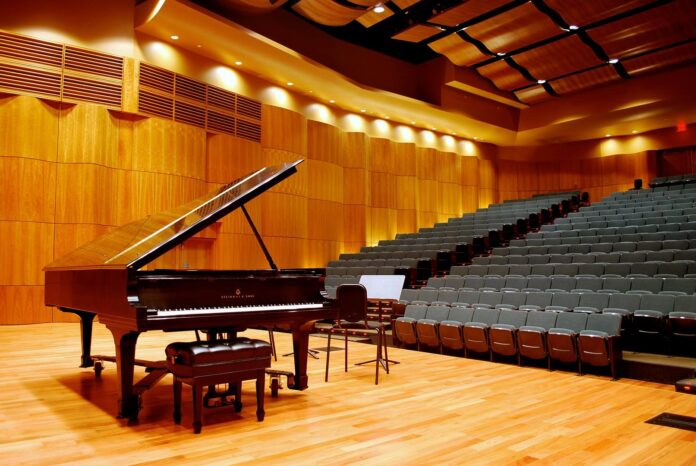

As modern architecture continues evolving toward open-concept design, minimalist aesthetics, glass-heavy construction, collaborative workspaces, and large-scale mixed-use interiors, one problem has quietly intensified across commercial buildings everywhere: noise.
Corporate offices echo. Restaurants become unintelligible. University lecture halls struggle with speech clarity. Performance spaces fight acoustic inconsistency. Healthcare facilities face growing concerns surrounding sound-related stress and patient recovery environments. Even luxury hospitality projects increasingly confront a difficult balancing act between visual elegance and functional acoustic performance.
That growing challenge is exactly where RPG Acoustical Systems, LLC is positioning its newest innovation.
The company, widely recognized as one of the leading manufacturers of architectural sound-control products, has officially launched the Perfecto® Micro Quick Ship Program, an advanced line of high-performance acoustical wall and ceiling panels engineered to absorb sound waves while preserving the visual appearance of luxury wood millwork.
What makes the system especially notable is that much of its acoustic technology is effectively invisible.
At first glance, the panels appear almost indistinguishable from premium solid wood architectural surfaces commonly found throughout high-end offices, performance venues, universities, hospitality environments, and executive interiors. But beneath that refined appearance sits an extraordinarily complex sound-management system built around microscopic laser perforation engineering.
Each 4-foot by 8-foot panel reportedly contains more than 700,000 laser-drilled perforations measuring roughly 0.4 millimeters wide — openings so small they become nearly imperceptible to the human eye at normal viewing distance.
Those microscopic perforations fundamentally transform how the surface interacts with sound.
Rather than reflecting sound waves back into a room — the primary cause of echo, reverberation, speech distortion, and acoustic fatigue — the perforated system captures and absorbs sound energy with remarkably high efficiency. According to the product specifications, the panels achieve a Noise Reduction Coefficient rating of up to 0.95, meaning they can absorb as much as 95 percent of the sound energy striking the surface.
Within the architectural acoustics industry, that level of performance places the system among the highest-functioning commercial acoustic treatment solutions currently available.
For Explore New Jersey readers following innovation, engineering, architecture, commercial development, and emerging building technologies, the launch reflects a much larger shift currently reshaping modern interior design and construction itself.
Acoustics are no longer treated as secondary technical concerns hidden behind decorative finishes or retrofitted after project completion.
They are increasingly becoming central design priorities integrated directly into the earliest stages of architectural planning.
That transformation is happening because contemporary building design has fundamentally changed how sound behaves indoors.
For years, modern architecture prioritized openness, reflective materials, exposed ceilings, hard surfaces, and expansive shared environments designed to maximize natural light and spatial flexibility. While visually striking, many of those spaces unintentionally created severe acoustic problems. Glass, concrete, polished wood, steel, and open-floor layouts frequently amplify reverberation while reducing speech intelligibility and increasing cognitive fatigue.
As workplace culture, wellness research, and educational design continue evolving, architects and developers are placing much greater emphasis on sound quality as a core component of human experience inside buildings.
Acoustics now directly influence productivity, stress levels, communication clarity, concentration, hospitality comfort, educational performance, and even long-term employee satisfaction.
RPG Acoustical Systems’ new Perfecto® Micro QSP line appears engineered specifically around that intersection between acoustic science and visual design sophistication.
The key breakthrough may not simply be sound absorption alone.
It is the ability to achieve extremely high acoustic performance without visually disrupting premium interior aesthetics.
Historically, many commercial acoustic treatments carried an obvious visual identity. Foam panels, exposed absorptive materials, visible perforations, or industrial-looking sound treatments often forced architects into aesthetic compromises. Designers frequently faced difficult decisions between preserving a clean luxury visual environment or implementing the acoustic control necessary for functional comfort.
The Perfecto® Micro system attempts to eliminate that tradeoff entirely.
From standard viewing distances, the panels reportedly maintain the appearance of uninterrupted high-end wood surfaces while simultaneously functioning as sophisticated acoustic absorbers. That combination allows designers to preserve minimalist visual continuity without sacrificing sound performance.
The timing of the launch is particularly significant because demand for acoustically optimized interiors is accelerating rapidly across multiple industries.
Corporate office design increasingly prioritizes acoustic wellness as companies attempt to improve collaboration without creating distraction-heavy environments. Universities and lecture halls continue investing heavily in speech intelligibility systems tied directly to learning outcomes. Hospitality developers now recognize that sound quality significantly influences guest perception inside restaurants, hotels, and luxury gathering spaces.
Performance venues, meanwhile, continue seeking solutions capable of balancing aesthetic sophistication with precision acoustic control.
The “Quick Ship Program” component of the launch may ultimately prove just as important commercially as the technology itself.
Traditionally, custom architectural wood acoustics involve lengthy fabrication schedules, specialized production timelines, and extended delivery delays that can disrupt fast-track construction schedules. High-end acoustic millwork frequently requires months of lead time, particularly for projects involving customized specifications or complex architectural integration.
RPG’s QSP designation reportedly reduces that timeline dramatically.
According to launch specifications, the company can manufacture and ship the ready-to-install panel systems within approximately two weeks of order placement — an unusually fast turnaround for high-performance architectural acoustical products.
That acceleration matters enormously within today’s construction economy.
Commercial development schedules increasingly operate under aggressive completion demands driven by financing structures, tenant timelines, labor coordination, and rising project costs. Delays tied to specialty materials can ripple through entire construction schedules. Products capable of combining premium customization aesthetics with rapid fulfillment become highly attractive to architects, developers, contractors, and project managers operating under compressed deadlines.
The system’s field-cutting flexibility further strengthens its appeal.
One of the long-standing frustrations surrounding many acoustical panel systems is that they often lose structural integrity or acoustic effectiveness when modified on-site. Standard panels can crack, crumble, chip, or become visually compromised during installation adjustments.
The Perfecto® Micro QSP reportedly addresses that issue through a proprietary Flex core MDF backing allowing contractors to safely cut and trim panels directly on-site without damaging performance integrity.
That capability may sound technical, but within construction and architectural installation environments it represents a major operational advantage.
Real-world job sites rarely align perfectly with idealized architectural dimensions. Contractors routinely encounter unexpected field conditions requiring material adjustments, corner modifications, ceiling transitions, or wall refinements during installation. Materials capable of adapting to those realities without failure save both time and labor cost while reducing installation risk.
The environmental and regulatory components of the system also reflect broader trends reshaping modern building specification standards.
The panels reportedly utilize sustainable reconstituted wood veneers available in SoniQ™ White Oak and SoniQ™ Walnut finishes, aligning with growing demand for environmentally conscious architectural materials. Additionally, the use of ultra-low emitting formaldehyde cores meeting strict California air-quality and fire-safety standards reflects increasing emphasis on indoor environmental health throughout commercial construction.
That focus on environmental compliance and material safety continues growing particularly important in healthcare, education, government, and wellness-oriented development sectors.
The visual finish options themselves also align strongly with current architectural design trends.
White oak aesthetics continue dominating contemporary commercial and hospitality interiors due to their warm modern appearance, while walnut finishes remain associated with executive environments, luxury hospitality spaces, and darker contemporary design palettes. By aligning acoustic technology with current luxury finish preferences, RPG appears intentionally positioning the system not merely as technical infrastructure but as a design-forward architectural product.
The launch also reflects New Jersey’s continued role within advanced manufacturing, engineering innovation, and building technology development.
While the public conversation surrounding innovation often focuses heavily on consumer electronics or software platforms, enormous technological advancement continues happening inside industrial engineering sectors tied to architecture, materials science, acoustics, environmental systems, and commercial infrastructure.
Products like the Perfecto® Micro QSP demonstrate how deeply specialized engineering increasingly shapes everyday human experience inside buildings.
Most occupants may never consciously notice microscopic acoustic perforation systems embedded within luxury wood panels. Yet they immediately experience the results through clearer conversation, lower fatigue, reduced echo, improved focus, and more comfortable spatial environments.
That invisible performance may ultimately be the product’s defining achievement.
For Explore New Jersey readers following cutting-edge innovation, architectural technology, commercial design, and the future of intelligent building systems, RPG Acoustical Systems’ newest launch represents more than another construction material announcement.
It reflects the growing realization that modern buildings must now function not only visually, but psychologically and acoustically as well.
And in an era increasingly dominated by open environments, collaborative workspaces, immersive public interiors, and experience-driven architecture, the ability to engineer silence without sacrificing beauty may become one of the most valuable design technologies of all.
















