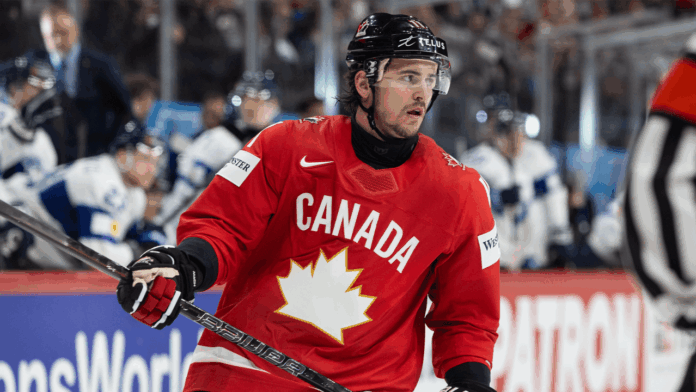

Even though the Stanley Cup Playoffs are continuing without either New Jersey or Philadelphia still alive in the bracket, the rivalry between the Devils and Flyers is quietly extending far beyond the NHL postseason this spring as both organizations send an intriguing blend of established stars, emerging young talent, and future cornerstone players to the 2026 IIHF Men’s World Championship beginning May 15 in Zurich and Fribourg.
For fans across the Northeast corridor, this year’s tournament carries a distinctly Metropolitan Division flavor.
The Devils arrive heavily represented by internationally proven NHL talent and veteran leadership figures, while the Flyers enter the tournament cycle showcasing something very different: the organization’s rapidly evolving youth movement and next generation of high-ceiling prospects now beginning to emerge onto the world stage.
Taken together, the tournament effectively becomes an early international preview of where both franchises may be heading in the years ahead.
For New Jersey specifically, the 2026 IIHF World Championship arrives carrying a mixture of pride, unfinished business, and long-term organizational optimism. While the Devils failed to extend their NHL season into a deeper playoff run, the franchise’s global footprint remains remarkably strong as several key members of the roster immediately transition into major international responsibilities.
At the center of that storyline sits Team Switzerland.
As one of the host nations for this year’s championship tournament, Switzerland enters the event under enormous national pressure and expectation, and the Devils will once again form the backbone of that effort. Captain Nico Hischier and power winger Timo Meier are both preparing to represent the host country in front of passionate home crowds expected to transform Zurich and Fribourg into some of the loudest hockey environments anywhere outside the Stanley Cup Playoffs themselves.
For Hischier, the tournament represents more than another international appearance.
He has increasingly become one of the defining faces of modern Swiss hockey. Calm, disciplined, intelligent, and relentlessly reliable in all three zones, Hischier embodies the exact identity Switzerland has worked years to establish internationally — a nation capable of developing elite NHL-caliber talent while competing structurally and mentally with traditional world hockey powers.
The emotional weight of competing on home ice only amplifies that significance.
International hockey inside Europe carries an entirely different atmosphere than NHL competition. The crowds are louder, more rhythmic, more nationalistic, and deeply emotionally invested. Every game feels closer to a soccer-style national sporting event than a standard professional league matchup. For Swiss fans especially, this tournament represents another opportunity to prove their hockey program now belongs permanently among the world’s elite.
Meier, meanwhile, enters the tournament with an opportunity to further cement his reputation as one of Switzerland’s most dangerous offensive weapons.
His blend of speed, physicality, shot power, and aggressive puck-driving ability often becomes even more dangerous in international tournament settings where larger ice surfaces and open transition play can create additional offensive space. When engaged physically, Meier remains one of the hardest forwards in hockey to contain because of his ability to attack defenders with force while still maintaining elite-level finishing ability.
The Swiss roster, however, will notably miss Devils defenseman Jonas Siegenthaler, who is sitting out tournament play because of a lingering late-season injury. Despite being unavailable on the ice, reports indicate Siegenthaler will remain around the Swiss camp in a supportive leadership role throughout the event, underscoring the tight chemistry that has increasingly become central to Switzerland’s international success.
That continuity and familiarity remain enormous advantages for the Swiss program.
Unlike some countries that assemble temporary all-star collections each spring, Switzerland increasingly operates like a deeply connected long-term hockey ecosystem built around players who have spent years developing together internationally. The Devils’ strong Swiss presence therefore reflects more than coincidence — it reflects New Jersey’s broader commitment to high-IQ, internationally developed talent capable of thriving within structured systems.
Meanwhile, Team Canada will feature another major Devils storyline through forward Dawson Mercer.
Mercer’s late addition to the Canadian roster further reinforces how highly respected his game continues becoming internationally. Even after a frustrating Devils season overall, Mercer remains viewed as one of the NHL’s most versatile young forwards because of his ability to contribute across virtually every game situation imaginable.
His value to Team Canada likely stems from exactly that flexibility.
Mercer can play with skilled offensive players, pressure aggressively defensively, forecheck relentlessly, and adapt quickly to different line combinations — all critical traits in compressed international tournament formats where chemistry must develop almost immediately. Canada rarely lacks high-end talent; the challenge instead becomes balancing roles, pace, and structure inside short tournament windows.
Mercer’s game naturally fits that environment.
Joining him on Team Canada is veteran NHL forward Connor Brown, adding another layer of familiarity and professional experience inside the Canadian camp as the country once again attempts to reclaim gold-medal dominance.
For Team USA, the Devils will also have representation through physical forward Paul Cotter, who earned a spot on the preliminary American roster.
Cotter brings a much different dimension compared to many of the Devils’ finesse-oriented international representatives. His game revolves around energy, forechecking pressure, physical disruption, straight-line speed, and momentum-changing physical play. International hockey often becomes surprisingly aggressive emotionally, especially during medal-round competition, making players with Cotter’s style particularly valuable in emotionally charged tournament settings.
While the Devils bring established NHL names and international veterans to the championship, the Philadelphia Flyers arrive telling a very different story — one centered almost entirely around youth, development, and the organization’s increasingly aggressive rebuilding timeline.
Philadelphia’s representation at the 2026 IIHF World Championship heavily emphasizes the future of the franchise rather than its veteran core.
Most notably, the Flyers will feature rising sensation Porter Martone on Team Canada.
Martone’s inclusion instantly becomes one of the most fascinating storylines involving any Metropolitan Division prospect entering the tournament. Still only 19 years old, Martone has experienced one of the most chaotic and accelerated developmental stretches in recent memory, moving across multiple levels of hockey within an incredibly compressed timeframe.
Over the course of a single year, Martone has navigated the Ontario Hockey League, NCAA competition at Michigan State, and even a 10-game NHL postseason stint following Philadelphia’s playoff push before ultimately accepting Team Canada’s invitation after the Flyers’ second-round elimination against Carolina.
That trajectory alone highlights how aggressively Philadelphia’s organizational timeline may be accelerating.
Martone already projects as one of the franchise’s most important long-term pieces because of his combination of size, offensive instincts, competitive edge, and high-end skill. International tournaments like the World Championship often become critical developmental environments for players transitioning from elite junior competition into professional hockey because they expose prospects directly to NHL veterans, Olympic-level systems, and high-pressure elimination games.
For Flyers fans, Martone’s inclusion may therefore serve as an early glimpse of the player Philadelphia hopes eventually becomes a franchise centerpiece.
The Flyers will also have representation through center prospect Jack Berglund, who earned a place on Team Sweden’s senior national roster.
Berglund’s selection speaks volumes about how highly regarded he remains inside Sweden’s developmental pipeline. Swedish hockey continues producing some of the world’s most polished two-way centers because of its emphasis on skating intelligence, positional discipline, puck support, and tactical structure. Berglund entering the senior national environment this early in his development suggests Philadelphia’s prospect system may possess more long-term upside than many outside observers fully recognize yet.
Interestingly, Philadelphia’s veteran NHL core is largely absent from this year’s tournament.
Players such as Travis Konecny and Travis Sanheim reportedly declined international invitations following an exhausting 82-game regular season and an emotionally draining 10-game playoff run. That decision reflects how physically demanding modern NHL seasons have become, especially for players carrying heavy minutes and leadership responsibilities throughout deep playoff pushes.
The contrast between New Jersey and Philadelphia’s tournament representation therefore becomes fascinating.
The Devils arrive internationally anchored by current NHL stars already carrying major leadership responsibilities for their countries. The Flyers arrive showcasing the future — younger prospects, developmental upside, and the next wave of organizational identity beginning to emerge.
In many ways, the 2026 IIHF World Championship becomes an unofficial continuation of the Metropolitan Division rivalry itself.
Both franchises enter the offseason attempting to answer different questions.
New Jersey is trying to reestablish itself as a consistent playoff contender capable of maximizing a talented but still maturing core. Philadelphia continues building toward long-term sustainability through aggressive prospect development and youth integration.
The international stage now offers both organizations another proving ground.
For fans across New Jersey and Philadelphia, the tournament also provides something invaluable during the NHL postseason absence: meaningful, emotionally charged hockey involving players who will directly shape the future of both franchises.
And as Zurich and Fribourg prepare to host one of hockey’s premier international showcases, the Devils and Flyers once again find themselves connected — this time not through divisional standings or playoff battles, but through the global evolution of the sport itself.