
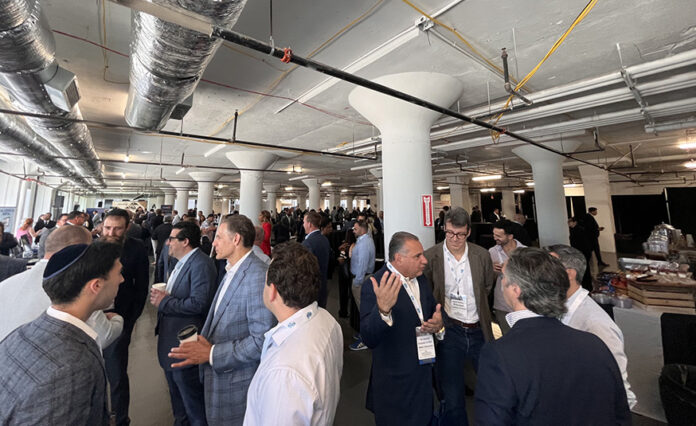

Few places better illustrate New Jersey’s evolving economic story than Jersey City. Once viewed primarily as a commuter city across the Hudson River from Manhattan, Jersey City has transformed into one of the most dynamic urban centers in the United States, attracting global investment, major corporate tenants, technology companies, life sciences firms, educational institutions, and a rapidly growing residential population. That transformation took center stage on June 4 as more than 1,250 leaders from the worlds of real estate, finance, government, technology, higher education, healthcare, and economic development gathered for the 11th Annual Jersey City Summit for Real Estate, Economic Development & Innovation.
Held on the expansive fourth floor of Harborside 1 overlooking the Manhattan skyline, the sold-out event served as both a celebration of Jersey City’s remarkable growth and a roadmap for what comes next. Throughout a full day of keynote discussions, executive panels, fireside conversations, and networking sessions, participants explored the opportunities and challenges shaping not only Jersey City but the broader future of New Jersey’s economy.
The summit arrived at a pivotal moment for the Garden State. As communities throughout New Jersey compete for investment, talent, housing, innovation, and infrastructure funding, Jersey City continues to position itself as one of the region’s most influential economic engines. The conversations held during the summit reflected that reality, focusing on everything from affordable housing and commercial development to life sciences, education, placemaking, transportation, workforce development, and emerging technology.
The backdrop itself told part of the story.
Harborside has become one of the most recognizable symbols of Jersey City’s evolution. Once known primarily as an office destination, the district is undergoing a sweeping transformation into a mixed-use environment that blends residential living, commercial space, entertainment, public gathering areas, dining, innovation hubs, and cultural programming. For many attendees, the location served as a real-world example of the very concepts being discussed throughout the day.
The event opened with a strong focus on leadership and governance, highlighting the growing importance of public-private collaboration in shaping urban development.
Newly elected Jersey City Mayor James Solomon delivered one of the summit’s most anticipated addresses, outlining his vision for continued economic growth while balancing the needs of residents, businesses, and investors. His remarks emphasized the importance of sustainable development, infrastructure investment, housing opportunities, and maintaining Jersey City’s competitiveness in an increasingly crowded marketplace for capital and talent.
Governor Mikie Sherrill also addressed attendees through opening remarks, reinforcing the state’s commitment to fostering innovation, expanding economic opportunity, and supporting strategic development initiatives throughout New Jersey.
Together, those messages underscored a central theme that echoed throughout the summit: economic growth is no longer measured solely by new construction projects or corporate relocations. Success increasingly depends upon creating communities that are attractive places to live, work, learn, innovate, and build businesses.
That philosophy was particularly evident during discussions focused on housing.
Housing affordability remains one of the most significant issues facing communities across New Jersey. As demand for residential space continues to rise and development costs remain elevated, local governments, developers, and housing advocates are searching for practical solutions that preserve accessibility while encouraging continued investment.
A panel featuring Jersey City Council President Denise Ridley, Jersey City Housing Authority Executive Director Stephen Cea, and other regional leaders explored the complex realities of balancing growth with affordability. The discussion highlighted the need for innovative public-private partnerships, strategic planning, and long-term housing policies that can accommodate population growth while ensuring residents are not priced out of their communities.
The conversation reflected a broader challenge facing many New Jersey municipalities. Whether in Hudson County, Bergen County, Middlesex County, or communities throughout South Jersey, the ability to create housing opportunities across multiple income levels has become a central component of economic development.
The summit also explored the growing role of placemaking in urban development.
For decades, economic development often focused on square footage, occupancy rates, and tax revenues. Today, successful cities increasingly recognize that quality of life plays an equally important role in attracting residents, employers, and investors.
Industry leaders examined how Jersey City’s waterfront continues evolving into a destination that blends residential neighborhoods, educational institutions, cultural attractions, entertainment venues, public spaces, and employment centers into a cohesive urban experience.
The concept often described as “live, learn, work, and play” was a recurring theme throughout the day.
Panelists discussed how communities that successfully integrate these elements tend to outperform competitors in attracting talent, particularly younger professionals seeking vibrant, walkable environments with access to amenities and experiences beyond the workplace.
The importance of culture and creativity also emerged as a key factor in modern economic development.
Arts organizations, public programming, cultural events, and community gathering spaces are increasingly viewed as essential infrastructure rather than optional amenities. As cities compete nationally and globally, cultural identity has become a powerful differentiator that helps define a community’s character and attractiveness.
Another major focus of the summit centered on capital markets and finance.
The real estate industry continues navigating an environment shaped by evolving interest rates, construction costs, financing conditions, and investor expectations. Representatives from leading financial institutions, commercial real estate firms, and economic development agencies examined how developers and investors are adapting to changing market conditions.
Discussions explored commercial lending, project financing, tax incentives, public-private partnerships, and state-level economic development tools designed to encourage investment.
The New Jersey Economic Development Authority played a prominent role in these conversations, reflecting the agency’s growing importance in supporting strategic projects throughout the state. From innovation districts and life sciences campuses to mixed-use developments and infrastructure investments, public-sector participation continues to influence the trajectory of many large-scale initiatives.
Technology and innovation represented another critical pillar of the summit.
While Jersey City has long been recognized as a financial services hub, it is increasingly building a reputation as a center for technology, healthcare innovation, life sciences research, and entrepreneurial activity.
Several sessions examined how organizations such as Liberty Science Center’s SciTech Scity initiative are helping create ecosystems designed to support innovation, research, workforce development, and commercialization.
The growth of life sciences attracted particular attention.
New Jersey’s legacy as a pharmaceutical and healthcare leader continues to evolve as biotechnology, medical research, diagnostics, and health technology companies expand their presence throughout the state. Industry leaders discussed how Jersey City is positioning itself to capture a larger share of that growth while creating opportunities for highly skilled workers and entrepreneurs.
Healthcare itself remains a major component of the region’s economic future.
Representatives from Jersey City Medical Center and other healthcare organizations highlighted the increasingly important relationship between healthcare systems and economic development. Modern healthcare institutions function not only as providers of medical services but also as major employers, innovation centers, educational partners, and community anchors.
The future workforce became another central topic during the summit.
A dedicated higher education discussion brought together leaders from New Jersey City University and Saint Peter’s University to examine how educational institutions can better align academic programs with workforce needs.
Their conversation highlighted the growing importance of talent development in economic competitiveness. Companies evaluating potential locations increasingly look beyond tax incentives and real estate availability. They want access to skilled workers, research partnerships, and educational institutions capable of producing the next generation of professionals.
For New Jersey, that challenge presents both opportunities and responsibilities.
The state is home to an extraordinary concentration of universities, colleges, research institutions, and workforce development organizations. Leveraging those assets effectively could become one of the defining factors in maintaining long-term economic growth.
Throughout the day, attendees repeatedly returned to one overarching theme: Jersey City’s evolution is far from complete.
The city’s transformation over the past two decades has been remarkable, but many participants believe the next chapter may prove even more consequential. Continued investment in housing, infrastructure, transportation, innovation, education, healthcare, technology, culture, and public spaces is positioning Jersey City as one of the most significant urban growth stories in the Northeast.
That momentum carries implications far beyond Hudson County.
The discussions held at the summit reflected broader trends shaping communities throughout New Jersey. Questions surrounding affordability, infrastructure, workforce development, economic competitiveness, innovation, sustainability, and quality of life are increasingly influencing planning decisions across the state.
As New Jersey continues navigating an era of rapid change, gatherings like the Jersey City Summit provide more than networking opportunities. They serve as forums where ideas become strategies, partnerships take shape, and visions for the future begin to emerge.
Looking across the Manhattan skyline from Harborside, attendees could see both the history and future of regional development unfolding simultaneously. Yet the most important view may have been closer to home.
The conversations taking place inside the summit were not simply about buildings, investments, or development projects. They were about how New Jersey can continue building communities that attract talent, encourage innovation, create opportunity, and strengthen the state’s position as one of the nation’s most influential economic and cultural centers.
If the energy, participation, and vision displayed throughout the 11th Annual Jersey City Summit are any indication, the next phase of that story is already well underway.
















