
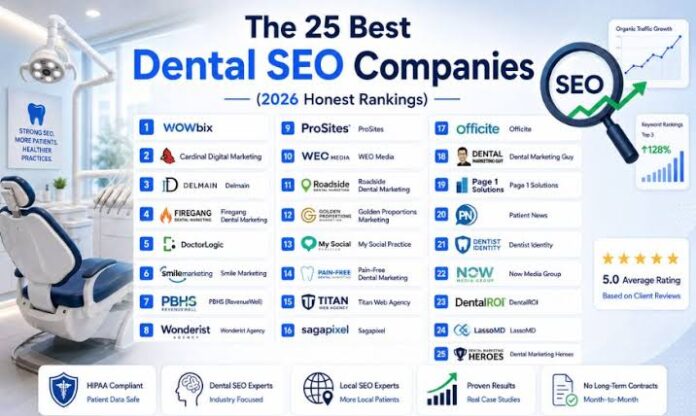

Wowbix, the Bergen County digital marketing firm, reviewed more than 100 dental practice websites nationwide and found the majority suffering from slow mobile speeds, outdated content, and missing trust signals, a gap the agency argues is quietly undoing the SEO investment many practices are already making.
A Paramus Agency Audited 100 Dental Websites, and Most of Them Are Losing Patients Before They Ever Call
Wowbix, the digital marketing and SEO agency headquartered in Paramus, has released a new analysis examining more than 100 dental practice websites across the United States, and the findings suggest a lot of practices are paying for search visibility their own websites are quietly undermining. The study, released this month, found that outdated design, sluggish mobile performance, weak user experience, and stale content remain widespread problems, even among practices actively investing in search engine optimization.
The numbers point to a consistent pattern across the practices Wowbix reviewed. More than 70 percent showed signs of outdated design or poor mobile usability, and nearly 80 percent demonstrated slow or inconsistent performance on mobile devices specifically, a critical weak point given how much local search traffic now arrives through a phone rather than a desktop browser. Nearly two thirds of the sites lacked prominent patient testimonials or other trust building elements in the places visitors actually look for them, and more than 60 percent made it unnecessarily difficult to find or complete an appointment request. Beyond the technical issues, more than 70 percent of the sites reviewed contained photography, staff information, or service descriptions that had gone unrefreshed for two years or longer.
Traffic Without a Landing Strip
The core argument behind the study is that search engine optimization and website performance have too often been treated as separate problems when they are really two halves of the same equation. A practice can generate meaningful search visibility and still lose prospective patients if the site that visibility sends people to loads slowly, is awkward to navigate on a phone, displays outdated information, or buries the appointment request behind unnecessary clicks.
Wowbix has pointed to a structural reason this gap tends to persist industry wide. Traditional web design firms often focus heavily on visual polish without fully accounting for search visibility, local landing page structure, or the technical signals that help Google understand a practice’s services and locations. SEO focused agencies, meanwhile, frequently optimize an existing website without addressing the underlying design, speed, or conversion problems dragging down its actual performance. The result, according to the firm, is a fragmented approach in which rankings, site experience, and patient acquisition end up managed by entirely separate teams, even though all three directly shape how many visitors actually become booked patients.
Early Results From Combining the Two
To address that gap, Wowbix has increasingly positioned itself around merging website development and dental specific SEO into a single, coordinated strategy rather than treating them as sequential services. That approach folds in mobile first, SEO oriented site design, technical and on page optimization, local search targeting, and a growing focus on how AI powered search tools interpret and surface practice information, alongside ongoing performance tracking that looks at calls, contact form submissions, and appointment requests rather than rankings alone.
The firm says early results from practices that have adopted the combined approach have been measurable. One dental practice that paired a website overhaul with ongoing SEO work reported improved visibility across more than 15 local search terms alongside a 40 percent increase in appointment bookings within roughly 60 days, while a second practice has also seen positive early movement as its combined strategy continues to develop. Wowbix has been careful to note that results vary by practice, local competition, and a site’s existing search history, a reasonable caveat for any single case study, but the underlying pattern, that fixing the website often unlocks value that SEO investment alone could not, is consistent with what independent research on user experience and conversion rates has shown across other industries as well.
Why It Matters More in Crowded Local Markets
The findings carry particular weight for dental practices competing in dense local markets, a category New Jersey’s Bergen and Essex county corridors know especially well, where independent dentists, cosmetic specialists, orthodontists, and oral surgeons often operate within a few miles of several direct competitors. In that kind of environment, ranking well in local search results only matters if the click that follows actually converts, and Wowbix’s data suggests a meaningful share of practices are leaving that conversion on the table without realizing their own website is the reason. Aziz summed up the underlying philosophy driving the firm’s approach plainly, saying the goal was never simply to make a dental website look newer, but to build one that supports search visibility, communicates credibility, answers the questions prospective patients are actually searching for, and ultimately turns that visibility into booked appointments.
















