
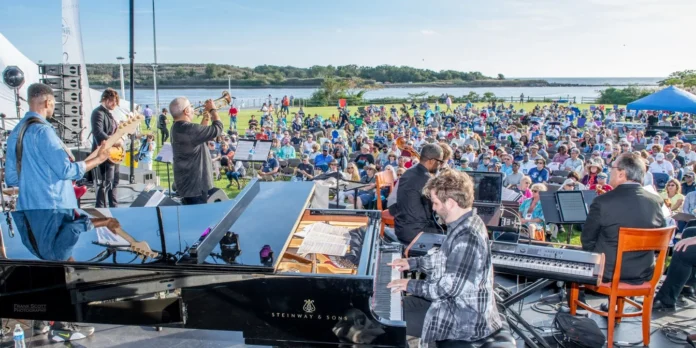

For three extraordinary days every spring and fall, Cape May stops behaving like a traditional seaside town and begins operating like one of the most vibrant live music destinations anywhere in America.
The Victorian architecture remains. The ocean air still drifts across Beach Avenue. The historic hotels, restaurants, bars, and storefronts continue glowing beneath the shoreline skyline. But something dramatically different overtakes the city itself during Exit Zero Jazz Festival weekend. Music spills into every corridor. Brass bands parade through downtown streets. Jazz fans move from ballroom performances to deck stages and intimate late-night club rooms. Musicians carrying instruments walk alongside tourists, longtime locals, students, photographers, collectors, and first-time festival visitors discovering Cape May through music instead of simply summer tourism.
That transformation officially returns May 15 through May 17 as the Exit Zero Jazz Festival once again takes over Cape May for what has evolved into one of New Jersey’s defining cultural institutions and one of the most respected destination jazz festivals on the East Coast.
For Explore New Jersey readers tracking the state’s expanding music ecosystem, arts culture, and live entertainment identity, the 2026 edition of Exit Zero may represent one of the strongest demonstrations yet of how deeply New Jersey has established itself as a legitimate national arts destination far beyond the traditional arena-tour circuit.
This is no longer simply a regional jazz festival.
It is now a full-scale cultural migration.
Anchored by Festival Central at Cape May Convention Hall along Beach Avenue, the 2026 spring edition delivers one of the festival’s most ambitious and historically layered lineups to date, blending Miles Davis centennial celebrations, Coltrane tributes, jazz fusion innovators, brass ensembles, Afro-global experimentation, Latin jazz, vocal legends, student engagement, second-line processions, and immersive community-centered nightlife into a weekend that transforms the entire city into a living soundtrack.
The key to Exit Zero’s success remains its refusal to separate music from environment.
Unlike many large festivals that isolate audiences behind gates and parking lots disconnected from surrounding communities, Exit Zero integrates itself directly into the architectural, social, and emotional identity of Cape May itself. The result feels less like attending a scheduled event and more like temporarily entering a parallel version of the city where jazz becomes the operating language of everyday life.
That distinction matters enormously.
People do not simply arrive for concerts.
They inhabit the atmosphere.
Coffee shops become discussion spaces for improvised solos and rare recordings. Restaurants transform into post-show gathering points packed with conversations about setlists, arrangements, and performances. Historic hotel porches fill with musicians exchanging stories late into the evening. Beachfront walkways pulse with brass rhythms drifting from nearby stages. Small rooms inside Carney’s erupt into packed crowds dancing only feet away from performers. The line between audience and environment begins disappearing entirely.
That immersive quality is precisely why Exit Zero continues growing into one of the most emotionally distinctive music festivals anywhere along the Atlantic coastline.
The 2026 lineup reinforces the festival’s artistic ambitions immediately.
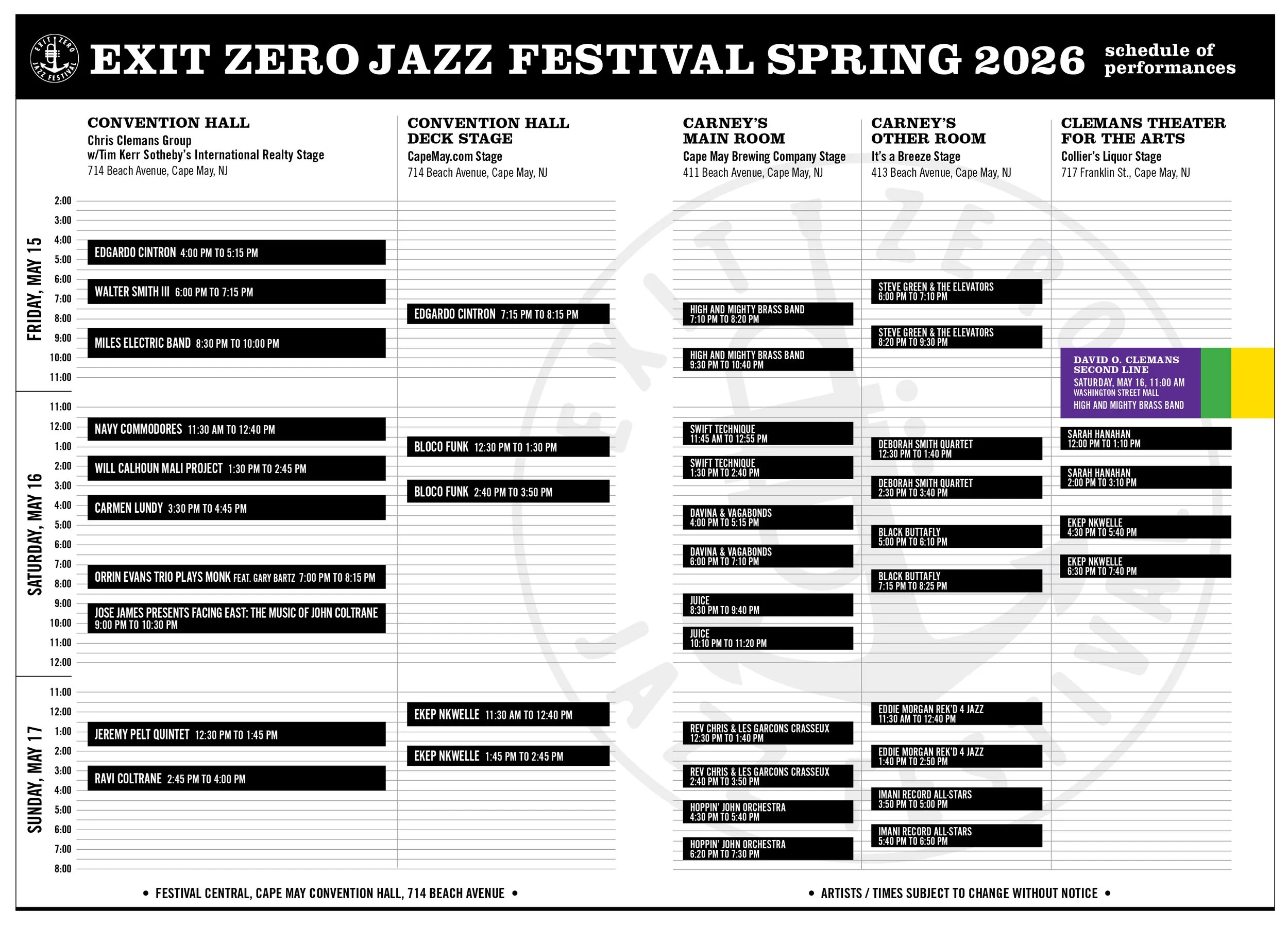
Friday evening’s centerpiece performance — The Miles Davis Centennial Celebration featuring The Miles Electric Band — arrives as one of the most important bookings in the festival’s modern history. Scheduled for May 15 from 8:30 PM to 10:00 PM inside Cape May Convention Hall, the performance honors the 100th anniversary of one of the most transformative figures in modern music while simultaneously exploring the continuing ripple effects of jazz fusion itself.
Miles Davis did not simply influence jazz.
He permanently altered the trajectory of modern music.
From modal experimentation and electric fusion to improvisational philosophy and genre deconstruction, Davis shaped virtually every musical conversation connected to artistic reinvention during the twentieth century. Bringing a centennial celebration of his work into Cape May elevates the festival into a much larger national conversation about jazz legacy and evolution.
The inclusion of The Miles Electric Band also reinforces Exit Zero’s broader artistic philosophy.
This festival consistently avoids nostalgia for nostalgia’s sake.
Instead, it treats jazz history as active creative fuel still capable of expansion, reinterpretation, and emotional immediacy in the present day.
That same approach carries directly into Saturday evening’s major performance when José James presents “Facing East: The Music of John Coltrane.”
Few artists in American music history carry the same spiritual and artistic gravity as John Coltrane. His catalog remains foundational not only because of technical innovation, but because of the emotional and philosophical depth embedded within his music. José James, known for blending jazz, soul, hip-hop, spoken word, and contemporary improvisation into highly personal performance styles, brings a modern interpretive perspective to Coltrane’s work that feels perfectly aligned with Exit Zero’s evolving identity.
The Coltrane thread deepens even further Sunday afternoon with Ravi Coltrane taking the Convention Hall stage.
That booking may ultimately become one of the weekend’s most symbolically powerful moments.
As the son of both John and Alice Coltrane, Ravi represents a living continuation of one of jazz’s most influential artistic bloodlines. Yet he has simultaneously built his own deeply respected identity as a contemporary saxophonist, composer, and bandleader. His presence creates a remarkable bridge between jazz history and contemporary evolution occurring directly inside the same festival weekend.
That multi-generational continuity defines Exit Zero beautifully.
The festival never treats jazz as static historical preservation.
It presents the genre as a living cultural organism still evolving through younger performers, new interpretations, global influences, and cross-generational dialogue.
Throughout the rest of the lineup, that philosophy appears everywhere.
Walter Smith III opens Friday evening with one of contemporary jazz’s most respected tenor saxophone voices. Jeremy Pelt Quintet delivers modern hard-bop sophistication Sunday afternoon. Carmen Lundy continues representing one of jazz vocal performance’s most enduring artistic presences. Sarah Hanahan, Ekep Nkwelle, and Will Calhoun’s Mali Project all inject younger-generation experimentation, Afro-global rhythms, and genre-bending exploration into the weekend schedule.
Meanwhile, Orrin Evans Trio Plays Monk featuring Gary Bartz may become one of the festival’s defining performances among serious jazz audiences.
The combination of Evans, Bartz, Robert Hurst, and Jeff “Tain” Watts effectively assembles a powerhouse ensemble rooted deeply within modern jazz excellence and improvisational history. The Thelonious Monk-centered format adds another layer of historical depth to a weekend already heavily connected to jazz lineage and transformation.
Importantly, however, Exit Zero refuses to become academically rigid or culturally exclusionary.
That accessibility remains one of the festival’s greatest strengths.
Throughout the weekend, high-energy performances spread across Carney’s Main Room, Carney’s Other Room, the Convention Hall Deck Stage, and Clemans Theater for the Arts ensure the atmosphere remains celebratory, social, and welcoming even for audiences unfamiliar with deeper jazz scholarship.
The High & Mighty Brass Band immediately injects New Orleans-style energy into the festival with multiple appearances including the David Clemans Second Line procession Saturday morning. Bloco Funk adds percussion-heavy movement and dance rhythms directly into the shoreline atmosphere. Davina & The Vagabonds bring powerful genre-crossing vocal performance styles into packed late-day sets. Black Buttafly, Juice, Hoppin’ John Orchestra, Swift Technique, Deborah Smith Quartet, and Eddie Morgan Rek’d 4 Jazz all contribute to the broader ecosystem of movement, nightlife, improvisation, and communal energy that separates Exit Zero from more traditional seated concert festivals.
Edgardo Cintron’s celebration of Tito Puente further expands the festival’s cultural reach.
Latin jazz has always been deeply interconnected with the evolution of American jazz itself, and performances honoring Puente reinforce the festival’s understanding that jazz history has always been multicultural, rhythmic, border-crossing, and globally interconnected. The Tito Puente tribute promises one of the weekend’s most dance-oriented and rhythmically explosive experiences.
One of the festival’s most important qualities, however, exists beyond the lineup entirely.
The Cape May Jazz Festival Foundation continues operating year-round educational outreach initiatives that increasingly position Exit Zero as one of New Jersey’s strongest music advocacy organizations.
That work matters profoundly.
While many festivals function solely as ticketed entertainment businesses, the Cape May Jazz Festival Foundation invests directly into music education, artist residencies, in-school performances, youth engagement programs, and student ensemble opportunities throughout the year. More than 2,000 students reportedly participated in educational outreach initiatives during 2025 alone.
Programs such as the David O. Clemans Music Connects Big Band and youth performance opportunities ensure jazz remains accessible to future generations rather than confined to institutional nostalgia.
That investment becomes increasingly important as arts education nationwide continues facing budget reductions and structural instability.
Exit Zero’s long-term educational commitment fundamentally changes the meaning of the festival itself.
This is not simply entertainment.
It is cultural stewardship.
The physical geography of Cape May also remains central to the festival’s emotional impact.
Festival Central at Cape May Convention Hall — located directly along the beachfront — creates one of the most visually distinctive jazz settings anywhere in the country. Visitors picking up passes or attending performances move between ocean views, historic architecture, late-night venues, and intimate streetscapes while remaining continuously immersed in music.
The town itself becomes an extension of the stage.
That intimacy helps explain why audiences return repeatedly.
Unlike massive urban festivals dominated by exhausting logistics and overwhelming crowds, Exit Zero feels navigable, human-scaled, and emotionally connected. Attendees can move organically between venues while still maintaining proximity to performers, conversations, restaurants, hotels, and the ocean itself.
For New Jersey’s broader music culture, Exit Zero now represents something increasingly important.
The state’s artistic identity has historically been dominated by rock history, Shore bar circuits, punk scenes, arena concerts, and club culture. Exit Zero demonstrates just how sophisticated, globally connected, and culturally ambitious New Jersey’s jazz ecosystem has become as well.
Cape May is no longer simply a vacation town during festival weekends.
It becomes one of America’s most immersive music cities.
And as the 2026 spring edition prepares to begin, Exit Zero Jazz Festival once again stands ready to prove that some of the most meaningful live music experiences in the country are unfolding directly along the shores of New Jersey.
















