
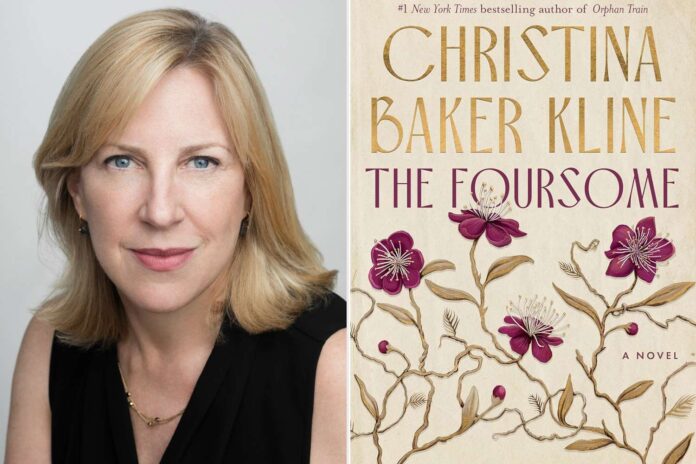

New Jersey’s literary community is once again finding itself at the center of a major national publishing moment as bestselling author Christina Baker Kline returns with what may become one of the most discussed historical fiction releases of 2026. Her newly released novel, The Foursome, arrives carrying all the hallmarks of a major literary event: a true story stranger than fiction, morally layered historical complexity, emotionally charged family dynamics, hidden American history, and a deeply personal connection tying the narrative directly back to the author herself.
But what makes the novel especially significant for New Jersey readers is that its story is now inseparable from the state’s evolving literary identity.
Although The Foursome unfolds primarily in nineteenth-century North Carolina, the novel’s cultural launch has been deeply rooted in New Jersey through Christina Baker Kline’s longstanding connection to Montclair, one of the state’s most influential literary and arts communities. The book officially entered the national spotlight following a major early release event at the Montclair Literary Festival, hosted in partnership with the Montclair Public Library as part of the region’s growing “Open Book/Open Mind” cultural programming.
That launch immediately positioned the novel not only as a national publishing release, but also as a defining moment within New Jersey’s expanding literary and intellectual landscape.
For Explore New Jersey readers following the state’s arts and culture scene, The Foursome represents something larger than another successful book release. It reflects the continuing emergence of New Jersey — particularly communities like Montclair — as major contributors to contemporary literary culture, author development, and nationally relevant storytelling.
Kline herself remains one of the most recognizable literary voices associated with the region.
Best known internationally for the blockbuster novel Orphan Train, Christina Baker Kline has spent years building a reputation as a writer uniquely skilled at uncovering overlooked histories, emotionally buried narratives, and deeply human stories existing just beyond the edges of mainstream historical memory. Her work frequently explores themes of displacement, identity, family fracture, social marginalization, and forgotten lives hidden beneath more familiar versions of American history.
That artistic instinct appears to reach perhaps its most ambitious form yet in The Foursome.
Released nationally through Mariner Books on May 12, 2026, the novel reimagines the astonishing real-life story of sisters Sarah and Adelaide Yates, who married the world-famous conjoined twins Chang and Eng Bunker — the historical figures whose names and public identities ultimately became linked forever to the phrase “Siamese twins.”
At first glance, the premise alone feels almost impossible to fictionalize responsibly.
The historical reality surrounding Chang and Eng Bunker already occupies an unusual place within American cultural history. Born in Siam, now Thailand, the brothers were brought into the Western entertainment world during the nineteenth century and became global curiosities through exploitative exhibition culture. Yet their lives evolved far beyond public spectacle. They eventually settled in North Carolina, became wealthy landowners, married sisters, raised large families, and navigated decades of shifting American political and social upheaval.
What Kline recognized, however, was that the emotional center of the story may never have belonged solely to the famous brothers themselves.
Instead, The Foursome focuses heavily on Sarah and Adelaide Yates — two women who largely disappeared from historical accounts despite living at the center of one of the most unusual family structures in American history.
That decision fundamentally reshapes the narrative.
Historical documentation surrounding the wives remained sparse. They did not leave behind extensive personal archives, newspaper interviews, or detailed correspondence collections capable of fully reconstructing their emotional experiences. Kline reportedly described this absence directly during her Montclair Literary Festival appearance, emphasizing her fascination with stories that survive “in the margins” of more publicly visible history.
That absence became the novel’s opportunity.
Rather than retelling the already sensationalized mythology surrounding Chang and Eng, Kline instead attempts to imagine what life may have actually felt like inside these marriages — emotionally, psychologically, socially, and domestically.
The result becomes far more than a historical curiosity.
It evolves into a layered examination of identity, intimacy, loyalty, gender expectations, family pressure, race, class structure, and survival within one of the most rigidly constrained periods in American history.
Set beginning in 1839 and spanning five decades, The Foursome follows the sisters as they become entangled in the Bunkers’ extraordinary lives while navigating a rapidly transforming America moving toward Civil War, abolition, and enormous social upheaval.
Adelaide emerges as bold, ambitious, and eager to reclaim security and social standing following family scandal, while Sarah appears quieter, more observant, and emotionally cautious. The tension between those personalities reportedly becomes central to the emotional structure of the novel itself.
That complexity matters enormously because Kline appears intentionally resisting the temptation to simplify these historical figures into romanticized symbols or one-dimensional victims of circumstance.
Instead, the novel reportedly confronts the deeply uncomfortable realities embedded within the family’s historical situation.
Chang and Eng Bunker themselves eventually became slave owners in North Carolina, introducing profound moral contradictions into the story. Kline has openly acknowledged the difficulty of navigating those realities while writing the book, reportedly wrestling for years with questions surrounding historical ownership, perspective, revisionism, and narrative responsibility.
That struggle may ultimately be one of the novel’s greatest strengths.
Historical fiction often fails when it attempts to flatten moral ambiguity into simplified contemporary messaging. The most compelling historical novels instead acknowledge the emotional and ethical contradictions of the past without attempting to erase them.
By all indications, The Foursome embraces that complexity directly.
The personal dimension of the project deepens the story even further.
Kline herself reportedly discovered that the Yates sisters were distant relatives within her own family lineage, transforming the novel from a purely intellectual historical exercise into something far more intimate and emotionally personal. That family connection appears to have intensified her commitment to uncovering the women’s inner lives and emotional realities rather than allowing them to remain invisible footnotes within someone else’s public narrative.
One of the novel’s most emotionally revealing inspirations reportedly came when Kline visited the Bunker family graveyard in North Carolina.
There, she discovered that Sarah was buried separately — not alongside the twins and her sister, but instead with her daughters and formerly enslaved individuals connected to the household. That detail reportedly sparked Kline’s realization that significant emotional tension and separation may have existed beneath the outward public image of the family itself.
Moments like that demonstrate why historical fiction continues holding such cultural importance.
Facts alone rarely capture emotional truth fully. Fiction allows writers to explore the psychological interior spaces history often leaves undocumented — especially for women, marginalized individuals, or people excluded from official records altogether.
That thematic approach also explains why Kline’s work resonates so strongly with modern audiences.
Readers increasingly seek historical fiction that feels emotionally investigative rather than merely decorative or nostalgic. They want novels that interrogate buried histories, recover overlooked voices, and challenge inherited assumptions about how the past functioned privately beneath public mythology.
The Foursome appears positioned squarely within that evolving literary movement.
Its release also reinforces New Jersey’s expanding role within contemporary literary culture itself.
Communities like Montclair have become increasingly influential hubs for authors, festivals, independent bookstores, public-library programming, literary discussions, and intellectual arts culture throughout the Northeast. The Montclair Literary Festival in particular continues growing into one of the region’s most respected public literary gatherings, regularly attracting nationally recognized authors and major publishing attention.
Kline’s launch event there underscores how deeply connected New Jersey has become to the modern publishing ecosystem.
For Explore New Jersey readers, the novel’s emergence also highlights something broader about the state’s arts identity. Increasingly, New Jersey is not merely serving as a commuter extension of New York or Philadelphia cultural scenes. It is developing stronger recognition as a standalone creative environment producing nationally significant writers, artists, musicians, festivals, and intellectual programming in its own right.
Books like The Foursome reinforce that evolution.
The novel’s combination of hidden American history, emotionally complex storytelling, multigenerational family dynamics, and moral ambiguity places it directly within the larger contemporary conversation surrounding historical memory itself — particularly which stories are preserved publicly and which are allowed to disappear.
Kline’s work suggests that many of the most compelling stories in American history still exist buried beneath the surface, waiting to be reexamined through fresh emotional and literary perspectives.
And through the lens of Sarah and Adelaide Yates — two women history nearly forgot — The Foursome appears determined to bring one of America’s strangest, most complicated, and most emotionally layered family stories fully back into public consciousness.
For New Jersey’s literary community, it is also another reminder that some of the nation’s most important storytelling voices continue emerging directly from within the Garden State’s own evolving arts and culture landscape.
















