Home Blog Page 88

Satellite Snow Blanket and Arctic Pattern Put New Jersey Back in a Classic Winter Grip

Brief midweek thaw offers only short relief as another Arctic surge, light snow rounds, and coastal flooding concerns shape the week ahead across the Garden State

A sweeping satellite view of the eastern United States this week tells a striking story about winter’s persistence across New Jersey and much of the Northeast.

Recent NOAA GOES satellite imagery reveals an unusually broad and continuous snow cover stretching from the Mid-Atlantic through the Northeast and into the central Plains—an expanse that remains firmly in place after successive winter systems and an extended stretch of Arctic air. With last weekend’s snowpack still largely intact and fresh winter weather having affected the southern Mid-Atlantic over the weekend, the region now resembles a mid-season winter landscape more typical of earlier decades.

For New Jersey, the imagery serves as a visual reminder that the state is still fully capable of delivering a classic, high-impact winter—despite recent milder seasons.

So far this winter, temperatures have averaged below normal statewide, while snowfall has finished well above seasonal expectations in most areas. North Jersey remains the standout, running more than 10 inches above average in several communities. Central New Jersey is generally tracking around five inches above normal. South Jersey, while less extreme, is still coming in one to three inches above average for seasonal snowfall.

Those numbers are the product of a remarkably active stretch of winter weather dating back to mid-December.

A widespread storm on December 13 and 14 delivered a general four to eight inches across the state. On December 27, a warm air advection event produced another three to six inches in parts of North Jersey. The pattern intensified again during the January 16 through 18 period, when a two-part weekend system brought three to six inches to North Jersey on Friday as a shortwave rode an Arctic boundary, followed by two to five inches across much of Central and South Jersey on Sunday from a weak coastal low.

The winter reached its most disruptive point last weekend, when a powerful snow-to-ice system slammed the state. Totals ranged from 12 to 16 inches in North Jersey, eight to 12 inches in Central Jersey, and four to eight inches in South Jersey. In the days since, a few narrow snow bands narrowly missed portions of southeastern New Jersey that could easily have added another one to four inches. Instead, most locations only saw scattered snow showers and flurries with little accumulation.

Layered on top of those larger events were multiple “nickel-and-dime” systems—fast-moving clippers and lake-effect driven snow showers—that frequently coated roads and sidewalks, keeping snow cover fresh and persistent.

After nearly three straight weeks of near-constant storm tracking and deep cold, residents across the state are finally seeing a short break.

Today, Tuesday, February 3, marks the first meaningful pause in a nine-day Arctic freeze. Temperatures across South Jersey, including the Cherry Hill area, have climbed just above freezing under partly sunny skies. Afternoon highs are reaching the mid-30s, with a noticeably less biting feel compared to the sub-20-degree readings that dominated much of the past week.

Tonight turns mostly cloudy, with lows settling near 20 degrees.

That temporary moderation will continue through Thursday. Afternoon temperatures are expected to rise above freezing during peak daytime hours, offering a much-needed opportunity for crews and property owners to chip away at stubborn ice and refreeze-prone runoff left behind by last weekend’s storm.

Still, winter is far from finished.

Two weak snow-producing systems are expected to pass through New Jersey before the next Arctic outbreak arrives.

The first system arrives late tonight and continues into early Wednesday morning. It is a weak disturbance and is expected to favor South Jersey. Most areas will see little more than flurries or a light dusting, but isolated spots could approach an inch. With colder overnight temperatures, snow-to-liquid ratios will be higher, meaning even light precipitation could accumulate more efficiently than usual. While significant impacts are not anticipated, slick spots may develop for the Wednesday morning commute.

The second system arrives on Friday in the form of a fast-moving clipper and accompanying Arctic front. While forecast confidence on exact placement and intensity will improve over the next several days, the current expectation points to scattered snow showers and snow squalls across much of the state. Gusty winds of 30 to 40 miles per hour are also possible, creating brief visibility reductions and localized travel disruptions.

Neither system is expected to trigger widespread closures or major delays. However, both have the potential to produce quick coatings that could catch drivers off guard—particularly early Wednesday morning and again during the day Friday.

More concerning than the snow itself is what follows.

Another surge of Arctic air is poised to spill into New Jersey behind Friday’s clipper. By Saturday and Sunday, daytime highs are expected to struggle to reach the teens. Wind chills may drop as low as 15 degrees below zero in some locations, creating dangerously cold conditions for anyone spending extended time outdoors.

The cold air is expected to linger into early next week.

Along the coast, the cold pattern is being paired with elevated tidal concerns. The National Weather Service has issued a coastal flood advisory for portions of the Jersey Shore, citing the potential for minor flooding during high-tide cycles early this week. While significant storm surge is not expected, repeated minor flooding can still affect low-lying roadways, bayside neighborhoods, and parking areas near marinas and inlets.

Meteorologists are also closely monitoring larger-scale atmospheric signals that could influence the second half of February.

A recent sudden stratospheric warming event in the upper atmosphere has disrupted the polar circulation aloft, increasing the likelihood of a split in the polar vortex in the coming days. Historically, these stratospheric disruptions often take one to two weeks to translate into colder and more active weather patterns closer to the surface. That timing aligns closely with the return of Arctic air this weekend and supports the idea of an active and wintry pattern continuing into the Valentine’s Day time frame.

In plain terms, New Jersey is entering a brief window of relative calm rather than a true seasonal shift.

Temperatures will moderate into the low and mid-30s during the afternoons through Thursday, while still dropping below freezing each night. The overall pattern remains mostly dry, aside from two chances for light snow—late tonight into early Wednesday, mainly across South Jersey, and again on Friday statewide.

Neither event currently appears disruptive enough to force closures or widespread schedule changes, but both could generate enough light snow to produce slick travel during peak periods.

By late Friday and into the weekend, Arctic air returns in force, setting up another stretch of bitterly cold weather across the Garden State.

Winter may be showing brief signs of easing, but the satellite picture, snow totals, and large-scale atmospheric signals all point to a season that is still very much alive—and capable of delivering more true winter weather in the days ahead. For continuing updates and localized tracking, readers can follow Sunset Daily’s ongoing weather report coverage throughout the week.
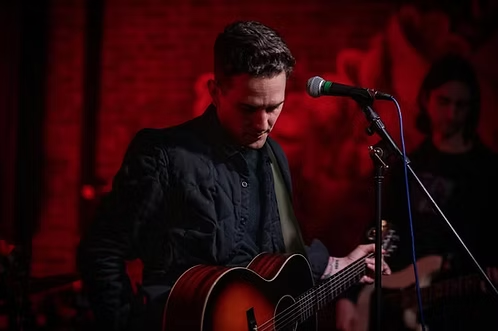
Tim Hause

0

A Night of Storytelling and Sound on the Shore: Tim Hause Brings His Intimate Folk-Pop Craft to Lizzie Rose Music Room

February 6 @ 6:00 PM 11:30 PM

One of New Jersey’s most beloved small venues is set to host a night built for listeners who value lyrics, vulnerability, and real connection between artist and audience. On Friday, February 6, 2026, the Lizzie Rose Music Room will welcome acclaimed Philadelphia singer-songwriter Tim Hause for an evening performance that promises the kind of emotional, stripped-down musical experience that has quietly become the hallmark of this intimate Tuckerton stage.

The show begins at 7:30 p.m., with New Jersey-based act Mindful Melodies opening the night and setting the tone for an evening focused on heartfelt songwriting, acoustic textures, and immersive atmosphere. For fans searching for meaningful live performances rather than arena-scale spectacle, this concert represents exactly why small venues continue to define the soul of the region’s live scene.

The Lizzie Rose Music Room has built its reputation as a listening room in the truest sense of the term. Nestled in Ocean County and widely recognized for its candlelit ambiance, pristine acoustics, and attentive crowds, the venue attracts artists who rely on storytelling and nuance as much as melody. It is a space where subtle arrangements and honest lyrics are not lost in crowd noise or cavernous rooms, but instead become the central focus of the night.

That environment aligns perfectly with Tim Hause’s musical identity.

A longtime fixture of the Philadelphia songwriter circuit, Hause has steadily earned recognition for his emotionally grounded folk-pop style, weaving introspective themes with warm acoustic arrangements and understated production. His songwriting draws heavily from lived experience, often exploring relationships, mental health, personal growth, and the quiet moments that define everyday life. The result is music that resonates deeply with listeners who value authenticity over trend-driven polish.

Over the years, Hause has developed a loyal following through both his studio recordings and his reputation as a compelling live performer. On stage, he blends gentle humor, candid storytelling, and thoughtful pacing between songs, creating a relaxed and conversational atmosphere that feels more like a shared gathering than a conventional concert. That connection is precisely what makes his upcoming appearance at Lizzie Rose Music Room so well suited for the venue’s intimate design.

For New Jersey music fans, this performance offers more than a single night of entertainment. It reflects the ongoing strength of the regional singer-songwriter community that thrives just outside the national spotlight but continues to produce artists with depth, professionalism, and creative integrity. Concerts like this remain a cornerstone of the state’s live performance ecosystem and continue to anchor the broader local and touring landscape highlighted across Explore New Jersey’s live music coverage.

Opening the evening will be Mindful Melodies, a New Jersey-based project known for its calming acoustic sound and reflective songwriting. Their music emphasizes atmosphere, gentle harmonies, and lyrical optimism, making them an ideal complement to Hause’s emotionally driven set. For early arrivals, the opening performance provides an opportunity to experience another emerging voice in the region’s growing acoustic and folk-influenced scene.

The timing of the show also makes it especially appealing for audiences seeking a meaningful winter escape along the Jersey Shore. February in coastal New Jersey offers a quieter, more personal version of its beach towns—perfect for intimate venues, relaxed evenings, and community-centered performances. A night at Lizzie Rose Music Room often becomes as much about the shared experience of being in the room as it is about the artist on stage.

Hause’s catalog reflects a consistent evolution rather than abrupt stylistic shifts. His recent material leans further into layered acoustic textures and restrained pop sensibilities, allowing lyrical content to remain front and center. Listeners can expect a carefully balanced set that blends earlier fan favorites with newer songs that showcase his continued growth as both a songwriter and performer.

What sets Hause apart in a crowded singer-songwriter field is his ability to translate deeply personal stories into universally relatable moments. His lyrics often center on themes of vulnerability, emotional resilience, and self-reflection, delivered without theatrical excess. Instead, his performances rely on clarity, sincerity, and emotional precision—qualities that thrive in a room designed for listening rather than spectacle.

The Lizzie Rose Music Room, which has hosted an impressive range of touring and regional artists across folk, Americana, blues, and acoustic pop, has become a trusted destination for audiences who value curated programming and artist-forward presentation. Its small capacity allows every seat to feel close to the stage, and its attentive audiences create a respectful environment that encourages artists to take creative risks and share new material.

For fans of songwriter-driven music, the February 6 performance offers a rare opportunity to see Tim Hause in a setting that amplifies everything his work represents: honest expression, musical craftsmanship, and genuine human connection.

As New Jersey continues to assert itself as a vital hub for independent touring artists and grassroots venues, nights like this reinforce the importance of community-based stages in sustaining creative culture across the state. Whether you are a longtime supporter of acoustic and folk music or someone discovering this corner of the live scene for the first time, this show stands as a reminder that some of the most memorable performances happen far from massive theaters and festival fields.

Tim Hause’s appearance at Lizzie Rose Music Room, supported by the reflective sounds of Mindful Melodies, promises an evening where music is not simply heard, but felt—an experience shaped by shared stories, quiet moments, and the unmistakable warmth of live performance in one of New Jersey’s most intimate and respected music spaces.

Lizzie Rose Music Room

609-276-6758

View Organizer Website

The Lizzie Rose Music Room

217 E Main St, , NJ
Tuckerton, New Jersey 08087 United States
+ Google Map
(609) 276-6758
View Venue Website

Why February Is Now the Most Critical Month for New Jersey Contractors Planning Heavy Equipment Sales in 2026

From tax strategy to fleet optimization, owners across the Garden State are using the winter slowdown to position assets before the next construction cycle begins

February has quietly become one of the most strategic months of the year for heavy equipment owners across New Jersey who are preparing to sell, replace, or restructure their fleets ahead of the 2026 building season.

For contractors, fleet managers, and independent equipment owners operating throughout the state, the timing is no longer accidental. February sits at the precise intersection of slowed winter job activity, early spring bidding cycles, and financial planning deadlines that increasingly influence how and when major equipment decisions are made.

Across New Jersey’s highway, infrastructure, utility, and private development markets, many firms use this narrow winter window to take a hard look at aging assets, underutilized machines, and shifting job requirements tied to upcoming construction projects.

The result is a growing trend: February is becoming the decision month, even if the actual sale or trade does not occur until later in the year.

Industry professionals say the shift is being driven by three overlapping pressures—capital efficiency, changing project profiles, and tighter competition for high-quality used equipment.

Unlike late fall, when equipment owners are still closing out jobs, or early spring, when crews and machines are already redeploying, February offers rare operational clarity. Most winter work in New Jersey is limited to emergency utility projects, select municipal contracts, and indoor or weather-resistant construction. That lull allows owners to assess utilization data without the noise of daily production demands.

For many firms, this is when fleet audits take place.

Equipment managers evaluate machine hours, maintenance histories, downtime trends, and telematics data to determine which assets are no longer aligned with upcoming work. In 2026 planning cycles, that review is increasingly influenced by the nature of new contracts, which are shifting toward infrastructure rehabilitation, energy upgrades, warehouse development, and transit-oriented construction rather than large-scale greenfield builds.

Machines that were once essential for heavy site development—such as large scrapers or specialized earthmoving equipment—may no longer match the mix of bridge rehabilitation, utility replacement, and urban redevelopment work that now dominates much of New Jersey’s project pipeline.

February is also when financial planning teams begin locking in tax and capital expenditure strategies tied to the upcoming fiscal year.

Owners looking to sell equipment before placing orders for newer machines are using February to model depreciation schedules, capital gains exposure, and reinvestment timing. With financing conditions remaining more selective and interest costs higher than pre-2023 levels, timing the sale of large assets has become an operational decision rather than a simple disposal exercise.

Many New Jersey-based contractors are now aligning equipment sales with early equipment reservations for late 2025 and early 2026 deliveries, especially for machines affected by longer manufacturer lead times.

Another factor driving February’s importance is market visibility.

By late winter, auction platforms, private dealers, and broker networks have clearer insight into buyer demand for the coming season. Equipment owners who begin positioning assets in February are often able to enter the market before supply increases in late spring, when many companies attempt to offload similar machines simultaneously.

That early positioning can materially affect pricing.

Used equipment buyers—particularly out-of-state contractors and infrastructure firms operating in southern and western markets—frequently begin sourcing in the first quarter to secure inventory ahead of their own seasonal work. New Jersey equipment that enters the marketplace in February is often exposed to a broader pool of buyers before competition intensifies.

Fleet managers also point to maintenance economics as a reason February has become a trigger point.

Machines coming out of winter storage or limited winter use typically require service inspections before full redeployment. For equipment nearing major maintenance thresholds—such as undercarriage replacement, hydraulic rebuilds, or emissions system upgrades—owners must decide whether to invest additional capital or sell while the asset still carries strong market appeal.

Selling before high-cost maintenance milestones can significantly improve net recovery value, especially on older Tier 4 machines where emissions-related repairs continue to escalate.

Labor availability is another subtle driver.

With technician shortages affecting service departments across New Jersey, extended repair timelines can delay equipment readiness just as spring schedules ramp up. Owners who sell underperforming or maintenance-heavy units in February avoid the risk of having capital tied up in machines that are still in the shop when work resumes.

The February planning window is also increasingly tied to changes in how construction projects are structured in the state.

Public infrastructure funding, utility modernization programs, and transit-related developments are creating more fragmented job schedules, tighter site constraints, and higher compliance requirements. Contractors are prioritizing more versatile machines—compact equipment, low-emission units, and technology-enabled platforms—over large single-purpose assets.

That shift is forcing companies to rebalance fleets well before bid awards are finalized.

Rather than waiting to see which contracts are secured, firms are using February to prepare their fleets to compete more effectively, replacing heavier legacy equipment with more flexible and compliant machines that can operate in dense urban environments, environmentally sensitive zones, and active traffic corridors.

Technology is also influencing February decision-making.

Telematics data, predictive maintenance systems, and utilization dashboards now give owners a clear picture of which machines generate consistent revenue and which assets quietly drain operational resources. By winter, those analytics reveal full-year patterns that make sell-or-hold decisions far more objective than in the past.

For independent owner-operators and small contractors—who make up a substantial share of New Jersey’s construction workforce—February offers a practical window to exit equipment before insurance renewals, registration costs, and spring staffing commitments compound financial pressure.

Just as important, February is when buyers begin to engage.

Dealers and brokers report that qualified buyers are more active earlier in the year as they seek to lock in machines ahead of rising demand and potential price movement. Sellers who enter the market in February are often able to negotiate with less urgency and greater leverage than those listing during peak construction months.

The growing importance of February does not mean all equipment must be sold immediately.

Instead, industry advisors say the real advantage lies in preparation. Owners who begin valuation discussions, documentation reviews, compliance checks, and asset marketing plans during February are positioned to execute transactions efficiently once market conditions align.

In today’s tighter, more competitive equipment market, waiting until spring to begin planning can mean missing the strongest pricing window.

For New Jersey’s heavy equipment owners navigating a complex 2026 outlook shaped by infrastructure investment, labor constraints, and evolving job types, February has quietly become the month that determines whether next year’s fleet is a competitive advantage—or a costly legacy.

Princeton-Based Nearsite Redefines Corporate Housing in 2026 as AI Platform Solves Workforce Mobility Crunch

New leadership, enterprise integrations and automation-driven sourcing position New Jersey firm at the center of a rapidly shifting corporate housing market

A growing shortage of flexible, high-quality corporate housing is reshaping how major employers, insurers and relocation firms move talent across the country—and a Princeton-based technology company is emerging as one of the most closely watched solutions in that market.

As of early 2026, Nearsite is scaling its AI Copilot platform to meet surging demand for furnished, short-term housing for enterprise workforces, catastrophe response teams and large-scale infrastructure projects. The company’s technology-driven model is designed to replace the fragmented, manual housing procurement process that has dominated corporate relocations for decades.

Nearsite’s approach has quickly drawn attention across the national business landscape, where rising rental costs, limited inventory and unpredictable staffing cycles have made temporary housing one of the most complex operational challenges facing large organizations.

The platform is built around a predictive workforce intelligence layer that converts project timelines and staffing forecasts into concrete housing demand months before employees are deployed.

For industries such as data center construction, life sciences expansion, infrastructure modernization and large commercial buildouts, workforce size can swing dramatically between planning, engineering, installation and commissioning phases. Nearsite’s AI models translate those shifting headcounts into forward-looking housing needs, allowing employers to secure appropriate inventory well ahead of peak demand.

Company leaders say this predictive workforce mapping is particularly valuable for capital-intensive projects where delays in housing availability can directly affect labor availability and construction schedules.

The second major engine inside the platform is Nearsite’s automated sourcing marketplace.

Instead of relying on broker-driven spreadsheets, disconnected vendor lists and manual RFP cycles, Nearsite uses an AI-powered inventory engine to surface vetted, furnished properties in real time. The system evaluates location, quality standards, availability windows, lease terms and proximity to job sites or corporate offices.

This capability becomes especially critical during sudden workforce surges, such as disaster recovery operations and insurance catastrophe deployments. During peak CAT season, adjuster and inspection teams often need housing in large volumes within days. Nearsite’s platform is designed to respond to those spikes in demand without the bottlenecks typically associated with short-term housing procurement.

A defining feature of Nearsite’s model is its direct-to-doorstep sourcing structure.

By bypassing traditional intermediaries and negotiating directly with property owners and operators, the company reports that clients can reduce overall housing costs by approximately 20 to 30 percent. For enterprises managing thousands of short-term placements annually, those savings translate into meaningful reductions in operating expense at a time when urban and suburban rental markets remain highly competitive.

Equally important for corporate real estate and human resources teams is budget transparency. Nearsite’s contract structure allows decision-makers to track unit-level pricing, location premiums and length-of-stay costs in real time—helping companies maintain financial control as deployment volumes fluctuate.

The platform also reflects a broader shift toward what Nearsite describes as a human-centric mobility ecosystem.

Rather than focusing solely on proximity to job sites, the AI layer incorporates lifestyle and retention factors into housing recommendations. The system prioritizes access to schools, parks, public transportation and essential services, aligning housing placement with employee well-being and long-term retention strategies—an increasingly important consideration in a hybrid and mobile workforce environment.

Nearsite positions this approach as a response to what many corporate planners now describe as a geographic mismatch between where talent lives and where projects or offices are located.

In 2026, corporate housing demand is increasingly concentrated in dense urban centers and fast-growing technology corridors, driven by return-to-office initiatives, AI infrastructure development and large-scale digital transformation projects. Rather than relying on new construction, Nearsite’s platform mobilizes existing residential inventory to rapidly absorb demand spikes without waiting for additional housing supply to come online.

The company’s expansion strategy received an additional boost with the appointment of industry veteran Jacq Johnson as Senior Director, tasked with scaling North American sales and enterprise partnerships.

Johnson brings deep experience across corporate housing, workforce mobility and enterprise services, and will lead Nearsite’s efforts to expand relationships with Fortune 1000 employers, national insurers and relocation providers. Company leadership says the appointment reflects a strategic push to align enterprise sales with the platform’s rapidly expanding technical capabilities.

Behind the scenes, Nearsite operates on a SaaS-plus-transaction pricing model designed specifically for high-volume corporate users.

Enterprises subscribe to the AI Copilot platform for workforce forecasting, automated sourcing and operational analytics. Transactional sourcing fees are embedded directly into housing agreements with property partners. Nearsite says this structure is intentionally designed to be cost-neutral by offsetting platform costs with the savings generated through direct-to-landlord sourcing and reduced broker involvement.

From a systems perspective, Nearsite’s technology has been built to integrate directly into enterprise human resources workflows.

The platform synchronizes with leading Human Resource Information Systems, including Workday and SAP SuccessFactors. When a new project assignment, relocation event or temporary deployment is created within a company’s HR system, Nearsite’s automation layer can immediately initiate a housing search for the affected employees.

This integration removes the lag between workforce planning and housing procurement, allowing mobility teams to operate as an extension of HR operations rather than a downstream administrative function.

Nearsite’s growth in New Jersey is unfolding alongside parallel expansion by other AI-driven service providers in the state’s digital economy.

Edison-based Zuztec Media, for example, is scaling modular AI marketing and commerce infrastructure that complements workforce and housing platforms through predictive analytics, automation and enterprise integrations. While the two companies operate in different segments, both reflect a broader trend toward platform-driven operational efficiency across corporate services.

Zuztec Media’s modular pricing model allows enterprise clients to adopt individual AI engines—such as predictive analytics or automated customer support—without committing to full agency retainers. Its marketplace integrations feed AI-generated content and dynamic pricing into Shopify and Amazon systems through direct administrative connections, supporting rapid go-to-market execution for growing brands.

Together, Nearsite in Princeton and Zuztec Media in Edison illustrate how New Jersey is becoming an increasingly strategic base for applied artificial intelligence platforms that solve real operational bottlenecks for national enterprises.

For corporate leaders navigating workforce mobility in 2026, the message is becoming clear.

As housing availability tightens, projects scale faster and employee expectations evolve, the ability to predict demand, automate sourcing and integrate mobility directly into HR systems is no longer a competitive advantage—it is becoming a baseline requirement.

With its AI Copilot platform, direct-sourcing marketplace and newly expanded North American leadership, Nearsite is positioning New Jersey at the center of a new generation of enterprise housing infrastructure—one built for speed, transparency and a workforce that is more mobile than ever before.

Edison Emerges as a Digital Commerce Hub as Zuztec Media Scales AI-Driven E-Commerce Services Across the U.S.

Global digital agency expands its New Jersey operations with modular, automation-first tools designed to modernize online retail, marketing, and platform infrastructure

Edison is quickly strengthening its position as one of New Jersey’s rising technology and digital commerce centers, following a major expansion announcement by Zuztec Media, a global full-service digital marketing and e-commerce solutions firm now significantly scaling its U.S. operations through its New Jersey hub.

The company confirmed in early February that it has formally expanded its American service portfolio, introducing a new modular, “AI-ready” e-commerce framework built to help U.S. retailers, brands, and marketplace sellers modernize complex online platforms without dismantling their existing systems.

The move places New Jersey squarely in the middle of a fast-growing shift toward automation-driven digital infrastructure and enterprise-grade retail platforms—an evolution increasingly shaping the state’s technology economy.

Zuztec Media operates as a digital transformation agency focused on e-commerce development, automated operations, and data-driven marketing systems. While the company maintains its corporate headquarters in Karachi, Pakistan, its expanding North American footprint is now anchored in Edison, where project management, client delivery, and U.S. platform integrations are being coordinated.

The firm employs between 51 and 200 professionals worldwide and serves brands that require scalable digital infrastructure rather than off-the-shelf storefront solutions. Chris Anderson serves as a primary point of contact for the company’s U.S. operations and client partnerships.

At the center of Zuztec Media’s expansion is a redesigned service framework that allows businesses to assemble only the technical components they need, rather than adopting a single, rigid platform. The modular structure is built for companies operating across multiple sales channels, applications, and fulfillment environments.

Executives say the new approach is specifically designed for retailers and enterprise sellers struggling with fragmented digital systems—separate tools for inventory, marketing, analytics, mobile apps, and customer service that often fail to communicate effectively with one another.

Instead of replacing existing technology stacks, Zuztec Media focuses on embedding automation and artificial intelligence into current platforms, allowing organizations to scale with minimal disruption.

A major pillar of the company’s new U.S. service portfolio is its AI-powered e-commerce toolkit.

The agency integrates predictive analytics systems that apply machine learning models to customer behavior, product performance, and traffic patterns. These tools are used to forecast purchasing trends, identify emerging demand, and allow brands to plan campaigns and promotions before shifts appear in standard reporting dashboards.

Zuztec Media has also introduced automated content engines that generate product descriptions, promotional copy, and social media messaging based on customer segmentation and historical performance data. Rather than creating generic listings, the platform adapts language, tone, and product positioning to specific audience profiles and buying behaviors.

Dynamic pricing automation has become another major offering within the company’s U.S. rollout. The system continuously evaluates competitor pricing, market demand, and stock availability to adjust product prices in real time. The goal is to help merchants maintain competitive positioning without relying on manual monitoring or delayed pricing updates.

Customer experience automation is also a central feature of the expanded portfolio. Zuztec Media deploys AI-driven customer support chat systems designed to handle inquiries around the clock. These systems can answer common pre-purchase questions, assist with order tracking, and escalate complex cases to live agents when necessary. Retailers using these tools report lower abandonment rates and shorter response times during peak traffic periods.

Beyond storefront technology, the company continues to provide digital growth services that support visibility and customer acquisition. Its portfolio includes white-hat search engine optimization, paid search advertising management, and social media operations designed to integrate directly with its e-commerce automation layer.

By tying performance marketing to live sales data and inventory systems, Zuztec Media aims to create tighter feedback loops between campaign execution and real revenue outcomes—an approach increasingly favored by performance-driven retail brands.

The February expansion is centered on Edison and introduces a new U.S. delivery structure focused on three high-demand areas.

The first is modular e-commerce development, allowing companies to deploy targeted upgrades such as mobile application development, custom checkout systems, logistics integrations, or backend platform modernization without rebuilding entire storefronts.

The second is platform interoperability, which company leaders describe as one of the most persistent technical challenges for modern retailers. Zuztec Media’s engineers focus on enabling real-time data synchronization between web stores, mobile apps, third-party marketplaces, enterprise resource planning systems, and fulfillment providers.

This layer of connectivity is designed to improve transparency across operations, giving business leaders clearer insight into inventory movement, order status, customer behavior, and campaign performance across all channels.

The third area of focus is Amazon automation services, developed specifically for high-volume marketplace sellers. The new workflows include automated product discovery based on market demand signals, intelligent listing optimization, coordinated inventory management, and synchronized pricing across Amazon and proprietary storefronts.

These tools are aimed at reducing the manual workload required to manage large product catalogs while improving ranking performance and stock accuracy.

While Zuztec Media is primarily known for digital infrastructure and marketing technology, its expanded U.S. service framework is also built to support emerging retail ecosystems that integrate blockchain-enabled product tracking, automated supply chain validation, and tokenized loyalty and rewards platforms.

Company engineers say the modular architecture allows advanced commerce features to be layered into existing systems as regulatory standards and market adoption mature, positioning retailers to adopt next-generation technologies without overhauling their current operations.

For New Jersey, the expansion reflects a broader shift in how global technology firms are using the state as a strategic delivery and integration hub for U.S. clients. Edison’s proximity to major logistics corridors, data centers, and corporate headquarters across the Northeast continues to attract digital infrastructure providers seeking regional scale without the overhead of larger metropolitan tech centers.

As U.S. retailers face increasing pressure to operate across multiple platforms, marketplaces, and fulfillment channels simultaneously, agencies capable of unifying automation, artificial intelligence, and digital commerce infrastructure are rapidly becoming essential partners.

Zuztec Media’s decision to expand its U.S. e-commerce service portfolio through New Jersey places the state directly at the intersection of enterprise retail technology, marketing automation, and platform engineering—further reinforcing New Jersey’s growing role in the national digital economy.

New Jersey Launches Veteran-Focused Reentry Program to Break the Cycle of Incarceration

Corrections, reentry and health leaders roll out statewide partnership to deliver benefits, housing and treatment for justice-involved veterans

New Jersey has taken a major step to strengthen public safety and honor the service of justice-involved veterans with the launch of a new, coordinated reentry initiative designed to dramatically reduce re-arrest and reincarceration among former service members returning to their communities.

The New Jersey Department of Corrections has formally launched a strategic partnership with the New Jersey Reentry Corporation and Education and Health Centers of America to create a veteran-centered reentry pathway that begins inside correctional facilities and continues seamlessly after release.

The agreement was signed on January 28 and establishes what state officials describe as a true continuum of care for incarcerated veterans—one that follows individuals from the point of identification during incarceration through the critical transition period after release and into long-term community stabilization.

At its core, the initiative is built to close one of the most persistent gaps in the reentry process: the disconnect between a person’s release from custody and their ability to immediately access housing, medical care, benefits, and legal assistance.

Under the new framework, incarcerated veterans will receive immediate verification of military service, allowing program staff to rapidly determine eligibility for state and federal veteran benefits. Once verified, participants are enrolled directly into appropriate benefit programs and connected with case managers who coordinate medical care, mental health treatment, and substance use services prior to release.

The model also emphasizes continuity—ensuring that clinical providers, reentry specialists and housing partners are prepared to receive participants as soon as they return to the community.

Officials say the partnership is specifically designed to address the unique challenges faced by justice-involved veterans, including untreated trauma, service-related disabilities, disrupted family networks and employment barriers created by criminal records.

Beyond benefits and health care, the initiative includes individualized case management, legal assistance to address licensing and employment obstacles, and direct housing referrals to prevent homelessness during the reentry period—a factor widely recognized as one of the strongest predictors of reoffending.

Acting Department of Corrections Commissioner Victoria Kuhn said the program reflects a broader commitment to building smarter, more targeted public safety strategies.

“This initiative honors our commitment to those who have served by ensuring they receive the community services necessary to reenter civilian life,” Kuhn said. “By partnering with the New Jersey Reentry Corporation and Education and Health Centers of America, we are creating a specialized pathway that combines legal advocacy, health care access and career support to help veterans succeed after incarceration and to strengthen public safety across New Jersey.”

The veteran reentry effort also brings the New Jersey Department of Military and Veterans Affairs into closer alignment with corrections and community-based providers.

Acting Commissioner Vincent Solomeno said the transition from incarceration back into civilian life should not disrupt a veteran’s access to the services they have earned.

Supporting veterans, he said, must extend beyond the courtroom and prison gates. Through coordinated action, agencies can ensure veterans return home with direct access to benefits, housing support and treatment resources that stabilize their lives and reduce the likelihood of future justice involvement.

Although accurately measuring the number of incarcerated veterans nationwide remains challenging due to inconsistent identification practices, New Jersey has emerged as a national leader in tracking veteran status in its correctional system.

The state is one of only 16 nationwide to participate in the Veterans Re-Entry Search Service, a federal verification system that confirms military service using Social Security records. Based on those records, New Jersey reports the smallest proportion of veterans in state prison in the country—slightly more than two percent of the incarcerated population.

Advocates say that reliable identification is essential, because veterans who are not recognized as such often miss access to specialized benefits, trauma-informed treatment and housing programs that can significantly alter reentry outcomes.

The operational backbone of the new partnership is the New Jersey Reentry Corporation, a Jersey City–based nonprofit that operates ten service locations across Central and North Jersey and provides reentry support to individuals returning from state prisons, county jails and addiction treatment facilities.

The organization reports outcomes that sharply outperform statewide averages.

According to program data, participants served through New Jersey Reentry Corporation programs experience a re-arrest rate of just 19.7 percent, compared with 51.4 percent for the broader reentry population in New Jersey. Reincarceration rates also drop substantially, with roughly 10 percent of participants returning to custody, compared with more than 30 percent statewide.

James McGreevey, executive director and chairman of the New Jersey Reentry Corporation, credited Governor Mikie Sherrill and state leadership for prioritizing veterans within the broader reentry system and for supporting data-driven strategies that focus resources on populations with distinct service needs.

Education and Health Centers of America, the third partner in the initiative, brings a statewide network of veteran-focused support services into the collaboration.

EHCA Chief Executive Officer Steve Johnson said his organization has already served more than 700 incarcerated veterans across New Jersey during the past seven years and expects the new partnership to expand both reach and effectiveness.

EHCA provides documentation assistance, veterans affairs referrals, housing placement support, transportation services, food and clothing assistance, and other basic necessities for both incarcerated and formerly incarcerated veterans throughout the state.

The formal partnership now integrates those services directly into the corrections reentry process rather than relying on referrals after release.

Criminal justice reform experts say the initiative reflects a broader shift toward population-specific reentry strategies—programs tailored to the distinct risks, health needs and service histories of individuals leaving custody.

Veterans, in particular, often face complex challenges related to post-traumatic stress, service-related injuries and disrupted employment histories, which can complicate traditional reentry models designed for the general population.

By aligning corrections, health providers and reentry specialists into a single coordinated system, state officials believe the program can deliver faster access to care, reduce administrative barriers and shorten the time between release and stabilization.

State leaders say the new veteran reentry initiative is also expected to play a role in reducing long-term correctional costs by lowering recidivism and decreasing emergency health and housing interventions after release.

As the partnership begins enrolling participants statewide, officials say its outcomes will be closely monitored and may serve as a model for future targeted reentry programs across New Jersey’s broader [law and order] landscape.

For veterans returning home after incarceration, the message behind the new initiative is clear: New Jersey is building a reentry system that recognizes military service, responds to individual needs and replaces fragmented support with a coordinated pathway back into stable civilian life.

New Jersey-Linked Digital Securities Breakthrough: OTCM Protocol Schedules Regulated Token Swap for February 14

Groovy Company’s beta crypto assets will convert into SEC-aligned, board-authorized equity tokens in a landmark shift for compliant blockchain finance

A major step toward regulated digital ownership is set to arrive on February 14, 2026, as Groovy Company, Inc., operating as OTCM Protocol, prepares to launch a sweeping token conversion that will move its early-stage crypto assets into a fully compliant, issuer-backed security token structure.

The upcoming swap marks one of the most concrete transitions yet from experimental “beta” blockchain tokens into regulated digital securities designed to function as real equity under U.S. securities law—a development closely watched by fintech, digital infrastructure, and compliance-driven business leaders across New Jersey’s rapidly expanding innovation sector.

The event will allow holders of three existing beta tokens—$GROO, $MSPC, and $GRLF—to convert their assets into newly issued regulated security tokens under a one-to-one exchange model. Each eligible token will be swapped at a 1:1 ratio, preserving holders’ positions while replacing the underlying token architecture with a structure designed for long-term regulatory certainty.

The eligible assets include $GROO, associated with Groovy Company itself, $MSPC issued by MSPC Holdings, and $GRLF, which represents a participating beta partner within the OTCM Protocol ecosystem.

Unlike many previous token migrations that focused solely on technology upgrades, this conversion is centered on regulatory alignment and formal corporate authorization.

The new tokens will be issued using the SPL Token-2022 standard—often referred to in industry circles as the ST22 framework—on the Solana blockchain. This standard introduces programmable “transfer hooks,” a built-in compliance layer that allows issuers to enforce regulatory requirements directly at the token level.

Those hooks enable real-time rule enforcement for transfers, including restrictions related to investor eligibility, jurisdictional limitations, holding periods, and corporate actions. In practice, this means the token itself becomes a compliance instrument rather than a simple digital wrapper.

For issuers and investors alike, this design represents a fundamental shift in how digital assets can satisfy federal securities obligations without relying exclusively on off-chain monitoring systems.

The February 14 swap is also structured to reflect newly clarified federal guidance issued at the end of January 2026. Under that guidance, the new tokens fall into what regulators classify as Category 1 issuer-sponsored digital securities.

Category 1 classification carries a critical distinction: the tokens are formally authorized by the issuer’s board of directors and are designed to represent actual ownership interests, rather than synthetic or derivative claims.

In this case, the newly issued digital securities will represent equity tied to Series M Preferred shares. Those underlying shares will not be held directly by token holders on personal ledgers. Instead, custody of the registered equity will be maintained by Empire Stock Transfer, an SEC-registered transfer agent responsible for official shareholder records, corporate actions, and regulatory reporting.

This structure aligns the digital layer with the traditional securities infrastructure that governs public and private company ownership in the United States.

For investors, the shift introduces a level of institutional protection that early-stage blockchain projects historically lacked. The use of a regulated transfer agent establishes a verifiable shareholder registry, formal reconciliation processes, and legal recognition of ownership in the event of disputes, audits, or corporate transactions.

OTCM Protocol officials describe the initiative as the formal graduation of the platform’s early beta ecosystem into a fully regulated capital structure.

The original beta tokens were designed to test infrastructure, liquidity mechanisms, and digital distribution models. While they functioned as placeholders for ownership and participation, they were not built to satisfy the full scope of federal securities compliance.

The February conversion is intended to close that gap.

By pairing on-chain compliance logic with off-chain regulated custody and board-approved issuance, the new token structure is designed to deliver what regulators increasingly expect from digital securities: transparency, traceability, investor protections, and enforceable governance.

For New Jersey’s growing digital asset and fintech community, the move carries broader significance.

The state has steadily positioned itself as a hub for financial services, technology operations, and regulated market infrastructure, particularly along the Princeton–New Brunswick corridor and within emerging innovation districts in North Jersey. Projects that successfully bridge traditional securities regulation with blockchain execution are widely seen as a critical catalyst for attracting institutional capital, enterprise partnerships, and public-sector collaboration.

Industry analysts say compliant digital securities could reshape how private companies raise capital, manage shareholder records, execute corporate actions, and distribute returns—while still operating within the established regulatory framework.

The technical foundation behind the ST22 standard also opens the door to programmable compliance features that go well beyond simple transfer restrictions. Issuers can embed logic related to dividend distribution, voting rights, lock-up periods, and automated reporting triggers—functions that traditionally require multiple intermediaries and reconciliation layers.

For holders of $GROO, $MSPC, and $GRLF, the February 14 event represents a direct conversion of their existing positions into the new regulatory format without dilution or repricing. The 1:1 exchange ratio preserves the original token quantities while replacing the legal and technical structure beneath them.

Participation in the swap will be limited to current holders of the eligible beta tokens, and the newly issued securities will be recognized as issuer-sponsored digital equity rather than utility or experimental tokens.

In a market still recovering from years of regulatory uncertainty and high-profile enforcement actions, the Groovy Company and OTCM Protocol initiative is emerging as a case study in how digital assets can be rebuilt from the ground up to operate as compliant financial instruments rather than speculative technology experiments.

As February approaches, the conversion is expected to draw attention from institutional investors, compliance officers, and infrastructure providers looking for scalable models that integrate blockchain efficiency with U.S. securities law.

For New Jersey’s financial technology landscape, the shift signals something deeper than a token upgrade—it reflects the accelerating convergence between regulated capital markets and next-generation digital infrastructure, a convergence that is rapidly redefining how modern equity can be issued, managed, and owned.

Lights, Luggage and High Fashion: How New Jersey Quietly Stepped Onto the Set of The Devil Wears Prada 2

When the world’s most famous fictional fashion editor returns to the screen this spring, New Jersey will have played a discreet but meaningful role in bringing her story back to life.

The highly anticipated sequel, The Devil Wears Prada 2, may unfold primarily in the glittering corridors of New York City and the luxury capitals of northern Italy, but one of its most pivotal production moments was staged much closer to home. For one tightly coordinated day last fall, Newark became part of Hollywood’s production map, transforming one of the state’s busiest transportation hubs into a working film set for a franchise that still defines modern fashion cinema.

For a state that continues to grow its reputation as a serious filming destination, the production is another high-profile reminder that New Jersey’s screen presence is no longer limited to background locations or regional projects. It is increasingly part of major studio storytelling, a trend that continues to be tracked across Explore New Jersey’s coverage of film and television in the state.

The production team behind The Devil Wears Prada 2 arrived in Newark in September 2025 to film a key airport sequence at Newark Liberty International Airport. While the scene itself remains tightly under wraps, it has been described internally as a critical moment in the film’s storyline, tying directly into the jet-setting, globe-hopping world that has always defined Miranda Priestly’s orbit.

For a single day, terminals, gate areas and surrounding access points were carefully reworked to accommodate cameras, lighting rigs and a fast-moving crew operating within the highly regulated environment of a major international airport. The shoot required precision timing and cooperation between local authorities, airport operations and production managers, underscoring how far New Jersey’s infrastructure has evolved to support large-scale film work.

Adding to the local connection, casting teams specifically sought New Jersey residents to appear in the airport sequence. Extras were recruited to portray both first-class and economy passengers, allowing residents to take part in a production that will be seen by millions of viewers worldwide when the film opens next year.

Beyond the terminals themselves, nearby streets were temporarily transformed to support exterior shots and production logistics. According to state officials, the entire Newark portion of the shoot was completed in one highly concentrated day, a logistical achievement that further demonstrated the state’s ability to host high-profile productions efficiently without extended disruption to surrounding neighborhoods.

New Jersey’s presence may be brief on screen, but its connection to the film runs far deeper than a single filming location.

The Devil Wears Prada 2 reunites one of the most recognizable ensembles in modern movie history, bringing back the original quartet that powered the 2006 cultural phenomenon. Meryl Streep returns as the formidable Miranda Priestly. Anne Hathaway steps back into the role of Andy Sachs. Emily Blunt reprises her sharp-tongued, hyper-driven Emily Charlton. Stanley Tucci once again brings elegance and wit to Nigel Kipling, the creative heart of Runway magazine.

For New Jersey audiences, that reunion carries a uniquely local resonance.

Hathaway, who grew up in Millburn, and Streep, whose New Jersey roots include Bernardsville, Basking Ridge and Summit, are two of the state’s most celebrated acting exports. The sequel also marks a home-state reunion behind the camera. Screenwriter and producer Aline Brosh McKenna, who grew up in Demarest and Montvale, returns to write the next chapter in a story she helped define nearly two decades ago. Director David Frankel, who guided the original film to both critical and commercial success, is also back at the helm.

This convergence of New Jersey talent at every creative level gives the sequel an unusually strong Garden State fingerprint for a global studio production.

The story itself reflects how dramatically both fashion and media have changed since audiences last followed Andy Sachs through the halls of Runway. In the sequel, Miranda Priestly is no longer ruling an industry untouched by digital disruption. The new narrative places her at the center of a media landscape reshaped by declining print circulation, shifting consumer habits and fierce competition from luxury conglomerates and digital platforms.

Emily Charlton, once Miranda’s overworked and underappreciated assistant, now occupies a powerful executive role within a major luxury group. Her professional ascent brings her into direct conflict with her former boss, setting up a corporate and creative rivalry that mirrors the real-world power shifts taking place across fashion publishing and brand leadership.

Andy Sachs, who famously walked away from the fashion world at the end of the original film, reenters Miranda’s orbit in a new capacity as the features editor of Runway magazine. Her return reframes the tension that once defined their relationship. No longer an uncertain outsider struggling to survive in a demanding industry, Andy arrives with professional authority and hard-earned confidence, challenging Miranda in ways that were impossible two decades earlier.

The newly released full trailer, which debuted during the Grammy Awards broadcast, leans heavily into that emotional history. Early moments center on Andy attempting to reintroduce herself to Miranda, only to be met with the same cool detachment that once defined their dynamic. The trailer’s tagline, delivered with Miranda’s trademark restraint, captures the central tension of the sequel: ambition never fades, but power can shift hands.

The response has been immediate and massive. The trailer quickly surged into the multi-million-view range online, building on a teaser that first surfaced in late 2025 and reigniting global interest in a franchise that has never truly disappeared from pop culture conversation.

Stanley Tucci’s Nigel provides one of the film’s narrative anchors, offering perspective on how Runway evolved in Andy’s absence and how the publication now stands as more than a magazine. His voiceover frames Runway as a global cultural institution rather than a traditional print outlet, a subtle acknowledgment of how media brands must now exist across platforms, partnerships and international markets.

Emily Blunt’s Emily Charlton emerges as one of the sequel’s most dramatically transformed figures. No longer tethered to Miranda’s schedule or emotional volatility, Emily commands authority within the luxury world she once merely served. In the trailer, her interactions with Andy carry both humor and unresolved tension, reflecting how ambition reshapes relationships over time.

The film’s expanded cast deepens its generational and international reach. Kenneth Branagh joins the ensemble as Miranda’s husband, introducing a new layer to the famously private editor’s personal life. Simone Ashley, Lucy Liu, Justin Theroux and B.J. Novak bring additional star power, while younger voices such as Caleb Hearon, Conrad Ricamora and Pauline Chalamet reflect the evolving cultural landscape of fashion and media.

Another notable New Jersey connection arrives through Helen J. Shen, a rising star from Basking Ridge and a Ridge High School alum whose recent Broadway success has already drawn national attention. Her inclusion reinforces the sequel’s remarkable concentration of New Jersey-linked performers.

Fans of the original film will also recognize returning supporting characters, including Andy’s best friend Lily and the formidable publishing executive Irv, grounding the sequel firmly in its established universe.

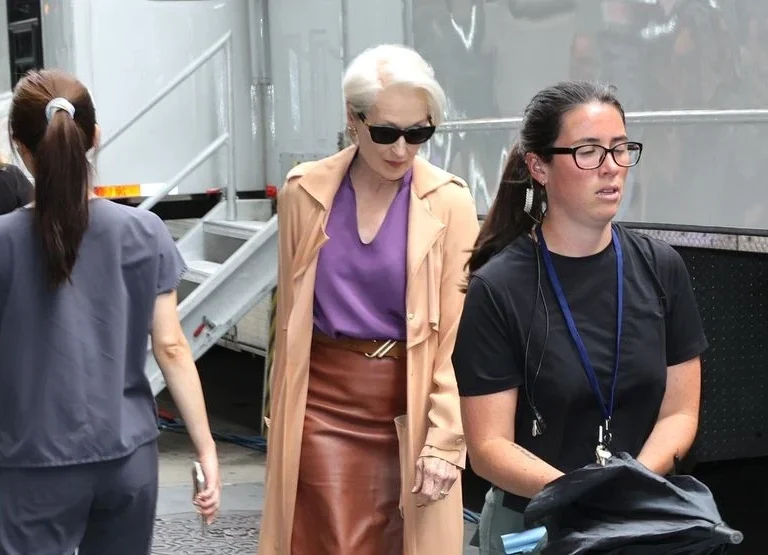
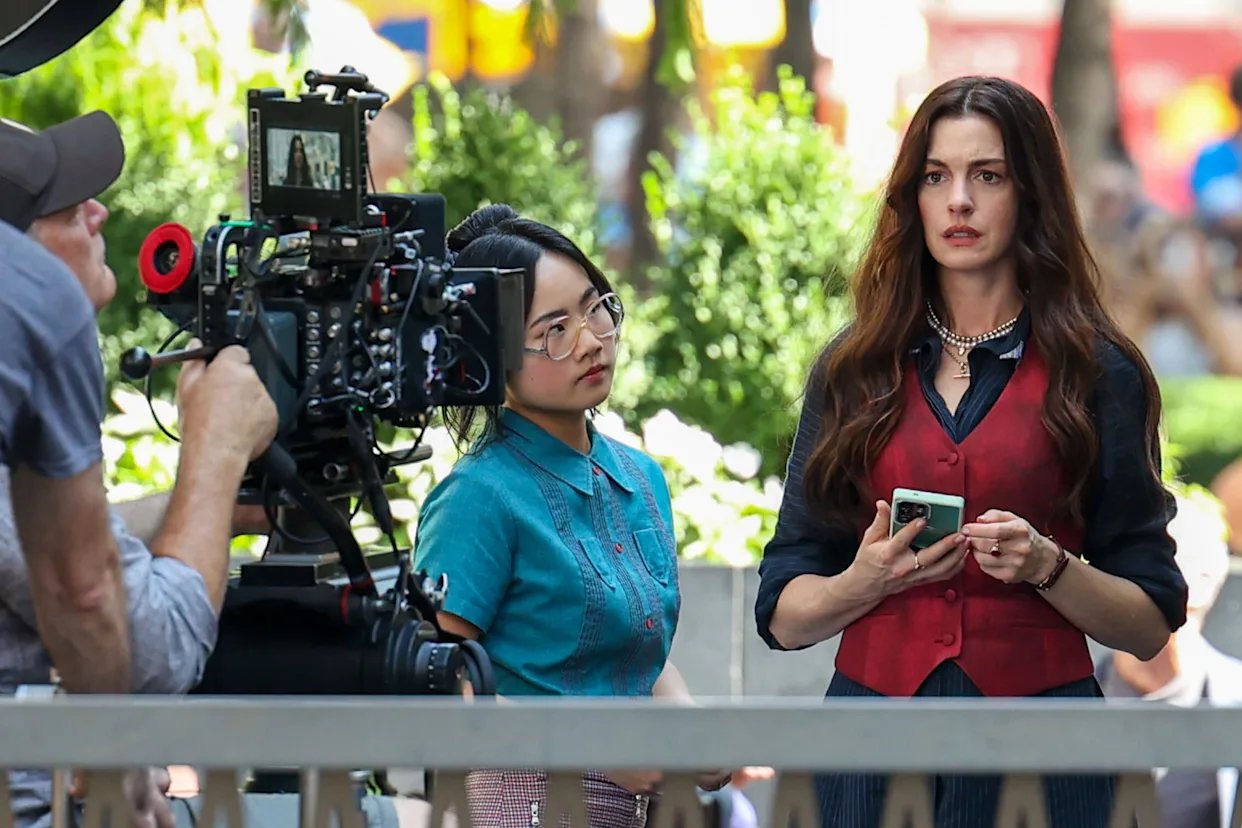
Production for The Devil Wears Prada 2 unfolded across multiple international locations. In New York City, filming spanned Manhattan neighborhoods including Chelsea, Midtown and the Upper East Side, with highly publicized street shoots drawing crowds eager to catch glimpses of Hathaway and Streep in character. Those outdoor sequences became fashion showcases of their own, offering early visual hints of costume design, evolving character styles and narrative shifts.

Across the Atlantic, the production traveled to Milan and Lake Como, continuing the franchise’s tradition of pairing fashion storytelling with iconic European backdrops. In the original film, Paris Fashion Week symbolized both aspiration and professional compromise for Andy Sachs. The sequel’s Italian locations suggest a similarly elevated visual language tied to luxury branding, international markets and creative power.

Yet for all its international polish, the film’s New Jersey chapter stands out for its realism. Airports represent transition, decision and movement, and Newark Liberty International Airport serves as one of the most recognizable gateways between New Jersey, New York and the rest of the world. The choice to stage a crucial scene there quietly embeds the state into the emotional geography of the film.

The sequel also draws inspiration from a literary universe that predates the first movie. The original screenplay adapted a bestselling novel written by a former fashion publishing assistant whose real-world experiences shaped the biting realism that made the story resonate. Subsequent novels expanded the world of Runway and its characters, particularly focusing on Emily’s post-Runway career, a narrative thread that now appears to influence the direction of the sequel.

The commercial legacy of The Devil Wears Prada remains formidable. The original film generated hundreds of millions of dollars worldwide and became a cultural reference point for workplace ambition, creative industries and the mythos of fashion authority. Nearly twenty years later, its dialogue, scenes and characters still circulate widely across social media, fashion commentary and film retrospectives.

For New Jersey, the arrival of its sequel carries significance beyond celebrity headlines.

Every major studio production that chooses to film even a portion of its story within the state contributes to local employment, small business engagement and the broader perception of New Jersey as a versatile production partner. Casting local residents as on-screen performers, hiring regional crews and coordinating with state agencies reflects a growing production ecosystem that continues to mature.

As The Devil Wears Prada 2 prepares for its theatrical release on May 1, 2026, New Jersey audiences will be watching not only for the return of beloved characters, cutting dialogue and couture-level costuming, but also for a fleeting, meaningful moment when Newark becomes part of a cinematic world defined by power, reinvention and ambition.

In a story built around global fashion empires and elite creative circles, New Jersey’s role may be understated, but its contribution is unmistakably woven into the film’s journey. For a state whose talent helped write, direct and star in the sequel—and whose streets and terminals helped bring it to life—the return of Miranda Priestly is also, in its own way, a homecoming.

From G-League Grind to Center-Stage Breakout: Dominick Barlow Powers Philadelphia’s Surge in Statement Win Over the Clippers

On a night that quietly reshaped the narrative around Philadelphia’s evolving rotation, Dominick Barlow delivered the most complete performance of his young NBA career and helped propel the 76ers to a convincing 128–113 win over the Los Angeles Clippers, extending the club’s surge to four straight victories and reinforcing a growing belief that this roster is finding unexpected answers in the middle of an unpredictable season.

For New Jersey and regional basketball fans tracking every development surrounding the Sixers, the performance stands out not only for its box-score impact, but for what it represents about Philadelphia’s depth, adaptability, and willingness to elevate overlooked contributors when circumstances demand it. Those storylines continue to be a major focus across Explore New Jersey’s ongoing coverage of the team within our Philadelphia 76ers section, where roster trends and player development are shaping the broader conversation around the franchise’s future.

Barlow, a former undrafted prospect who has steadily carved out a role through persistence and defensive reliability, exploded for 26 points and 16 rebounds, controlling the paint on both ends and repeatedly punishing Los Angeles on second-chance opportunities. His activity level set the tone early, but it was his poise around the basket and decisiveness in traffic that transformed a strong outing into a genuine breakout moment.

Philadelphia never trailed in the contest.

The Sixers came out sharp, aggressive, and fully committed to attacking mismatches inside, building an early rhythm that forced the Clippers into a reactive posture. By halftime, the home side had already opened a commanding 72–53 advantage, fueled by relentless transition pressure and crisp ball movement that consistently created clean perimeter looks.

Tyrese Maxey remained the engine.

The All-Star guard poured in 29 points, burying seven three-pointers and once again showcasing why he has become the emotional and tactical heartbeat of Philadelphia’s offense. Maxey’s ability to stretch the floor opened wide driving lanes for Barlow and Joel Embiid, creating a three-pronged attack that Los Angeles struggled to contain throughout the night.

While Maxey’s perimeter shooting provided the highlight moments, the story underneath the scoring was Philadelphia’s control of tempo and physicality. Barlow’s rebounding dominance repeatedly short-circuited Clippers possessions and allowed the Sixers to dictate the pace of play, a critical factor against a veteran opponent built around half-court execution.

Joel Embiid, continuing to work his way back into full rhythm following a right ankle injury, added 24 points in a steady, controlled performance that reflected a star still calibrating timing and explosiveness. The numbers were solid. The comfort level is clearly still trending upward. Yet even in a game where Embiid was not asked to carry the entire offensive burden, his presence continued to warp defensive coverage and create spacing advantages for teammates.

One of the more intriguing subplots of the night centered on two marquee names who were notably absent from the NBA’s All-Star reserve selections: Embiid and Clippers forward Kawhi Leonard. Both players used the game as a quiet reminder of their continued elite impact.

Leonard led Los Angeles with 29 points and delivered several late highlights, including two powerful dunks and a three-pointer during a brief fourth-quarter push. However, the Clippers were never able to string together the sustained defensive stops required to make the game truly competitive in the final period, and Leonard eventually watched the closing minutes from the bench.

Jordan Miller provided a lift off the bench for Los Angeles, contributing 21 points and injecting energy during stretches when the Clippers needed momentum. But even his production could not compensate for the absence of James Harden, who missed his second consecutive game due to personal reasons. Clippers head coach Tyronn Lue confirmed prior to tip-off that Harden remained at home in Phoenix, leaving the team short on playmaking and offensive orchestration.

That void became increasingly apparent as the game wore on.

Philadelphia’s defensive rotations were sharp, perimeter close-outs were timely, and the Sixers repeatedly forced Los Angeles into late-clock situations that stalled potential runs before they could develop. Even when the Clippers briefly trimmed the margin, the response from Philadelphia was immediate and organized.

The pivotal stretch came in the third quarter.

Although the Clippers narrowly outscored the Sixers 34–28 in the period, Philadelphia still emerged with a 100–87 lead, a testament to the cushion built earlier and the composure of the offense. Maxey, Barlow, and Embiid combined for 22 points during the quarter, answering each Los Angeles push with baskets that stabilized the flow of the game.

For a Sixers roster navigating unusual circumstances this season, including the continued absence of Paul George due to a 25-game suspension for violating the league’s anti-drug program, the ability to generate consistent production from unexpected sources has become a defining characteristic of their recent success. With George sidelined, Philadelphia improved to 11–10 in games played without him, a mark that underscores both the challenge and resilience facing the club.

Barlow’s emergence could not have come at a more important moment.

Beyond the raw totals, his defensive positioning, willingness to contest without fouling, and effort on box-outs provided the structural backbone for Philadelphia’s interior defense. Against a Clippers lineup designed to exploit switches and drive-and-kick opportunities, Barlow consistently closed space and recovered quickly enough to disrupt second actions.

Just as critical was his offensive patience.

Rather than forcing shots, Barlow operated within the flow of the offense, capitalizing on dump-offs, offensive rebounds, and quick finishes generated by Maxey’s penetration and Embiid’s gravitational pull in the post. It was a performance built on timing, discipline, and trust in the system—exactly the traits coaches value when determining whether a breakout night can translate into a sustainable role.

Los Angeles entered the contest playing strong basketball, winning eight of its previous 11 games while attempting to remain firmly within reach of the Western Conference play-in picture. Yet the matchup exposed how thin the margin becomes when one or two critical pieces are unavailable, particularly for a team heavily dependent on half-court creation.

For Philadelphia, the win was about more than extending a streak.

It reinforced an identity that has quietly taken shape over the past several weeks—an identity built around speed on the perimeter, collective rebounding, and opportunistic scoring from players willing to seize expanded responsibilities. The Sixers have not simply survived lineup disruptions. In several key moments, they have evolved because of them.

That evolution is especially visible in the way Maxey has embraced his leadership role. His shot selection has grown more selective, his reads out of double teams have sharpened, and his willingness to trust emerging teammates such as Barlow speaks to a locker room dynamic that continues to mature under pressure.

The schedule offers little time to celebrate.

Philadelphia closes a demanding back-to-back on the road against the Golden State Warriors, a test that will quickly reveal whether the momentum generated by this performance can carry over against a different style of opponent and a more mobile defensive structure.

Still, nights like this resonate beyond a single box score.

Dominick Barlow’s career performance stands as a reminder that NBA seasons are often shaped by unexpected contributors rising when opportunity appears. For the Sixers, searching for stability and continuity during a turbulent stretch of the calendar, his emergence may prove to be one of the most meaningful developments of their midseason push.

Portal North Cutover Begins, Marking a Historic Turning Point for New Jersey’s Rail Future

Six-week realignment of the century-old Portal Bridge launches one of the most complex rail construction operations in the state’s modern history, reshaping service and setting the stage for a long-awaited infrastructure breakthrough

New Jersey entered a decisive new phase in its largest and most technically demanding rail upgrade this week as crews began the long-planned “cutover” process that will physically transition rail operations away from the 114-year-old Portal Bridge and prepare the corridor for full use of the new Portal North Bridge.

The operation marks a rare and highly intricate moment in major rail construction: aligning two generations of infrastructure—one built in the early twentieth century and one engineered for twenty-first-century rail demands—without severing one of the busiest passenger corridors in the nation.

Over the next six weeks, specialized construction and track forces will methodically disconnect and reconfigure rail alignments, power systems, signaling equipment, and structural interfaces that have defined travel across the Hackensack River for more than a century. The work is expected to continue through March and will bring widespread schedule changes, rerouting, and service cancellations for NJ Transit and Amtrak riders throughout northern New Jersey and into New York.

The cutover is not a ceremonial milestone. It is a live, operational transformation that directly affects how trains move through one of the most congested segments of the Northeast rail network.

For decades, the aging Portal Bridge has stood as a primary source of cascading delays. The steel swing bridge must open to accommodate maritime traffic, forcing passenger trains to halt, stack, and recover—often triggering ripple effects that spread far beyond the Meadowlands and into the broader Northeast Corridor. Mechanical failures, weather-related disruptions, and structural limitations have repeatedly amplified those delays, creating reliability challenges that commuters know all too well.

The new Portal North Bridge has been engineered to permanently eliminate that bottleneck. Built higher and fixed in place, the modern span allows vessels to pass beneath without interrupting rail traffic, fundamentally changing the operational reality of this critical crossing.

What makes the current cutover especially complex is that the transition must be executed while portions of the corridor remain active. Crews are performing precision work that includes track realignment, turnout installation, signal integration, overhead catenary adjustments, and extensive testing—all within a narrow construction window designed to minimize long-term service disruption.

Project managers describe the effort as a phased operational migration rather than a simple switch.

Trains cannot simply be rerouted overnight. Each segment must be physically tied into the new alignment, electrically energized, digitally integrated into the signaling network, and verified through repeated test runs before any revenue service is permitted to operate over the new structure.

During this transition, NJ Transit and Amtrak have been forced to temporarily reduce service levels and reassign equipment and crews. Riders should expect shifting schedules, canceled trains, and modified routing patterns throughout the six-week construction window, particularly during off-peak periods and overnight operations when the most disruptive work is scheduled.

Transportation officials stress that the inconvenience, while significant, is unavoidable for a project of this scale.

The Portal North Bridge is not an isolated improvement. It is a cornerstone of New Jersey’s long-term rail modernization strategy and a critical element of the broader Gateway Program, which aims to strengthen the entire rail link between New Jersey and New York. Without this bridge, future capacity upgrades—including new Hudson River tunnel infrastructure—cannot reach their full operational potential.

In practical terms, the new bridge will allow more trains to move reliably through the corridor each day, reduce chronic congestion during peak commuting hours, and stabilize schedules across multiple interconnected lines serving Bergen, Passaic, Essex, and Hudson counties.

Beyond reliability, the project carries major economic implications for the state.

The rail corridor supported by the Portal crossing underpins daily access to one of the largest employment centers in the world. Every delayed or canceled train affects not only individual commuters but also employers, regional productivity, and the broader competitiveness of New Jersey’s labor market.

From a construction perspective, the cutover also represents a rare demonstration of advanced rail delivery techniques being deployed at scale within the state. The work integrates high-precision surveying, digital modeling, prefabricated track components, and coordinated field execution—reflecting the evolving standards now shaping large-scale transportation construction projects across the country. Readers interested in how these large public works initiatives are transforming New Jersey’s infrastructure landscape can explore more of Sunset Daily’s in-depth coverage of regional [construction] projects and corridor upgrades.

While the new bridge structure itself is already in place, the operational transition remains the most sensitive and technically demanding phase of the project. A single misalignment, software conflict, or power inconsistency can delay commissioning and force crews to revisit completed work.

That risk is why the six-week window has been carefully staged to include multiple testing cycles, backup work plans, and overlapping engineering teams monitoring performance in real time.

Once the cutover is complete and the new Portal North Bridge is fully integrated into regular service, the change will be immediately visible to riders—even if the engineering behind it remains largely unseen.

Trains will no longer be forced to wait for bridge openings. Schedules will become more predictable. Dispatching flexibility will improve. And the corridor will gain a level of operational resilience that has been unattainable for more than a century.

For New Jersey, the moment carries symbolic weight as well.

The Portal Bridge, opened in 1910, has served through two world wars, multiple generations of rail equipment, and the transformation of the region from an industrial powerhouse to a modern service-driven economy. Its replacement is not simply a matter of steel and concrete. It signals a generational shift in how the state invests in its transportation backbone.

As crews continue the painstaking work of aligning old infrastructure with new, the coming weeks will test the patience of riders—but they will also deliver one of the most consequential upgrades to New Jersey’s rail network in modern history.

By early spring, the state will be positioned to move beyond one of its most stubborn transportation bottlenecks—and closer to a rail system capable of supporting the region’s growth for decades to come.

The Devils are playing their final few games before the 2026 Winter Olympics break

A Season Hanging in the Balance: Why the New Jersey Devils’ Health Crisis and a Rookie Breakout Are Defining the Franchise’s Future. The Devils did not play last night, but they have a game tonight, February 3, 2026, at home against the Columbus Blue Jackets

Upcoming Schedule

The Devils are playing their final few games before the 2026 Winter Olympics break, which begins on February 6. 

Date OpponentLocationTime (EST)
Tonight, Feb 3vs. Columbus Blue JacketsPrudential Center7:00 PM
Thursday, Feb 5vs. New York IslandersPrudential Center7:00 PM
Wednesday, Feb 25vs. Buffalo SabresPrudential Center7:00 PM
Thursday, Feb 26@ Pittsburgh PenguinsPPG Paints Arena7:00 PM
  • Broadcast Info: Tonight’s matchup will be televised on MSG Sportsnet and is available for streaming via the official NHL Gamecenter.
  • Last Outing: The Devils’ most recent game was on Saturday, January 31, where they lost 4–1 to the Ottawa Senators.

The New Jersey Devils entered the heart of winter believing they were finally positioned to turn elite talent into sustained contention. Instead, as the Metropolitan Division tightens and every point becomes magnified, the organization finds itself navigating a season that now feels dictated less by tactics or matchups and more by medical reports and lineup availability.

With 28 wins on the board and buried in the traffic jam of the Metropolitan race, the Devils are living in the NHL’s most uncomfortable reality: close enough to the playoff picture to justify urgency, but far enough away that even a small stumble can turn into a season-defining slide. In that narrow space, injuries have become more than an inconvenience. They are actively reshaping how this roster functions, how management evaluates its options, and how the future of this core is being accelerated in real time.

No player symbolizes that tension more clearly than Jack Hughes.

The Devils escaped their latest outing with an overtime win against Nashville, but the result felt secondary once Hughes quietly disappeared from the bench. His night lasted just over two minutes across three short shifts. A test skate teased a return. It never came. By the time the game ended, the concern had already shifted from the scoreboard to the training room.

Postgame confirmation that the issue was lower body — and not related to the hand injury that derailed much of his season earlier — offered limited relief. Imaging was scheduled. His short-term availability remained uncertain. And for a team already operating with razor-thin margin, uncertainty is almost as damaging as a confirmed absence.

This is not simply about missing a star. It is about losing the structural centerpiece of how the Devils generate offense, manipulate defensive matchups, and break pressure at even strength.

Since returning from his finger injury, Hughes has produced 16 points in 19 games. On paper, that is respectable production. On the ice, the difference has been visible. He has not consistently played with the same explosiveness through traffic or the same confidence in tight puck battles. Even so, his presence alone changes how opponents deploy their best defenders and checking lines. The Devils’ lineup is constructed around that gravitational pull.

Without Hughes, the center depth chart becomes alarmingly thin. Nico Hischier remains the lone proven two-way pivot capable of absorbing top competition. Dawson Mercer, Paul Cotter and Luke Glendening can fill minutes, but asking that group to shoulder extended matchup responsibility against playoff-caliber opponents is a dangerous gamble — particularly on the road.

That concern is amplified by the status of Cody Glass, who has quietly become one of the Devils’ most stabilizing forwards over the past several weeks. Before a leg injury suffered on a blocked shot, Glass had delivered six goals and nine points over a nine-game stretch, while providing reliable defensive structure and forecheck pressure in the middle of the lineup. His potential return helps. It does not solve the problem created by a missing Hughes.

The calendar only sharpens the anxiety.

With just a handful of games remaining before the Olympic break, the Devils realistically cannot climb back into a secure playoff position before league play pauses. The window to stabilize their season is now. Dropping games while icing a depleted lineup risks turning a precarious race into a statistical long shot.

That context also reframes the organization’s recent roster move.

General manager Tom Fitzgerald finally made a decisive in-season adjustment, sending Ondrej Palat and draft capital out in exchange for Maxim Tsyplakov. The transaction did more than add a physical winger with legitimate scoring touch — it removed a burdensome contract and cleared meaningful cap space for future flexibility. From a long-term roster construction standpoint, it was a logical and necessary correction.

But timing matters.

Cap flexibility only becomes a competitive weapon if the roster can actually support an aggressive push. If Hughes is sidelined for multiple games and the Devils limp into the break shorthanded down the middle, the incentive to leverage newly created financial room for short-term reinforcements becomes far more complicated. Mortgaging future assets for a late-season charge makes little sense if the lineup cannot realistically sustain it.

And this is where the Devils’ injury problem becomes truly systemic.

Jack Hughes is not the only missing piece.

On the blue line, Luke Hughes’ shoulder injury removed the one defenseman on the roster capable of consistently transforming defensive recoveries into controlled exits with speed. His skating allowed the Devils to bypass forechecking pressure and compress the neutral zone before opposing structures could reset. Without him, New Jersey’s transition game slows noticeably.

The ripple effect has been immediate. More responsibility has fallen onto Dougie Hamilton and Simon Nemec to create offense from the back end. Both can distribute and activate in-zone. Neither replicates Luke Hughes’ ability to transport the puck under pressure. That gap has subtly altered how the Devils attack, often forcing more reliance on chip-and-chase entries and extended zone time rather than clean rush opportunities.

Ironically, Jack Hughes had already begun to compensate for that structural loss by rotating deeper into breakout sequences and supporting defensemen near the points. With both Hughes brothers unavailable, even temporarily, the Devils lose two of their most efficient puck movers in different layers of the ice. That is not a coincidence. It is a tactical vulnerability.

Against opponents still fighting for postseason survival, such as Ottawa, that weakness becomes magnified. These are not low-stakes games. They are four-point nights. Lose one, and the damage extends beyond the standings — it reshapes the psychological margin for error inside the room.

Yet, buried inside this frustrating season, a genuine bright spot has emerged.

Lenni Hameenaho is not saving the Devils’ campaign. That burden would be unreasonable for any rookie. What he is doing, however, is providing a rare and meaningful glimpse into what this organization’s next competitive iteration may look like.

Called up only weeks ago, the 2023 second-round selection has played with a maturity that belies his limited NHL experience. His early production — two goals and two assists in seven games — tells only part of the story. What stands out far more is how consistently play tilts in the Devils’ favor when he is on the ice at five-on-five.

In controlled possession metrics and quality scoring chance generation, Hameenaho has already driven results at a level typically associated with established middle-six forwards. His expected goal share has remained north of sixty percent across multiple games, even as his deployment has grown more demanding with each passing night.

Sheldon Keefe’s usage tells the deeper story.

Hameenaho has not been sheltered. He has faced top-six forwards. He has drawn difficult defensive matchups. He has been placed alongside both young linemates and veteran centers. And in several instances, he has been tasked with absorbing minutes against opposing first lines, not merely surviving them.

In his NHL debut in Calgary, Hameenaho held his own against Nazem Kadri in extended five-on-five minutes, driving play decisively in New Jersey’s favor. The following night in Edmonton, he recorded a perfect expected goal share during his ice time — an extraordinary statistical outlier, regardless of competition level.

The real statement came in Vancouver.

Matched frequently against a Canucks top line featuring Brock Boeser and Filip Chytil, Hameenaho not only survived the matchup but dominated it territorially. He recorded his first NHL goal and assist in the same game, while finishing with the strongest overall performance on the Devils’ bench. It was the type of breakout game that alters internal perception of a prospect almost overnight.

Even when the results became more mixed — as they did against Seattle and Winnipeg — the trust from the coaching staff never wavered. Against the Jets’ elite top line anchored by Mark Scheifele and Kyle Connor, Hameenaho experienced his first truly punishing assignment. The raw possession numbers dipped. The context, however, was revealing. A rookie winger was deployed directly into one of the league’s most dangerous matchups, with last change available. That is not accidental.

The trend continued against Nashville, where Hameenaho again drew a difficult blend of top-line forwards and a premier defensive pair. While some of his individual matchups proved challenging, his overall on-ice impact rebounded sharply. He finished the night as one of the Devils’ most effective players at even strength.

The reality of rookie development finally surfaced in Ottawa.

Facing another elite forward group, Hameenaho struggled along with the rest of the lineup. The Devils were collectively overwhelmed. His metrics dipped into the red. That is not unusual. It is development.

What matters is the larger pattern.

Across seven games, Hameenaho has demonstrated strong puck support, intelligent spacing in the offensive zone, and a surprising level of composure under forecheck pressure. His playmaking instincts fit seamlessly within the Devils’ speed-based attack identity. Just as importantly, he has shown he can remain defensively responsible while still pushing pace — a combination that earns ice time quickly in Keefe’s system.

For a team whose current roster has underperformed relative to expectations, Hameenaho’s emergence is quietly reshaping internal optimism about the near future. It is one of the few developments this season that meaningfully strengthens the long-term outlook without requiring projection gymnastics.

For Devils fans following the organization’s broader trajectory, this kind of development is central to the franchise’s next competitive cycle — a cycle chronicled throughout Explore New Jersey’s in-depth New Jersey Devils coverage, which continues to track how young talent is reshaping the club’s identity and future direction.

That future, however, cannot fully materialize until the present stabilizes.

The Devils’ biggest challenge is no longer tactical alignment or lineup chemistry. It is durability. Freak injuries, blocked shots, and awkward collisions have accumulated into a season-wide structural issue. When a roster is built around speed, puck movement, and layered support through the middle of the ice, losing multiple high-skill transition players simultaneously is more destabilizing than losing a single top scorer.

Jack Hughes remains the hinge point.

Whether he misses one game or several, the next stretch will reveal how resilient the Devils truly are without their offensive engine. Asking Nico Hischier to carry matchup minutes, defensive responsibility, and scoring burden simultaneously is a recipe for exhaustion over time. Asking a thin center group to replicate Hughes’ impact is simply unrealistic.

At the same time, the continued integration of Lenni Hameenaho offers a compelling reminder that the Devils are not devoid of upward momentum. The organization’s player development pipeline is delivering. The question is whether the current season can survive long enough for that progress to matter in the standings.

If both Hughes brothers remain sidelined for any meaningful stretch, the consequences extend well beyond a few lost games. The Devils’ transition structure, matchup flexibility, and scoring depth would all be compromised simultaneously. In a conference where playoff races routinely come down to one or two points, that combination can quietly erase months of work.

The season is not over.

But it is balanced precariously on health, timing, and the ability of a young roster — now leaning heavily on both its franchise star and its newest rookie revelation — to navigate one of the most unforgiving stretches of the NHL calendar.

Hudson Tunnel Project Thrown Into Legal Crisis as Gateway Commission Sues Federal Government Over Frozen Funds

Court fight threatens construction halt, nearly 1,000 immediate job losses, and mounting regional economic fallout for New Jersey and New York

The Gateway Development Commission has warned that construction on the Hudson Tunnel Project may pause by February 6, 2026, if federal funding disbursements do not resume. This could impact nearly 1,000 jobs immediately.

The future of the most critical transportation project in the Northeast Corridor—and one of the most consequential infrastructure investments in the nation—was thrown into legal and political turmoil this week as the Gateway Development Commission filed a breach of contract lawsuit against the federal government in the U.S. Court of Federal Claims, seeking the immediate release of long-promised funding for the Hudson Tunnel Project.

The lawsuit places New Jersey at the center of a rapidly escalating infrastructure standoff that could halt construction by February 6, 2026, trigger the loss of nearly 1,000 union construction jobs, and jeopardize the long-term reliability of the busiest passenger rail link in the United States.

The Hudson Tunnel Project is designed to transform and safeguard the rail lifeline between New Jersey and New York by constructing a new two-track tunnel beneath the Hudson River and rehabilitating the existing North River Tunnel, which first entered service in 1910 and has become a chronic source of systemwide delays. Hundreds of thousands of daily riders depend on the aging tunnel, which connects New Jersey commuters directly into Midtown Manhattan and supports a rail corridor that underpins roughly one-fifth of the nation’s economic activity.

At issue in the lawsuit is more than just timing. Gateway officials say the federal government is in direct violation of binding grant and loan agreements that were finalized in July 2024, when full federal participation in the Hudson Tunnel Project was formally secured. Those agreements include multiple federal funding programs and federally backed financing instruments that together represent the majority share of the project’s total construction budget.

According to the complaint, federal agencies stopped releasing contractually obligated funds on October 1, 2025, despite the project remaining fully active and compliant with the requirements set out in the signed agreements. The Gateway Development Commission argues that the funding freeze constitutes a clear breach of federal contracts and that shifting justifications offered for withholding the money have no lawful basis.

More than $1 billion has already been invested in active construction and project development. Work is underway on multiple components tied to tunnel construction, staging facilities, engineering systems, and site preparation on both sides of the Hudson. The sudden disruption of federal disbursements, project leaders warn, has pushed the commission to the brink of financial exhaustion.

Gateway officials disclosed at their January 27, 2026 board meeting that all remaining contingency funding and credit mechanisms have now been fully utilized to keep construction moving while federal payments remain suspended. Without an immediate resumption of disbursements, work will be forced to stop on February 6.

A construction shutdown would produce immediate and cascading consequences across New Jersey’s construction workforce and transportation economy. Nearly 1,000 workers would be laid off at once. If the stoppage extends beyond a short interruption, approximately 11,000 jobs tied to current project contracts would be placed at risk. Over the life of the project, the Hudson Tunnel initiative is projected to generate roughly 95,000 jobs and nearly $20 billion in total economic activity across the region.

Beyond the labor impacts, the commission warns that a prolonged pause substantially increases the likelihood of an operational failure in the existing North River Tunnel—already a major choke point for Amtrak and New Jersey Transit service. Any forced closure or extended outage in the 116-year-old tunnel would effectively sever the single most heavily traveled passenger rail segment in the country, triggering billions of dollars in lost productivity, missed work hours, and business disruption for the New York–New Jersey metropolitan region.

New York Governor Kathy Hochul framed the funding freeze as a direct threat to both regional stability and national economic output, emphasizing that more than 200,000 daily commuters rely on safe, dependable rail service under the Hudson River to sustain a regional economy that accounts for approximately 20 percent of U.S. economic activity. She accused the federal administration of unlawfully withholding funding that had already been approved and contractually committed.

New Jersey Governor Mikie Sherrill said the state is pursuing legal action to protect jobs and economic growth in New Jersey, warning that the disruption of a project of this scale would reverberate through the state’s construction industry, supply chains, and regional transportation network.

U.S. Senate Majority Leader Chuck Schumer echoed those concerns, calling the Hudson Tunnel Project the single most important infrastructure project in the country and stressing that tens of thousands of union jobs depend on its uninterrupted progress.

Gateway Development Commission Chief Executive Officer Tom Prendergast said the commission had worked for months with federal partners to resolve concerns raised by federal agencies, including extensive documentation and compliance reviews related to the federally mandated Disadvantaged Business Enterprise program. Project leaders maintain that the Hudson Tunnel Project is fully aligned with the most recent federal regulatory standards.

The lawsuit asks the court to declare that the federal government is obligated to release the funds already committed under the signed grant and loan agreements. In addition to approximately $205 million in immediate disbursements currently due, the complaint also seeks damages that would result from a construction pause, including termination costs, contractual penalties, and project restart expenses.

The broader implications for New Jersey extend far beyond the tunnel itself.

The Hudson Tunnel Project is foundational to the future capacity and reliability of New Jersey Transit and Amtrak service into New York City. It is also central to the state’s long-term strategy to sustain economic growth while managing one of the nation’s most intense commuter flows. Without new tunnel capacity, the region remains dependent on infrastructure that predates World War I and has already suffered long-term damage from Superstorm Sandy and decades of heavy use.

Transportation planners have repeatedly warned that the existing two-track configuration under the Hudson leaves no operational redundancy. Any major outage instantly cripples service across the Northeast Corridor, disrupting travel from Washington, D.C. to Boston and creating ripple effects throughout New Jersey’s rail network.

The legal challenge now unfolding also injects a volatile new dimension into the national infrastructure debate and is rapidly becoming a defining flashpoint in federal-state relations. As the case moves forward, the dispute is expected to dominate transportation and infrastructure discussions in Washington and Trenton alike, further intensifying the political spotlight on federal infrastructure commitments. Readers following the evolving state and federal politics surrounding transportation funding and regional investment can track continuing coverage through Sunset Daily News.

For New Jersey, the stakes are uniquely high. The Hudson Tunnel Project is not merely a transit upgrade. It is a cornerstone of regional mobility, labor market access, climate resilience planning, and long-term economic competitiveness. A prolonged funding interruption would not only delay a long-awaited infrastructure fix—it would deepen the vulnerability of the very transportation backbone that enables New Jersey’s commuter economy to function.

With a hard February deadline approaching, Gateway officials say time is no longer a negotiable variable. Unless federal funds begin flowing again immediately, construction will stop, workers will be sent home, and the most critical rail project in the country will enter an uncertain and legally contested future.

New Jersey’s Hidden Economic Paradox: Record Incomes, Relentless Budget Pressure

Why a state filled with high earners still struggles to fund the services residents expect

New Jersey has quietly become one of the most economically complex states in the country. On paper, its residents rank among the wealthiest in America. In practice, the state’s public finances continue to feel constrained, forcing lawmakers to navigate recurring budget stress, structural gaps, and rising demands for relief.

New Jersey Economic Overview (2024–2025)

Metric ValueGrowth (Annualized/YoY)Rank (U.S.)
Real GDP (2025)~$695 Billion3.1% (5-year avg: 2.3%)23rd
Personal Income~$832 Billion~3.0% to 4.7% (Quarterly varies)6th (per capita)
Unemployment4.9% – 5.0%Ticking upward (Aug 2025)Elevated

At the center of this contradiction is a structural imbalance that economists increasingly describe as New Jersey’s income-output divide — a condition in which personal income dramatically outpaces the economic production taking place inside the state’s borders.

New Jersey’s economy is undeniably large. Its gross domestic product is now approaching the $1 trillion threshold, placing the state firmly among the nation’s top-tier economic engines. Yet a growing share of the income earned by New Jersey households is generated elsewhere — primarily in New York City and surrounding downstate markets — and that reality carries deep consequences for how the state collects revenue and funds public services.

In the third quarter of 2025 alone, New Jersey residents earned an estimated $89 billion from jobs located outside the state. That figure represents more than 10 percent of all personal income earned by New Jersey residents during the period — an extraordinary level of dependence on out-of-state employment for a state with its own diversified economy.

The result is a commuter-driven income gap that reshapes New Jersey’s fiscal outlook in ways that are often misunderstood by the public.

High salaries earned across the Hudson River flow back into New Jersey households, boosting property values, consumer spending, and overall affluence. But when it comes to income tax collections, the state does not capture the full benefit of that prosperity. Taxes paid to New York are credited against a commuter’s New Jersey income tax obligation, leaving Trenton with significantly less revenue than headline income statistics might imply.

In effect, New Jersey bears the cost of serving a high-income population without fully benefiting from the tax base that would normally accompany those earnings.

This revenue mismatch is one of the primary contributors to what state budget analysts describe as a persistent structural deficit — not necessarily a short-term shortfall, but a recurring gap between the level of public services residents expect and the revenue generated by New Jersey’s in-state economy.

The pressure is most visible in the areas that define everyday life across the state: public education, transportation infrastructure, property tax relief, public safety, healthcare access, and local government support. A population with elevated income and housing costs demands higher service quality, modernized facilities, and expanded programs. Yet the tax base tied directly to New Jersey’s internal business activity has not expanded fast enough to support that demand without repeated budget adjustments.

Economic researchers have increasingly referred to the need for what they call a “swell” in New Jersey’s internal economic output — a period in which state-based industry growth significantly outpaces personal income growth. Without that shift, New Jersey’s public finances remain dependent on commuter wealth that does not translate into proportional state revenue.

The most recent economic data illustrates the challenge.

In 2025, New Jersey’s real gross domestic product was estimated at approximately $695 billion, growing at an annualized rate near 3.1 percent. While that performance represents an improvement over the state’s longer-term five-year average growth of roughly 2.3 percent, it still places New Jersey in the middle tier nationally for economic expansion.

By contrast, total personal income across the state reached approximately $832 billion, ranking New Jersey sixth nationally on a per-capita basis. Quarterly growth has fluctuated between roughly 3.0 and 4.7 percent, consistently outpacing the expansion of the state’s internal production base.

At the same time, labor market signals are becoming less favorable. Unemployment hovered between 4.9 and 5.0 percent in late summer 2025 and has shown a gradual upward trend. While still manageable, the increase is occurring as employers in several core industries remain cautious about hiring amid higher interest rates and slowing regional growth.

The deeper issue, however, is not cyclical. It is structural.

New Jersey’s economic profile is heavily shaped by its proximity to one of the world’s most powerful metropolitan job markets. Highly compensated professionals in finance, technology, law, consulting, media, and corporate management continue to live in New Jersey while working in Manhattan and nearby New York employment centers. That dynamic has fueled decades of population stability in affluent commuter corridors — but it has also constrained the state’s ability to organically grow its own high-value business base at the same pace.

State initiatives designed to strengthen in-state industry — including innovation hubs, life sciences expansion, clean energy investment, logistics modernization, and advanced manufacturing incentives — have gained traction in recent years. But economic observers note that the growth of these sectors has not yet closed the widening gap between resident income and in-state output.

Analysts from the Garden State Initiative and NJ Spotlight News have repeatedly pointed out that while New Jersey’s population remains wealthy, the state’s industrial and commercial growth frequently lags national averages, particularly when measured against fast-expanding Sun Belt and Midwest technology and manufacturing centers.

The implications extend well beyond abstract economic charts.

Because New Jersey’s fiscal system is built around a mix of income taxes, corporate taxes, and property taxes, slower internal business expansion places disproportionate pressure on homeowners and local governments. Property taxes — already among the highest in the nation — become the backstop when state revenues struggle to keep pace with spending needs.

School districts, municipalities, and county governments feel the strain most directly. Rising labor costs, pension obligations, healthcare expenses, and infrastructure needs leave little room for flexibility. Even modest slowdowns in revenue growth can ripple outward into budget caps, delayed capital improvements, and politically charged tax debates.

The commuter income dynamic also creates vulnerability to external economic shocks. A downturn in New York City’s financial sector, technology hiring, or commercial real estate market can quickly affect household income in New Jersey without providing any counterbalancing increase in in-state employment or business activity. In such scenarios, New Jersey experiences the downside of regional economic exposure while lacking the fiscal insulation that stronger internal output would provide.

For policymakers, the path forward increasingly centers on one priority: scaling in-state economic production faster than resident income growth.

That objective includes accelerating life sciences research commercialization, expanding advanced manufacturing corridors, modernizing port and logistics infrastructure, deepening artificial intelligence and fintech ecosystems, and improving the speed and predictability of business permitting and regulatory processes. Workforce development — particularly in engineering, healthcare, cybersecurity, and clean energy — is now viewed as a central lever for stabilizing long-term growth.

Equally important is retaining fast-growing firms once they establish a presence in the state. New Jersey’s competitive challenge is no longer simply attracting companies; it is ensuring that headquarters, research operations, and high-margin functions remain rooted locally instead of migrating to lower-cost regions once early growth phases are complete.

Until that internal economic swell takes hold, New Jersey’s paradox will persist: a state filled with high earners, premium housing markets, and strong consumer spending — yet one that continually wrestles with the fiscal realities of funding top-tier public services.

For a deeper look at how shifting corporate investment and regional economic strategy are reshaping the state’s outlook, follow Sunset Daily’s ongoing business coverage in our New Jersey economy section.

New Jersey does not lack wealth. What it lacks — at least for now — is enough homegrown economic output to fully sustain the level of public investment its residents expect and deserve.

A Century of Recognition, A Statewide Celebration: How New Jersey Is Marking 100 Years of National Black History Observance

Today, February 2, 2026, marks a historic milestone across the nation—the 100th anniversary of the first officially recognized national celebration honoring Black history and achievement. In New Jersey, that legacy is being honored not with a single ceremony, but through a sweeping, statewide series of festivals, exhibitions, performances, historical reenactments, and educational gatherings that reflect both the depth of African American history and the living, evolving cultural influence shaping the state today.

Today, February 2, 2026, officially marks the 100th anniversary of the first national Black History celebration. New Jersey has a robust schedule of festivals, historical recreations, and community expos throughout the month.

Major Festivals & Community Expos

  • Black History Month 2026 Expo (Union Township): A massive free community event on Feb. 7 from 1:00 PM – 6:00 PM at the Jefferson School Auditorium. It features an art gallery, live music, and over 40 Black-owned business vendors.
  • 7th Annual African American Read-In (Piscataway): Scheduled for Feb. 21 at 11:00 AM at the John F. Kennedy Library, this event celebrates Black authors and cultural contributions through literature and crafts.
  • Rays of Hope: Living Black Museum (Princeton): On Feb. 23 at 3:00 PM, the Arts Council of Princeton will host a “living museum” celebrating Black culture through interactive exhibits by local youth. 

Historical Recreations & Performance

  • Madame Selika: 1878 Songbird in the White House (Elizabeth): A free theatrical recreation on Feb. 19 at the Union County Courthouse (or adjacent venue) commemorating the first free person of color to perform at the White House.
  • Hannah Till: Black History in the Revolutionary War (South Orange): Historical interpretation sessions throughout February at The Woodland Parlor, focusing on the life of General Washington’s enslaved cook.
  • Cirque Kalabante: Afrique en Cirque (Morristown): A high-energy performance showcasing African culture and acrobatics at the Mayo Performing Arts Center on Feb. 13 at 8:00 PM. 

Art Exhibitions & Museum Events

  • Honor the Past, Inspire the Future (Margate): This exhibition opens today, Feb. 2, at the Katz JCC and runs through March 1, featuring regional artists like E.B. Lewis and Kimberly Camp.
  • Allan Rohan Crite: Neighborhood (New Brunswick): A major exhibition opening this month at the Zimmerli Art Museum at Rutgers, with a celebratory “SparkNight” event on Feb. 12 featuring live music and art activities.
  • Seeing America Exhibit (Newark): Throughout February, the Newark Museum of Art features galleries dedicated to the Harlem Renaissance and the Civil Rights Movement. 

Lectures, Tours & Book Signings

  • Four Centuries of African American Soldiers (Trenton): A living history program on Feb. 21 at the William Trent House documenting the stories of Black warriors throughout American history.
  • Douglass Day (Skillman): The Stoutsburg Sourland African American Museum will host a special event on Feb. 13 featuring records from the historic Colored Conventions movement.
  • A Raisin in the Sun (Maplewood): A local production of the Lorraine Hansberry classic begins on Feb. 13 as part of the township’s month-long celebration.
  • A’Lelia Bundles Author Talk (Montclair): On Feb. 21, the Montclair Public Library hosts A’Lelia Bundles to discuss her new biography on Harlem Renaissance icon A’Lelia Walker. 

Overnight & Immediate Events (Feb 2 – Feb 3)

  • Union County Flag Raising: Today at 1:00 PM at the Union County Courthouse Rotunda in Elizabeth.
  • Crafternoon: Traffic Light Craft: Today at 4:00 PM at the Mercer County Library (Hopewell Branch), honoring inventor Garrett Morgan.
  • Underground Railroad Virtual Lecture: On Feb. 3 at 6:00 PM, the Mercer County Library is hosting a virtual program on abolition in South Jersey. 

Throughout February, communities from Union County to Atlantic County, from Newark to Princeton, and from Morristown to Maplewood are transforming libraries, schools, museums, theaters, and civic spaces into places of remembrance, creativity, dialogue, and shared celebration. Together, these events form one of the most ambitious and inclusive Black History Month schedules New Jersey has ever presented.

At the center of the month’s community programming is the Black History Month 2026 Expo in Union Township, a large-scale, free public gathering scheduled for February 7 from 1:00 p.m. to 6:00 p.m. at Jefferson School Auditorium. Designed as both a cultural showcase and an economic empowerment platform, the expo brings together an immersive art gallery, live musical performances, and more than forty Black-owned business vendors representing fashion, wellness, food, publishing, and creative services. The event functions as a vibrant marketplace of ideas and entrepreneurship, while also offering families and students an accessible entry point into Black cultural heritage through hands-on experiences and community storytelling.

In Piscataway, the 7th Annual African American Read-In continues its growing tradition on February 21 at 11:00 a.m. at the John F. Kennedy Library. This interactive literacy-focused event highlights Black authors and illustrators while pairing readings with youth-centered activities, crafts, and family engagement sessions. The Read-In has become a cornerstone for introducing children to stories that reflect diverse identities and lived experiences, reinforcing the role of literature as a powerful tool for cultural preservation and imagination.

Princeton offers one of the most immersive and youth-driven programs of the month through Rays of Hope: Living Black Museum, presented by the Arts Council of Princeton on February 23 at 3:00 p.m. This innovative living museum transforms student researchers and performers into historical interpreters, guiding visitors through interactive exhibits that explore Black history, artistic expression, and community leadership. Rather than relying on static displays, the experience allows audiences to engage directly with young historians and artists whose work reflects both historical scholarship and contemporary cultural voices.

Historical storytelling takes center stage in Elizabeth with Madame Selika: 1878 Songbird in the White House, a free theatrical recreation scheduled for February 19 at the Union County Courthouse or an adjacent civic venue. The performance honors one of the earliest known free people of color to perform at the White House, blending historical research with live interpretation to illuminate the overlooked cultural influence of Black artists in the post–Civil War era. The production offers audiences an emotionally resonant window into the political and social barriers navigated by Black performers during the 19th century.

South Orange deepens that historical lens throughout the month with Hannah Till: Black History in the Revolutionary War at The Woodland Parlor. These ongoing interpretation sessions examine the life of George Washington’s enslaved cook, using primary-source research and living history techniques to explore the often-silenced roles of enslaved individuals during the nation’s founding. The program challenges visitors to reconsider whose stories have traditionally been preserved—and whose have been excluded from mainstream historical narratives.

Contemporary performance and global cultural expression are powerfully represented in Morristown on February 13 at 8:00 p.m., when Cirque Kalabante brings Afrique en Cirque to the stage at the Mayo Performing Arts Center. The production combines high-energy acrobatics, live percussion, dance, and movement inspired by West African traditions. The result is a visually electrifying performance that celebrates African cultural heritage through modern circus arts, connecting ancestral traditions with contemporary stage innovation.

New Jersey’s museums and galleries are also anchoring the centennial commemoration through major exhibitions and public programs. In Margate, Honor the Past, Inspire the Future opens today, February 2, at the Katz JCC and runs through March 1. The exhibition features the work of respected regional and national artists including E.B. Lewis and Kimberly Camp, presenting visual narratives that explore identity, memory, and resilience through painting, illustration, and mixed media.

In New Brunswick, the Zimmerli Art Museum at Rutgers University opens a significant exhibition dedicated to Allan Rohan Crite, whose work captured the daily rhythms and spiritual life of Black communities with extraordinary intimacy and artistic discipline. The exhibition is accompanied by a celebratory SparkNight event on February 12, combining live music, gallery activities, and family-friendly art experiences that invite audiences to explore Crite’s legacy through both scholarship and creative participation.

In Newark, the Newark Museum of Art is dedicating February programming to galleries exploring the Harlem Renaissance and the Civil Rights Movement, allowing visitors to trace how artistic innovation and political activism shaped—and were shaped by—one another. Through paintings, archival material, and interpretive installations, the museum positions Black creativity as a driving force in American cultural history.

Together, these exhibitions form a central pillar of New Jersey’s broader cultural programming, connecting seamlessly with the state’s expanding network of heritage institutions, creative spaces, and interdisciplinary programming highlighted through Explore New Jersey’s ongoing coverage of the state’s art and culture scene.

Educational programming and historical scholarship remain equally prominent across the state. In Trenton, Four Centuries of African American Soldiers arrives at the William Trent House on February 21, offering a living history program that documents the stories of Black warriors from the colonial period through modern conflicts. Through reenactments, first-person interpretation, and historical artifacts, the program confronts the complex relationship between military service, freedom, and citizenship.

In Skillman, Douglass Day is being observed on February 13 at the Stoutsburg Sourland African American Museum with a special program centered on records from the historic Colored Conventions movement. The event invites participants to engage with digital archives and original documents connected to Black political organizing during the 19th century, highlighting how grassroots activism shaped early civil rights efforts long before national legislation.

The performing arts continue to play a defining role in the centennial celebration. In Maplewood, a new local production of Lorraine Hansberry’s landmark drama A Raisin in the Sun opens on February 13 as part of the township’s month-long programming. The play remains one of the most influential works in American theatre, and its exploration of family, housing discrimination, generational ambition, and dignity continues to resonate powerfully with contemporary audiences.

Literary scholarship and cultural preservation take center stage in Montclair on February 21, when author and historian A’Lelia Bundles appears at the Montclair Public Library to discuss her newly released biography of Harlem Renaissance figure A’Lelia Walker. The conversation explores Black entrepreneurship, artistic patronage, and women’s leadership during one of the most influential cultural movements in American history.

The centennial also includes a series of immediate and community-focused events taking place at the very start of the month. Today at 1:00 p.m., Union County will host a ceremonial flag raising at the Union County Courthouse Rotunda in Elizabeth, marking the official opening of Black History Month observances across the county. Later this afternoon at 4:00 p.m., the Mercer County Library’s Hopewell Branch presents a hands-on Crafternoon program centered on inventor Garrett Morgan, encouraging children to learn about his contributions through creative activities.

Looking ahead to tomorrow, February 3 at 6:00 p.m., the Mercer County Library will host a virtual lecture examining Underground Railroad networks and abolitionist activity in South Jersey, offering residents statewide access to scholarly insight into one of the region’s most important historical chapters.

Together, these programs represent far more than a calendar of events. They reflect a statewide commitment to honoring Black history not as a closed chapter of the past, but as a living, evolving foundation of New Jersey’s identity. As the nation marks one hundred years since the first official Black History celebration, New Jersey is choosing to commemorate the moment through education, creativity, performance, scholarship, and community—ensuring that the next century of remembrance begins with stories told boldly, inclusively, and together.

Kinky Boots

0

High Heels, High Heart, and High Energy: Kinky Boots Brings Its Global Hit to New Jersey for an Unmissable Weekend of Theatre

February 27 @ 5:00 PM 11:30 PM

A joyous, unapologetically uplifting celebration of individuality, community, and courage is stepping onto a New Jersey stage this winter as the international smash hit Kinky Boots arrives for a limited run that promises laughter, heart, and powerhouse musical moments in equal measure.

Performances are scheduled for Friday, February 27 at 8:00 p.m., Saturday, February 28 at 2:00 p.m. and 8:00 p.m., and Sunday, March 1 at 1:00 p.m., creating a full weekend of opportunities for audiences to experience one of the most beloved modern musicals to tour the country.

From its very first downbeat, Kinky Boots has earned a reputation as a feel-good theatrical phenomenon that delivers both spectacle and substance. The production has been celebrated across the international theatre world, collecting major honors including six Tony Awards, a Grammy Award for Best Musical Theatre Album, and the Olivier Award for Best Musical in London. Its success is not built on flashy costumes and dance numbers alone, but on a story that resonates deeply with audiences searching for authenticity, connection, and optimism.

The musical is driven by an irresistibly energetic score written by pop icon Cyndi Lauper, whose music infuses the production with infectious melodies, emotional honesty, and unexpected depth. The book comes from legendary playwright and performer Harvey Fierstein, whose storytelling brings humor, vulnerability, and unmistakable warmth to every scene. Original direction and choreography were created by Jerry Mitchell, whose staging blends Broadway spectacle with character-driven movement that keeps the audience engaged from curtain rise to final bow.

At its core, Kinky Boots is inspired by real-life events and centers on a struggling family-owned shoe factory facing the brink of collapse. Charlie Price, the reluctant new owner, is under intense pressure to rescue the business while honoring the legacy left behind by his late father. Burdened by uncertainty and self-doubt, Charlie finds himself searching for answers in all the wrong places—until an unexpected encounter changes the direction of both his company and his life.

That turning point arrives in the form of Lola, a dazzling, charismatic performer with a bold vision and a very practical problem: traditional footwear simply cannot support the demands of her stage performances. What begins as a business idea—creating sturdy, stylish boots designed for performers—becomes something far more meaningful. As Charlie and Lola work together to reimagine the future of the factory, they begin to challenge one another’s assumptions, confront personal fears, and discover that transformation is not only possible, but powerful.

The story’s emotional engine lies in the unlikely partnership between these two characters. Charlie, cautious and overwhelmed by responsibility, and Lola, fearless in her self-expression and identity, appear to have nothing in common on the surface. Yet through collaboration, setbacks, and moments of genuine vulnerability, they uncover shared struggles around acceptance, expectations, and the courage it takes to be honest about who you are.

The musical’s central message—that the world changes when we change the way we think—has helped Kinky Boots connect with audiences of all ages and backgrounds. It celebrates resilience in the face of failure, empathy in moments of conflict, and the strength found in building community rather than clinging to tradition for tradition’s sake. The result is a production that leaves audiences energized, smiling, and often unexpectedly moved.

Beyond the story itself, this New Jersey engagement offers audiences added opportunities to deepen their experience. A special pre-performance talk will take place before the Saturday evening performance, giving theatergoers a behind-the-scenes perspective on the production and its themes. Following that same Saturday night show, audiences are invited to stay for a post-show Pride Party, extending the celebration into a community-focused event that reflects the show’s inclusive and affirming spirit.

The Saturday evening performance is underwritten in part by Todd A. Shamy and Joey Grinkley, whose support helps bring this nationally recognized production to local audiences and reinforces the importance of accessible, high-quality performing arts programming throughout the region.

For New Jersey’s theatre lovers, Kinky Boots arrives as part of a broader resurgence of touring productions and live performance experiences that continue to energize the state’s cultural landscape. From intimate playhouses to major touring venues, the Garden State remains a vital destination for audiences seeking world-class stage entertainment. Readers looking to explore more of what is happening across the region can find ongoing coverage of live productions and venues through Explore New Jersey’s dedicated guide to New Jersey theatre experiences.

What ultimately makes Kinky Boots such a lasting favorite is its ability to blend spectacle with sincerity. The choreography is thrilling, the costumes are dazzling, and the musical numbers deliver nonstop energy—but it is the heart of the story that lingers long after the curtain falls. It reminds audiences that success does not come from perfection, but from persistence. That belonging is not granted by conformity, but earned through compassion. And that sometimes the bravest thing we can do is take one bold step forward in a very unexpected pair of boots.

With only four performances scheduled—Friday, February 27 at 8 p.m., Saturday, February 28 at 2 p.m. and 8 p.m., and Sunday, March 1 at 1 p.m.—this limited engagement offers a rare opportunity for New Jersey audiences to experience one of the most celebrated musical comedies of the modern era in their own backyard. For anyone searching for a night of laughter, inspiration, and unforgettable music, Kinky Boots promises to lift spirits to truly high-heeled heights.

State Theatre New Jersey

732-246-7469

View Organizer Website

The Lizzie Rose Music Room

217 E Main St, , NJ
Tuckerton, New Jersey 08087 United States
+ Google Map
(609) 276-6758
View Venue Website

Devils and Blue Jackets Collide in a High-Stakes Metropolitan Showdown

The New Jersey Devils return to the ice at Prudential Center on Tuesday night with far more than two points at stake, hosting the Columbus Blue Jackets in a matchup that has quickly evolved into one of the most consequential games of the season for both clubs. Puck drop is set for 7:00 p.m. in downtown Newark, and the standings, the schedule, and the recent form of both teams all point to this contest carrying genuine playoff-race weight.

New Jersey enters the night at 28-25-2, sitting seventh in the Metropolitan Division and chasing a shrinking margin of error as the calendar pushes deeper into February. Columbus arrives just three points ahead in fourth place at 27-20-7, making this game a direct head-to-head opportunity for the Devils to cut into the gap and reassert themselves in the division picture.

For a team searching for consistency, the timing could not be more urgent.

The Devils are coming off a frustrating 4–1 loss to Ottawa on Saturday, a game that exposed many of the same offensive and special-teams issues that have lingered throughout the season. Despite controlling stretches of five-on-five play and earning multiple power-play opportunities, New Jersey struggled to generate sustained net-front pressure and high-danger chances, leaving too much of the offensive burden on perimeter shots and point attempts. The result was another night in which the scoreboard did not reflect the amount of work being put into possession and zone time.

That performance now becomes the immediate backdrop to a far different challenge.

Columbus arrives in Newark riding one of the hottest stretches in the entire league. The Blue Jackets have won five consecutive games and are 9-1-0 over their last ten, averaging close to four goals per game during that span. Their surge has vaulted them into firm contention for home-ice positioning in the first round and has turned them into one of the most difficult matchups in the Eastern Conference.

The contrast in recent form could not be sharper. Over the same ten-game window, the Devils sit at 6-4-0 and remain stuck in a season-long pattern of short bursts of success followed by costly dips in execution.

This is also a rivalry that has quietly become one of the more competitive season series in the division. New Jersey currently holds a 2-1 edge against Columbus this year, including a tightly contested 3–2 win on December 31. That victory now looms large, not only in the standings but also in the potential tiebreaker picture that could matter significantly by April.

Tuesday night’s setting in Newark provides a familiar environment for a Devils group that has often relied on home ice to stabilize its game. Prudential Center remains one of the loudest buildings in the division when the team finds momentum, and this matchup has the ingredients to quickly turn into a playoff-style atmosphere.

Statistically, the game sets up as a revealing test of identity for both clubs.

New Jersey is scoring 2.58 goals per game and allowing just over three against, numbers that reflect a team capable of playing structured, responsible hockey but one that continues to fight for offensive rhythm. Columbus, by comparison, is generating 3.19 goals per game but surrendering 3.28, leaning more heavily into tempo, transition offense, and aggressive pressure in the neutral zone.

On special teams, the Devils hold a slight edge on the penalty kill at 81.5 percent, while their power play remains below league average at 18.2 percent. Columbus brings in a slightly stronger power play at 20.1 percent but a more vulnerable penalty kill at 78.4 percent. In a game between two clubs separated by just three points in the standings, discipline and special-teams efficiency may ultimately decide the outcome.

One of the central storylines entering the night revolves around health.

Jack Hughes, the Devils’ most dynamic offensive driver and transition catalyst, is currently listed as day-to-day with a lower-body injury after missing the previous game. His availability will significantly influence how New Jersey structures its top six and its first power-play unit. Without Hughes, the Devils lose a major source of controlled zone entries and east-west puck movement, two elements that have already been inconsistent during recent games.

If Hughes is unable to go, the responsibility once again falls heavily on captain Nico Hischier, who continues to set the pace for New Jersey at both ends of the ice. Hischier leads the Devils with 18 goals and remains the team’s most reliable two-way forward, regularly tasked with the toughest defensive matchups while still carrying primary scoring expectations. His ability to push play through the middle of the ice and establish early forechecking pressure will be critical against a Columbus team that thrives on quick counterattacks.

The Blue Jackets’ offensive engine runs through Zach Werenski, who enters the game with 60 points on the season, including 19 goals and 41 assists. Werenski’s ability to activate from the blue line, create mismatches off the rush, and quarterback the power play has become one of the defining features of Columbus’ surge. The Devils’ defensive structure will need to remain disciplined, particularly when tracking late trailers and defending broken plays in the high slot.

Beyond the individual matchups, this game carries a broader message for where the Devils are headed in the second half of the season.

New Jersey remains a team built on speed, puck possession, and layered support through the neutral zone. When those elements are working in unison, the Devils can overwhelm opponents with sustained pressure and rapid puck movement. When execution slips, however, the offense becomes predictable and too easily defended, forcing low-percentage shots and rushed decisions in scoring areas.

Tuesday night provides a real-time measuring stick.

Columbus is currently one of the most confident and aggressive teams in the league. They forecheck with pace, attack off turnovers, and do not hesitate to push defensemen into the offensive zone. For the Devils, the response will need to be proactive rather than reactive. Quick puck support below the goal line, decisive breakouts, and consistent net-front traffic are not optional details in this matchup — they are structural necessities.

This game also fits squarely into a pivotal stretch of the schedule as New Jersey attempts to build momentum before the upcoming break. Every point gained or lost now directly influences the team’s margin for error down the stretch, particularly with several Metropolitan Division rivals playing well and tightening the race for playoff positioning.

For fans following the broader arc of the season, lineup decisions, injury updates, and the evolving playoff race, full ongoing coverage of the club’s journey can be found through Explore New Jersey’s complete New Jersey Devils reporting.

From a narrative standpoint, Tuesday’s contest offers clarity.

A win over a red-hot Columbus team would send a meaningful signal that the Devils can still rise to the level of elite competition when urgency peaks. A loss would deepen the pressure surrounding an offense that has struggled to consistently finish and a special-teams unit that has too often failed to tilt games in New Jersey’s favor.

In a division where separation is measured in single points rather than comfortable gaps, the Devils do not simply need a response after Saturday’s loss — they need a statement. And with the Blue Jackets standing directly in their path, that statement must be delivered in real time, on home ice, against one of the most confident teams in the Eastern Conference.

A Cherry Hill Salon Becomes a Community Lifeline for Camden Families

On Sunday afternoon in Cherry Hill, a neighborhood hair salon quietly transformed into something far more powerful than a beauty destination. For four hours, the chairs, mirrors, and styling stations inside Louis Christian Robert John Salon became the setting for a community-driven fundraiser designed to deliver real support to families raising children with intellectual and developmental disabilities in Camden.

The event, titled Styled With Heart, was hosted by Raise the Bar Family Services, a Camden-based nonprofit whose work has rapidly become essential for families navigating the emotional, financial, and logistical realities of disability care. From noon to 4 p.m., guests filled the salon along Route 70 for manicures, blowouts, and full haircut-and-style packages—knowing that every dollar spent would be redirected back into services for local families.

The fundraiser was intentionally simple in its concept. Manicures were offered at $30, professional blowouts at $50, and haircut and blowout combinations at $80. Yet behind that straightforward menu was a carefully designed community benefit model. There were also plenty of clothing, accessories, and jewelry available for sale at GemNi Boutique, located inside the salon. One hundred percent of the proceeds generated through salon services were committed directly to Raise the Bar Family Services’ programs supporting families caring for children with intellectual and developmental disabilities.

Among the community partners helping bring Styled With Heart to life was host location Louis Christian Robert John Salon, whose entire professional team donated their time, talent, and space to ensure that every service directly benefited local families. The event also featured GemNi Boutique, the South Jersey-based fashion and accessories retailer that joined the pop-up as a participating vendor, offering guests a curated selection of specialty pieces while helping amplify the fundraiser’s visibility throughout the region. Additional local small businesses and independent makers participated throughout the afternoon as supporting vendors and raffle partners, reinforcing the grassroots, community-powered nature of the event and highlighting how collaboration between neighborhood businesses and nonprofit leaders continues to play a critical role in sustaining programs for families within Camden’s intellectual and developmental disabilities community.

The salon itself became a welcoming hub, with local vendors set up throughout the space, raffles running continuously, and refreshments available for guests who lingered to connect with organizers, volunteers, and other families. Rather than feeling like a traditional fundraiser, the afternoon unfolded more like a neighborhood gathering—intimate, relaxed, and deeply personal.

That sense of accessibility mirrors the way Raise the Bar Family Services approaches its work in Camden.

Founded in October 2022, the organization was created by Karly Forman Cohen after years of firsthand experience advocating for her nonverbal sister, Sydney. What began as a personal mission quickly evolved into a structured community nonprofit focused on closing the service gaps faced by families caring for children and young adults with intellectual and developmental disabilities.

In a region where public systems are often fragmented and families are left to navigate complex programs alone, Raise the Bar was designed to act as both a support network and a practical guide. The organization now operates around three central pillars that shape every initiative it offers: youth programming, caregiver and family support, and hands-on resource navigation.

At the heart of its youth programming are two signature initiatives. Kids Club serves children ages three through eleven, offering structured social experiences that support communication, independence, and peer connection. For older participants, the Social Squad program serves teens and young adults beginning at age twelve and extending into adulthood, providing age-appropriate social opportunities that help reduce isolation while building confidence and life skills. Just as important, both programs offer families meaningful respite—time that caregivers can use to rest, recharge, and manage the demands of daily life.

Equally vital is Raise the Bar’s commitment to family support. Each month, the organization hosts Caregiver Support Nights, which combine educational sessions, wellness-focused activities, and open peer discussion. These evenings give parents and guardians a space to speak honestly about challenges that are often invisible outside disability communities—burnout, anxiety about long-term care, school placement issues, and the emotional strain of advocacy.

The third pillar, resource navigation, has quickly become one of the organization’s most impactful services. Through structured office hours and direct consultations, families receive step-by-step guidance through public and private support systems, including benefits applications, school-based services, therapy access, and community programs. For many caregivers, this hands-on assistance represents the difference between stalled paperwork and real progress.

As of late 2024, Raise the Bar Family Services had already served approximately 42 families and facilitated more than 40 community events throughout Camden and surrounding areas. While those numbers continue to grow, the organization’s leadership remains focused on depth of impact rather than scale alone.

Cohen, a University of Pennsylvania graduate and the daughter of Forman Mills founder Rick Forman, serves as executive director. Her leadership style reflects both professional rigor and lived experience, creating an organization rooted equally in operational discipline and personal empathy. That balance has earned Raise the Bar recognition well beyond the local nonprofit community, including being named AmeriHealth’s 2024 Be of Service Corporate Citizen of the Year.

The organization’s main office operates from 808 Market Street in Camden, positioning Raise the Bar directly within the neighborhoods it serves. That geographic proximity has become a defining strength, allowing staff and volunteers to build relationships with families and community partners that go far beyond program enrollment.

The Styled With Heart pop-up fundraiser in Cherry Hill was designed specifically to help sustain and expand these programs—particularly youth programming and resource navigation services that require consistent staffing, training, and coordination.

While the afternoon centered on self-care and community connection, the underlying goal was long-term stability. Funds raised through the salon event will directly support operational costs tied to programming delivery, caregiver workshops, and expert-led navigation sessions that help families overcome bureaucratic barriers to care.

Events like Styled With Heart also reflect a broader trend across South Jersey, where nonprofit organizations increasingly partner with small businesses to create hyper-local fundraising models that blend commerce with community impact. From retail pop-ups to fitness studios and creative spaces, grassroots philanthropy is becoming an important driver of neighborhood resilience and local economic participation. Coverage of how community-based organizations intersect with regional development and housing stability can be found through ongoing real estate and neighborhood reporting within the regional community and property development news section.

For Raise the Bar Family Services, however, the value of Sunday’s event went beyond dollars raised.

Throughout the afternoon, caregivers spoke with volunteers about upcoming youth sessions, siblings met one another while parents waited for appointments, and organizers shared details about future programs, including summer camps and monthly activities. In many cases, families attending the fundraiser were learning about Raise the Bar for the first time—often through word of mouth rather than advertising.

That organic growth is central to the organization’s long-term strategy. Volunteers are actively recruited to support Kids Club sessions, Social Squad outings, monthly caregiver nights, and summer programming, with training provided to ensure inclusive and supportive engagement for participants with a wide range of needs.

As the Styled With Heart fundraiser wrapped up and the final raffle prizes were announced, the salon returned to its usual rhythm. But for the families and organizers who spent the afternoon together, the impact extended far beyond a single day of self-care.

In a region where disability support systems remain difficult to access and families frequently carry the burden of coordination alone, Raise the Bar Family Services continues to build something rare—a reliable, human-centered network rooted in trust, advocacy, and practical support. Sunday’s fundraiser was not just a community event. It was a visible reminder that when local businesses and nonprofit leadership align around shared values, small spaces can generate meaningful change for some of South Jersey’s most underserved families.

Judiciary Committee Takes Up High-Stakes Nominations Today as Sherrill Puts Forward Picks for Attorney General and State Treasurer

Today’s hearing sets the tone for New Jersey’s next era of public safety, affordability, and fiscal leadership.

All eyes across Trenton and the wider political landscape will be focused today on the Senate Judiciary Committee as lawmakers begin formal confirmation interviews for two of Governor Mikie Sherrill’s most consequential cabinet nominations: Jennifer Davenport for Attorney General and Aaron Binder for State Treasurer.

The hearing is scheduled to begin at 10:30 a.m. and will mark the first public test of the governor’s leadership team as her administration prepares to take shape.

The committee is chaired by Senator Brian P. Stack of the 33rd Legislative District, with Senator Troy Singleton of the 7th District serving as vice chair. Both lawmakers are expected to play central roles in guiding questioning on law enforcement priorities, civil rights protections, state finances, and the long-term direction of New Jersey’s government.

Davenport, Sherrill’s nominee for Attorney General, was first announced by the governor on December 15 of last year. A lifelong public servant, Davenport brings more than 15 years of experience working in law enforcement and prosecutorial roles at both the state and federal levels. Her career has spanned complex civil and criminal matters, public safety initiatives, and cross-agency cooperation focused on community trust and accountability.

In introducing her nominee, Governor Sherrill emphasized that the Attorney General’s office will be a central pillar of her administration’s broader agenda to make New Jersey safer, fairer, and more affordable.

“A strong Attorney General is critical to delivering for New Jerseyans, whether that means taking on price gougers, fighting for federal resources, or protecting our rights and freedoms,” Sherrill said when announcing the nomination. She pointed to her professional history with Davenport at the U.S. Attorney’s Office and described Davenport’s record as one rooted in constitutional integrity, community engagement, and an ability to work across institutional and political lines to solve difficult problems.

According to the governor, Davenport’s background handling complex investigations and high-stakes litigation will be especially important as the state confronts rising concerns over consumer protection, public safety, and federal-state conflicts that may emerge in the coming years.

Davenport, speaking after her nomination, framed her potential role as Attorney General as both a continuation of her public service career and an expansion of her commitment to protecting New Jersey residents.

She said the Attorney General’s Office plays a vital role in advancing the administration’s mission of keeping residents safe while also addressing affordability pressures that affect families across the state. Davenport highlighted a broad enforcement and policy portfolio that would include combating gun violence and human trafficking, protecting children, strengthening consumer protections, and defending New Jersey residents from what she described as emerging legal and policy challenges coming from Washington.

She also underscored a central theme likely to be explored by senators during today’s hearing: the importance of collaboration between law enforcement agencies and the communities they serve.

“I have spent my career in public service and alongside law enforcement, and in each role I have worked to bring people together and solve the toughest problems facing our state,” Davenport said.

Following Davenport’s interview, the committee will turn to Aaron Binder, Governor Sherrill’s nominee for State Treasurer, a position that oversees one of the largest and most influential departments in New Jersey government.

Binder currently serves as the state’s Deputy Treasurer and brings extensive experience from the Legislature, including prior roles as budget director for the Assembly Budget Committee and as deputy executive director for the Assembly Majority Office. As Treasurer, Binder would be responsible for managing New Jersey’s multi-billion-dollar operating budget, overseeing taxation policy, supervising the state’s pension system and investment operations, and leading a department with more than 3,000 employees.

The nomination places Binder at the center of some of the state’s most pressing and politically sensitive challenges, including long-term pension sustainability, property tax relief, infrastructure investment, and economic resilience.

Governor Sherrill has described the Treasury Department as a critical frontline agency as New Jersey navigates uncertainty at the federal level and prepares for potential shifts in national fiscal and regulatory policy.

She said she is seeking an experienced and steady hand to ensure that taxpayer dollars are spent wisely, that the pension system continues to be fully funded, and that state investments remain focused on helping families manage rising costs of living.

Binder, in accepting the nomination, pointed to recent initiatives he helped lead as Deputy Treasurer, including efforts to fund the pension system responsibly and implement property-tax and rental-relief programs aimed at lowering the cost of owning or renting a home.

He said his priorities as Treasurer would focus on building fiscally responsible budgets, strengthening long-term financial planning, and ensuring that public dollars are directed toward programs that produce measurable benefits for residents and communities.

“I look forward to working with the Governor-elect to continue building fiscally responsible budgets that invest in the future of our state, lower costs for families, and ensure that New Jerseyans’ tax dollars are being spent wisely, efficiently, and in the areas that matter most,” Binder said.

Today’s hearing comes at a pivotal moment for state government, as lawmakers and the incoming administration confront growing concerns about affordability, public safety, consumer protection, and economic stability. The Attorney General and Treasurer will serve as two of the administration’s most influential cabinet officials, shaping how New Jersey enforces its laws, protects its residents, and manages its financial future.

While confirmation hearings often move quickly, the scope of responsibility attached to both positions suggests senators will closely examine each nominee’s experience, management approach, and readiness to lead large, complex state agencies.

The outcome of today’s Judiciary Committee session will determine whether both nominations advance to the full Senate for confirmation, setting the stage for Governor Sherrill to formally install her top legal and financial leadership team.

For continuing coverage of today’s hearing and broader developments shaping New Jersey politics, Sunset Daily News will provide ongoing reporting and analysis throughout the day.

Appeals Court Deals Another Blow to 27 New Jersey Towns Challenging State Affordable Housing Law, but Local Leaders Signal Fight Will Continue

A coalition of 27 New Jersey municipalities suffered another legal setback this week in their high-profile effort to block the state’s new affordable housing framework, after a federal appeals judge refused to pause the law while their broader lawsuit moves forward.

In a brief order issued Friday, Judge Cindy K. Chung of the U.S. Court of Appeals for the Third Circuit denied the towns’ request for an emergency stay of New Jersey’s recently enacted Affordable Housing Reform Law. The ruling marks the third rejection of emergency relief for the group in just over two weeks and leaves the state’s new housing mandates fully in effect.

The municipalities, organized under the banner Local Leaders for Responsible Planning, had turned to the federal appeals court after losing twice in rapid succession before a U.S. District Court judge. Their appeal was aimed at stopping implementation of the law while they continue to challenge its legality and constitutionality.

Instead, the Third Circuit’s decision reinforces a growing judicial consensus that the new rules governing housing obligations in New Jersey will remain in place as litigation continues.

Despite the loss, municipal officials made clear that their legal strategy is far from over.

Montvale Mayor Mike Ghassali, whose borough is the lead plaintiff in the case, said in a public statement that the group will now seek emergency intervention from the U.S. Supreme Court. Ghassali indicated that a filing directed to Justice Samuel Alito, the Supreme Court justice assigned to handle emergency matters from the Third Circuit, is expected to be submitted in the coming days.

The lawsuit brings together mostly affluent suburban communities across North and Central New Jersey, including towns such as Holmdel, Millburn and Franklin Lakes. Many of these municipalities have a long history of opposing high-density development and have previously engaged in litigation over affordable housing obligations dating back to earlier rounds of statewide housing enforcement.

At the center of the dispute is New Jersey’s Affordable Housing Reform Law, enacted in 2024 as part of a sweeping overhaul of how the state calculates and enforces municipal obligations to provide housing opportunities for lower- and moderate-income residents. The law shifted key elements of the affordable housing process away from the courts and into an administrative framework overseen by the state, including a new Affordable Housing Dispute Resolution Program.

State defendants named in the case include the New Jersey attorney general, the administrative director of the courts, and members of the state program responsible for resolving municipal housing disputes.

The towns argue that their request for a stay is critical because once local zoning changes, approvals and construction begin, the impact of the law becomes irreversible. Even if the municipalities were to prevail later in their appeal, they contend, new developments could already be under construction, rendering any court victory largely symbolic.

In their filings, the towns maintain that the law alters long-standing procedures governing affordable housing enforcement in ways that undermine local planning authority and impose accelerated development obligations without sufficient procedural safeguards. They also argue that the law fundamentally reshapes how disputes are resolved by limiting the judiciary’s role and replacing it with a largely administrative process.

Supporters of the law, however, say the reform was designed to bring clarity, consistency and predictability to a system that had become bogged down by years of litigation, inconsistent rulings and prolonged negotiations between municipalities and housing advocates. State officials have repeatedly emphasized that the new structure is intended to accelerate the production of affordable housing across New Jersey at a time when the state faces an acute shortage of homes at nearly every price point.

The broader legal battle is unfolding against the backdrop of an intensifying housing crisis that has reshaped land-use policy debates throughout the state. Rising rents, shrinking inventories and increasing development pressure in suburban communities have turned zoning and growth into some of the most politically sensitive issues in local government. Municipal leaders argue that state-driven housing targets could dramatically alter community character, infrastructure capacity and school enrollment, while housing advocates counter that decades of resistance to multifamily development have contributed directly to regional inequality and limited access to opportunity.

The coalition of towns first filed its lawsuit in state court shortly after the law was signed by Governor Phil Murphy in 2024, seeking to invalidate the statute before municipalities were required to begin compliance. When those efforts failed to halt implementation at the trial level, the group pivoted to emergency relief in federal court, triggering the rapid series of denials now stacking up against their case.

Legal analysts following the litigation note that the Third Circuit’s refusal to issue a stay does not resolve the underlying lawsuit, but it does significantly weaken the towns’ leverage. Without a pause in enforcement, municipalities must continue working under the new rules while the courts weigh the merits of their claims.

For local governments, that means moving forward with housing plans, zoning amendments and negotiations with developers under a regulatory system they are actively challenging in court. For builders and housing advocates, the ruling provides additional certainty that projects aligned with the new law can proceed without the risk of a sudden statewide halt.

The dispute is being closely watched by planners, developers and public officials across New Jersey’s real estate community, where the law is already reshaping local development strategies, site selection and municipal compliance planning. Industry leaders say the outcome could define how future residential growth is distributed across the state, particularly in suburban towns that have historically produced little multifamily or income-restricted housing.

As the case heads toward the nation’s highest court on an emergency basis, the clash highlights a deep divide between local control and statewide housing policy that shows no sign of easing. Whether the Supreme Court will intervene remains uncertain, but for now, New Jersey’s affordable housing framework continues to move forward, placing pressure on municipalities to adapt quickly to a new legal and regulatory reality shaping the future of housing and development across the state.

Readers following the evolving impact of the law on New Jersey’s housing market can find continuing coverage and analysis in Sunset Daily News’ dedicated real estate reporting.

No Evidence Links Cory Booker to Epstein Donations as New Jersey Senator Pushes for Full Transparency in Federal Case

At a moment when public trust in political institutions is under intense national scrutiny, a renewed wave of online speculation has placed New Jersey Senator Cory Booker in the orbit of the Jeffrey Epstein scandal. A review of available campaign finance records and verified reporting, however, shows no public evidence that Booker ever accepted campaign donations from Epstein, despite repeated claims circulating on social media and political message boards.

What stands out instead is Booker’s increasingly visible role in demanding the public release of unclassified federal records connected to Epstein and his longtime associate, Ghislaine Maxwell. As a senior member of the Senate Judiciary Committee, Booker has positioned himself as one of the most persistent voices pressing the Department of Justice to open its files and clarify how the federal government handled one of the most notorious criminal investigations of the past two decades.

According to public filings and widely reviewed donor data, Booker’s name does not appear on verified lists of politicians who received financial contributions from Epstein prior to Epstein’s 2008 conviction or during subsequent years when Epstein continued to maintain political and institutional relationships. This distinction has become increasingly relevant as previously sealed materials, commonly referred to in public discourse as the Epstein files, continue to generate fresh scrutiny of powerful individuals and institutions.

Rather than appearing in connection with Epstein’s donor history, Booker’s involvement is tied to legislative and oversight efforts aimed at forcing transparency. In late 2025, Booker introduced amendments intended to compel the Department of Justice to disclose all unclassified documents related to both Epstein and Maxwell. The proposed measures were crafted to ensure that materials such as investigative records, flight documentation, and internal correspondence could no longer remain shielded from public view solely through administrative delay.

Booker has also publicly called for a floor vote on the Epstein Files Transparency Act, a proposal designed to establish a clearer federal obligation to release unclassified materials tied to the case. In committee hearings and confirmation proceedings, Booker has gone further by questioning judicial nominees and senior Justice Department officials about whether any records were withheld, delayed, or mischaracterized during prior reviews of the Epstein investigation.

For New Jersey voters and national observers alike, Booker’s posture aligns with a broader theme that has defined much of his recent legislative messaging: accountability in high-profile federal cases and institutional responsibility when criminal investigations intersect with political power.

That focus on ethics and transparency extends beyond the Epstein matter. Booker has long emphasized restrictions on his own fundraising practices, including his refusal to accept corporate PAC money. He has also publicly acknowledged past criticism surrounding pharmaceutical industry contributions and previously moved to pause or decline donations from that sector, framing the decision as part of a larger effort to reinforce public confidence in his independence from corporate influence.

The conversation becomes more complicated, however, when attention turns to one of Booker’s most prominent personal and political supporters: Silicon Valley billionaire Reid Hoffman.

Hoffman, a co-founder of LinkedIn and one of the Democratic Party’s most influential donors, has been linked to Booker for decades through a combination of shared academic history, personal friendship, and political support. The two attended Stanford and Oxford during overlapping periods and have maintained a long-standing relationship that predates Booker’s rise in national politics.

Over the years, Hoffman has contributed significant sums to Booker’s political campaigns and played a visible role as a high-profile fundraiser during Booker’s 2020 presidential run. Their professional relationship also includes Hoffman’s early investment in Waywire, a social media startup Booker co-founded in 2012 while serving as mayor of Newark. That combination of personal ties, campaign support, and business history has made Hoffman a recurring presence in discussions about Booker’s broader political network, particularly within Democratic fundraising circles.

The distinction between Hoffman’s financial support for Booker and Hoffman’s own controversial association with Epstein has become an increasingly sensitive topic in political commentary. While no evidence links Epstein to Booker’s campaign finances, Hoffman has publicly acknowledged having contact with Epstein after Epstein’s conviction.

Hoffman has stated that he spent one night on Epstein’s private Caribbean island, Little St. James, in 2014. He has also acknowledged visiting Epstein’s Manhattan townhouse and planning trips connected to Epstein’s New Mexico ranch. Those interactions, now scrutinized as part of recently released court materials and investigative reporting, have fueled renewed public debate about how Epstein maintained relationships with influential figures even after his criminal record became widely known.

Hoffman has repeatedly asserted that his involvement with Epstein centered on fundraising activities for the MIT Media Lab, a prestigious academic research institution that received donations connected to Epstein. He has publicly expressed regret for what he described as lending his reputation to efforts that indirectly helped rehabilitate Epstein’s public standing within elite academic and philanthropic circles.

The political ramifications of those admissions have been amplified by Hoffman’s role as a major donor to Democratic candidates, including Booker and President Joe Biden. Critics and political opponents have sought to draw broader conclusions about Democratic fundraising practices based on Hoffman’s past interactions with Epstein. Hoffman, in response, has called for the full and unredacted release of all Epstein-related documents, arguing that comprehensive disclosure is the only way to establish an accurate public record of who was involved, in what capacity, and for what purpose.

For Booker, the overlap between his legislative push for transparency and the scrutiny surrounding a close political ally places him in a uniquely visible position. Supporters argue that Booker’s aggressive stance toward disclosure strengthens, rather than undermines, his credibility in this debate. By advocating for the release of unclassified federal records regardless of political fallout, Booker has effectively endorsed a standard of openness that could place uncomfortable facts on the public record for figures across the political and philanthropic spectrum.

The broader implications reach well beyond one senator or one donor. The Epstein case has evolved into a test of whether federal agencies are willing to subject their own investigative histories to public evaluation, particularly in matters involving wealthy and well-connected individuals. Lawmakers who now call for transparency are also confronting longstanding public skepticism about selective enforcement, prosecutorial discretion, and the influence of power in criminal justice outcomes.

In New Jersey, Booker’s role in this national debate carries particular weight. As a senior Democratic voice from a state with deep ties to federal policy, financial services, and legal institutions, his calls for disclosure resonate locally as well as nationally. They also intersect directly with the ongoing conversation in state and national politics about ethics, campaign finance, and the obligations of public officials to disclose uncomfortable truths, even when they implicate influential allies.

As discussions continue across the landscape of national politics, Booker’s legislative posture places him among the small group of lawmakers actively attempting to move the Epstein issue from public speculation into formal congressional action. Whether those efforts ultimately result in the full release of unclassified federal records remains uncertain. What is clear, based on available evidence, is that claims linking Booker to Epstein’s campaign donations are unsupported, while his record shows sustained involvement in efforts to expose how the federal government handled one of the most consequential criminal cases in modern American history.

For ongoing coverage and analysis of how this issue is shaping national and New Jersey politics, readers can explore related reporting through Sunset Daily News’ political coverage hub.

Summary Table

Feature Reid HoffmanCory BookerJeffrey Epstein
RoleTech Billionaire / Major DonorU.S. Senator (NJ)Convicted Sex Offender
Epstein LinkAdmitted island visitor; MIT fundraisingNo known record of meetings or donations
Mutual LinkHoffman is a top donor to BookerBooker has pushed for transparency in the Epstein case

While Hoffman’s name appears in Epstein’s schedules and flight logs, no victims have made public allegations of wrongdoing against him.

How New Jersey Shaped One of the Biggest Nights in Music Last Night at The Grammy Awards Show

New Jersey did far more than simply show up at the 68th Annual Grammy Awards on Sunday, February 1, 2026 — the Garden State helped define the tone, the sound, and several of the most talked-about moments of the entire night. From major category wins to emotional on-air tributes and nationally broadcast performances, artists with deep New Jersey roots turned the ceremony into an unmistakable celebration of the state’s creative reach and cultural influence.

New Jersey had a major presence at the 68th Annual Grammy Awards held yesterday (Sunday, Feb. 1, 2026). The “Garden State” was well-represented by several winners and high-profile performers: 

Key NJ Winners & Highlights

  • SZA (Maplewood): The R&B star took home Record of the Year for “luther” (a collaboration with Kendrick Lamar). This was a standout moment as she was one of the night’s most celebrated artists.
  • Jack Antonoff (Bergen County): The prolific producer and Meadowlands-area native won multiple awards for his work on “luther” and other projects.
  • Lauryn Hill (South Orange): She delivered a powerful performance during the In Memoriam segment, paying tribute to legendary artists Roberta Flack and D’Angelo. 

Local Nominations

  • Tye Tribbett: The Camden-raised gospel artist was nominated for Best Gospel Album for Only On The Road (Live).
  • Queen Latifah (Newark): She was featured as a presenter during the live telecast. 

If you missed the show, you can find the full list of winners on the official Grammy website. 

At the center of the evening’s most electric momentum was Maplewood native SZA, whose sweeping year of artistic dominance reached a powerful peak when she captured Record of the Year for “luther,” her acclaimed collaboration with Kendrick Lamar. The win marked one of the most visible and competitive categories of the night, and SZA’s victory immediately placed New Jersey in the national spotlight. Her sound, shaped by both global R&B innovation and the authenticity of her hometown upbringing, has become emblematic of how New Jersey artists consistently blur genre boundaries while remaining emotionally grounded and unmistakably personal.

For many New Jersey viewers, the moment carried special resonance. Maplewood has long been known as a quiet incubator of creative talent, but SZA’s continued rise has elevated the town into an unlikely landmark on the modern music map. The Grammy recognition did more than validate a single track — it underscored how artists emerging from New Jersey communities continue to redefine what mainstream success can look like without sacrificing originality.

Equally influential behind the scenes was Bergen County’s own Jack Antonoff, whose fingerprints could be felt across multiple major projects honored throughout the ceremony. Widely regarded as one of the most sought-after producers and collaborators in contemporary music, Antonoff earned multiple Grammy wins for his production and songwriting contributions, including his work on “luther.” A longtime Meadowlands-area native, his career trajectory reflects a distinctly New Jersey creative mindset: collaborative, stylistically fearless, and deeply invested in the craft itself. While performers command the spotlight, Antonoff’s multi-award presence served as a reminder that New Jersey’s impact extends just as powerfully into the control room and the studio.

The emotional heartbeat of the evening arrived during the In Memoriam segment, when South Orange icon Lauryn Hill delivered a striking and reverent performance that honored the enduring influence of legendary artists including Roberta Flack and D’Angelo. Hill’s appearance was not simply a nostalgic callback to one of the most influential voices in modern soul and hip-hop history. Instead, it stood as a living bridge between generations of artistry — one New Jersey artist honoring others who reshaped global music culture.

Hill’s performance resonated deeply with viewers, particularly across New Jersey, where her legacy remains inseparable from the region’s creative identity. South Orange and its surrounding communities have long championed the intersection of activism, education, and artistic expression, and Hill’s return to the Grammy stage reinforced the idea that New Jersey’s musical heritage is as socially conscious as it is sonically innovative.

The Garden State’s presence extended well beyond the winner’s circle and marquee performances. Camden-raised gospel powerhouse Tye Tribbett earned a national nomination for Best Gospel Album for Only On The Road (Live), further highlighting New Jersey’s extraordinary diversity of musical voices. Tribbett’s career has consistently bridged faith, contemporary production, and live performance energy, and his Grammy recognition placed South Jersey firmly within the broader national gospel and inspirational music conversation.

Newark also took its place on the world stage through cultural trailblazer Queen Latifah, who appeared as a featured presenter during the live broadcast. Her presence reinforced the city’s longstanding contributions to entertainment, music, and popular culture, while offering a reminder that New Jersey’s artistic influence reaches far beyond the recording booth and into film, television, business, and community leadership.

Together, these moments formed a powerful narrative arc for New Jersey at this year’s Grammys. From genre-defining R&B and pop production to gospel recognition and legacy-driven performances, the state’s creative ecosystem was represented across nearly every corner of the ceremony. It is a reflection of a broader reality taking shape throughout the region — one fueled by independent venues, community arts programs, studio collectives, and a deeply interconnected creative network that continues to nurture emerging talent.

That ecosystem can be felt across New Jersey’s clubs, theaters, recording spaces, and cultural festivals, where artists at every level sharpen their sound and build audiences long before reaching national platforms. Readers exploring the depth and diversity of the state’s evolving performance landscape can discover more about New Jersey’s vibrant live and recording culture through Explore New Jersey’s dedicated coverage of the state’s music scene.

The 68th Annual Grammy Awards ultimately told a much bigger story than individual trophies. They offered a high-profile snapshot of a state whose creative output continues to shape the national conversation — not through one singular sound, but through an extraordinary range of voices, styles, and artistic paths. Whether it was SZA redefining modern R&B from her Maplewood roots, Jack Antonoff steering the sonic direction of chart-topping projects, Lauryn Hill elevating a tribute into a moment of cultural reflection, or emerging and established figures like Tye Tribbett and Queen Latifah expanding the boundaries of what New Jersey artists represent, the Garden State once again proved that its influence on the music industry is not a fleeting headline — it is a sustained and growing force.

Overall, New Jersey at the Grammys:

Jack Antonoff: Born in Bergenfield, the frequent Taylor Swift collaborator was once again a presence among the night’s winners and nominees.

Presenters & Performers:

Queen Latifah: The Newark native served as a high-profile presenter during the telecast.

Lauryn Hill: Raised in South Orange, she gave a powerful performance during the In Memoriam segment, honoring D’Angelo and Roberta Flack.

SZA: The Maplewood-raised star was a major winner, taking home Record of the Year for “luther”.

I brought up Cher because she presented the Award last night for SZA and Jack, and I met her back in or about 1989 in Sea Bright, New Jersey. That was an incredible “Jersey moment!” She played the piano along side of me and meeting Cher through Richie Sambora in Sea Bright in 1989 put me right in the middle of their high-profile romance.

Sambora FYI, did pre production on their New Jersey record at the studio I managed those years. At that time, Richie was living in the Rumson/Sea Bright area, and Cher spent a significant amount of time there with him while he was at the height of his Slippery When Wet and New Jersey album fame. The place I saw them at was I think at the Tradewinds (the legendary beach club that stood in Sea Bright until 2002).

Coincidently, while she has long since returned to her Malibu sanctuary, she still has strong ties to the area—she was just back in New Jersey a few months ago for her book tour.

I thought that she lived in Jersey. Now I am thinking that she maybe lived with Richie and I assumed she lived here.

WRAT and WDHA Present Cheap Trick with James Hatem

0

Fifty Years Loud: Why Cheap Trick’s Relentless Drive Still Defines American Rock—and Why New Jersey Has Always Been Part of the Story

March 20 @ 5:00 PM 11:30 PM

As Cheap Trick moves toward its 50th anniversary milestone, the band’s legacy is no longer just a matter of hit singles, chart placements, or platinum plaques. It has become something far more enduring—a blueprint for how American rock bands survive, evolve, and stay culturally relevant without sacrificing identity. For fans across New Jersey, where live music loyalty runs deep and classic touring acts remain central to the state’s concert culture, Cheap Trick’s longevity is not simply impressive. It feels personal.

Few bands can claim to have built a sound so instantly recognizable that a single chord change, a vocal inflection, or a jagged guitar figure immediately signals who is playing. Cheap Trick’s unique blend of melodic precision, power-pop craftsmanship, and arena-sized guitar punch created a lane that countless artists would later follow. But what truly sets the Rockford, Illinois-born quartet apart is not just how influential they became—it is how stubbornly alive their creative engine has remained.

From the beginning, Cheap Trick was never content to exist inside one musical box. The band’s original lineup—Robin Zander on vocals and rhythm guitar, Rick Nielsen on lead guitar, Tom Petersson on bass, and Bun E. Carlos on drums—approached songwriting with a rare balance of humor, vulnerability, and razor-sharp structure. Their early material married teenage urgency with grown-up musicianship, blending British Invasion melodies, American hard rock muscle, and pop sensibility into a sound that was simultaneously clever and explosive.

That duality became the backbone of Cheap Trick’s rise. When the group formally came together in the mid-1970s and began performing relentlessly throughout the Midwest, their reputation as a live act spread quickly. Early showcases revealed a band that could move seamlessly between aggressive riffs and hook-heavy choruses without ever sounding calculated. That organic tension between bite and beauty would later define their catalog.

Their self-titled debut in 1977 quietly laid the groundwork for what would become one of the most distinctive bodies of work in modern rock history. Though it initially slipped under the mainstream radar, songs such as “He’s a Whore,” “Oh, Candy,” and “Elo Kiddies” became cult favorites among musicians and tastemakers, admired for their fearless structures and sharp lyrical personality. Within months, the band returned with In Color, a record that refined their melodic instincts and opened the door to their first major international breakthrough.

It was in Japan, however, where Cheap Trick’s global identity was truly forged. The explosive response from Japanese audiences during their 1978 concerts at Tokyo’s Nippon Budokan elevated the band into a phenomenon. The resulting live album, recorded in front of deafeningly devoted crowds, became an unexpected cultural earthquake back in the United States. Imports of the album circulated rapidly among American fans before the record label moved to release it domestically, and Cheap Trick at Budokan quickly transformed from a regional success story into a national obsession.

For many listeners, that live album remains the moment Cheap Trick crossed from promising rock band into permanent fixture of American music. The energy, precision, and playful swagger captured on those recordings turned songs like “I Want You to Want Me” into generational anthems and set a new standard for how live rock albums could translate urgency into the living room.

The momentum carried directly into Heaven Tonight, the album that delivered “Surrender,” a song that would become one of the most defining youth anthems of the late twentieth century. Its brilliance lies not only in its sing-along chorus, but in its narrative subtlety—a coming-of-age reflection disguised as a power-pop singalong. Decades later, it still resonates with listeners navigating identity, rebellion, and self-acceptance.

By the time Dream Police arrived, Cheap Trick had expanded its sonic reach without losing its mischievous core. Sweeping arrangements, layered harmonies, and more adventurous production revealed a band comfortable with experimentation, even as their music continued to dominate radio playlists and arena stages. That creative confidence allowed them to avoid the stylistic stagnation that derailed many of their peers.

The early 1980s marked another pivotal chapter. Working with legendary producer George Martin and engineer Geoff Emerick, Cheap Trick pushed further into melodic complexity and studio sophistication. Rather than distancing fans, the evolution strengthened the group’s reputation as musicians willing to challenge themselves and their audience. They were no longer simply riding a sound—they were refining a language.

The late 1980s brought one of the most commercially visible peaks of their career with Lap of Luxury. Anchored by “The Flame,” the band achieved its first number-one single, introducing Cheap Trick to an entirely new generation of listeners while reaffirming their place in mainstream pop culture. Yet even at the height of chart success, the group resisted becoming defined solely by radio metrics. Touring never slowed. Songwriting never stopped.

That constant forward motion became their defining trait. Through the 1990s and into the 2000s, Cheap Trick’s influence quietly expanded across alternative rock, pop-punk, and power-pop revival scenes. Artists spanning multiple generations—from garage revivalists to stadium-filling alternative acts—publicly cited the band as a primary creative reference point. Their ability to balance distortion with melody became a template for bands trying to reconcile aggression with accessibility.

Personnel changes never fractured the group’s identity. When drummer Daxx Nielsen joined the lineup in the 2010s, the transition felt less like a reinvention and more like a continuation of an inherited musical philosophy. The release of Bang, Zoom, Crazy…Hello reaffirmed Cheap Trick’s refusal to age out of relevance. The album felt playful, loud, and unpretentious—a direct extension of the band’s original DNA.

Recognition finally arrived in institutional form when Cheap Trick was inducted into the Rock and Roll Hall of Fame. The honor, while long overdue, simply confirmed what fans had known for decades: this was a band that shaped modern rock songwriting without ever demanding critical permission to do so.

Yet what may be most remarkable is how Cheap Trick has continued to treat recording and touring as equally essential parts of their identity. Their twentieth studio album, In Another World, released more than four decades after their debut, charted impressively and was widely praised for its energy and clarity of vision. Produced with contemporary polish but unmistakably rooted in classic Cheap Trick grit, the album demonstrated that the band remains capable of creating new material that stands comfortably beside their most celebrated work.

For New Jersey fans, Cheap Trick’s story is deeply intertwined with the culture of live performance that defines the state’s concert landscape. From legendary theaters to modern amphitheaters and festival stages, New Jersey audiences have long embraced touring acts that value musicianship, consistency, and genuine connection. The band’s relentless return to the road—often logging well over a hundred performances each year—has made them a familiar and beloved presence for local concertgoers who appreciate authenticity over nostalgia packaging.

That ongoing relationship between touring veterans and New Jersey audiences continues to fuel the state’s broader live entertainment ecosystem, which remains one of the most active in the Northeast. Readers interested in discovering how national and emerging artists continue to shape the local soundscape can explore the evolving New Jersey music scene through Explore New Jersey’s dedicated music coverage.

Approaching their 21st studio album and a global anniversary tour, Cheap Trick stands as a living contradiction to the notion that legacy acts must either reinvent themselves completely or quietly fade into heritage branding. They have done neither. Instead, they have simply kept working—writing, recording, rehearsing, performing, and laughing their way through an industry that has transformed around them.

Perhaps the band’s greatest achievement is not the number of certifications on their walls or the awards listed in their biography. It is the fact that they never allowed success to interrupt curiosity. Five decades in, Cheap Trick still sounds like a band that expects its next song to matter.

For audiences across New Jersey and beyond, that enduring sense of purpose is why Cheap Trick remains more than a legendary name on a marquee. They remain a reminder that real rock and roll—hook-driven, guitar-powered, emotionally honest, and joyfully loud—does not belong to a single era. It belongs to anyone willing to keep showing up, night after night, and playing like it still means everything.

AXS

1-888-929-7849

View Organizer Website

The Lizzie Rose Music Room

217 E Main St, , NJ
Tuckerton, New Jersey 08087 United States
+ Google Map
(609) 276-6758
View Venue Website

February Turns Jan’s Boutique Into South Jersey’s Formalwear Powerhouse

February has quietly become the most influential month on the formalwear calendar in South Jersey and the greater Philadelphia region, and this year, Jan’s Boutique in Cherry Hill is setting the pace with an expanded slate of designer trunk shows built for one purpose: delivering a truly elevated, personalized shopping experience at the exact moment families, students, and couples begin preparing for spring’s most important celebrations.

From wedding weekends and black-tie fundraisers to prom nights and milestone anniversaries, February is the gateway month for formal dressing decisions. Jan’s Boutique has responded by transforming its showroom into a rotating showcase of exclusive designer collections, extended style assortments, and limited-edition gowns that rarely appear on standard retail floors. For shoppers navigating the crowded and often overwhelming world of formalwear, the boutique’s carefully curated trunk show calendar provides a rare opportunity to explore high-level fashion in an environment centered entirely on individualized service.

What distinguishes a trunk show at Jan’s Boutique is not simply the presence of designer collections. It is the way those collections are presented. Throughout the month, guests are invited into an appointment-only experience that prioritizes one-on-one styling, professional fit guidance, and a calm, private setting designed to remove the pressure often associated with major wardrobe decisions. Stylists work closely with each client to understand event details, venue formality, personal comfort, color preferences, and silhouette goals before a single dress is selected from the rack.

For many shoppers, the ability to access extended collections is the true draw. Trunk shows allow Jan’s Boutique to present a significantly broader range of designs than what is normally available in-store, including newly released pieces, seasonal statement gowns, and special-order styles reserved for select retailers. These events often unlock customization options as well, giving clients the flexibility to adjust fabric choices, modify necklines, refine sleeve designs, or tailor embellishment details to suit their individual vision.

The month opens with a highly anticipated mother-of-the-bride and eveningwear presentation centered on sophisticated silhouettes, fluid tailoring, and rich, luxurious textiles. Designed for women seeking a refined, confident look for wedding ceremonies and formal receptions, this opening showcase also features an in-store opportunity to meet directly with a designer. These private consultations offer an unusually personal level of creative collaboration, allowing clients to explore subtle design modifications and fit refinements that elevate a beautiful gown into a truly bespoke piece.

Early February shifts focus to the region’s prom shoppers, welcoming a collection built for bold expression and unforgettable entrances. This trunk show highlights couture-inspired designs featuring intricate beadwork, sculpted bodices, dramatic skirt volumes, and contemporary cuts created for students eager to stand out. With exclusive styles available only during the event and limited quantities across multiple sizes, early appointments are strongly encouraged. For families navigating tight school calendars and busy spring schedules, this focused showcase streamlines the process by placing the season’s most in-demand looks in one carefully curated setting.

Midway through the month, Jan’s Boutique returns to its roots in timeless elegance with a second mother-of-the-bride and eveningwear event known for refined lacework, soft draping, and beautifully balanced proportions. These collections appeal to women who appreciate classic design elevated by modern craftsmanship. Made-to-order sizing and thoughtful customization options make this showcase especially appealing for clients seeking a precise fit without sacrificing style or comfort.

As February continues, the boutique introduces two luxury eveningwear trunk shows running simultaneously, creating a rare opportunity to compare multiple designer perspectives under one roof. These collections emphasize confident silhouettes, polished tailoring, and size-inclusive designs developed with meticulous attention to construction and wearability. From sleek column gowns to architectural ballgowns and structured cocktail styles, the dual showcase serves women attending black-tie weddings, charity galas, formal corporate functions, and milestone celebrations who expect both impact and refinement from their wardrobe.

Behind every event is a service philosophy that has defined Jan’s Boutique for more than half a century. Located in Cherry Hill, the boutique has built its reputation as one of the East Coast’s most respected formalwear destinations by placing equal value on selection and service. With an inventory exceeding 15,000 dresses in sizes 000 through 26, the store offers one of the most comprehensive size ranges and style assortments available in the region.

Stylists are trained not only in fashion trends, but in body-proportion styling, fabric behavior, and event-appropriate dressing, allowing them to guide clients through choices that feel flattering, functional, and authentic. In-house fitting expertise and professional alterations further ensure that each gown leaves the boutique ready to perform as beautifully as it looks.

The boutique’s influence also extends well beyond Cherry Hill. Shoppers regularly travel from across New Jersey, Pennsylvania, Delaware, and neighboring states, drawn by Jan’s reputation for access, inclusivity, and consistent quality. Its role within the broader regional fashion landscape reflects the growing demand for specialty retailers that combine personal service with elevated designer access, a trend increasingly visible across New Jersey’s evolving boutique community. Readers looking to explore more independent fashion destinations and specialty retailers can discover additional standout shops through Explore New Jersey’s curated boutiques coverage.

February’s expanded trunk show schedule underscores a larger shift in how formalwear is being experienced in the region. Instead of rushed appointments, crowded showrooms, and limited stock, Jan’s Boutique is redefining the process around collaboration, customization, and confidence. Clients are encouraged to take their time, ask questions, and explore multiple options with the support of professionals who understand both fashion and the emotional significance attached to life’s most meaningful events.

From the first fitting to the final hem, the boutique’s appointment-based model ensures that each client’s story, style, and celebration remain at the center of the experience. In a season filled with milestone moments, February at Jan’s Boutique is not simply about shopping. It is about preparation, self-expression, and the quiet assurance that when the spotlight arrives, every detail will already be in place.

Appointments are required for all February trunk shows, and availability is limited as designers, stylists, and fitting specialists work closely with each scheduled guest to deliver the level of attention and access that has made Jan’s Boutique a regional destination for more than 50 years.

Freedom, Forward: How New Jersey Is Reframing Black History Month as a Living, Creative Future

In New Jersey this February, Black History Month is being launched not as a look backward, but as a declaration of momentum — a statewide affirmation that history is not something finished, sealed, or safely archived. It is something still being written.

Today, February 2, 2026, officially marks the 100th anniversary of the first national Black History celebration. New Jersey has a robust schedule of festivals, historical recreations, and community expos throughout the month.

Major Festivals & Community Expos

  • Black History Month 2026 Expo (Union Township): A massive free community event on Feb. 7 from 1:00 PM – 6:00 PM at the Jefferson School Auditorium. It features an art gallery, live music, and over 40 Black-owned business vendors.
  • 7th Annual African American Read-In (Piscataway): Scheduled for Feb. 21 at 11:00 AM at the John F. Kennedy Library, this event celebrates Black authors and cultural contributions through literature and crafts.
  • Rays of Hope: Living Black Museum (Princeton): On Feb. 23 at 3:00 PM, the Arts Council of Princeton will host a “living museum” celebrating Black culture through interactive exhibits by local youth. 

Historical Recreations & Performance

  • Madame Selika: 1878 Songbird in the White House (Elizabeth): A free theatrical recreation on Feb. 19 at the Union County Courthouse (or adjacent venue) commemorating the first free person of color to perform at the White House.
  • Hannah Till: Black History in the Revolutionary War (South Orange): Historical interpretation sessions throughout February at The Woodland Parlor, focusing on the life of General Washington’s enslaved cook.
  • Cirque Kalabante: Afrique en Cirque (Morristown): A high-energy performance showcasing African culture and acrobatics at the Mayo Performing Arts Center on Feb. 13 at 8:00 PM. 

Art Exhibitions & Museum Events

  • Honor the Past, Inspire the Future (Margate): This exhibition opens today, Feb. 2, at the Katz JCC and runs through March 1, featuring regional artists like E.B. Lewis and Kimberly Camp.
  • Allan Rohan Crite: Neighborhood (New Brunswick): A major exhibition opening this month at the Zimmerli Art Museum at Rutgers, with a celebratory “SparkNight” event on Feb. 12 featuring live music and art activities.
  • Seeing America Exhibit (Newark): Throughout February, the Newark Museum of Art features galleries dedicated to the Harlem Renaissance and the Civil Rights Movement. 

Lectures, Tours & Book Signings

  • Four Centuries of African American Soldiers (Trenton): A living history program on Feb. 21 at the William Trent House documenting the stories of Black warriors throughout American history.
  • Douglass Day (Skillman): The Stoutsburg Sourland African American Museum will host a special event on Feb. 13 featuring records from the historic Colored Conventions movement.
  • A Raisin in the Sun (Maplewood): A local production of the Lorraine Hansberry classic begins on Feb. 13 as part of the township’s month-long celebration.
  • A’Lelia Bundles Author Talk (Montclair): On Feb. 21, the Montclair Public Library hosts A’Lelia Bundles to discuss her new biography on Harlem Renaissance icon A’Lelia Walker. 

Overnight & Immediate Events (Feb 2 – Feb 3)

  • Union County Flag Raising: Today at 1:00 PM at the Union County Courthouse Rotunda in Elizabeth.
  • Crafternoon: Traffic Light Craft: Today at 4:00 PM at the Mercer County Library (Hopewell Branch), honoring inventor Garrett Morgan.
  • Underground Railroad Virtual Lecture: On Feb. 3 at 6:00 PM, the Mercer County Library is hosting a virtual program on abolition in South Jersey. 

Across Union County, Atlantic County, Essex County, and Mercer County, today’s kickoff events form a coordinated cultural pulse that stretches from courthouse rotundas to university walkways, neighborhood galleries, and children’s craft tables. Together, they echo the same central idea now gaining traction in Black scholarship and storytelling: freedom is not the end of the story. It is where the real work begins.

That message is also being amplified through a new historical novella marking the centennial of Black History Month, a literary project that deliberately resists familiar narratives of closure and triumph. Instead of framing liberation as a final destination, the story positions it as a fragile, complicated, and often unfinished beginning. Its characters are not only inheritors of struggle, but architects of what comes next — a reframing that resonates powerfully with what is unfolding today throughout New Jersey.

In Union County, the official opening of the county’s Black History Month observance takes place this afternoon inside the courthouse rotunda, where a ceremonial flag raising signals far more than a calendar milestone. The setting itself is symbolic. A space traditionally associated with law, authority, and civic power becomes a platform for acknowledging how Black history has shaped — and continues to shape — public life, local governance, and collective responsibility. The ceremony draws county leaders, community advocates, students, and residents into a shared moment of recognition that extends beyond celebration into civic affirmation: Black history belongs at the center of New Jersey’s public institutions.

That sense of presence and visibility carries south to Margate, where the Katz JCC opens a new exhibition titled Honor the Past, Inspire the Future. The gallery brings together prominent Black artists from Atlantic City and the surrounding region in a show designed to highlight both creative excellence and generational continuity. Paintings, mixed media works, and contemporary visual storytelling occupy the same cultural space, offering visitors an immersive portrait of how Black artists interpret legacy in real time.

The exhibition is especially notable for how it situates regional voices within a broader artistic narrative. Rather than importing national figures to define cultural value, the show centers local creators whose work is shaped by the lived realities of South Jersey’s coastal communities, urban corridors, and evolving neighborhoods. The result is not simply an art display, but a regional cultural statement — one that positions Atlantic County as an active contributor to the state’s creative future. For readers seeking a deeper look at how visual arts and cultural programming continue to shape communities statewide, Explore New Jersey’s ongoing coverage of New Jersey’s art and culture scene provides a broader context for how exhibitions like this fit into a much larger creative ecosystem.

In Newark, the opening of Rutgers–Newark’s month-long initiative, RU-N with Legacy: Celebrating 100+ Years of Black Excellence, extends the conversation into higher education and public scholarship. The launch event on the PRCC Student Street transforms the campus into an open community gathering space, inviting students, faculty, alumni, and city residents to participate in a shared exploration of Black achievement across disciplines.

The program is designed as a living archive — not a static lecture series, but a multi-week sequence of conversations, performances, workshops, and historical reflections that trace Black excellence through education, science, public service, literature, activism, and the arts. By situating the kickoff outdoors and in the heart of campus foot traffic, the university reinforces its message that Black history is not confined to academic departments or special observances. It is embedded in everyday institutional life and intellectual leadership.

What makes this year’s Rutgers–Newark observance especially significant is its framing. The theme deliberately extends beyond commemoration, emphasizing continuity and responsibility. Students are encouraged to examine how past achievements inform present challenges — from access and equity in education to representation in research and public leadership. The programming underscores that the legacy being celebrated is not something to admire from a distance, but something to steward.

That emphasis on stewardship becomes most tangible in Mercer County, where the Hopewell Branch of the Mercer County Library System hosts a hands-on “Crafternoon” designed for children. Young participants will create traffic light–themed crafts inspired by the work of Garrett Morgan, the inventor whose innovations improved traffic safety and emergency response.

For many families, this program will be a child’s first introduction to the idea that inventors, engineers, and problem-solvers come from every background — and that Black innovation has shaped everyday life in ways most people never pause to consider. By translating history into creative activity, the library is doing something quietly powerful: it is teaching young residents that Black history is not distant, abstract, or reserved for textbooks. It is visible in the infrastructure that organizes their streets, protects their communities, and supports modern life.

This child-centered approach mirrors the philosophy behind the new historical novella being released to mark the 100-year legacy of Black History Month. Rather than recounting familiar moments of emancipation or landmark court victories as narrative endpoints, the story follows families and community leaders navigating what freedom actually requires once legal barriers fall. Education gaps, economic uncertainty, cultural preservation, and political participation become central plotlines — emphasizing that liberation is not a single event, but an ongoing practice.

The novella’s relevance to today’s New Jersey observances is striking. From courthouse ceremonies to gallery walls, university streets to library craft tables, the same themes surface again and again: agency, creativity, and responsibility. Each event, in its own way, reinforces the idea that history gains meaning only when it actively informs how communities organize, teach, and imagine their future.

What distinguishes this year’s Black History Month kickoff across New Jersey is its regional breadth paired with a unified cultural message. Union County foregrounds civic belonging. Atlantic County elevates creative leadership. Essex County invests in scholarly and community dialogue. Mercer County plants the seeds of innovation and representation with its youngest residents. Together, these programs form a statewide narrative arc that mirrors the evolving national conversation about how Black history is taught, shared, and lived.

Just as importantly, these initiatives challenge the notion that Black history programming must be limited to lectures and memorials. In New Jersey, it is unfolding as ceremony, exhibition, storytelling, public scholarship, and creative play — multiple entry points designed to engage residents of all ages and backgrounds.

At a time when public discourse around history, identity, and representation remains deeply polarized, New Jersey’s Black History Month launch offers a different model. It replaces defensiveness with openness, and replaces nostalgia with forward motion. The events unfolding today are not positioned as symbolic gestures, but as living platforms — spaces where community members can see themselves reflected, recognized, and invited into the work of shaping what comes next.

In that sense, the new novella’s central premise resonates far beyond its pages. Freedom, as New Jersey’s communities are demonstrating this month, is not a commemorative finish line. It is an open door — and the responsibility to decide, together, how boldly to step through it.

Barry Manilow The Last Newark Concert

0

A Farewell Fit for a Legend as Barry Manilow Brings His Final Newark Performance to Prudential Center

April 14 @ 8:00 PM 11:30 PM

Newark is preparing to host one of the most emotionally significant concerts in its modern entertainment history as Barry Manilow returns to the city for a once-only celebration billed as The Last Newark Concert. On Tuesday, April 14, at 7 p.m., the internationally beloved singer, songwriter, and performer will take the stage at Prudential Center for what is being presented as his final live appearance in Newark—a milestone moment for both the artist and the city that has welcomed generations of iconic performers.

For longtime fans and newcomers alike, this evening represents far more than a greatest-hits show. It is the closing chapter of a relationship between a legendary performer and a New Jersey audience that has embraced his music across decades, formats, and cultural shifts. Manilow’s return brings together nostalgia, gratitude, and celebration in one carefully crafted farewell experience.

Audiences can expect a sweeping, emotionally charged setlist that spans the full arc of Manilow’s remarkable career. From the tender vulnerability of “Mandy” and the timeless anthem “I Write the Songs” to the romantic optimism of “Looks Like We Made It” and “Can’t Smile Without You,” the evening is designed to honor the songs that have become woven into the personal soundtracks of millions of lives. Of course, no Manilow performance would be complete without the infectious, theatrical energy of “Copacabana (At the Copa),” a song that continues to ignite audiences and define his unmistakable stage persona.

What makes this Newark appearance especially powerful is its framing as a true farewell. Manilow’s performances have long been known for their warmth and connection, built on an artist-to-audience relationship that feels personal even inside massive arenas. His live shows blend polished orchestration, dynamic lighting, and seamless transitions between ballads and high-energy numbers, but the emotional center of every performance remains his storytelling and sincere connection to the crowd.

Over the course of his career, Barry Manilow has quietly assembled one of the most durable catalogs in popular music history. His songs have transcended radio eras, chart formats, and generational shifts, remaining relevant through film, television, live performance, and cultural memory. His ability to write melodies that linger and lyrics that speak to vulnerability, commitment, and hope has made his work deeply personal for listeners of all ages.

The Last Newark Concert arrives at a moment when large-scale live music events in New Jersey are enjoying renewed national attention. Prudential Center, now firmly established as one of the state’s premier entertainment destinations, continues to attract historic tours, final performances, and legacy artists whose careers have shaped popular culture. Manilow’s farewell appearance joins a growing list of unforgettable nights that have defined the venue’s identity within the broader regional live music scene.

For fans following the ever-expanding concert calendar across the state, this performance stands out as one of the most meaningful dates of the season. Readers looking to explore additional upcoming concerts, touring artists, and major festival moments can discover more highlights through Explore New Jersey’s dedicated music coverage, which continues to spotlight the performers and venues shaping the Garden State’s live entertainment landscape.

From a production standpoint, the show is expected to reflect the refined presentation Manilow has perfected over years of international touring. His band and vocal ensemble remain central to the experience, delivering rich arrangements that allow each song to unfold with clarity and emotional depth. The pacing of his concerts—moving from intimate piano-led moments to full-ensemble showstoppers—creates a narrative flow that mirrors the emotional journey of his career.

The farewell theme also offers fans a rare opportunity to reflect on the extraordinary breadth of Manilow’s legacy. Few artists have maintained such enduring relevance while remaining firmly rooted in the core values of songwriting and performance. His influence stretches well beyond pop radio, inspiring performers, composers, and producers who continue to draw from his melodic sensibility and commitment to emotional authenticity.

Presale access for the show begins Thursday, January 29, from 10 a.m. to 10 p.m. Eastern Time, with general public ticket sales opening Friday, January 30, at 10 a.m. Demand is expected to be exceptionally strong, driven not only by Manilow’s devoted fan base, but by the unmistakable significance of a final Newark appearance.

When Barry Manilow steps onto the Prudential Center stage on April 14, the night will serve as a collective thank-you—an opportunity for fans to celebrate the songs that have marked weddings, graduations, heartbreaks, and lifelong memories. In a city that continues to shape New Jersey’s cultural identity, The Last Newark Concert will stand as a powerful reminder that some voices, and some songs, never truly fade—they simply take their final bow in front of the audiences who loved them most.

Live Nation Entertainment

1 (800) 653-8000

View Organizer Website

The Lizzie Rose Music Room

217 E Main St, , NJ
Tuckerton, New Jersey 08087 United States
+ Google Map
(609) 276-6758
View Venue Website

The Black Crowes and Whiskey Myers

0

A Summer Rock Reckoning in Newark as The Black Crowes and Whiskey Myers Ignite the North to Shore Festival Stage

June 20 @ 5:00 PM 11:30 PM

On Saturday, June 20, Newark becomes the epicenter of modern American rock as The Black Crowes and Whiskey Myers take over Prudential Center for one of the most anticipated nights of the North to Shore Festival. Scheduled for a 7 p.m. start, the pairing brings together two fiercely independent, road-tested bands whose live reputations have been built not on spectacle, but on volume, sweat, swagger, and an unshakable devotion to the raw power of guitar-driven music.

This is not a nostalgia tour. It is a collision of eras, attitudes, and audiences—an unapologetic celebration of what rock and roll still does best when it is played loud, honest, and without compromise.

For The Black Crowes, the Newark appearance lands during one of the most remarkable late-career surges in modern rock. Fresh off their first GRAMMY nomination in more than three decades and a recent nomination for the Rock & Roll Hall of Fame, the band arrives with renewed urgency and a catalog that has only grown more influential with time. The Robinson brothers continue to lead a lineup that refuses to soften its edges, delivering the blues-soaked, rhythm-driven sound that first made them one of the defining American rock bands of their generation.

Live, The Black Crowes remain fiercely unpredictable. Their sets are known to stretch and breathe, driven by deep grooves, extended instrumental sections, and spontaneous shifts that reflect the band’s roots in classic soul, Southern rock, and gritty barroom blues. Fans can expect a career-spanning performance that moves effortlessly between era-defining staples like “She Talks to Angels” and “Hard to Handle” and the lean, hard-hitting new material that has defined their latest creative chapter. Songs from their recent releases, including Happiness Bastards and A Pound of Feathers, showcase a band not content to trade on reputation, but intent on proving that its voice still belongs in the present tense.

What makes a Black Crowes show resonate, particularly in an arena setting like Prudential Center, is the band’s ability to make even the largest rooms feel personal. Their sound strips rock back to its essential elements—gritty guitar interplay, loose-but-locked-in rhythm sections, and vocals delivered with conviction rather than polish. The result is a performance that feels less like a production and more like a living, breathing jam session scaled up for thousands.

Sharing the bill is Whiskey Myers, a band whose rise has been fueled almost entirely by relentless touring and organic fan support rather than mainstream radio cycles. With nearly 3,000 live shows behind them, the Texas-based group arrives in Newark as one of the most battle-tested and consistently explosive live acts in modern Southern rock.

Whiskey Myers’ sound blends the emotional grit of outlaw country storytelling with the muscular weight of classic rock and Southern jam traditions. Their music carries echoes of the Allman Brothers’ groove-driven exploration and the crushing, riff-forward impact of Led Zeppelin, while maintaining a modern edge that keeps their songs firmly rooted in today’s cultural landscape. The band’s latest release, Whomp Whack Thunder, captures a group operating at full throttle—confident, focused, and unafraid to lean into both melody and volume.

On stage, that energy translates into a set built for movement. Driving rhythms, soaring choruses, and tightly wound guitar work create a physical response in the crowd, turning large-scale venues into communal release valves for fans who crave authenticity over perfection. Their ability to command massive rooms has already earned them landmark appearances at venues like Red Rocks and high-profile tour stops alongside some of the most iconic names in rock history.

What makes this North to Shore Festival stop especially compelling is how naturally these two bands complement one another. The Black Crowes bring the deep roots of American blues and soul-inflected rock, while Whiskey Myers injects modern Southern fire and arena-ready urgency. Together, they create a full-spectrum rock experience—one that moves from groove-heavy swagger to full-blown, riff-driven catharsis.

The setting only amplifies the impact. Prudential Center, located in the heart of downtown Newark, has become one of New Jersey’s most important live entertainment destinations, anchoring major cultural events that draw audiences from across the state and the greater New York metropolitan area. As part of the North to Shore Festival, the show reflects the broader vision of positioning New Jersey as a premier home for large-scale music experiences that blend national touring talent with regional cultural energy.

For fans who closely follow the state’s growing live performance scene, this event stands as one of the most significant rock bookings of the summer. Readers looking to explore more upcoming concerts, artist spotlights, and festival highlights across the Garden State can find expanded coverage through Explore New Jersey’s dedicated music section, which continues to spotlight the venues and performers shaping New Jersey’s evolving soundscape.

Beyond the headliners, the evening represents something increasingly rare in modern touring schedules: a major arena show built around musicianship, spontaneity, and live risk. Both bands are known for reshaping their setlists, stretching arrangements, and letting the moment dictate the performance. That approach ensures no two nights feel the same—and it is precisely what keeps longtime fans returning and first-time listeners instantly converted.

For anyone searching for rock and roll in its most honest form—unfiltered, emotionally charged, and unapologetically loud—June 20 offers a rare opportunity. When The Black Crowes and Whiskey Myers step onto the Prudential Center stage, the night will not be about trend lines or algorithms. It will be about guitars pushed to their limits, voices raised with conviction, and a reminder that the heart of rock still beats strongest when it is played live, without safety nets, and with everything on the line.

Live Nation Entertainment

1 (800) 653-8000

View Organizer Website

The Lizzie Rose Music Room

217 E Main St, , NJ
Tuckerton, New Jersey 08087 United States
+ Google Map
(609) 276-6758
View Venue Website

Tab Benoit: Soul of the Swamp

0

A Swamp-Born Sound Returns to New Jersey as Tab Benoit Brings His Soul of the Swamp Tour to The Newton Theatre

July 9 @ 8:00 AM 5:00 PM

On Thursday, July 9, at 8 p.m., one of the most unmistakable voices in modern roots and blues music returns to a New Jersey stage when Tab Benoit brings his Soul of the Swamp Tour 2026 to The Newton Theatre, delivering an evening built on raw musicianship, deep Southern storytelling, and the uncompromising spirit that has defined his career for more than three decades. Tickets for this highly anticipated summer performance go on sale this Friday at 10 a.m., and demand is expected to be strong for what is shaping up to be one of Sussex County’s most significant live music events of the year.

For longtime fans and new listeners alike, Benoit’s return to New Jersey represents far more than a nostalgic tour stop. It is the continuation of a creative resurgence for an artist whose influence has quietly shaped modern blues and Americana while remaining fiercely independent of commercial trends. Known equally for his uncompromising sound and his outspoken commitment to environmental protection in the Louisiana wetlands, Benoit has built a reputation as a musician who allows authenticity to lead every artistic decision.

The Soul of the Swamp Tour reflects that philosophy in its purest form. Benoit performs exactly as he always has—without digital effects, processing, or studio polish. What audiences hear is the unfiltered connection between guitar, amplifier, and performer. It is a stripped-down approach that places every nuance of touch, phrasing, and tone at the center of the experience, allowing the music to breathe in real time. In an era dominated by layered production and digital manipulation, Benoit’s live performances stand out for their honesty and immediacy.

Over the course of a career that includes more than 20 releases, Benoit has become widely respected for a sound that blends swamp blues, Southern soul, and roots-driven rock into something instantly recognizable. His early recordings produced enduring radio staples such as “Nice and Warm” and “Cross the Line,” songs that introduced listeners to a voice often compared to the emotional weight and grit of classic Southern soul legends, while his guitar work earned praise for its individuality and refusal to mimic blues clichés.

That signature voice and style remain firmly intact today. In 2024, Benoit returned with his first new studio recording in more than a decade, releasing I Hear Thunder, an album that marked a confident and deeply personal reemergence. Rather than revisiting past formulas, the record delivered a collection of songs rooted in reflection, resilience, and the lived experience of an artist who has spent years balancing creative life with activism and personal renewal. For many fans, the album confirmed what Benoit’s live audiences have known for years—his artistic evolution is far from finished.

The July 9 performance in Newton will draw heavily from that extensive catalog, weaving newer material into the songs that established his reputation in the 1990s and early 2000s. Setlists on the Soul of the Swamp Tour are built to feel organic rather than scripted, allowing space for extended guitar passages, spontaneous moments between band members, and the emotional pacing that comes only from musicians deeply connected to their material.

Joining Benoit on this tour is Sgt. Splendor, whose supporting set brings an energetic and modern counterpoint to the evening’s roots-driven foundation. The pairing creates a well-rounded night that bridges generations of blues and rock-influenced music, highlighting how the genre continues to expand without losing its emotional core.

The Newton Theatre provides a fitting setting for an artist whose performances thrive on intimacy and connection. The historic venue’s close sightlines and natural acoustics allow Benoit’s guitar tone and vocals to reach the audience without distraction, reinforcing the feeling that each song is being delivered directly rather than filtered through production spectacle. For many concertgoers, it is exactly this kind of environment that transforms a show into a memory.

Benoit’s presence in New Jersey also arrives during a moment of renewed attention on the state’s live performance scene, where theaters and independent venues continue to attract nationally recognized touring artists seeking spaces that value musicianship over scale. Audiences interested in exploring additional concerts, festivals, and artist appearances across the Garden State can discover a wide range of upcoming performances through Explore New Jersey’s music coverage, which highlights how New Jersey’s venues are increasingly becoming essential stops for respected touring artists.

Beyond his work on stage, Benoit’s identity as a wetlands activist has become inseparable from his music. He has long used his platform to advocate for the protection of Louisiana’s rapidly disappearing coastal ecosystems, often speaking openly about the cultural and environmental cost of their loss. That commitment is reflected in both his songwriting and his onstage presence, where the themes of land, heritage, and responsibility quietly run beneath the surface of his performances.

The Soul of the Swamp Tour does not attempt to recreate the past. Instead, it offers a living portrait of an artist who continues to refine his voice, deepen his storytelling, and challenge himself creatively while staying grounded in the traditions that shaped him. Benoit’s guitar style remains unmistakably his own—sharp, expressive, and rhythmically alive—while his vocals carry the emotional weight of experience rather than nostalgia.

When Tab Benoit steps onto the stage at The Newton Theatre on July 9, audiences will not simply be attending a concert. They will be stepping into a living conversation between roots and modern expression, between environmental conscience and personal reflection, and between an artist’s past and the music he continues to create in the present. For New Jersey blues and roots fans, it is an opportunity to experience one of the genre’s most genuine voices in a setting built for exactly the kind of connection his music demands.

Skylands Performing Arts Center (SkyPAC)

(973) 940-6398

View Organizer Website

The Lizzie Rose Music Room

217 E Main St, , NJ
Tuckerton, New Jersey 08087 United States
+ Google Map
(609) 276-6758
View Venue Website

Walter Trout

0

From the Jersey Shore to the World Stage, Walter Trout Brings His Most Urgent Tour to The Newton Theatre

April 19 @ 8:00 PM 11:30 PM

Few artists in modern blues-rock have built a career as uncompromising, enduring, and emotionally direct as Walter Trout, and this spring, New Jersey audiences will have the rare opportunity to experience his most powerful work yet when the Sign of the Times Tour arrives at The Newton Theatre on Sunday, April 19 at 7 p.m. Tickets go on sale this Friday at 10 a.m., marking one of the most anticipated live blues events of the season in Sussex County and well beyond.

For longtime fans and new listeners alike, this tour represents more than a standard concert stop. It is the live extension of a new creative chapter for an artist whose career has spanned more than five decades and whose voice has always stood apart in a genre often defined by tradition. Trout’s latest album, Sign of the Times, is a deeply personal, fiercely honest collection of songs shaped by the world unfolding around him. It captures anxiety, resilience, frustration, and hope through blistering guitar work and raw, unfiltered storytelling that feels especially resonant in today’s cultural climate.

Yet what continues to define Walter Trout’s legacy is his refusal to tell audiences what to believe. Throughout his career, he has remained a street-level observer rather than a political messenger, allowing listeners to find their own meaning inside the music. Sign of the Times does not prescribe answers. Instead, it opens space for reflection, catharsis, and emotional release—qualities that have always separated Trout from artists chasing trends or headlines.

The upcoming appearance at The Newton Theatre places this music inside one of northern New Jersey’s most intimate and respected performance venues. Known for its acoustics and close-range sightlines, the historic theatre provides a setting that allows Trout’s playing and songwriting to connect directly with the audience, without spectacle overshadowing substance. For a guitarist celebrated for both precision and emotional intensity, the venue becomes an ideal canvas for extended solos, dynamic shifts, and the quiet moments that make his live shows as powerful as his recordings.

Trout’s career path remains one of the most remarkable stories in contemporary blues and rock. Before establishing himself as a globally recognized solo artist, he sharpened his sound alongside two of the most influential forces in modern blues history—first with Canned Heat and later with John Mayall and the Bluesbreakers. Those years shaped his technical command and deepened his understanding of the blues tradition, but his solo work ultimately defined his identity. Over time, Trout evolved into a songwriter whose material confronts personal struggle, survival, social tension, and the fragile space between despair and hope.

That evolution carries added significance for New Jersey audiences, because Walter Trout’s story is also a local one. He hails from Ocean City, New Jersey, and has long carried his Jersey roots into his international career. For fans across the state, his return to perform on a New Jersey stage represents more than a tour stop—it is a homecoming of one of the region’s most respected musical voices.

The Sign of the Times album has been widely recognized as one of Trout’s most emotionally charged releases, blending hard-edged blues-rock with introspective songwriting that confronts uncertainty and change head-on. Musically, the record showcases his signature combination of muscular riffs, fluid phrasing, and expressive bends, supported by arrangements that leave room for vulnerability as well as power. Lyrically, the songs explore isolation, anger, endurance, and the complicated search for meaning in a world that often feels fractured.

On stage, those themes become even more immediate. Trout’s live performances are known for their intensity and authenticity. He does not dilute his sound or his message for comfort. Instead, he leans into the emotional weight of the material, inviting the audience into the same reflective space that shaped the songs. Longtime concertgoers describe his shows as immersive experiences, where storytelling, improvisation, and personal connection unfold naturally between songs and solos.

The Newton Theatre performance also underscores New Jersey’s growing reputation as a destination for nationally and internationally recognized touring artists in intimate, community-centered venues. From classic blues and roots music to contemporary rock and genre-blending performers, the state’s live music calendar continues to expand in both depth and diversity. Readers exploring upcoming concerts and artist appearances across the state can discover additional performances and festival highlights through Explore New Jersey’s dedicated music coverage, which continues to spotlight the evolving soundscape of the Garden State.

For Walter Trout, the Sign of the Times Tour stands as a reflection of both where he has been and where his music continues to go. After more than half a century as a working musician, he remains creatively restless and emotionally open, refusing to coast on reputation or nostalgia. His songwriting continues to evolve, his guitar playing remains fearless, and his connection to audiences feels as personal as ever.

When the lights go down at The Newton Theatre on April 19, the evening will not simply celebrate a legendary career. It will showcase an artist still responding to the world in real time—through songs that carry the weight of experience, the urgency of the present moment, and the unmistakable voice of one of New Jersey’s own blues-rock icons.

Skylands Performing Arts Center (SkyPAC)

(973) 940-6398

View Organizer Website

The Lizzie Rose Music Room

217 E Main St, , NJ
Tuckerton, New Jersey 08087 United States
+ Google Map
(609) 276-6758
View Venue Website

Two Sky-High Showpieces Redefine Boutique Living in Jersey City Heights at The James

A new standard of elevated urban living has arrived in Jersey City Heights as The James, a striking six-residence boutique condominium at 433 Central Avenue, officially releases its two crown jewels—Penthouse 4 and Penthouse 5—offering buyers a rare opportunity to secure full-floor homes with sweeping Manhattan skyline views in one of the neighborhood’s most design-forward new developments.

With the building’s two-bedroom residences already sold, these final penthouses represent the last chance to own within a tightly curated, low-density property that blends architectural refinement, smart-home innovation, and direct access to one of Jersey City’s fastest-rising residential corridors.

The James is being represented by JC Luxury Group at SERHANT., a development-focused real estate team that has rapidly built a reputation along New Jersey’s Gold Coast for launching and leasing high-impact residential projects. Industry observers say the team’s growing influence mirrors a larger shift in buyer demand toward thoughtfully designed, lifestyle-driven buildings that emphasize both quality and location.

According to JC Luxury Group’s Alexander Calle, the project was conceived specifically for the evolving Jersey City Heights market—where buyers increasingly expect the sophistication of luxury construction paired with the neighborhood energy and accessibility that make the Heights one of the region’s most competitive submarkets.

Perfectly positioned along Central Avenue, The James places residents at the center of the Heights’ retail, dining, and cultural core, while still offering fast, practical access to Hoboken, Manhattan, and major transit corridors. The address itself has become a key selling point, with walkable streets, neighborhood restaurants, and everyday conveniences just steps from the front door.

Architecturally, the building reflects a design-forward collaboration led by Hampton Hill and interior design studio walkTHIShouse. The result is a modern, restrained aesthetic that emphasizes clean lines, premium materials, and light-filled living spaces. One of the building’s most coveted features is its direct elevator-to-residence access—an amenity rarely found in boutique-scale developments in this part of Jersey City, and one that immediately sets a private, elevated tone for daily life.

Crowning the structure is an expansive shared rooftop deck that delivers unobstructed panoramic views of the Manhattan skyline, stretching from Billionaire’s Row and the Empire State Building to the World Trade Center. The rooftop is designed to function equally well for entertaining and quiet evening retreats, offering residents an outdoor extension of their living space high above the city.

Inside the final two homes, Penthouse 4 and Penthouse 5 introduce a full-floor living experience that is increasingly difficult to find in new urban construction. Both residences feature open layouts framed by floor-to-ceiling windows, allowing natural light to flood every room while maximizing skyline visibility. White oak chevron flooring runs throughout the homes, anchoring the interiors in understated elegance and craftsmanship.

Penthouse 5 further distinguishes itself with a private rooftop terrace reserved exclusively for the residence. The east-facing outdoor space delivers dramatic, unobstructed views of Manhattan, making it a natural setting for morning coffee, sunset gatherings, or intimate evening entertaining under the city lights.

The penthouses are equipped with a comprehensive suite of modern lifestyle and technology features designed to enhance comfort, security, and efficiency. LED-lit cove walls create subtle architectural accents, while heated floors in the primary bathrooms elevate everyday routines. Ecobee smart thermostats allow residents to manage energy usage remotely, and built-in ceiling speakers support seamless whole-home audio.

Security and access systems are also fully integrated. Swiftlane video intercom technology provides residents with modern entry control and monitoring, reinforcing the building’s emphasis on privacy without sacrificing convenience.

Across the building, every residence includes solid core doors, in-unit washer and dryers, and energy-efficient tankless hot water heaters—features that reflect both long-term durability and sustainability-conscious design. These practical elements, often overlooked in luxury marketing, have become increasingly important to buyers evaluating long-term operating costs and overall quality of construction.

Beyond the private residences, The James has been designed to elevate daily life through a series of carefully curated shared amenities. In addition to the rooftop deck, residents have access to a landscaped rear patio that offers a quieter, more intimate outdoor setting. A secure package room supports modern delivery needs, while dedicated bike storage caters to residents who prioritize alternative transportation and active lifestyles.

One of the building’s most distinctive offerings is an on-site Pilates studio located within the ground-floor retail space. This wellness-focused amenity allows residents to access fitness programming without leaving the building—an increasingly desirable feature for buyers who value time efficiency and health-conscious living.

From a market perspective, The James enters the Heights at a moment when buyers are becoming more selective and design-savvy. As new construction price-per-square-foot averages in the neighborhood continue to rise, this boutique project positions itself as a compelling value proposition—delivering elevated finishes, private elevator access, full-floor layouts, and skyline views that are typically reserved for much larger and higher-density developments.

Real estate professionals tracking the area say the appeal of The James lies not only in its features, but in its scale. With just six total residences, the building offers a sense of exclusivity and community that larger towers struggle to replicate—an increasingly attractive proposition for buyers seeking privacy without sacrificing proximity to urban life.

For readers following the evolving residential landscape through Sunset Daily’s coverage of New Jersey real estate, The James represents a clear example of how boutique development is reshaping expectations in Jersey City Heights.

Surrounded by a vibrant mix of local boutiques, restaurants, bars, and cultural destinations, and supported by convenient bus routes, nearby highways, and access to the 9th Street Light Rail Station, the location reinforces the project’s core promise: luxury living anchored in a highly livable neighborhood.

With only two homes remaining—Penthouse 4 and the rooftop-equipped Penthouse 5—The James stands as one of the most refined new residential offerings currently available in Jersey City Heights. For buyers seeking full-floor living, panoramic skyline views, smart-home integration, and an amenity-rich boutique environment, the final penthouses present a rare opportunity to claim a front-row seat to one of New Jersey’s most dynamic urban skylines.

New Jersey’s $58.4 Billion Construction Surge Signals a Transformational Two Years for Transit, Housing, and Critical Infrastructure

New Jersey is preparing to enter one of the most ambitious construction and infrastructure investment cycles in its modern history, with state and regional spending projected to reach a record-setting $58.4 billion across the 2026–2027 period—an unprecedented surge that is already reshaping transportation corridors, housing development, public safety planning, and the long-term outlook for manufacturers, distributors, and construction firms statewide.

The scale of the spending reflects a strategic pivot toward utility modernization, transit reliability, and large-scale redevelopment projects designed to support population growth, climate resilience, and economic competitiveness. At the center of that effort are major upgrades to NJ Transit stations and rail infrastructure, projects that state transportation leaders say are critical to restoring reliability along some of the Northeast Corridor’s most congested routes.

Among the most closely watched projects is the long-troubled Portal North Bridge over the Hackensack River, one of the most notorious bottlenecks in the region’s rail network. The new bridge is now entering its final phase of construction, with a second major rail “cutover” scheduled for fall 2026. Once completed, the modernized crossing is expected to dramatically improve reliability for thousands of daily riders traveling between North Jersey and Manhattan, eliminating the mechanical and alignment failures that have plagued the century-old structure for years.

Transportation planners view the Portal North Bridge replacement as a defining milestone in the broader modernization of New Jersey’s rail system, particularly as ridership patterns continue to evolve after years of hybrid work and shifting commuter demand.

While transit infrastructure is commanding statewide attention, redevelopment activity is accelerating along the Jersey Shore as well. In Middle Township, a long-idle and familiar roadside landmark—the former Islander Family Fun Park along Route 47—is poised to give way to a major residential redevelopment. Plans call for approximately 400 new housing units on the property, representing one of the most significant private investments in the corridor in years.

Local officials say the project reflects a broader regional push to increase housing supply while reinvigorating underutilized commercial parcels. For Cape May County, the redevelopment also signals a transition toward year-round residential and workforce housing, rather than seasonal, tourism-only land use.

At the same time, infrastructure safety and aging public assets remain front and center across the state.

In Irvington, a major fire recently tore through a cannabis dispensary, injuring two firefighters and raising new questions about building safety, code enforcement, and emergency preparedness for rapidly expanding retail sectors. Fire officials have emphasized the complexity of modern commercial occupancies, particularly those involving security systems, fortified structures, and specialized storage environments that can complicate firefighting operations.

Elsewhere, officials are confronting the future of one of the region’s oldest and most iconic crossings—the Washington Crossing Bridge connecting Mercer County with Pennsylvania. Now more than 120 years old, the bridge has been deemed structurally deficient, placing it squarely in the crosshairs of long-term capital planning. Engineers are weighing whether continued rehabilitation is financially viable or whether full replacement will ultimately be necessary.

Transportation authorities acknowledge that decisions surrounding the bridge will carry significant regional implications, affecting freight movement, tourism, daily commuting, and emergency response access across the Delaware River corridor.

As New Jersey undertakes this sweeping wave of investment, state leaders are increasingly factoring climate resilience and extreme weather readiness into project design, materials selection, and scheduling—an approach shaped by intensifying winter storms, coastal flooding, and prolonged heat events. These evolving conditions continue to drive interest in statewide weather reporting and climate tracking, which many planners now rely on when modeling construction timelines and infrastructure durability.

Behind the public-facing projects, the scale of New Jersey’s capital pipeline is already triggering major strategic shifts for the businesses that build and support the state’s infrastructure.

For manufacturing and distribution leaders, 2026 is shaping up to be a pivotal year for aligning capital investment with long-term growth and operational resilience. New credits and incentives introduced in 2025 have made facility upgrades, production equipment, and automation investments more financially attractive than at any point in recent years, while also placing new pressure on executive teams to make disciplined, multi-year decisions.

The introduction of Qualified Production Property provisions under the federal OBBBA framework has created fresh opportunities for manufacturers seeking to modernize plants, expand capacity, and reposition operations closer to domestic supply chains. Industry advisors say the greatest benefit will go to companies that treat capital planning as a multi-cycle strategy rather than a short-term response to market conditions.

Supply chain diversification is also becoming a defining theme for New Jersey’s manufacturing and distribution sector. Many companies are actively restructuring supplier networks to reduce dependence on single-region sourcing and to build redundancy into critical materials and components. At the same time, digital platforms for demand forecasting, inventory optimization, and logistics visibility are rapidly becoming standard tools across the sector.

Artificial intelligence, automation, and advanced analytics are increasingly deployed to reduce operational errors, improve response time, and provide real-time insights into production and delivery performance. For many firms, technology investment is no longer a discretionary expense—it is a competitive necessity in an environment shaped by tight labor markets and volatile global trade conditions.

The construction industry itself is entering 2026 with both opportunity and pressure.

Many of the same incentives available to manufacturers—including bonus depreciation, Section 179 expensing, and, for certain contractors, research and development credits—are enabling construction firms to accelerate investments in heavy equipment, digital project management platforms, and field technology. However, the growing complexity of public and private infrastructure projects is also raising expectations from lenders, sureties, and public agencies.

Financial transparency and project-level reporting are now viewed as baseline requirements. Contractors are increasingly adopting advanced cash-flow monitoring systems, multi-year forecasting tools, and scenario-based planning models that allow them to respond more quickly to material pricing volatility, tariff exposure, and shifting labor availability.

With public projects accounting for a larger share of upcoming work, firms are also under pressure to demonstrate strong internal controls and consistent performance metrics, particularly when bidding on multi-year transportation and utility contracts.

Workforce development remains one of the most persistent challenges—and one of the most strategic opportunities—facing the construction sector.

As veteran tradespeople continue to retire, contractors are investing in digital upskilling programs designed to bridge traditional craft expertise with emerging technologies such as automated surveying, drone-based site inspection, and real-time project collaboration platforms. Succession planning is becoming more formalized across many firms, with leadership teams focused on cultivating supervisors and project managers capable of navigating both technical execution and data-driven decision-making.

The convergence of infrastructure spending, private redevelopment, and industry modernization is reshaping how New Jersey’s economy prepares for the next decade.

From the final construction phase of the Portal North Bridge and the transformation of Route 47 in Middle Township, to the urgent evaluation of century-old bridges and evolving fire safety challenges, the state’s infrastructure agenda is expanding well beyond traditional road and rail projects.

For manufacturers, distributors, and contractors, 2026 represents far more than a busy construction season. It marks a turning point in how organizations align capital, technology, workforce strategy, and financial discipline with a rapidly evolving public investment landscape.

The opportunities ahead are substantial. But as New Jersey moves into one of the largest building cycles in its history, success will depend on the ability of both public agencies and private businesses to pair innovation with rigorous planning, transparent execution, and long-term risk management—ensuring that record investment translates into durable, resilient infrastructure for the communities it is meant to serve.