
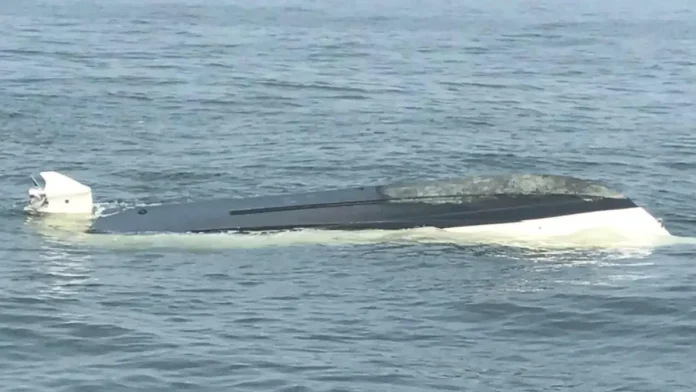

At approximately 4:30 p.m. on Saturday, July 4, as tall ships from around the world were completing their passage through New York Harbor as part of the Sail 4th 250 celebration of America’s 250th birthday, the firefighters aboard Carteret Fire Department Marine Unit 2 were heading home. They had spent the day on a regional marine security detail in the Port of New York and New Jersey, working alongside other municipal marine units from communities along Raritan Bay to provide security for the historic Parade of Ships that had drawn hundreds of thousands of spectators to the waterfront. Their mission was complete. They were passing south of the Arthur Kill, the narrow shipping channel that runs between New Jersey and Staten Island, approaching the mouth of Raritan Bay on a direct return to Carteret waters, when the boat suddenly shook with a violence no mechanical explanation could produce. A whale had breached directly beneath the vessel’s stern.
The impact caused what Mayor Dan Reiman later described as catastrophic damage — not the understated bureaucratic language of an official statement, but an accurate description of what happens when a large marine mammal surfaces beneath the engine and propulsion section of a working fire boat. The stern bore the full weight and force of the strike. The boat immediately began taking on water. The firefighters had seconds, not minutes, to understand what had happened and respond to it. They abandoned ship — not in the controlled, sequenced manner that maritime emergency training envisions, but in the sudden, physical reality of a vessel disappearing beneath them with the bay’s water already at their feet.
No one had called for help. There was no time. The boat went down fast enough that the crew entered the water before any communication had gone out to other marine units, which means that what saved the lives of the Carteret firefighters was not the emergency response infrastructure they had spent that afternoon helping to support, but two civilians who happened to be on the bay at the right moment. A recreational jet ski operator was the first person to reach the firefighters in the water, pulling alongside crew members still in the shipping channel and getting them aboard or holding them at the surface until additional help arrived. A nearby civilian boat provided further immediate assistance. The Perth Amboy Fire Department Marine Unit arrived shortly after to bring the wet, shaken firefighters safely to shore. Mayor Reiman subsequently made a point that is worth repeating exactly as he stated it: every firefighter aboard Marine Unit 2 was wearing a properly fitted personal flotation device during transit. The life jackets kept them at the surface during the seconds between the capsize and the arrival of the jet skier. Protocol observed under routine conditions became the margin between outcome and catastrophe.
A nearby recreational vessel’s crew had reported seeing a pod of whales breaching in the area both before and after the collision — which means the whales were present and visible in the bay before the boat entered the channel, and that the strike, while it could not have been specifically anticipated, occurred in water where their presence was at least abstractly knowable to anyone who had been watching the surface. Whether that information was shared with the marine security detail before they entered those waters, and what obligation recreational boaters have to communicate whale sightings to working vessels in shared shipping channels, are questions the incident’s review will examine.
The Carteret Fire Department’s official statement following the incident acknowledged, with a directness that reflected the genuine strangeness of what had happened, that while the department’s marine unit trains for all manner of water emergencies — fires, vessel accidents, chemical spills, overboard rescues — an event of this nature is something no one anticipates. That statement is accurate as far as it goes, but the history of the waters where it occurred suggests that the failure to anticipate marine encounters of unusual violence is a pattern that the Raritan Bay region has reason to revise. This is not the first time that the water in and around this bay has produced consequences that no reasonable safety plan had specifically prepared for.
The July 4 whale strike arrived almost exactly 110 years after the most famous marine disaster in New Jersey history — one whose effects on American culture have extended so far past the original events that most people who know the cultural product it inspired do not know that the events themselves were real, specific, and located in Monmouth County. In July 1916, a series of shark attacks in waters connected to the Jersey Shore killed four people and injured one in a two-week period that produced the first mass shark hysteria in American history and that provided Peter Benchley the historical material for Jaws. The attack sequence began on July 1 with the death of Charles Vansant in Beach Haven on Long Beach Island. A second victim died July 6 in Spring Lake. The attacks that produced the greatest terror occurred July 12 in Matawan Creek, a tidal waterway in Monmouth County: a young man named Lester Stillwell was killed first, and then a man named Stanley Fisher, who entered the water to try to recover Stillwell’s body, was also killed. A third victim, 12-year-old Joseph Dunn, was attacked in the same creek on the same day but survived after a struggle in which the shark was reportedly pulled away from the boy by bystanders. The Matawan attacks — a shark traveling twelve miles up a tidal creek in Monmouth County to attack people in water that no one had ever considered dangerous — are the incident that embedded the specific irrational terror of unseen marine threat into the American popular imagination and eventually into the teeth of the movie screen. A shark finaly caught in the area days later had human remains in its stomach. The attacks stopped.
A hundred and ten years later, on the same July holiday weekend that the 1916 attacks began, and in the same general arc of coastal water connecting the New York Harbor to the open Atlantic, a whale sank a fire boat. The physical mechanism is different — a whale strike is not an attack, it is a collision between a large animal acting on entirely instinctive biological impulse and a vessel that happened to be in the wrong position at the moment of the breach — but the structural situation is the same: trained, responsible public servants operating in water they had every reason to believe was within the bounds of their professional preparedness, encountering a marine event for which that preparedness turned out to be insufficient. The 1916 shark attacks produced new understanding of shark behavior in tidal waters. The 2026 whale strike adds a specific data point to an emerging and concerning pattern of humpback-vessel collisions in the waters around New Jersey that marine safety researchers have been tracking for several years.
The July 2026 Carteret incident is neither the first nor the most severe whale-vessel collision in New Jersey’s recent maritime record. Last summer, in August 2025, a whale breached in Barnegat Bay and struck a vessel, throwing a woman into the water. In 2020, near Seaside Park, a humpback whale surfaced beneath a 25-foot commercial fishing boat, capsizing it and sending two fishermen into the surf. The population of humpback whales in the waters off New Jersey and New York has increased significantly over the past decade, a consequence of improved protections under the Marine Mammal Protection Act and the partial recovery of the Atlantic humpback population after the decimation of the commercial whaling era. The same waters through which the 1916 shark attacks occurred, through which the tall ships of the Sail 4th 250 celebration passed this week, and through which Carteret Marine Unit 2 was transiting on the Fourth of July, are now regularly patrolled by humpback pods whose presence has made encounters with recreational and working vessels a recurring rather than exceptional maritime event. The New Jersey coast and its adjacent bays have always been ecologically active in ways that human activity in the same water has not always sufficiently respected. The Carteret whale strike is the most dramatic reminder in recent memory of that persistent reality.
The Carteret Fire Department’s Marine Unit 2 is a loss — a purpose-built rescue vessel that the department will need to replace, a cost that falls on a small Middlesex County municipality — and the firefighters who abandoned it in Raritan Bay on the afternoon of July 4 are, by all accounts, doing as well as anyone could be expected to after their boat sank under them. Mayor Reiman’s statement called for the incident to serve as a reminder to all boaters to wear life jackets. It is a reasonable and appropriate reminder. It does not fully account for what the incident actually means in the broader context of a coastline whose marine encounters are becoming more frequent and less predictable with each passing summer, and whose emergency responders will need to expand their operational planning to include threats that the Standard training curriculum still categorizes as something no one anticipates.
















