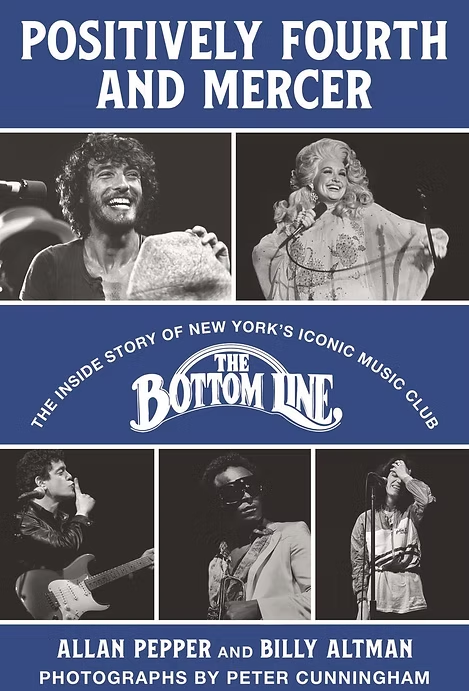

There is a specific kind of grief that attaches to the loss of a place that was genuinely irreplaceable — not merely nostalgic, not the general sadness of a changed neighborhood, but the specific mourning for a room whose combination of physical characteristics and accumulated history made it unlike anything else that has ever been built to serve the same purpose. The Bottom Line, the 400-seat showcase club that Allan Pepper and Stanley Snadowsky opened in Greenwich Village in 1974 at the corner of West 4th Street and Mercer Street, and that New York University forced to close in December 2004, is that kind of loss — a room whose sightlines and sound system and no-minimum-drink, no-smoking policy had made it, for three decades, the venue where the most important nights in American popular music most reliably happened, and whose absence from the New York music landscape remains felt in ways that no subsequent room has fully addressed. On Wednesday, July 15, at 7 p.m., Pepper will be at Watchung Booksellers in Montclair to discuss the club’s history alongside music journalist Billy Altman in conversation with radio host Jerry Treacy, in support of the book they co-authored: Positively Fourth and Mercer: The Inside Story of New York’s Iconic Music Club, The Bottom Line, published by Backbeat Books.
The book’s title is drawn from the club’s geographic coordinates — West 4th Street and Mercer Street, in the Greenwich Village neighborhood whose cultural density in the 1970s and early 1980s made it the most generative few square miles in American popular music — and from the spirit of Bob Dylan’s “Positively 4th Street,” whose tone of intimate accounting and refusal of nostalgia’s comfortable distortions captures something of what Pepper and Altman are attempting in reconstructing the club’s history. The book is structured as oral history and biography in combination: Pepper’s firsthand memories of what he witnessed and produced across 30 years of booking, alongside Altman’s journalistic framing of those memories in the broader cultural and music industry context that gives them their full meaning. Altman is the right collaborator for this project — a music journalist whose bylines in the New York Times, Rolling Stone, and Esquire reflect a career spent taking the history of popular music seriously at a time when that was not always the default editorial position of the institutions that employed him.
The specific event that anchors most accounts of what the Bottom Line was and why it mattered is one that New Jersey readers require less explanation to appreciate than almost any other population on earth. In August 1975, Bruce Springsteen and the E Street Band performed ten shows over five nights at the club — a residency that coincided with the release of Born to Run and that was covered by Jon Landau, Dave Marsh, and a cohort of music critics whose reviews transformed what had been a well-regarded regional artist into a figure whose name was being attached to the future of rock and roll in print that appeared in every publication covering popular music. The shows were extraordinary — the recordings that have circulated among collectors for decades confirm this independently of the critical mythology that surrounded them — and the specific qualities of the Bottom Line as a venue were inseparable from what made them extraordinary: a room small enough that 400 people could hear every dynamic shift in the music, see every physical gesture of the performance, and feel the heat of the moment rather than observing it at stadium distance. Springsteen understood what the room had meant for his career. When NYU ultimately moved to evict the club following years of post-September 11 financial difficulty and a rent dispute whose terms the university showed no flexibility in negotiating, Springsteen personally offered to pay the club’s back rent to prevent the closure. NYU declined and proceeded with the eviction regardless.
The Springsteen August 1975 residency is the most famous event in the club’s history but it is far from the most unusual or the most representative of what the Bottom Line actually was across its three decades. The venue’s booking philosophy, which Pepper developed and executed with the specific ambition of presenting serious music in a serious setting to audiences who came to listen rather than to drink and socialize against a background track, produced a programming history that reads like a digest of the most significant careers in American popular music across the last quarter of the 20th century. Miles Davis played there. Dolly Parton performed her first New York City engagement there. Linda Ronstadt, Harry Chapin, Patti Smith, Lou Reed, Tom Waits, and the full range of artists who defined the intersection of rock, folk, jazz, and the singer-songwriter tradition in the mid-1970s all performed at the Bottom Line, in a room whose intimate scale made the experience of seeing them qualitatively different from what the concert halls and arenas where the same artists performed their larger shows could offer.
The club’s physical configuration was central to its cultural function. The 400-seat capacity was deliberately constrained — not as a consequence of the building’s limitations but as a choice, a recognition that the showcase function the club was designed to serve required a room in which every seat was close enough to the stage to feel the particularity of the music being played on it rather than observing a performance from the middle distance. The sound system was consistently described by musicians as among the finest available in any club-scale room in the country, a function of investment and maintenance that reflected Pepper’s conviction that the audience’s experience of the music was the club’s primary product. The no-minimum-drink policy — the Bottom Line charged a cover and did not require beverage purchases — was a direct repudiation of the economic model that most clubs operated under, in which the revenue pressure to sell drinks competed with the acoustic and social conditions needed for serious listening. The no-smoking policy, implemented at a time when the separation of music and tobacco was far from standard in New York clubs, reflected the same hierarchy of values: the music came first.
The club’s closure in December 2004 was a convergence of forces that had been accumulating since the September 11 attacks in 2001, which devastated the New York tourism economy on which the club had always partially depended for its audience. The rent dispute with New York University, whose Greenwich Village campus had been expanding in ways that made the property under the Bottom Line increasingly valuable, produced an ultimatum that the club’s finances, weakened by three years of reduced attendance, could not survive. The specifics of that closure — including the Springsteen back-rent offer and NYU’s rejection of it — are among the book’s most documented and most emotionally resonant passages, and they illuminate something about what happens when the economics of institutional real estate meet the cultural economy of a venue that could not be replicated through any financial transaction regardless of how willing the parties might have been.
Watchung Booksellers, which has been hosting author events that connect the New Jersey literary community to significant books and their creators since its establishment as one of the region’s premier independent bookstores, is the right venue for this conversation. Montclair’s cultural geography — its proximity to New York, its own substantial music and arts community, its long history as a community where the creative industries are well-represented in the daily life of the town — produces exactly the kind of audience for a Bottom Line conversation that the book’s subject deserves: people who may have been at those Springsteen shows, or who watched the club from close enough distance to understand what its loss meant, or who know the history well enough to ask Pepper the questions that his 30 years of accumulated access and memory can actually answer.
The event on July 15 begins at 7 p.m., with tickets at $5 that include a 10 percent discount on the book purchase at the event. Watchung Booksellers is located at 54 Fairfield Street at Watchung Plaza in Montclair, New Jersey. Registration is available through the bookstore’s website. The conversation will be moderated by radio host Jerry Treacy, who brings his own decades of immersion in the New York and New Jersey music scenes to a subject that his background makes him specifically equipped to probe with the depth that Pepper’s memories and Altman’s research deserve. For anyone who was there for any of the Bottom Line’s 30 years, or who knows the history well enough to wish they had been, the July 15 conversation in Montclair is among the more meaningful ways available to spend a July evening in New Jersey.