
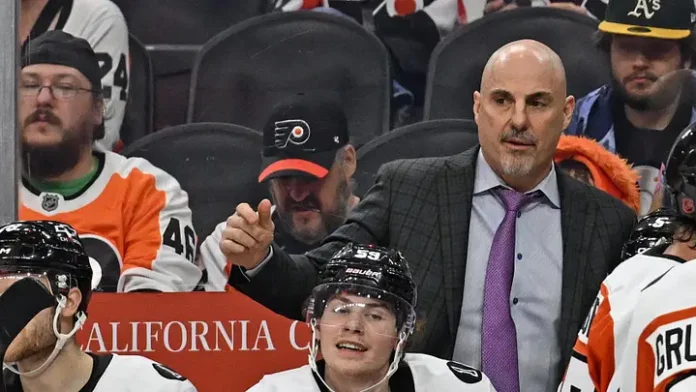

The ending hurt. There is no way around that reality in Philadelphia. A 4-0 series sweep is painful in any postseason, especially for a franchise and fanbase that had fought so hard to bring playoff hockey back to South Philadelphia after years of frustration, rebuilding, uncertainty, and organizational transition. Yet what unfolded at the end of Game 4 against the Carolina Hurricanes may ultimately become one of the most important moments of the Flyers’ modern rebuild because the reaction inside the arena said far more about the future than the final score ever could.
As the overtime loss sealed the series and the Carolina Hurricanes celebrated another step deeper into what has become a dominant postseason run, something unusual happened inside South Philadelphia. Fans stayed. They did not empty into the concourses early. They did not rain down boos. They did not turn bitter after another postseason elimination. Instead, a sold-out crowd rose to its feet and delivered a thunderous standing ovation to a young Flyers team that had reintroduced meaningful hockey to the city.
That response captured the true story of the Flyers’ 2025-26 season.
For the first time in years, Philadelphia hockey felt alive again.
The Flyers were clearly outmatched by Carolina. Anyone watching the series honestly could see the difference between a team learning how to become a contender and a team already operating as a legitimate Stanley Cup machine. The Hurricanes looked faster, deeper, calmer, and structurally superior in almost every phase of the game. Their pressure in transition suffocated Philadelphia’s breakout opportunities. Their forecheck controlled long stretches of possession. Their defensive rotations eliminated time and space. Their special teams execution exposed gaps the Flyers still need to close before they can truly enter the NHL’s elite tier.
And yet, despite all of that, there were unmistakable flashes throughout the series that suggested Philadelphia is getting closer than many expected.
That is why the mood surrounding the Flyers today feels dramatically different than it did even one year ago.
This season was never supposed to be about winning the Stanley Cup. Internally and externally, the year began with cautious optimism at best. The organization remained in the middle stages of General Manager Danny Briere’s roster reconstruction, the prospect pipeline was still developing, and the Flyers entered the season without the national expectations attached to true contenders. By February, the club still sat eight points outside of a playoff position and appeared destined for another offseason focused primarily on development and draft positioning.
Then everything changed.
Philadelphia surged after the Olympic break with one of the league’s most aggressive late-season pushes, posting an 18-7-1 stretch that transformed the entire direction of the season. Suddenly, meaningful games returned to South Philadelphia. The building regained its energy. The rivalry intensity returned. The Flyers began resembling a franchise rediscovering its identity.
That identity was never built around finesse alone. Historically, Flyers hockey has always demanded competitiveness, emotional investment, physicality, relentless pressure, and resilience. Throughout this season, the team repeatedly demonstrated those qualities even while lacking the complete roster depth of the NHL’s true heavyweights.
The opening-round playoff victory over the Pittsburgh Penguins amplified that belief across the region. For Philadelphia fans, beating Pittsburgh in the postseason will always carry emotional weight beyond a standard playoff series. It was symbolic. It validated the progress of the rebuild while simultaneously reconnecting the fanbase with the emotional edge that once defined Flyers hockey.
By the time Philadelphia reached the second round, the organization was already ahead of schedule.
Then came Carolina.
What the Hurricanes demonstrated during the series was the difference between a rising playoff team and a fully mature contender operating at championship speed. Carolina entered the matchup already looking like one of the NHL’s most complete rosters, and throughout the series they proved exactly why many around the league view them as one of hockey’s most dangerous postseason teams.
The numbers alone tell part of the story. Carolina entered the Eastern Conference semifinals undefeated in the playoffs and continued that dominance against Philadelphia. Their defensive structure limited the Flyers offensively, while their puck movement and territorial control consistently tilted games in their favor.
But beyond statistics, the eye test revealed the real separation.
Philadelphia’s penalty kill, which had shown moments of aggressiveness and structure earlier in the postseason, looked fundamentally different against Carolina’s movement. The Hurricanes’ offensive-zone rotations forced the Flyers into collapse coverage repeatedly, creating open seams and constant puck movement around the zone. Carolina’s ability to maintain possession while rotating pressure from the blue line into the circles exposed the difference in speed, spacing, and composure between the two clubs.
The Hurricanes controlled pace almost effortlessly at times.
Their forecheck in the neutral zone disrupted Philadelphia’s transition game before it could even develop. Their ability to pressure carriers without sacrificing defensive structure created prolonged offensive-zone time that wore the Flyers down over entire periods. Carolina’s defensemen activated aggressively while still recovering into position with elite discipline, a hallmark of teams that have already learned how to survive deep playoff hockey.
Philadelphia simply could not sustain enough offensive possession consistently enough to counter it.
Yet even within that imbalance, there were stretches where the Flyers showed exactly why optimism around the organization continues growing.
There were moments where the speed of the young core flashed through. Moments where Philadelphia attacked with confidence, transitioned cleanly, and forced Carolina into uncomfortable situations. The Flyers did not look intimidated by the stage. They looked inexperienced against a superior machine, which is an important distinction.
If nothing else, I realized how much I hate Sean Walker. Seeing that No. 14 for the Carolina Hurricanes next season only adds to the list of players I cannot wait to see on the other side of the ice. He just looks like a complete douche. There are certain players you circle on the schedule the second the dates come out, and Walker has officially become one of them, assuming the Flyers continue progressing this year without losing talent. His facial expressions alone make you want somebody to deal with him in a big way. So when the Flyers see Carolina again next season, that matchup already has an extra edge to it. The Hurricanes have become one of the most aggravating teams in the Eastern Conference to deal with, and players like Walker fit directly into that identity. There is no pretending otherwise. I want Philly (and Jersey) to run them out of the building(s) next year. Not just beat them. Embarrass them. Knock em around. Most of all, wiper that smirk off that face while shutting him up from speaking on the oce (aka taunting) by setting the tone physically, emotionally, and on the scoreboard from the opening puck drop. The Teams on the Division are built on grudges, and this one is already brewing before the season even starts.
Regardless, that matters because playoff experience itself remains one of the NHL’s most difficult developmental hurdles. In recent years, the teams at the top were noticable. They have been faster, bigger and with finesse. The Flyers needed to get up to that high level.
Teams do not learn how to win deep playoff series overnight. Organizations evolve through exposure, failures, adjustments, and roster maturation. Carolina itself spent years building toward becoming the powerhouse it now appears to be. What Philadelphia experienced against the Hurricanes may ultimately serve as a critical developmental checkpoint rather than a discouraging endpoint.
Young players across the roster were exposed directly to the pace, precision, and relentless detail required to compete against elite postseason hockey. That education has value that extends beyond one series result.
The emergence of younger players and developing pieces throughout the season also reinforced why fans remain invested emotionally in the direction of the organization. Philadelphia’s prospect pipeline increasingly looks capable of supporting long-term competitiveness, while the roster already contains pieces that appear foundational moving forward.
For all intents and purposes, Porter Martone’s arrival in Philadelphia has been nothing short of explosive, and it has only been, what, two months? The 19-year-old Canadian right winger, selected sixth overall by the Flyers in the 2025 NHL Entry Draft, wasted absolutely no time proving why so many scouts believed he was one of the most NHL-ready forwards in his class. Before making the jump to the professional level, Martone spent the majority of the season dominating NCAA Division I hockey with the Michigan State Spartans. As a freshman, he immediately became the centerpiece of the offense, leading the team with 25 goals and 50 points in just 35 games while establishing himself as one of the most dangerous young scorers in college hockey. His combination of size, skill, confidence, and offensive instincts made it increasingly clear that his stay at the collegiate level was never going to last long.
Everything accelerated once Michigan State’s season came to an end. On March 29, 2026, the Flyers signed Martone to a three-year entry-level contract almost immediately after the Spartans were eliminated from the NCAA regional finals. Just two days later, he made his NHL debut on the road against the Washington Capitals, beginning what quickly turned into one of the most remarkable late-season rookie surges the organization has seen in years. On April 5, he delivered his first NHL goal in dramatic fashion, scoring an overtime game-winner against the Boston Bruins. Instead of being slowly introduced into the lineup, Martone was dropped directly into the middle of a high-pressure playoff race and responded by producing 10 points in his first nine regular-season games. When the Stanley Cup Playoffs opened against the rival Pittsburgh Penguins, the teenager elevated his game even further, scoring the game-winning goal in both Game 1 and Game 2. In the process, Martone became the first teenager in NHL history to record game-winning goals in each of his first two career postseason games, instantly turning a promising rookie season into one of the league’s biggest stories.
That is why this offseason now becomes one of the most fascinating periods the organization has faced in years. The Flyers now appear close enough that every roster decision suddenly feels magnified.
The challenge facing Danny Briere and the front office is obvious. The organization likely needs additional top-end talent to truly compete with teams like Carolina, Florida, or the Rangers over a seven-game series. We will see how real Buffalo is soon enough. But again, the Flyers will need more scoring depth, additional defensive stability, and perhaps another high-impact difference-maker who could elevate the roster significantly.
At the same time, the emotional connection fans have developed with this current group creates hesitation around major roster subtraction. Philadelphia supporters finally see a team they believe in again. They see chemistry, identity, effort, and growth. Nobody wants to disrupt that momentum carelessly.
That balancing act will define the summer.
The Flyers’ 2026 NHL Draft position adds another interesting layer to the conversation. Philadelphia enters the draft holding the 21st overall selection after their playoff run, along with a streamlined set of five total picks. Previous trades involving Trevor Zegras, Sean Walker, Carl Grundström, and other roster restructuring decisions reduced the organization’s mid-round inventory, placing additional importance on maximizing value with their remaining selections.
Still, the Flyers have historically performed exceptionally well drafting in this range. Players like Claude Giroux, Travis Konecny, and Tyson Foerster emerged from similar draft positions, giving Philadelphia confidence in its scouting infrastructure.
FYI, for what it’s worth, I was at the game on May 19, 1974, when the Flyers won their first Stanley Cup. We had season tickets back then. I do not remember ever caring much about the NHL Draft until I got older. I think the two big schools back then were Boston University and Minnesota. It felt like they played for the championship every year.
We also had the WHA then, which is where we got Bernie Parent. The first time I ever saw him play was when he was with the Philadelphia Blazers which had a pink puck. The first game I ever saw was against Minnesota at that time. They had a goalie named Gump Worsley who never wore a mask, and ironically, my first game ever against them at the Spectrum ended in a shutout loss.
Early projections suggest the Flyers could target additional center depth or left-side defensive development depending on how the board falls. Prospects linked to Philadelphia in preliminary discussions include Swedish center Alex Command, offensively dynamic defenseman Xavier Villeneuve, and physical power-forward center Maddox Dagenais. Each represents a different interpretation of what the organization still needs to become a complete contender.
And that is ultimately where the Flyers now exist. Not rebuilding from the bottom anymore. Not fully arrived yet either.
Instead, Philadelphia sits in one of the most difficult but promising positions in professional sports: the verge. The verge of legitimacy. The verge of sustained playoff relevance. The verge of becoming dangerous.
This postseason proved the Flyers can compete emotionally, structurally, and culturally again. The Carolina series revealed they still need another level to compete consistently with the NHL’s elite. Both things can be true simultaneously.
In many ways, that realization may actually increase optimism around the franchise rather than diminish it. I now know what the team needs to get to that higher level.
Philadelphia fans know hockey. They understand the difference between fraudulent playoff appearances and genuine organizational growth. What they witnessed this season felt real. The team fought through adversity, exceeded expectations, reignited the building, restored playoff intensity to South Philadelphia, and earned back emotional trust from a fanbase that had become increasingly disconnected during the rebuild years.
The standing ovation after elimination was not sympathy. It was recognition. Recognition that the Flyers finally look like a team moving somewhere meaningful again.
Explore New Jersey’s continuing Philadelphia Flyers coverage has followed the organization’s evolution closely throughout the season, documenting both the growing excitement surrounding the roster and the larger cultural impact playoff hockey continues to carry throughout the region. More than anything, this postseason confirmed that meaningful Flyers hockey still matters deeply in this area. And, with zero offense intended, it is very hard for me, as a longtime Flyers fan, to write about and cover the New Jersey Devils every day.
And now, for the first time in a long time, there is legitimate reason to believe the Flyers could become one of the NHL’s most important young teams over the next several years
















