
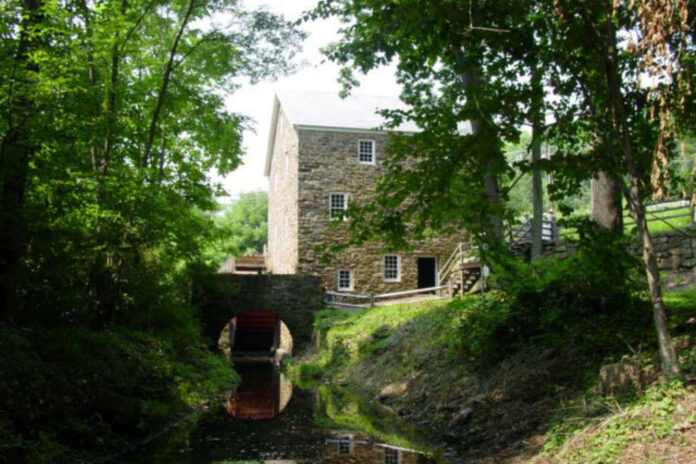

Two centuries after the machinery first turned along the banks of the Black River, the Cooper Gristmill is preparing to celebrate a milestone few American historical sites ever reach. The 200th Anniversary of the Nathan Cooper Gristmill will bring together living-history demonstrations, historic trade exhibitions, craft showcases, food, music, guided experiences, and immersive tours that reconnect visitors with one of the most important surviving industrial landmarks in New Jersey history.
In an era dominated by digital speed and modern convenience, the continued operation of a fully restored, water-powered flour mill from 1826 feels almost impossible. Yet in Chester Township, the Cooper Gristmill continues to operate much as it did generations ago, preserving not only machinery and architecture, but an entire way of life that once powered local economies across the region. The anniversary celebration represents far more than a historical commemoration. It stands as a tribute to New Jersey’s industrial beginnings, agricultural roots, engineering innovation, and enduring commitment to preserving the stories that shaped the state.
Located along the Black River in Morris County, the Nathan Cooper Gristmill remains the only restored water-powered gristmill still operating in New Jersey. Built in 1826 by retired military officer General Nathan Cooper, the towering four-story stone structure was considered technologically advanced for its era and quickly became one of the region’s most productive milling operations. Today, it survives as a rare living-history museum where visitors can experience the sounds, movement, craftsmanship, and mechanical complexity of 19th-century industry in real time.
The anniversary celebration is expected to transform the historic property into a full-scale historical experience that highlights not only the mill itself, but the broader cultural environment that surrounded it during the 1800s. Historic tradespeople and craftspeople will demonstrate traditional methods that once formed the backbone of everyday American life. Blacksmithing, woodworking, milling techniques, agricultural practices, and artisan craftsmanship will allow visitors to step directly into the world that existed when the mill operated at the center of local commerce.
For Explore New Jersey readers who follow the state’s growing cultural preservation movement, the Cooper Gristmill bicentennial represents one of the most significant historical celebrations taking place anywhere in New Jersey this year. Across the state, historic landmarks are increasingly drawing attention not simply as preserved structures, but as immersive educational destinations capable of connecting modern audiences with the realities of earlier generations. The Cooper Gristmill stands among the strongest examples of that movement because it remains functional, mechanical, and alive.
The mill’s origins trace back to a period when water-powered industry shaped the development of entire communities throughout the Northeast. Long before highways, suburban growth, and corporate distribution systems transformed the region, mills served as economic engines where farmers, merchants, tradesmen, and residents converged. Flour production was not merely a business operation. It was essential infrastructure supporting agriculture, commerce, and daily survival.
The site itself predates the current structure. Milling operations existed on the property as early as the 1760s before Nathan Cooper acquired the land at auction and developed the current facility. Cooper envisioned a more sophisticated and efficient industrial operation, incorporating automation systems considered highly advanced for the early 19th century. Elevators, conveyors, gears, and massive grinding stones worked together in a remarkably intricate mechanical network powered entirely by water diverted from the Black River.
At its peak, the mill could produce nearly ten tons of flour daily, a staggering output for the era. The facility’s two enormous grinding stones, each weighing approximately 2,000 pounds, processed grain continuously as the waterwheel transferred natural river energy into industrial production. Even today, witnessing the machinery engage remains one of the most captivating demonstrations of early American engineering available anywhere in the region.
That experience continues to define visits to the site. During guided tours, a master miller dressed in historical attire activates the waterwheel and machinery, allowing visitors to watch the grinding process unfold in real time. The sounds alone create an unforgettable atmosphere. The turning gears, moving belts, vibrating woodwork, and grinding stone mechanisms offer a sensory connection to history impossible to replicate through static museum exhibits alone.
The upcoming bicentennial celebration will expand that immersive experience significantly. Throughout the day, visitors will have opportunities to explore the grounds, interact with demonstrators, observe historic techniques, and learn how the mill functioned as part of a larger agricultural and industrial network that once sustained communities across Morris County and beyond.
The event also reflects growing public interest in experiential history tourism throughout New Jersey. Increasingly, residents and travelers are seeking destinations that combine education, authenticity, outdoor recreation, and cultural engagement. The Cooper Gristmill offers all of those elements simultaneously. Positioned within Black River County Park, the site blends historical preservation with natural beauty, creating an environment that feels both educational and restorative.
The surrounding landscape remains central to the experience. The mill’s 14-acre property serves as a scenic entry point into one of the region’s most beautiful trail systems. Visitors exploring the grounds can continue directly onto the blue-blazed Black River Trail and portions of the broader Patriot’s Path network, connecting them to river corridors, wooded landscapes, and nearby destinations including Willowwood Arboretum and Bamboo Brook Outdoor Education Center.
That connection between industry and environment is part of what makes the Cooper Gristmill so historically significant. Water power represented one of America’s earliest sustainable industrial systems, harnessing the natural force of rivers to drive production long before fossil fuels dominated manufacturing. The mill demonstrates how communities once adapted directly to local geography, building economies around waterways, agricultural cycles, and natural resources.
As preservation efforts across the country continue to confront funding challenges and modernization pressures, the survival of the Cooper Gristmill becomes even more remarkable. By the early 20th century, large commercial milling operations in the Midwest had eclipsed smaller regional mills, and industrial activity at the site ceased in 1913. Like many historic industrial properties of its era, the structure could easily have disappeared through neglect or demolition.
Instead, preservationists recognized its extraordinary historical value. The Morris County Park Commission eventually acquired the property and undertook extensive restoration efforts that protected the structure and returned portions of the machinery to operational status. In 1976, the Cooper Gristmill was officially added to the National Register of Historic Places, securing recognition as one of New Jersey’s most important preserved industrial landmarks.
The bicentennial celebration now arrives at a moment when interest in local history and regional identity continues to expand throughout the state. New Jersey’s cultural institutions, museums, preserved villages, theaters, and historical sites are experiencing renewed public attention as residents increasingly seek deeper connections to the communities and traditions surrounding them. Historic preservation is no longer viewed as passive nostalgia. It has become an active part of cultural tourism, education, and community engagement.
That broader movement continues to shape coverage across Explore New Jersey’s expanding Arts & Culture section, which has increasingly highlighted the institutions, historical landmarks, museums, cultural events, and preservation projects helping define the state’s evolving identity. The Cooper Gristmill anniversary stands as one of the clearest examples of how history can remain active, relevant, and deeply engaging for modern audiences.
For families, the anniversary event offers a rare opportunity to experience history beyond textbooks or exhibit cases. Children and younger visitors will have the chance to see large-scale machinery operate physically before them while learning how grain became flour, how rivers powered industry, and how entire communities depended on systems that now seem almost unimaginable in the modern world. The educational value extends naturally from the experience itself rather than relying solely on interpretation.
For history enthusiasts, architecture lovers, preservation advocates, and cultural travelers, the bicentennial provides an opportunity to witness one of New Jersey’s most remarkable surviving industrial sites during a once-in-a-generation milestone celebration. Every turning gear and moving mechanism inside the mill serves as evidence of the craftsmanship, engineering, labor, and ingenuity that shaped early American industry.
For New Jersey itself, the Cooper Gristmill’s 200th Anniversary serves as a reminder that some of the state’s most compelling destinations are not defined by size or spectacle, but by authenticity. The mill does not recreate history artificially. It preserves it mechanically, structurally, and physically. Visitors are not simply observing the past from a distance. They are standing inside a functioning piece of it.
As the bicentennial celebration approaches, the Cooper Gristmill remains more than a preserved building beside a river. It stands as a living monument to New Jersey’s industrial heritage, agricultural foundations, and cultural resilience. Two hundred years after Nathan Cooper constructed the stone mill along the Black River, the water still turns, the machinery still moves, and the story of early New Jersey continues to unfold inside one of the state’s most extraordinary historical treasures.
















