

New Jersey produces more Division I baseball talent per capita than nearly any other state in the country, a function of its geography — compressed enough that elite competition is accessible without traveling across state lines, diverse enough that public, private, parochial, and vocational school programs each develop distinct competitive cultures — and its demographics, which have created a multi-generational baseball community that has made the spring sport a genuinely serious pursuit for tens of thousands of families across 21 counties. The 2026 season, which ended with state championships contested at Rutgers University’s Bainton Field and Piscataway complexes in mid-June, produced the caliber of individual and team performances that the state’s most ardent followers expected and the kind of statistical seasons that the rest of the country will be reading about in college scouting reports for years. NJ.com’s annual All-State recognition package, published this week, is the definitive accounting of who excelled, who led, and which programs defined New Jersey baseball in 2026.
Player of the Year: Mickey Gilligan, Catcher, Passaic Tech
There are seasons that are impressive, and then there are seasons that exist in a different statistical universe than the competition. Mickey Gilligan’s 2026 at Passaic County Tech — a vocational school in Wayne that has quietly built one of the more competitive programs in Passaic County — belongs in the second category by a significant margin. Gilligan batted .639 for the season. Not a misprint. Not adjusted or contextualized into a different number — .639, meaning he recorded hits in nearly two-thirds of all at-bats over the course of a full spring season against competitive New Jersey public school competition. He added 13 home runs, leading every player in the state in that category, while driving in 48 runs and scoring 54. His line also included 11 doubles and four triples, meaning he hit for power across the spectrum of extra-base categories rather than simply pulling the ball for home runs against weaker pitchers in favorable counts.
Behind the plate, Gilligan’s pop time — the measurement from the moment the pitch hits the catcher’s glove to the moment a throw arrives at second base — registered in the 1.70-second range, a figure that places him at the high end of what major college programs expect from their starting catchers and in the range that professional scouts describe as a genuine weapon for preventing base-stealing. The combination of that defensive metric with his offensive numbers creates a player profile that is genuinely unusual at the high school level, where catchers with this offensive output typically sacrifice defensive skills for their hitting prowess and vice versa.
Gilligan’s family connection to the game runs deep. His father, Lawrence Gilligan, played collegiately at Tennessee and was selected by the Chicago White Sox in the 1990 MLB Draft. His brother Ty played at Rider and Dominican before joining the Sussex County Miners of the Frontier League. The baseball has been part of the Gilligan household for a long time, and the family’s training investment in Mickey’s development — he transferred to Passaic Tech from Lakeland High School after his sophomore year and immediately elevated the program’s offensive profile — is visible in every element of his 2026 line. Committed to Rutgers University, Gilligan heads to a Big Ten program that recruits New Jersey talent heavily and that will benefit from a catcher who, based on his high school exit velocity of 103.9 mph, bat speed, and throwing arm, profiles as a legitimate program centerpiece.
Pitcher of the Year: Selden Kolkebeck, RHP, NV-Old Tappan
There is a number that defines Selden Kolkebeck’s 2026 season, and it is not the 12-0 record or the 0.72 ERA or the 126 strikeouts. It is the 8.4 strikeout-to-walk ratio — a figure that puts him in historical company at the high school level and that speaks to a kind of pitching intelligence and command that scouts identify as the rarest attribute in the development pipeline. Kolkebeck threw 12 complete games, walked 15 batters all season, and posted a WHIP of 0.64. Every measurable indicator of pitching effectiveness points in the same direction: this was not an accumulation of good games. It was one of the most dominant individual pitching seasons in New Jersey high school baseball history.
Kolkebeck is 6-foot-4 and 200 pounds, built with the physical frame that college pitching coaches draw schematics around. His fastball sat in the low-to-mid 80s during his sophomore and junior years and climbed to 84-88 mph in 2026, touching 91 mph in the state championship game on the Rutgers radar gun. The velocity is useful but secondary to the location: Kolkebeck pounds the strike zone from multiple arm angles, deploying his fastball from a high three-quarter slot and dropping his slider to a lower arm angle to create the kind of visual differentiation that frustrates batters even when they know what is coming. His slider grades as a true two-plane pitch with late bite, and his changeup, which he keeps off-spin deliberately, provides the third look that turns lineups over a second time with difficulty.
Old Tappan, a competitive Bergen County program that had not won a state championship since 2008, claimed the Group 3 title at Bainton Field on June 14 with Kolkebeck pitching a four-hit shutout and driving in two runs with a two-out single as the offense broke open the game. He did not allow an earned run in the state tournament, going 26 innings across four playoff starts with 38 strikeouts and three walks. The catcher-pitcher tandem he formed with Anthony Onnembo, also recognized on the All-State teams, was described by Kolkebeck himself as a collaborative relationship built over years of shared development — one where pitch selection and location were genuine conversations rather than one-way directives. Committed to Columbia University in the Ivy League, Kolkebeck heads to a program that has produced professional pitchers and that will give him the academic environment for which the Columbia commitment signals he is well prepared.
Newcomer of the Year: Addison Adornato, Governor Livingston
The Newcomer of the Year recognition that went to Addison Adornato of Governor Livingston marks the emergence of one of the state’s more interesting programs. Governor Livingston, based in Berkeley Heights in Union County, claimed a second All-State recognition in teammate Zach Geertsma, who appears on the first team, indicating that the program’s 2026 was not defined by a single breakout player but by a broader environment of competitive development. Adornato’s recognition as the state’s top newcomer establishes him as one of the central names in New Jersey baseball’s 2027 and 2028 horizon.
Coach of the Year: Billy Kern, Mainland
The coaching recognition that went to Billy Kern of Mainland — an Atlantic County program based in Linwood — reflects a season in which his organization performed at a level that justified the state’s highest individual coaching honor. Kern has built Mainland into a program that competes annually in one of the most competitive regions of South Jersey baseball, where the county involves DePaul Catholic from Ramsey down through the Atlantic County public schools with significant programs at multiple schools. The Coach of the Year award is, among the various honors distributed in an end-of-season All-State package, the one most difficult to evaluate without the full context of what a team was expected to do and what it actually accomplished. Kern’s recognition suggests his 2026 team exceeded its projected ceiling in ways the selection process found impossible to overlook.
Team of the Year: Delbarton
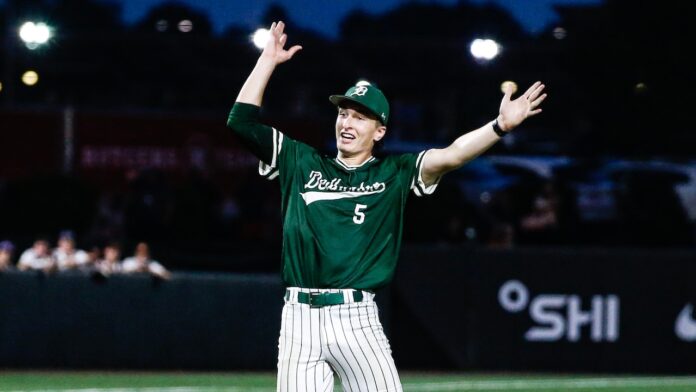
The Green Wave of Delbarton — the Morris County Catholic school that is arguably the most consistent program in New Jersey non-public baseball over the past decade — claimed the Team of the Year recognition for 2026 after winning the Non-Public A state championship at Rutgers University on June 10, defeating St. Augustine 4-1 in a title game that saw St. Augustine’s Alex Weingartner, himself a Gatorade New Jersey Player of the Year and a Penn State commit, lose in the championship round. Delbarton placed three players on the All-State First Team in 2026 — T. Masino, S. Garcia, and F. O’Loughlin — a concentration of individual excellence that rarely occurs and that reflects the depth of a program that attracts talent from across Morris County and the surrounding region.
The Green Wave’s championship adds to a program history that has made Delbarton’s spring baseball season an anticipated event in the state’s high school sports calendar annually. The program operates at a level of resource, coaching continuity, and recruiting depth that most public schools cannot match, and its competition within the Non-Public A category pits it against similarly resourced private programs in a bracket that produces some of the state’s most competitive baseball. Winning it requires defeating the kind of programs — Don Bosco Prep, St. Augustine, Seton Hall Prep — that recruit nationally and develop talent at a near-professional level. That Delbarton does it with the regularity it has established makes the 2026 Team of the Year recognition a fitting capstone to a season that the program’s supporters will remember as one of its best.
The 2026 First Team: Names That Will Appear in College Box Scores for Years
The thirteen players who constitute the 2026 NJ.com Baseball All-State First Team represent the most selective tier of individual recognition in the state’s annual awards process, chosen from a field of thousands of players across hundreds of programs competing in multiple NJSIAA classifications. The first team’s composition in 2026 reflects the geographic and institutional diversity that characterizes New Jersey baseball at its best: public schools and Catholic schools, North Jersey and South Jersey, vocational programs and selective prep institutions all contributed players who earned the state’s highest individual recognition.
Selden Kolkebeck (Old Tappan) and Mickey Gilligan (Passaic Tech) anchor the team as the award winners described above. T. Masino, S. Garcia, and F. O’Loughlin from Delbarton give the champion program three first-team selections and represent the offensive and defensive balance that defines the program’s style. J. Burwell of Seton Hall Prep continues the Prep’s tradition of producing All-State caliber players in an annual process that generates significant Division I recruiting attention each spring. N. Danza of Gloucester Catholic and M. Rosenberg of Bishop Eustace give South Jersey strong representation at the state’s top tier. R. Auten of Immaculata, B. Longo of Mount Olive, J. Amalbert and Z. Geertsma from Governor Livingston and DePaul respectively complete a first team whose members will collectively sign letters of intent and National Letters to programs across the Division I landscape.
Alex Weingartner of St. Augustine deserves specific recognition within the first-team context. Weingartner was named the 2026 Gatorade New Jersey Baseball Player of the Year — a distinction awarded independently of the NJ.com process and representing the Gatorade Company’s selection of the state’s top player based on athletic excellence, academic achievement, and exemplary character. A Penn State commit who batted .512 with 32 RBIs, 42 runs, and 28 stolen bases while also posting a 4-1 pitching record with a 1.19 ERA, Weingartner is a two-way player of the type that modern college baseball programs recruit aggressively — someone who can contribute in multiple dimensions rather than committing to a single position. His Gatorade recognition places him in elite national company, as each state’s Gatorade winner is then considered for the national award.
The Second and Third Teams: The Depth That Makes New Jersey Elite
The second and third All-State teams establish the full scope of what the 2026 season produced beyond its most decorated performers, and the school representation across those teams reflects New Jersey baseball’s genuine depth. Second team members include J. Drennan from Seton Hall Prep, alongside Kolkebeck’s teammate A. Onnembo from Old Tappan — the battery partner who Kolkebeck specifically credited for their collaborative relationship throughout the championship run. T. Collins and M. Hanna from Don Bosco Prep give the Ramsey Catholic program its customary presence in the state’s recognition list. B. Moore and T. Garbooshian from Brick Memorial represent a Mustangs program that reached its first-ever NJSIAA Group championship appearance in 2026, falling to Old Tappan in the Group 3 final. B. Lipoff from Gloucester Catholic continues the Rams’ tradition of producing All-State talent during a season in which the program won its fourth consecutive Non-Public B state title. R. Nitch of Ridgewood, B. Fry of Cranford, J.C. Pacheco of DePaul, R. Faiola of Bishop Eustace, L. Maselli of Delbarton, and C. Marchetti of Northern Burlington round out the second team with a geographic range that stretches from Bergen County through Burlington County.
The third team extends that geographic range further, with C. Murphy of Edison, H. Brown of North Hunterdon, L. Velit of Northern Burlington, J. Wagner of Northern Highlands, C. McNally of Ramsey, J. Dolan of Ridge, D. Massaro of South Plainfield, D. Lubach of Point Pleasant Beach, and B. Faigin of Monroe all earning recognition that places them among the state’s top thirty-nine players at the sport’s highest level of secondary competition. C. Marano of DePaul adds a third entry from the Wayne Catholic school to the third team. D. Golembiewski of Brick Memorial, whose near-home run in the Group 3 championship game was one of the most dramatic moments of the state finals before hooking foul, earns individual recognition that his team’s season — the program’s first sectional title, first Ocean County Tournament title in 30 years, and its first Group final appearance — richly deserves. M. Genao of Passaic Tech joins teammate Mickey Gilligan in the recognition pool, giving the vocational school a second player in the statewide honors.
The Context: Why This Season Mattered
The 2026 New Jersey high school baseball season produced individual statistical lines — Gilligan’s .639 average, Kolkebeck’s 0.72 ERA, Weingartner’s two-way contributions — that will be referenced in recruiting conversations and coaching discussions for the next several years. But what those numbers represent, beyond their individual impressiveness, is a season in which the pipeline of talent flowing from New Jersey into Division I college baseball and eventually to professional organizations was demonstrated at a level that reinforces the state’s reputation as one of the most productive high school baseball environments in the country.
Every player who appears on the 2026 All-State teams — first, second, and third — was developed in a New Jersey program, coached by New Jersey coaches, playing against New Jersey competition. The families who drove to early-morning practices, the coaches who built programs over decades of spring seasons, the communities that turned out for state championship weekends at Rutgers — all of it contributes to an ecosystem that produces the kind of player the college game depends on to maintain its competitive quality. The 2026 honors are the annual reckoning with what that ecosystem accomplished, and the answer, measured by every available standard, is that it accomplished something genuinely exceptional.
















