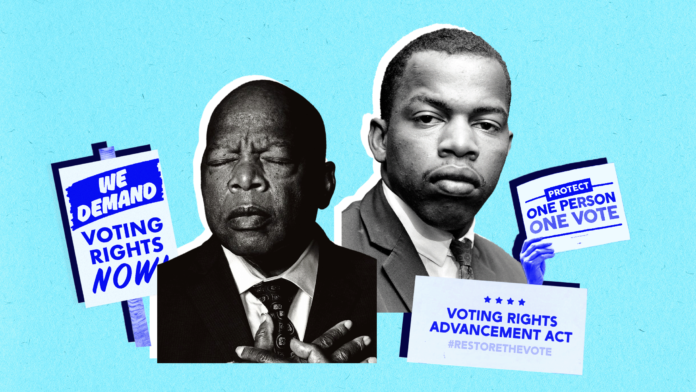

On Sunday morning, as the New Jersey Legislature’s budget committees were convening for their late-night votes on the $60.7 billion FY27 spending plan, a second significant piece of legislation moved through the Senate Budget and Appropriations Committee with far less public attention but potentially more lasting consequence for the democratic infrastructure of the state. The John R. Lewis Voter Empowerment Act of New Jersey — Senate Bill 282, House companion A1715 — advanced out of committee with the support of Senate President Nick Scutari and prime Senate sponsors Senators Turner and Cryan, clearing one of its final legislative hurdles before reaching the Senate floor for a full vote. The ACLU of New Jersey, which has been one of the bill’s most active and vocal advocates, celebrated the advancement in an immediate statement and called on the full Legislature to act swiftly and deliver the strongest possible version of the bill to Governor Sherrill’s desk.
The legislation’s timing is not coincidental, and its significance extends far beyond the procedural milestone of a committee vote. The John R. Lewis Voter Empowerment Act is New Jersey’s deliberate and explicit response to a national landscape in which the federal voting rights protections that governed American elections for six decades have been systematically weakened through Supreme Court decisions, in which the current federal administration has raised unprecedented questions about the future of democratic elections, and in which more than two dozen states have enacted laws that voting rights advocates and election scholars identify as barriers to participation disproportionately affecting voters of color, language-minority communities, and low-income citizens. New Jersey is attempting to fill a void that the federal system has created by building its own voting rights infrastructure — an infrastructure that, if the bill becomes law, will be enforced by a new independent state agency with powers that the federal government no longer applies.
The Name and the Legacy It Carries
The decision to name New Jersey’s voting rights legislation after John R. Lewis is itself a statement of legislative intent. Lewis, who died in July 2020 after 33 years representing Georgia’s 5th Congressional District in the House of Representatives, was not simply a lawmaker. He was one of the most consequential figures in the American civil rights movement, a person whose willingness to absorb violence in defense of democratic principle on March 7, 1965 — the day that became known as Bloody Sunday — contributed directly to the legislative breakthrough that produced the Voting Rights Act of 1965.
On that day, Lewis was 25 years old. He led approximately 600 marchers across the Edmund Pettus Bridge in Selma, Alabama, in a peaceful attempt to demonstrate for the right to vote that had been systematically denied to Black Americans across the South through a combination of legal mechanisms, administrative obstruction, economic intimidation, and physical violence. At the end of the bridge, Alabama state troopers and local law enforcement attacked the marchers with clubs and tear gas. Lewis suffered a fractured skull. The images broadcast that evening on network television produced a national revulsion that President Lyndon Johnson channeled into the legislative drive that produced the Voting Rights Act eight days later.
The act that followed from Bloody Sunday is the act whose protections have since been reduced to something significantly less than what Lewis and the marchers crossing the Edmund Pettus Bridge believed they were building toward. The Supreme Court’s 2013 decision in Shelby County v. Holder effectively gutted the VRA’s preclearance requirement — the provision that forced states and localities with histories of voting discrimination to obtain federal approval before changing their election laws or maps — on the grounds that the coverage formula used to identify those jurisdictions was outdated. Without preclearance, the primary preventive mechanism of the law was gone, replaced by a litigation-after-the-fact approach that is slower, more expensive, and less effective at stopping discriminatory changes before they harm voters in an actual election.
The Supreme Court’s most recent blow to the federal voting rights framework came in Louisiana v. Callais, a decision that civil rights advocates and election law scholars described as gutting the remaining provisions of the VRA that had barred the dilution of minority voting power. The decision immediately set off a wave of redistricting in Republican-controlled states to redraw or eliminate congressional and legislative districts where a majority of voters were not white — a consequence that Lewis’s former colleagues in Congress described as exactly the outcome he had spent his career fighting against. Naming New Jersey’s response to these developments after John R. Lewis is the Legislature’s declaration that the values for which he marched, and the protections his sacrifice helped produce, still matter — and that if the federal government will no longer guarantee them, New Jersey will guarantee them within its own borders.
What the Bill Actually Does: The Three Core Objectives
The John R. Lewis Voter Empowerment Act of New Jersey establishes three organizing objectives that govern the interpretation and enforcement of every provision that follows. All New Jersey statutes, rules, regulations, local laws, and ordinances related to elections must be construed liberally in favor of these three goals: protecting the right of voters to have their ballot cast and counted; ensuring that eligible voters are not impaired in registering to vote; and ensuring that voters of race, color, and language-minority groups have equitable access to fully participate in the electoral process in registering to vote and voting.
The significance of the liberal construction requirement is worth dwelling on, because it inverts the default interpretive posture that election administration tends to adopt in practice. When an election official or a court is asked to interpret an ambiguous provision of election law — a deadline that might apply to one set of ballots but not another, a signature requirement whose application to a specific ballot is unclear, a voter assistance rule whose reach is contested — the default in many jurisdictions is to resolve the ambiguity in favor of administrative convenience or against the challenged voter. The John R. Lewis Act would require New Jersey officials and New Jersey courts to resolve those ambiguities in favor of the voter — particularly in favor of the voter’s ability to have their ballot counted.
The prohibition on voting and election policies that unnecessarily deny or abridge the right to vote is the legislation’s clearest commitment to the framework of the original 1965 Voting Rights Act. It establishes that the burden of justification falls on the restriction rather than on the voter — that any election rule or administrative practice that has the effect of suppressing participation must be justified by a genuine and proportionate public interest, not simply deferred to because it has been on the books.
The protection against vote dilution is the provision most directly responsive to the recent Supreme Court decisions. The bill prohibits local election offices and political subdivisions from using election methods that have the effect of impairing the ability of members of a protected class to elect candidates of their choice or to influence the outcomes of elections as a result of vote dilution. This is state law creating a cause of action that now largely does not exist at the federal level — a New Jersey-specific guarantee that the composition of legislative districts and the structure of local elections cannot be engineered to minimize the electoral influence of communities of color, regardless of what the federal courts say about federal law.
The New Division of Voting Rights
The institutional centerpiece of the legislation is the creation of a new independent Division of Voting Rights, established within but operating independently of the Department of Treasury, with broad authority to investigate potential violations, issue rules and guidance, provide advisory opinions to election officials and political subdivisions, and initiate litigation to enforce the act’s provisions. The Division’s independence from the State Division of Elections is deliberate and meaningful — it creates a structural separation between the agency responsible for administering elections and the agency responsible for ensuring those elections comply with voting rights law, a separation that is analogous to the structural logic of having an independent civil rights enforcement agency rather than relying on the agencies whose practices are being regulated to also be the enforcers of the regulations governing those practices.
The Division’s investigative authority will allow it to examine election practices proactively rather than waiting for complaints to be filed. Its rulemaking power means it can establish binding guidance on how the Act’s provisions apply to specific situations without requiring legislative action for each interpretive question. Its litigation authority means that New Jersey’s voting rights enforcement is not dependent on private plaintiffs who may lack the resources to sustain complex election law litigation — the state itself can be the plaintiff when violations are identified.
For local election officials, the legislation creates a specific notification and resolution process. When a prospective plaintiff sends an NJVEA notification letter to a political subdivision identifying a potential violation, the political subdivision has the option to pass an NJVEA resolution committing to a specific remediation plan — identifying the violation, describing the steps to be taken to address it, and establishing a schedule for implementation. If the governing body fails to do so within the prescribed period, the matter moves to the Division for coordinated resolution. This structure creates an incentive for local governments to address potential violations cooperatively rather than through adversarial litigation, while maintaining enforcement authority when cooperation is not forthcoming.
Preclearance: The Provision That Defines the Bill’s Ambition
The most consequential and most contested element of the John R. Lewis Act is its preclearance requirement. The bill establishes that political subdivisions designated as “covered entities” — those that have been found to have violated election laws — must obtain approval from the Division of Voting Rights before implementing certain election-related changes. This is the state-level analog to the federal preclearance requirement that the Supreme Court eliminated in 2013: the mechanism that required advance review of election changes before they could take effect, rather than after-the-fact litigation to challenge them.
Voting rights advocates have consistently identified the elimination of federal preclearance as the single most damaging development in American election law over the past half-century, because it converted voting rights protection from a preventive mechanism to a remedial one. A voter whose ability to participate is impaired by a discriminatory election change enacted between elections cannot be made whole by a court ruling two years later that the change was illegal — they have already missed the election. Preclearance prevents the harm before it occurs. State-level preclearance, for the political subdivisions and election practices it covers, restores that preventive logic within New Jersey’s jurisdiction regardless of what the federal courts have said about federal law.
Senator Jon Bramnick, the moderate Republican who abstained rather than voted against the bill in the Senate Judiciary Committee in May, expressed a concern that the preclearance process might create litigation burdens for jurisdictions with no history of discrimination. That concern reflects a genuine tension in the bill’s design: the preclearance requirement is most valuable in jurisdictions where discrimination has occurred or is at risk of occurring, but its application must be defined carefully enough that it does not become an administrative obstacle for good-faith election administrators in jurisdictions with clean records. The bill’s coverage formula — focused on designated covered entities that have already violated election laws — attempts to address that concern, though the details of how that designation process will operate in practice will shape the preclearance requirement’s ultimate scope.
The Federal Context: Why This Legislation Is More Urgent in 2026
The specific legislative context of the John R. Lewis Act’s advancement cannot be understood without reference to the federal policy environment in which it is moving. The current administration in Washington has advanced the Safeguard American Voter Eligibility Act — the SAVE Act — which would require states to share their voter rolls with the Department of Homeland Security for cross-referencing against federal citizenship databases, significantly restrict mail-in voting, and create new documentation requirements for voter registration. Critics of the SAVE Act, including the nonpartisan election administration community, have noted that the federal citizenship database the legislation proposes to use has already been sued for incorrectly flagging naturalized citizens as non-citizens — meaning the cross-referencing process would create a vehicle for erroneously removing legitimate voters from the rolls.
The administration has also directed the Department of Justice to deprioritize voting rights enforcement, a shift from the DOJ’s historical role as the primary federal enforcer of the Voting Rights Act. Members of the administration have, in the characterization offered by Assemblywoman Verlina Reynolds-Jackson of Hunterdon and Mercer Counties, raised legitimate concerns for legislators over the federal government’s involvement with elections and the future of elections for federal office. Reynolds-Jackson, the bill’s primary Assembly sponsor, specifically noted that the federal government has engaged in raids of election offices — a development with no historical precedent in American democracy that has produced significant anxiety among election administrators and voting rights advocates about the direction of federal election policy.
In this environment, New Jersey’s legislators — operating in a state where Democrats control both chambers and the governorship — have concluded that waiting for federal protection that may not come is not an acceptable response to an accelerating erosion of voting rights at the national level. The John R. Lewis Act is the institutional answer to that conclusion: if the federal government will not protect New Jersey voters’ fundamental rights, New Jersey will protect them itself.
The ACLU’s Call for the Strongest Possible Version
Alejandra Sorto, Associate Director of Civic Engagement at the ACLU of New Jersey, was explicit in her statement about what the organization is asking for as the bill moves to its final legislative stages. She called on the Legislature to pass and send the strongest possible version of the bill to Governor Sherrill — language that signals the ACLU’s awareness that bills can be weakened in final negotiations and its commitment to ensuring that New Jersey’s voter protections emerge from the legislative process with the enforcement mechanisms and preclearance provisions intact that make the legislation genuinely protective rather than merely symbolic.
The ACLU’s specific priorities — the removal of barriers to voting that disproportionately harm voters of color, increased language access and assistance, and the prohibition of deceptive practices at the polls — reflect the three categories of voting rights violation that empirical research most consistently documents in American elections: administrative restrictions that create disparate barriers for communities of color, language barriers that leave voters without adequate assistance, and deliberate misinformation campaigns designed to suppress voting through deception.
Deceptive practices at the polls — false information about election dates, polling place locations, voter ID requirements, or the legal consequences of voting — have been documented in multiple election cycles in jurisdictions across the country. They are targeted with particular frequency at communities of color, at low-income voters, and at voters in college communities. The John R. Lewis Act’s prohibition on these practices, backed by the Division of Voting Rights’ investigative and enforcement authority, would make New Jersey one of the few states with a specific, enforceable state-law prohibition on election-related voter deception.
The Legislative Path to Governor Sherrill’s Desk
The bill’s status as of this week: the Assembly passed A1715 on March 23, 2026 by a vote of 54 to 20. The Senate Judiciary Committee approved the companion S282 in May on a largely party-line vote. The Senate Budget and Appropriations Committee advanced it Sunday morning. The remaining step before the bill reaches the Senate floor is a full chamber vote — a vote that Democratic leadership controls scheduling for and that, if the caucus remains unified, should produce the same kind of party-line outcome that has characterized the bill’s progress through each committee it has traversed.
Governor Sherrill has not issued a formal statement on the bill’s specific provisions, but her broader positions — opposition to federal overreach in elections, support for expanding democratic participation, stated commitment to protecting New Jersey from Trump administration policies that harm residents — are consistent with support for the legislation. A bill co-sponsored by the Senate President and advanced by the ACLU, the state’s civil rights community, and the Democratic legislative majority is unlikely to face a veto from a Democratic governor elected on a platform of protecting New Jersey’s democratic institutions.
The $2.5 million appropriation embedded in the legislation will fund the initial establishment and operation of the Division of Voting Rights — a relatively modest amount for a new state agency with significant responsibilities, reflecting an expectation that the Division’s budget will grow as its enforcement activities and its operational footprint develop over time. The organizational structure of the new Division — its independence from existing election administration, its investigative and rulemaking authority, its relationship to the state courts — will take shape through the implementation process after the legislation is signed.
For New Jersey voters, and particularly for the communities of color, language-minority populations, and historically marginalized constituencies the bill is designed to protect, the John R. Lewis Voter Empowerment Act represents something specific and meaningful: a state’s formal declaration that voting is a fundamental right whose exercise will be actively protected, that deception and obstruction at the polls will be treated as violations of law rather than political tactics, and that the erosion of federal voting rights protections will not be allowed to leave New Jersey’s voters without recourse. The bill is named for a man who crossed a bridge in Alabama knowing he might be beaten for the simple act of asserting that Black Americans deserved the right to vote. The state whose legislature is preparing to send it to the governor’s desk is not Alabama in 1965. But the principle for which John Lewis marched — that every citizen’s ballot deserves to be cast, counted, and treated as equal — is the principle the legislation enshrines in New Jersey law.